CCSD code F5010: Parotid duct transposition billing guide
CCSD code F5010 covers parotid duct transposition, one side or both CCSD code F5...

Last Updated: Oct 9, 2026
CPT code 28003 is the billing code for incision and drainage below the fascia of the foot in multiple areas. It applies with or without tendon sheath involvement. Coders often confuse it with 28002, the single bursal space code, or with the superficial I&D codes 10060 and 10061. That mix-up is a common cause of denials on these claims.
Payers want an operative note that confirms below-fascia access and names each drained area. Without both, 28003 downcodes to 28002 or is rejected outright.
Podiatrists and foot-and-ankle surgeons bill this code for deep-space foot infections, such as plantar space abscesses and web-space infections with subfascial spread. It carries a 90-day global period, and Medicare reimbursement varies by place of service. This reference covers each billing decision so your claims go through clean the first time.

CPT code 28003 covers I&D below the fascia of the foot in multiple areas, with or without tendon sheath involvement.
Its single-area counterpart is 28002, while 28001 is I&D of a bursa and 10060 and 10061 cover superficial abscesses.
Documentation must confirm below-fascia access and name each area drained, or the claim is likely to downcode or deny.
The code carries a 90-day global period, so an unrelated E&M visit in that window needs modifier 24.
Pabau’s claims management software sends 28003 claims through Claim.MD and tracks each one to payment.
According to the American Medical Association’s CPT code set is the source for the official descriptor. For CPT code 28003, it reads Incision and drainage, below fascia, with or without tendon sheath involvement, foot; multiple areas.
The code sits within the CPT 28000-28035 incision range for foot and toe procedures. It applies when a surgeon opens multiple deep compartments of the foot to drain infection. That infection has tracked below the plantar fascia or into tendon sheaths. A deep drainage confined to a single bursal space maps to 28002 instead.
Typical clinical scenarios that warrant CPT code 28003 include:
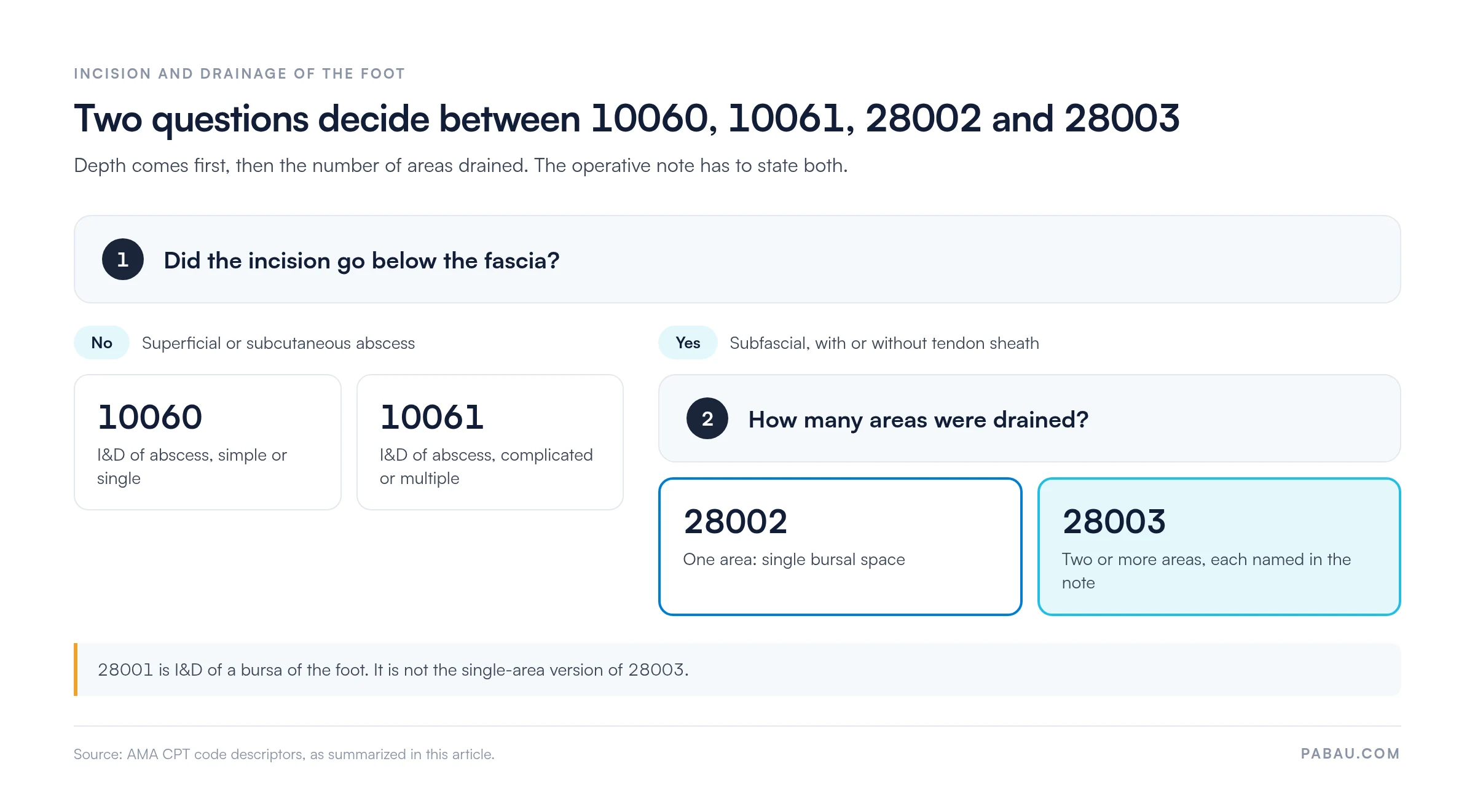
Selecting the correct incision and drainage CPT code turns on two questions. How deep is the infection, and how many areas were addressed? The table below maps CPT 28003 against its most commonly confused neighbors.
Neither 10060 nor 10061 fits a below-fascia foot infection. Billing 10060 for a plantar space abscess that required fascial penetration is undercoding, and billing 28003 for a superficial toe abscess is upcoding. The operative note settles it, and the choice always runs in the order shown below.
Every claim for CPT code 28003 needs a supporting ICD-10 diagnosis code that establishes medical necessity. Payers cross-check the diagnosis against the procedure, so the diagnosis has to explain why deep, multi-area drainage was needed.
Laterality matters. Use L03.115 (right lower limb) or L03.116 (left lower limb) whenever the operative note documents the side, and pick L02.611 or L02.612 the same way. Unspecified laterality codes are a low-level audit flag for certain payers. Our reference pages for M72.6 and E11.621 cover those two diagnoses in more depth.
CPT code 28003 has a defined set of applicable modifiers. Getting them right prevents unnecessary multiple-procedure reductions and makes sure bilateral cases pay correctly.
Bilateral billing (modifier 50) is uncommon for 28003 because simultaneous bilateral deep foot infections are rare. It does occur in diabetic patients with symmetric complications. Verify the payer’s bilateral billing preference before submitting. Medicare accepts modifier 50 on a single claim line, but many commercial payers require two separate lines with LT and RT.
Check the current NCCI edit table before appending modifier 59 to CPT code 28003. CMS updates NCCI edits quarterly, so an edit that allowed unbundling last quarter may have changed. Some payers also expect one of the X modifiers (XE, XP, XS or XU) in place of 59. The wrong modifier on a bundling conflict is an automatic denial.
Medicare reimburses CPT code 28003 under the Physician Fee Schedule at different rates depending on the place of service. Non-facility rates apply when the procedure is performed in a physician’s office. Facility rates apply in hospital outpatient departments and ambulatory surgery centers, where the facility bills separately for overhead costs.
Always look up the current-year rate using the CMS Physician Fee Schedule lookup tool. Rates shift each January with the annual conversion factor adjustment. The table below shows how the rate types differ, so confirm the exact 2026 amounts via CMS before billing.
For the exact RVU values and 2026 dollar conversion, use the FastRVU 2026 RVU lookup tool. It mirrors the current CMS dataset and shows work, practice expense, and malpractice RVUs for 28003 at a national level.
Medicaid rates are set by each state and can differ substantially from Medicare. Check the applicable state fee schedule before estimating reimbursement for Medicaid patients.
CPT code 28003 carries a 90-day global surgical period under the Medicare Physician Fee Schedule. The global package starts the day before surgery and runs 90 days after it. Routine care related to the procedure in that window is bundled into the surgical payment and cannot be billed separately.
Services that are bundled and cannot be billed during the 90-day global window:
Services that CAN be billed separately during the global period:
Medicare does not routinely require prior authorization for CPT code 28003. Most commercial payers follow suit for acute infections requiring urgent surgical drainage. Their requirements vary by plan and change over time, so verify with the payer before a scheduled, non-emergent procedure.
Situations where prior authorization is most likely required:
For emergent presentations where same-day or next-day drainage is clinically necessary, most payers accept post-service authorization within 24 to 48 hours. Document the clinical urgency explicitly in the chart, such as fever, rapid tissue spread, signs of necrotizing infection, or neurovascular compromise. That record protects against retrospective authorization denials.
The operative note for CPT code 28003 must establish three facts that distinguish it from 28002, 10060, and 10061. Miss any one of them and the claim is vulnerable to a downcode or denial.
Additional documentation elements that strengthen the claim and its audit defense:
Structured, complete operative notes support a clean claim submission on the first pass.
CPT code 28003 denials cluster around a handful of root causes. Each is preventable with the right documentation and pre-submission checks.
When a denial arrives, the fastest appeal path is a corrected claim with the updated operative note language attached. For bundling denials, include the NCCI edit and the clinical rationale for unbundling.
Effective denial management workflows log each denial reason by code, which surfaces patterns. If most 28003 denials at one payer are downcodes to 28002, fix the operative note template before questioning payer policy. For the CARC codes on the remittance itself, use our denial codes reference.
Run a quarterly audit of your 28003 claim outcomes. Pull every claim downcoded to 28002 or 10060 and compare the operative notes side by side. When the same wording is missing from each one, a single template update fixes future claims as well as the ones already denied.
A 28003 claim usually passes through three hands. The surgeon dictates the note, a coder reads it for depth and drained areas, and someone retypes the claim into a clearinghouse portal. Each handoff is a chance to lose the detail that keeps the code from downcoding.
Pabau, the practice management and billing platform we build, keeps those steps in one system. Its digital forms let you build an operative note template that asks for fascial depth, each drained area, and tendon sheath status. The note then supports the code before the claim exists.
Pabau’s billing and claims management turns the invoice into an electronic CMS-1500 claim through the Claim.MD clearinghouse. It runs a real-time eligibility check before submission and tracks the claim’s status with the payer.
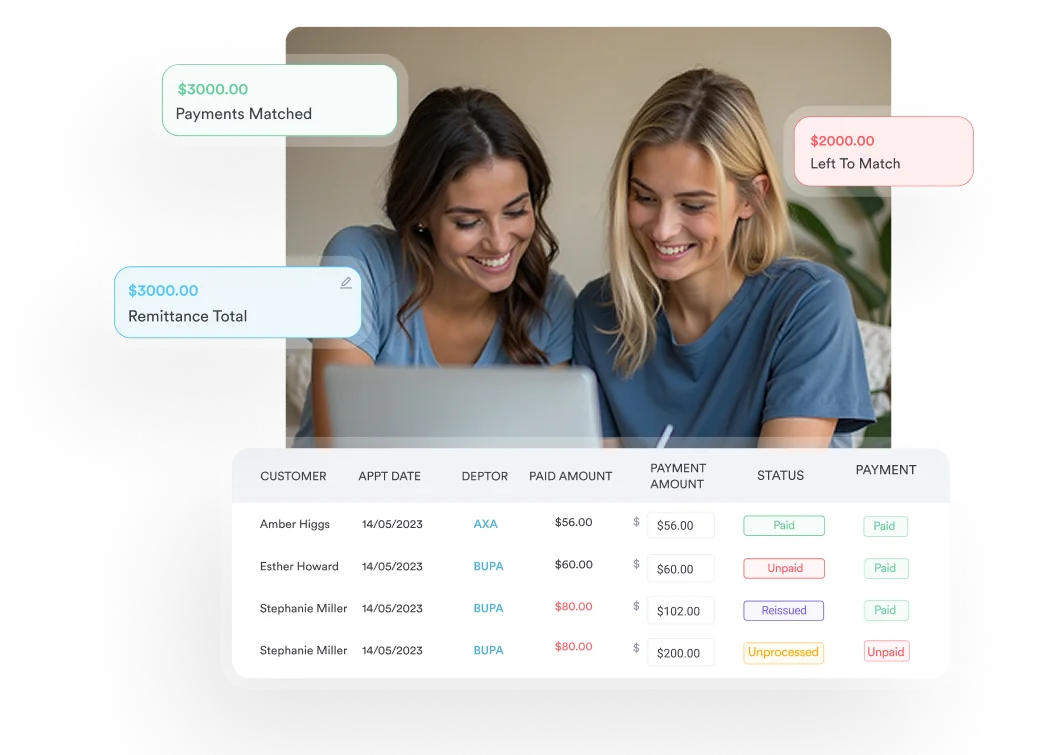
When the payer pays, the ERA remittance comes back into Pabau and matches against each claim. A 28003 line paid at a lower rate shows up in the unmatched balance. Your team can then appeal while the operative note is still fresh.

Pabau turns invoices into electronic claims through Claim.MD, checks eligibility in real time and brings remittances back into billing. Your team spends less time chasing denials on codes like 28003.

CPT code 28003 pays for deep, multi-compartment work, so each claim deserves a note that proves it. Start with the operative note template. Once it asks for fascial depth, each named area, and tendon sheath status, the usual downcodes to 28002 and 10060 lose their trigger.
The trade-off is a few extra lines of dictation per case. That costs far less than a corrected claim and an appeal on a procedure with a 90-day global period.
If your team still retypes claims into a clearinghouse portal, connect the note, the invoice, and the claim in one system. Book a demo to see how Pabau sends 28003 claims through Claim.MD and matches the remittance when it pays.

Need to understand how claims clear the payer network? How a medical claims clearinghouse works explains the end-to-end path from claim submission to payer adjudication.
Want to decode the remittance after your 28003 claim processes? Electronic remittance advice (ERA) explained breaks down how to read ERA files and match adjustments to specific denial reasons.
Building a denial prevention protocol for foot surgery codes? Superbill best practices covers how to structure charge capture so CPT codes and ICD-10 pairs are validated before the claim leaves the practice.
CPT code 28003 is the procedure code for incision and drainage below the fascia of the foot in multiple areas. It applies with or without tendon sheath involvement. Podiatrists and foot-and-ankle surgeons use it when a deep-space foot infection requires opening more than one compartment below the plantar fascia.
CPT 10060 covers simple incision and drainage of a superficial skin abscess and is limited to infections that do not penetrate the fascia. CPT 28003 is used only when the drainage extends below the fascia and involves multiple areas of the foot. Using 10060 for a subfascial foot infection is undercoding. Using 28003 for a superficial skin abscess is upcoding.
The most common are RT and LT for laterality, and 50 for bilateral procedures (or two lines with LT and RT, depending on the payer). Modifier 51 flags multiple procedures on the same date, and 59 marks a distinct procedural service against an NCCI edit. Modifier 57 marks the visit that led to the decision to operate. Modifier 24 covers unrelated E&M visits during the 90-day global period.
The operative note must confirm below-fascia access (e.g., “subfascial dissection performed”) and name each area drained, not just “multiple areas”. It must also document whether tendon sheaths were involved or evaluated. Culture specimens, wound irrigation details, and the clinical indication for multi-compartment drainage strengthen the claim and support audit defense.
The leading denial is a downcode to 28002 when the operative note doesn’t name multiple areas. The next is a downcode to 10060 when below-fascia access isn’t documented. Other denials come from an ICD-10 mismatch, such as a cellulitis code alone when a deep abscess was drained. NCCI bundling conflicts also deny 28003 when it is billed with a bundled code and no correct modifier.
Medicare does not require prior authorization for CPT 28003. Commercial and Medicaid managed-care plans vary by payer, and elective cases and workers’ compensation claims are the most likely to need it. For emergent presentations, most payers accept post-service authorization within 24 to 48 hours when the chart documents clinical urgency.