

HCPCS Code G0163: Skilled nursing observation and assessment
What is HCPCS Code G0163? HCPCS Code G0163 is a deleted Level II code for skille...

Last Updated: Oct 15, 2026
27488 is the CPT code for removal of prosthesis, including total knee prosthesis, methylmethacrylate with or without insertion of spacer, knee.
It covers removing every component of a total knee replacement and its bone cement, with or without an antibiotic spacer. No new implant goes in during that session. It is most often billed for the first stage of a two-stage revision for infection. If the surgeon places a new knee in the same session, 27486 or 27487 applies instead.
Let Pabau's smart automation suggest the right codes, reduce claim denials, and keep your practice compliant—effortlessly.
Automate repetitive tasks and focus on what matters most—your patients.
Reduce coding errors and ensure compliance with the latest regulations.
Clean claims, fewer denials, and faster reimbursements.
Powerful insights and reporting to help your practice thrive.
HIPAA compliant SOC 2 certified GDPR-compliant Trusted by 4,000+ clinics worldwide

CPT 27488 covers removal of every knee prosthesis component and its cement, with or without a spacer, and never includes reimplantation.
Use 27488 for the first stage of a two-stage revision, or when no new implant is planned. Stage 2 is billed separately with 27447 or 27487.
If the surgeon places a new implant in the same session, bill 27486 or 27487 instead of 27488.
Medicare expects an LT or RT modifier on 27488, and a missing laterality modifier is a common denial trigger.
Pabau, the practice management platform we build, checks each claim for missing details before it goes out and tracks it through the Claim.MD clearinghouse.
CPT code 27488 is the code for removing a total knee prosthesis and its bone cement when no new implant goes in. An antibiotic spacer may or may not be placed. The American Medical Association (AMA) descriptor reads: “Removal of prosthesis, including total knee prosthesis, methylmethacrylate with or without insertion of spacer, knee.” It bundles three surgical components.
The spacer is optional within the code. Placing a methylmethacrylate spacer doesn’t change the code or add a separate CPT charge, because it’s bundled into 27488.
Surgeons remove a knee prosthesis for two main reasons. The first is periprosthetic joint infection (PJI), and the second is aseptic loosening or component failure. Both need complete removal, but PJI cases almost always include a spacer to deliver local antibiotics between stages.
CPT code 27488 most often appears in the two-stage revision pathway. Stage one is the explantation session, billed with 27488. Stage two comes weeks to months later. That reimplantation session is billed separately, depending on what the surgeon performs. The options are 27447 (primary total knee arthroplasty) or 27487 (revision of the femoral and entire tibial component).
For aseptic loosening without infection, some surgeons go straight to reimplantation in the same operative session. In that case, 27488 is the wrong code. Bill the revision code (27486 or 27487) for the whole encounter instead.
Coders most often confuse 27488 with 27487, and one fact separates them. 27488 covers removal only, with no reimplantation on the same date. 27487 covers revision of the femoral and entire tibial component in a session that places the new implant.
A practical rule: If the operative report shows the surgeon removed components and placed a new implant in the same session, 27488 is wrong. Use 27487 when the femoral and entire tibial component were replaced, or 27486 when one component was. CPT code 27488 is correct only when the patient leaves the operating room without a permanent knee prosthesis. The decision diagram below maps that rule to each code.
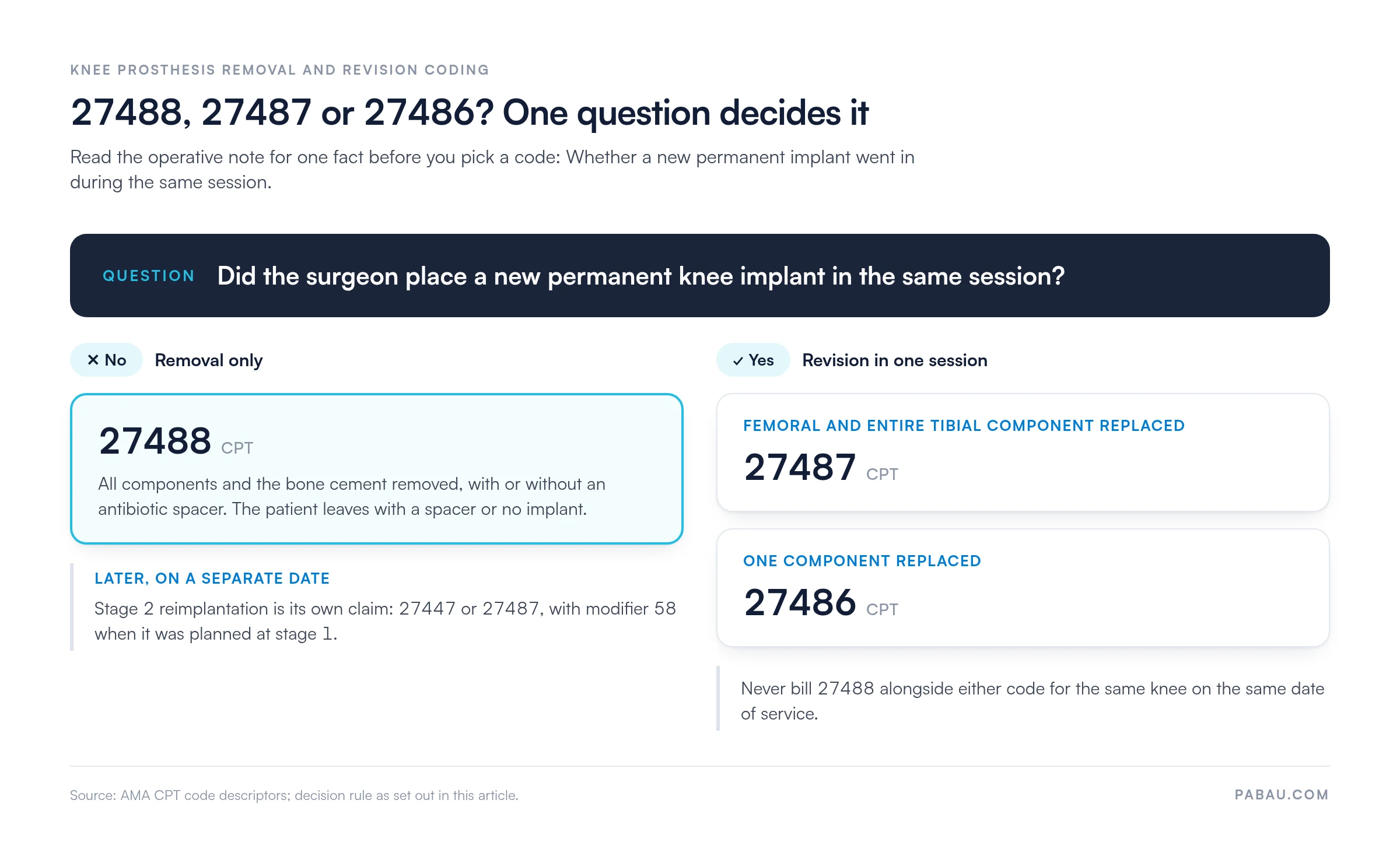
Six modifiers apply to CPT code 27488 in routine orthopedic billing. A missing or wrong modifier is one of the most common reasons these claims come back denied.
For bilateral procedures on the same date of service, bill 27488-LT and 27488-RT on separate claim lines. Some payers want modifier 50 (bilateral) instead, so check the payer contract before you submit. The AAPC Codify CPT lookup includes modifier guidance notes for each code.
Medicare pays CPT code 27488 from the relative value units (RVUs) published in the annual CMS Physician Fee Schedule. The 2026 conversion factor is $33.4009 per RVU (non-qualifying-APM participants). Clinicians who qualify through an Alternative Payment Model (APM) get a slightly higher factor.
Final payment also varies by the geographic practice cost index (GPCI) for your locality. Look up the current RVUs and your rate in the CMS Physician Fee Schedule lookup tool before you quote a figure. Commercial payer rates are contracted separately and usually differ from Medicare’s.
Pull the current fee schedule figures for 27488 from the CMS lookup tool before your annual contract renegotiation. Compare the facility and non-facility rates, because a surgeon operating in a hospital or surgery center is paid at the facility rate.
Medicare does not require prior authorization for CPT code 27488 as a blanket national policy, but many Medicare Advantage and commercial plans do. Run insurance eligibility verification before you schedule the explantation. An authorization that is denied after surgery is much harder to overturn than one sorted out beforehand.
Most payers that require authorization apply the clinical criteria below. Confirm the plan’s clinical policy, or for Medicare the local coverage determination (LCD), before submission.
Some Medicare Administrative Contractors (MACs) publish knee-specific guidance. Noridian’s billing and coding article A57685, “Billing and Coding: Total Knee Arthroplasty,” is one example. It is a billing article rather than an LCD, and it centers on knee replacement. Check what your own MAC publishes before billing CPT code 27488.
A clean claim for CPT code 27488 rests almost entirely on the operative note. Reviewers and auditors look for the elements below, and missing any one of them is grounds for denial or recoupment.
Structured, consistent documentation across orthopedic cases reduces audit exposure. A clean claim submission starts with the operative note, not the billing interface.
Pairing CPT code 27488 with the correct ICD-10-CM diagnosis code establishes medical necessity and prevents medical-necessity denials. These are the most frequently used diagnosis codes. Check each one against the patient’s documented clinical findings before selecting it.
These ICD-10 codes are examples based on common clinical scenarios. Confirm each against the patient’s documented findings and the current ICD-10-CM guidelines before submission. A complication with its own code, such as a broken prosthesis (T84.01-) or instability (T84.02-), takes that code instead of the “other” code.
Laterality matters: The knee codes split by side, so T84.032A is the right knee and T84.033A is the left. Match the ICD-10 laterality to the LT or RT modifier on the 27488 claim line.
Denials on CPT code 27488 fall into five predictable categories. Catching each one before submission saves rework later, and orthopedic denial management starts with code selection, not appeals.
Your MAC explains each 27488 rejection with claim adjustment reason codes (CARCs). Our guide to medical billing denial codes maps each one to its root cause.
National Correct Coding Initiative (NCCI) edits govern what can be billed on the same claim as CPT code 27488. Two rules matter most for orthopedic billers. One covers same-session reimplantation, and the other covers anesthesia and assistant surgeons on separate lines. Check current edits on the CMS NCCI edits page, because the tables update quarterly.
In many orthopedic practices, a coder still checks each 27488 claim by hand. They read the operative note, add the LT or RT modifier, then re-key the claim into a separate clearinghouse portal. Every manual step is another chance for a staged claim to go out incomplete.
Pabau raises the claim from the invoice your front desk already created. Its claims software for surgeons runs validation checks every time you go to send a claim. If a required detail such as an authorization code is missing, the claim stays unsent until someone fixes it.
In the US, Pabau connects to the Claim.MD clearinghouse. You can check eligibility in real time before scheduling the explantation, then submit the CMS-1500 claim electronically. Claim statuses and electronic remittance advice (ERA) flow back into one claims dashboard, and denied claims are flagged for rework. A stage 1 problem gets fixed before the stage 2 claim follows it.


Pabau checks each claim for missing details before it goes out, then tracks it through Claim.MD from submission to remittance. Your billing team spends less time reworking denied surgical claims.

CPT code 27488 is one of the easier orthopedic codes to bill once the operative note is right. Its scope is fixed. The old implant and its cement come out, no permanent implant goes in, and a spacer adds no separate charge.
The deciding work happens before billing. When surgeons dictate a clear “no permanent implant placed” line and the side of the knee, coders rarely face a 27488 vs 27487 dispute. The trade-off is a few extra lines in every explantation note, which costs far less than reworking a denied surgical claim.
Treat a staged revision as two linked claims, and keep both inside your medical billing compliance checks. Book a demo to see how Pabau tracks both stages of a knee revision, from eligibility check to remittance.

Need to understand how clearinghouses validate surgical claims? Medical claims clearinghouse explained covers how payer-specific edits catch errors before submission.
Working through a denial on a knee arthroplasty claim? Claim.MD clearinghouse overview details how ERA responses map denial CARC codes back to specific claim lines.
Building an end-to-end revenue cycle for your orthopedic practice? Revenue cycle management guide walks through the full billing lifecycle from eligibility check to final payment posting.
CPT code 27488 covers removal of a total knee prosthesis, including methylmethacrylate cement removal, with or without insertion of an antibiotic spacer. It does not include reimplantation. The patient leaves the operating room with either a spacer or no implant in the knee.
CPT 27488 is removal only, with no new permanent implant placed. CPT 27487 is revision of the femoral and entire tibial component in one session, with new components placed. Use 27488 when the patient leaves the operating room without a permanent implant, and 27487 when removal and reimplantation happen together.
Modifier LT (left) or RT (right) is required by Medicare to indicate which knee was operated on. Modifier 58 applies to the stage 2 reimplantation claim when the two-stage revision was planned at the time of the 27488 procedure. Modifier 22 may apply if the procedure involved unusual complexity, but it requires operative note documentation supporting the additional time and difficulty.
Yes, spacer insertion is bundled within CPT 27488 and does not generate a separate CPT charge. The official descriptor explicitly includes “with or without insertion of spacer.” Whether or not a spacer is placed, the code and its reimbursement stay the same.
No. Billing 27488 and 27447 on the same date of service for the same knee is an unbundling error. If the surgeon removed the failed prosthesis and placed a new one in the same session, bill only the revision code, 27486 or 27487. A planned stage 2 reimplantation goes on a separate date with modifier 58.
Traditional Medicare does not require prior authorization for CPT 27488 as a national policy, but many Medicare Advantage plans and commercial payers do. Criteria usually include culture-confirmed infection or imaging-documented loosening, and surgeon attestation of the staged plan. Some plans also ask for proof of prior conservative care. Confirm the specific plan’s requirements before scheduling.




