

HCPCS code E0198: Water pressure pad billing guide
HCPCS code E0198 is a water pad for a standard mattress HCPCS code E0198 is the ...

Last Updated: Oct 13, 2026
27487 is the CPT code for revision of total knee arthroplasty, with or without allograft; femoral and entire tibial component.
It applies when both the femoral component and the entire tibial component, including the baseplate, are removed and replaced. CPT 27486 covers a femoral-component-only revision, and confusing the two is a common source of denials. Omitting the LT or RT modifier, or linking the claim to a pain-only diagnosis, accounts for most of the remaining denials.
Let Pabau's smart automation suggest the right codes, reduce claim denials, and keep your practice compliant—effortlessly.
Automate repetitive tasks and focus on what matters most—your patients.
Reduce coding errors and ensure compliance with the latest regulations.
Clean claims, fewer denials, and faster reimbursements.
Powerful insights and reporting to help your practice thrive.
HIPAA compliant SOC 2 certified GDPR-compliant Trusted by 4,000+ clinics worldwide

CPT code 27487 applies when the femoral component and the entire tibial component are removed and replaced. An insert-only exchange does not qualify.
An LT or RT laterality modifier is mandatory on every line. Missing it is the leading denial trigger for 27487 claims.
Claims linked solely to T84.84XA (implant pain) are frequently denied without a supporting mechanical failure code such as T84.012A or T84.032A.
Pabau’s claims management software tracks orthopedic procedure codes, modifier requirements, and denial patterns across payer types in one workflow.
CPT code 27487 is defined by the American Medical Association as: Revision of total knee arthroplasty, with or without allograft; femoral and entire tibial component. The critical phrase is “entire tibial component”. The tibial tray, or baseplate, must be removed and replaced, not just the polyethylene insert sitting on top of it.
The code covers both cemented and cementless revision constructs. Allograft augmentation is included within the procedure when performed, so it does not require a separate code when billed under 27487.
Revision total knee arthroplasty is substantially more complex than a primary knee replacement. The surgeon removes failed implants from bone weakened by loosening, infection, or periprosthetic fracture, then reconstructs the joint with a new implant system. The operative note must reflect every step to support CPT code 27487 at audit.
The billing record for this procedure begins in the operating room. An operative report that does not specify which tibial components were removed and replaced turns a correctly performed surgery into a denied claim.
The decision between 27486 and 27487 turns on one question. Was the tibial baseplate removed and replaced?
If yes, use 27487. If only the femoral component was revised and the baseplate stayed in place, use 27486. If only the polyethylene insert was exchanged, neither code applies. The chart below carries that single question through to each code.
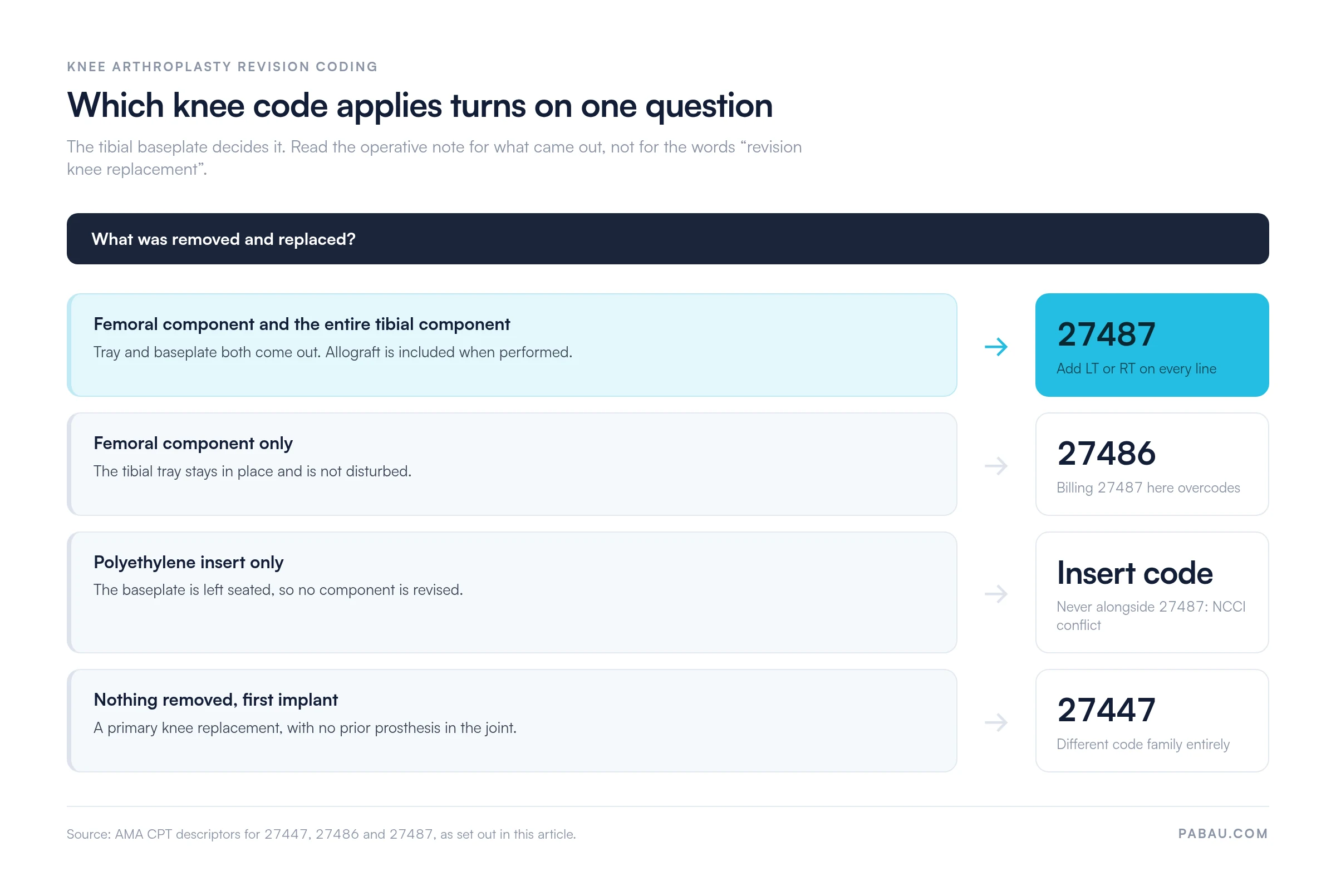
The American Academy of Orthopaedic Surgeons reports single-stage revision TKA with all components replaced under CPT code 27487. That holds whether one knee or both are operated on in the same session.
Modifier selection for this code follows the standard rules for major joint arthroplasty. Laterality is not optional. Missing LT or RT is the single most common denial cause across all payer types, per AAPC coding guidelines.
When billing modifier 22 for increased complexity, attach a brief operative summary letter to the claim explaining what made the procedure unusually complex. Payers rarely approve modifier 22 on the operative report alone. Without the letter, expect an automatic denial on first submission.
Payers require a diagnosis that objectively supports the medical necessity of full-component revision, so the ICD-10 link decides whether the claim pays. Pain alone rarely passes scrutiny. The ICD-10-CM code index lists each T84 subcategory in full, which helps when the documented failure mode is not in the table below.
AAPC forum data confirms a consistent denial pattern when 27487 is submitted with T84.84XA as the only diagnosis. Pain is a symptom, not a structural indication for full-component revision.
Payers expect a mechanical failure code as the primary diagnosis. That means T84.012A, T84.023A, T84.032A, or T84.59XA, with T84.84XA listed as secondary when relevant. Preoperative imaging supporting loosening or component failure belongs in the medical record, and the operative report should reference it.
When culture confirms a prosthetic infection and the operative note never names the joint, code it to T84.50XA. It covers infection of an unspecified internal joint prosthesis at the initial encounter.
This code carries a 90-day global surgery period under Medicare, classified as a “090” global. All postoperative care within 90 days of the procedure date is included in the surgical fee. Separate E/M visits inside that window need modifier 24 or modifier 79 to be separately billable.
Use the CMS Physician Fee Schedule lookup tool to retrieve current 2026 payment rates for your Medicare Administrative Contractor locality. Rates vary by geographic practice cost index. As a reference baseline:
Underpayments on revision claims surface during reconciliation rather than at submission. Practice management software like Pabau matches each posted payment against the contracted rate and flags the variance for review.
Its Claim.MD clearinghouse integration routes 27487 claims to thousands of payers, with real-time eligibility and electronic remittance processing built in.
Authorization requirements differ substantially by payer type. Submitting a 27487 claim without the required prior authorization is a preventable denial. It cannot be resolved on appeal, because payers rarely waive the requirement retroactively.
Confirm eligibility and authorization status before the patient’s surgery date. For Medicare Advantage, request the authorization in writing and keep the reference number with the claim file. Build a pre-surgical authorization checkpoint into the scheduling workflow for every 27487 case, whatever the payer.
Most 27487 denials fall into a handful of repeating patterns. Addressing them at the point of claim creation avoids the delay of rework and appeal. Practices that check modifier, diagnosis, and authorization status before the claim leaves the building see materially fewer first-pass denials.
Reviewing denials in aggregate rather than case by case shows which patterns run practice-wide and which are one-offs. A structured denial management process for orthopedic codes cuts rework time and stops repeat denials on the same root cause.
The operative report is the primary audit document for this code. Payers routinely request it on post-payment review, and a deficient op note can trigger full repayment of an already-processed claim. The note must contain specific elements, not simply confirm that a “revision knee replacement” was performed.
Capture these elements at the point of service rather than reconstructing them when a payer requests records. A pre-billing checklist built from the list above is what keeps a post-payment review from turning into a repayment.
The National Correct Coding Initiative edits for 27487 bundle several codes that cannot be billed separately on the same claim. The most common conflict comes from coding a tibial insert exchange alongside 27487. When the full tibial component is replaced, the polyethylene insert is included, so there is no separate insert exchange to bill.
When both knees are revised in the same operative session, bill two separate line items for 27487. One carries modifier LT and the other carries modifier RT. Do not use modifier 50 for this code under Medicare.
Medicare applies a 50% reduction to the lower-value procedure on the second line. The record must establish independent medical necessity for revising both knees at once.
The operative report and preoperative notes should address why a same-session bilateral procedure was clinically appropriate rather than a staged one. Most commercial payers follow the same two-line approach, though reimbursement rules vary by contract.
For bilateral same-session revision TKA, document in the preoperative note why simultaneous surgery was chosen over staged procedures. Payers increasingly scrutinize bilateral same-session arthroplasty for medical necessity. A clear clinical rationale in the chart prevents post-payment audit requests.
In most orthopedic billing teams, a revision claim is checked in three places at once. One person confirms the modifier, another chases the authorization reference, and the operative note sits in a separate system. A missing LT costs a week of rework and a resubmission.
Pabau’s claims management software holds the procedure code, the diagnosis link, the modifier rule, and the payer’s authorization requirement against the same patient record. Claims are scrubbed against those rules before submission, so a 27487 line missing its laterality modifier is caught inside the practice.
Billing teams then spend their time on the denials that need judgment, instead of the ones a checklist would have caught. Payment posting and remittance reconciliation run in the same place, so an underpaid revision claim becomes visible the week it lands.

Pabau connects your procedure codes, modifier rules, and payer requirements in one place. See how orthopedic practices use Pabau to reduce denials and accelerate reimbursement.

The difference between 27486 and 27487 comes down to one sentence in the operative note. Where the surgeon states that the tibial tray came out and a new one went in, the higher code is defensible at audit. Where the note is vague, the claim is rarely worth appealing.
Three things account for most of the loss on these claims: the laterality modifier, the primary diagnosis, and the authorization reference. All three are checkable before the claim leaves the practice, and an appeal cannot recover what was missing at submission. Book a demo to see how Pabau catches all three on orthopedic claims before they go out.

Need to understand how clearinghouse submissions work for surgical codes? Pabau’s Claim.MD clearinghouse guide explains how electronic claims reach payers and what happens when they are rejected.
Want a complete guide to preventing claim rejections before they happen? Clean claim best practices covers the elements every surgical claim needs to pass first-pass adjudication.
Handling multiple orthopedic billing codes and want a broader RCM reference? Best medical billing software for US practices evaluates the platforms orthopedic practices use to manage high-volume surgical claims.
CPT code 27487 is the procedure code for revision total knee arthroplasty. It covers removal and replacement of both the femoral component and the entire tibial component, with or without allograft augmentation. Use it when a previously implanted knee replacement fails and needs full-component revision, rather than 27486 for the femoral component alone.
CPT code 27487 covers revision of both the femoral and the entire tibial component, including the tibial tray and baseplate. Use 27487 when the tibial baseplate is removed and replaced. Use 27486 when only the femoral component is revised and the tibial tray remains in place. If only the polyethylene insert is exchanged without disturbing the baseplate, neither code applies.
LT or RT is mandatory on every 27487 claim to identify laterality. Modifier 22 applies where the procedure involves extraordinary complexity such as severe bone loss or infection. Modifier 62 is used when two surgeons of equal skill are required, and modifier 80 identifies the assistant surgeon. For bilateral same-session revision, bill two separate lines with LT and RT rather than modifier 50 under Medicare.
Payers deny 27487 claims with T84.84XA as the sole diagnosis because pain alone does not establish objective medical necessity for full-component revision. Code T84.84XA should be listed as a secondary diagnosis only. The primary diagnosis must be a mechanical failure code such as T84.012A (broken prosthesis), T84.032A (mechanical loosening), or T84.59XA (infection). Supporting imaging or culture documentation should be in the record.
Traditional Medicare fee-for-service does not require prior authorization for CPT 27487, but the procedure must meet CMS coverage criteria. Medicare Advantage plans typically require prior authorization, with requirements varying by plan. Commercial payers and most workers’ compensation payers also require PA, so verify with each payer before the procedure date.
Bill CPT code 27487 with modifier LT for a left total knee revision in which both the femoral and entire tibial components are replaced. If only the femoral component was revised on the left side, use 27486 with modifier LT. The laterality modifier is mandatory for all Medicare and most commercial claims, and omitting it is the leading cause of denial for this code family.



