HCPCS Code G0163: Skilled nursing observation and assessment
What is HCPCS Code G0163? HCPCS Code G0163 is a deleted Level II code for skille...

Last Updated: Oct 15, 2026
CPT code 27486 reports revision of total knee arthroplasty involving one prosthetic component, with or without allograft. It applies when the surgeon replaces a single femoral, tibial, or patellar implant in a knee that already carries a prosthesis. The code carries a 90-day global surgery period and a 2026 total facility RVU of 38.17.
Replacing all components in the same operative session moves the claim to CPT 27487 instead. The American Medical Association places 27486 in the Musculoskeletal System chapter, under Repair, Revision, and/or Reconstruction of the Knee.

CPT code 27486 describes revision of total knee arthroplasty, with or without allograft, involving one prosthetic component.
A 90-day global surgery period applies, bundling most post-operative services into the base reimbursement.
Confusing 27486 (one component) with 27487 (all components) is the most common coding error and triggers denials.
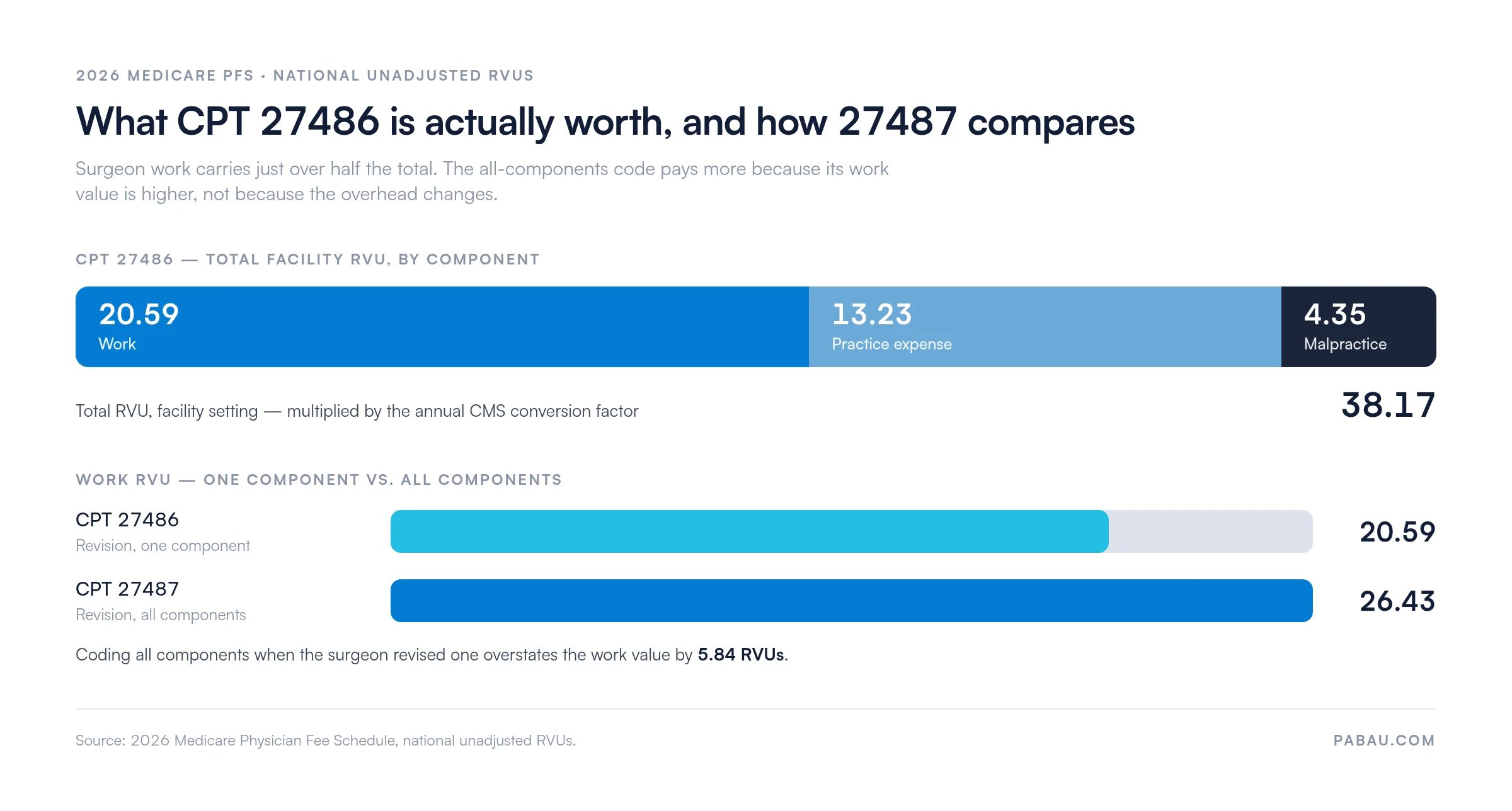
The 2026 total facility RVU is 38.17, of which surgeon work accounts for 20.59.
Pabau’s claims management software lets orthopedic practices attach CPT codes, modifiers, and ICD-10 pairings directly to patient records, reducing post-visit rework.
The phrase “one component” is the operative distinction. If the surgeon replaces only the femoral, tibial, or patellar implant during a revision procedure, CPT code 27486 applies. Replacing all components in the same operative session shifts the code to CPT 27487.
CMS and most commercial payers require documented medical necessity before approving CPT code 27486. Revision TKA is not a routine procedure, and payers scrutinize claims for evidence that conservative management failed before surgery.
Accepted clinical indications include:
The infection indication does not map to a T84.0 mechanical code. When the record documents a prosthetic joint infection but never names the joint, the diagnosis is T84.50XA.
The CMS Medicare Coverage Database article A57685 governs coverage for both primary and revision TKA. Coders should verify that the documented indication maps to a covered ICD-10-CM code, and that the operative report explicitly names the component revised. Missing either element is a common trigger for claim denial.
Diagnosis code selection must precisely reflect why the revision was performed. Each code sent on the claim should correspond to the documented clinical finding, not a generic “knee pain” code. The CMS ICD-10-CM code files are updated each October 1, so verify your selections against the current fiscal-year tables.
Laterality lives in the sixth character of every T84.0 code, and the sequence is easy to misread. Within each subcategory, 0 and 1 are the right and left hip. The numbers 2 and 3 are the right and left knee. So T84.011A is a broken left hip prosthesis, not a knee code at all, while the knee equivalent is T84.013A. Picking a hip code on a revision TKA claim is a clinical mismatch that a payer will catch.
The Z96.65x status codes document the presence of the existing prosthesis, and they belong on every revision TKA claim as secondary codes. Omitting them is a frequent documentation failure that payers use to question whether a revision procedure was actually performed. Our ICD-10-CM code reference covers the wider T84 and Z96 families these knee codes sit within.
Modifier selection for CPT code 27486 billing directly affects whether the claim pays at full, reduced, or denied status. Applying no modifier when one is required is as damaging as applying the wrong one.
RT and LT are not optional. CMS and most commercial payers require laterality identification on bilateral-capable procedures. Submitting CPT code 27486 without RT or LT frequently triggers an edit requesting clarification, adding days to payment turnaround.
Medicare payment for CPT code 27486 is calculated using the Resource-Based Relative Value Scale (RBRVS). Actual dollar amounts vary by geographic locality, and they change each January 1 when CMS publishes the updated Physician Fee Schedule. Use the CMS Physician Fee Schedule lookup tool or the FastRVU 2026 RVU lookup to pull locality-adjusted figures. The table below shows the national unadjusted RVU structure.
Check the remittance advice after submitting revision TKA claims. It tells you whether the payer applied the expected conversion factor, and whether any payment reduction was flagged.
Surgeon work carries just over half of that total, and 27487 is worth more mainly because its work value is higher. The chart below sets the two codes against each other.
RVU values are revised annually by CMS. Never hardcode dollar amounts in billing templates without citing the current PFS file. Commercial payer rates typically run higher than Medicare but vary significantly by contract. Verify with each payer’s fee schedule or contract addendum.
Run a payer-specific fee schedule lookup each January after CMS releases the updated conversion factor. A practice billing 40 revision TKA cases per year can see a four-figure revenue swing from a single conversion-factor change. Updating your billing templates early protects collections.
CPT code 27486 carries a 90-day global surgery period. During those 90 days, most post-operative visits and services related to the knee revision are bundled into the global fee and cannot be billed separately.
Billing a routine 2-week post-op visit as a separate E&M charge without a modifier is a common error. Payers bundle the claim automatically and deny it. Coders must document why each service during the 90-day window falls outside the global package.
Payers auditing revision TKA claims look for a specific documentation set. A missing operative report or implant record can convert an approved claim into a post-payment recoupment demand. Submitting a clean claim starts with complete documentation before the claim leaves the practice.
Required documentation for CPT code 27486 includes:
Allograft use should be noted in the operative report, but it does not require a separate CPT code. Payer-specific rules on separate HCPCS billing for allograft materials do vary. Verify with each payer before reporting allograft costs separately.
Where the allograft itself is the procedure, a different code applies. CPT 27415 covers open osteochondral allograft implantation in the knee, with the graft as the billed service.
Selecting between CPT 27486 and CPT 27487 is the most consequential coding decision on a revision TKA claim. The descriptor difference is precise: One component versus all components. The AAPC CPT code reference and AMA CPT descriptors both make this distinction explicit.
Upcoding a single-component revision to CPT 27487 constitutes fraud. Downcoding an all-component revision to CPT 27486 leaves significant revenue on the table. The operative report must explicitly state the components revised, because the code follows the operative findings, not the pre-operative plan.
Orthopedic coders working with revision TKA also encounter the broader knee arthroplasty code family regularly. These four codes cover the sequence from partial replacement through full revision.
27447 is the highest-volume code in this family. Coders occasionally apply CPT 27447 to a revision case because it is the familiar primary TKA code. That error results in a mismatch with the ICD-10-CM complication codes (T84.0xx series) that correctly accompany revision procedures, and payers will deny the claim.
Claim denial rates for revision TKA run higher than for primary TKA, partly because of coding complexity and partly because payers require more documentation. Denial prevention starts before submission, not after rejection. These are the errors orthopedic coders encounter most often with CPT code 27486:
CMS coverage for revision TKA under CPT code 27486 is governed by Local Coverage Determinations (LCDs). LCDs vary by Medicare Administrative Contractor (MAC) jurisdiction, so the coverage language a California practice works to differs from what a Texas practice faces. Check the applicable MAC’s LCD directly before submitting claims for edge-case indications.
Reference tools tell you what CPT code 27486 means. They do not tell you whether your last 30 revision TKA claims were accepted, denied, or partially paid. They also cannot catch a missing modifier before the claim leaves your practice. Practice management software like Pabau closes that loop with integrated claims management, from code lookup through to payment.
Pabau lets orthopedic practices build procedure templates that pre-populate CPT 27486 with its standard modifier set (RT or LT) and commonly paired ICD-10 codes. When a clinician closes an operative note, the billing code set is already attached to the record. That removes the manual transfer step where errors most often occur.
Claims then flow straight to the clearinghouse, where real-time eligibility checks and 837P scrubbing catch formatting errors before submission.
Pabau’s reporting layer surfaces denial patterns by CPT code. If CPT code 27486 claims are denying at a higher rate than comparable revision codes, the analytics flag the pattern, not just the individual claims. Practices can also generate a superbill for each encounter, giving surgeons a structured summary to review before submission.
Build a CPT 27486 procedure template in your practice management system. Have it auto-populate the RT or LT laterality modifier, the T84.0xx primary diagnosis code, and the Z96.65x status code. Review the template quarterly against current NCCI edits to ensure the bundled codes remain unbundled correctly.

Pabau’s integrated claims management attaches CPT codes, ICD-10 pairings, and modifiers to patient records at the point of care. That reduces rework and speeds up payment for high-complexity procedures like revision TKA.

CPT code 27486 demands precision at every stage. The operative report needs the correct component count, and the ICD-10-CM codes must match the documented indication. Every claim also needs laterality modifiers and watertight documentation for the 90-day global period. Any one of these handled carelessly turns a payable claim into a denial that costs more to rework than it was worth.
The single decision worth slowing down for is the component count, because 27486 and 27487 sit 5.84 work RVUs apart. Read that off the operative findings, never the pre-operative plan, and the rest of the claim tends to follow.
Pabau’s billing workflow attaches CPT codes, modifiers, and ICD-10 pairings to records at the point of care. Revision TKA claims then leave the practice correctly structured. Book a demo to see how Pabau handles high-complexity orthopedic billing end to end.

Need a deeper look at claim submission workflows? Understanding the medical claims clearinghouse process explains how claims move from practice to payer and where errors are caught.
Concerned about billing compliance? Medical billing compliance guidance covers documentation standards, audit readiness, and common risk areas for surgical codes.
Want to reduce denial rates systematically? Denial codes in medical billing provides a reference for interpreting CARC codes and routing each denial type for efficient rework.
CPT code 27486 is the procedure code for revision of total knee arthroplasty, with or without allograft, involving one prosthetic component. It is reported when a surgeon replaces a single component (femoral, tibial, or patellar) of a previously implanted total knee prosthesis. The code carries a 90-day global surgery period.
CPT 27486 covers revision of one prosthetic component, and CPT 27487 covers revision of all components in the same operative session. The operative report must explicitly state which components were replaced, and the code must match the operative findings exactly. Upcoding a single-component revision to 27487 creates a compliance risk.
Laterality modifiers RT (right) and LT (left) are required on every claim. Modifier 22 may be appended when the revision is significantly more complex than typical, but it requires supporting documentation. Modifiers 62 (co-surgeons), 80 (assistant surgeon), and AS (PA or NP assistant) apply in multi-surgeon scenarios, depending on the payer’s rules.
Medicare payment is locality-adjusted and changes each January 1 with the updated Physician Fee Schedule conversion factor. The national unadjusted total RVU is approximately 38.17 in the facility setting. Use the CMS Physician Fee Schedule search tool or a current-year RVU calculator to pull the applicable rate for your geographic area.
Medicare does not routinely require prior authorization for CPT 27486, but many commercial payers and managed Medicaid plans do. Verify with the specific plan before the procedure date, because authorization requirements change frequently and vary by payer and region.
The T84.0xx series (mechanical complications of internal joint prostheses) provides the primary diagnosis codes for most revision TKA indications. Knee-specific options include instability (T84.022A/T84.023A), mechanical loosening (T84.032A/T84.033A), periprosthetic osteolysis (T84.052A/T84.053A), and other mechanical complications (T84.092A/T84.093A). Always pair with a Z96.651 or Z96.652 status code to document the presence of the existing prosthesis.
The global period for CPT 27486 is 090 days (90 calendar days following the procedure date). Routine post-operative visits and related services during this period are bundled into the global fee. Services for unrelated conditions, complications requiring return to the OR, and staged procedures require appropriate modifiers (24, 78, or 58 respectively) to bill separately.