CPT code 63081: Vertebral corpectomy, cervical spine
CPT code 63081: official descriptor and procedure overview CPT code 63081 descri...

Last Updated: Oct 6, 2026
27415 is the CPT code for osteochondral allograft, knee; open. It covers implanting fresh donor bone and cartilage into a focal, full-thickness knee cartilage defect through an open arthrotomy.
Arthroscopic grafting is reported with 29866 or 29867 instead, and open autograft with 27416. The code carries a 90-day global period, and most payers require prior authorization before surgery.
Let Pabau's smart automation suggest the right codes, reduce claim denials, and keep your practice compliant—effortlessly.
Automate repetitive tasks and focus on what matters most—your patients.
Reduce coding errors and ensure compliance with the latest regulations.
Clean claims, fewer denials, and faster reimbursements.
Powerful insights and reporting to help your practice thrive.
HIPAA compliant SOC 2 certified GDPR-compliant Trusted by 4,000+ clinics worldwide

CPT code 27415 covers open osteochondral allograft implantation in the knee, while arthroscopic grafting is reported with 29866 or 29867.
Prior authorization is required by virtually all payers, and surgery performed without it is the most common denial trigger for this code.
Codes 29870 and 29877 are bundled into 27415 under NCCI edits, so check the current NCCI table before billing either one.
Pabau, the practice management platform we build, flags claims missing an authorization number before they reach the clearinghouse.
CPT code 27415 is defined by the American Medical Association as: Osteochondral allograft, knee; open. It sits in the 27380-27499 subsection, Repair, Revision, and/or Reconstruction Procedures on the Femur (Thigh Region) and Knee Joint.
The procedure involves transplanting a fresh osteochondral plug from a cadaveric donor knee into a focal cartilage defect on the recipient’s articular surface.
The key word in the descriptor is open. A surgical arthrotomy is required to reach and prepare the defect site, so a portal-only arthroscopic case never qualifies. “Allograft” means the graft comes from a donor, distinguishing it from autograft procedures where the surgeon harvests tissue from the patient’s own body.
The graft must be fresh, meaning viable chondrocytes are present at the time of implantation. Fresh allografts are transplanted within a narrow viability window, typically 28 to 35 days from procurement.
Frozen or cryopreserved grafts do not meet the clinical definition for this code; payer policies may also distinguish between graft types when assessing coverage. That is why the operative note has to name the graft type.
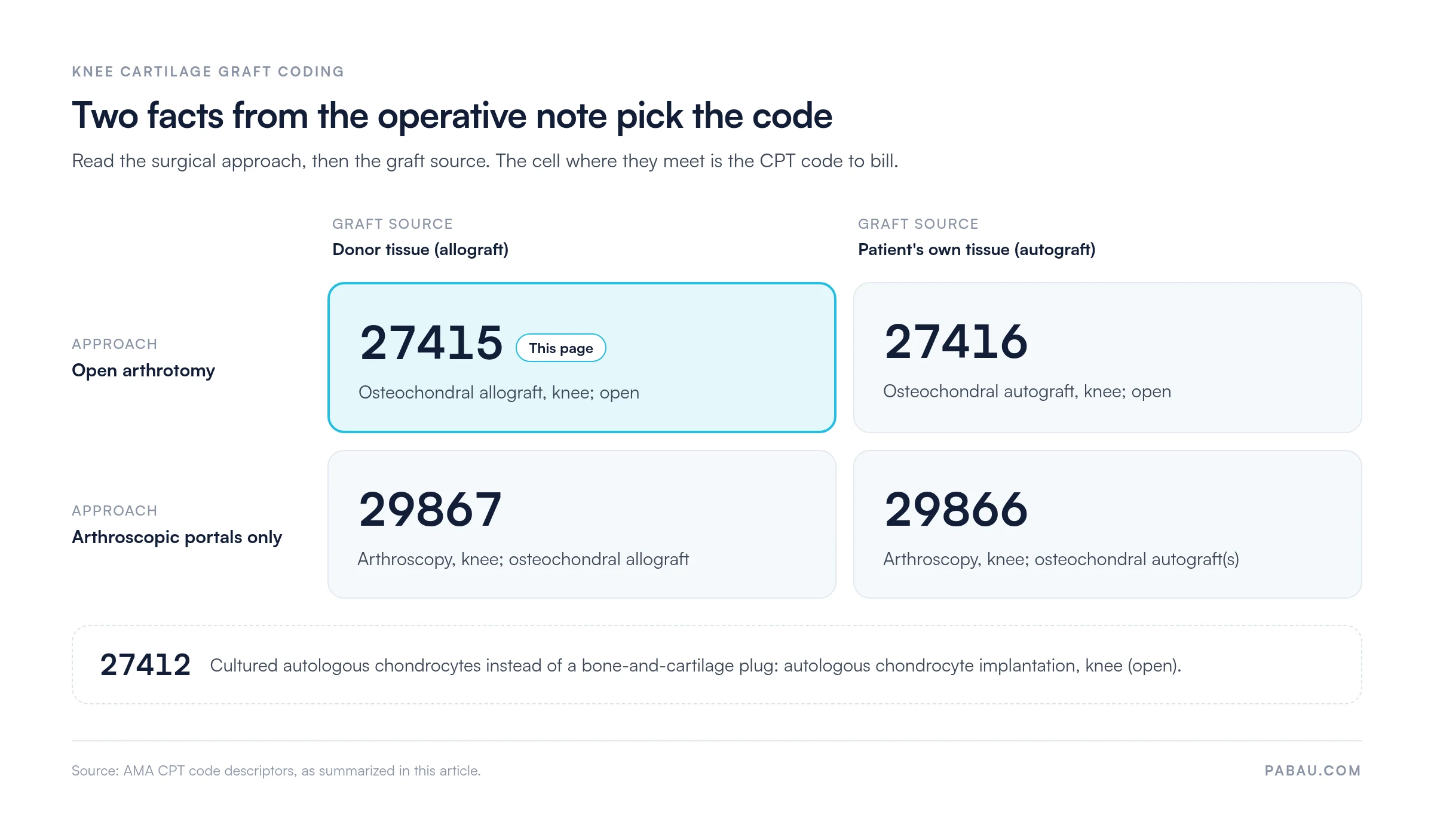
Before selecting 27415, the coder should confirm two facts from the note: an open approach and donor tissue.
The most common coding error with 27415 is reaching for it after an arthroscopic approach. The second is using it when the graft came from the patient rather than a donor. The table below clarifies the key distinctions. Full descriptors for each neighboring code sit in our CPT code reference.
The 27415 vs. 29867 question comes up frequently in audits. If the surgeon performed an arthroscopic allograft transplantation, 29867 is the correct code, not 27415. The approach documented in the operative note settles it. An arthrotomy supports 27415, while portal-only access points to an arthroscopic code.
The grid below reduces the choice to two questions for the note. How did the surgeon reach the defect, and where did the graft come from?
27415 carries a 90-day global surgical period, which means routine follow-up care is bundled. Several arthroscopic knee procedures are also bundled under NCCI edits and cannot be billed separately when performed at the same session.
NCCI edit relationships are updated quarterly by CMS. Bundling status for 29870 and 29877 should be verified against the current CMS Physician Fee Schedule and NCCI table before billing decisions are finalized.
Surgical modifiers for 27415 follow standard orthopedic conventions. Missing a laterality modifier is one of the most common causes of claim delay on knee procedures.
Modifier -50 for bilateral knee osteochondral allograft is uncommon given the high cost and tissue availability constraints, but it does occur. Some payers require -50 on a single line; others require two lines with -RT and -LT. Verify the specific payer’s bilateral billing policy before submitting.
The diagnosis codes linked to 27415 must describe a focal, full-thickness articular cartilage defect. Vague or incomplete diagnosis coding is a medical necessity failure that triggers denial regardless of whether the prior authorization was approved.
Osteochondritis dissecans codes (M93.261/M93.262) are the most commonly paired diagnoses for this procedure. When the defect resulted from trauma, S83 series codes (knee dislocation or ligament injury) may also apply as secondary diagnoses to establish the mechanism. Verify the laterality matches the operative site on both the diagnosis code and the CPT modifier.
Reimbursement for CPT code 27415 is set annually by the CMS Physician Fee Schedule. Rates vary by geographic location through the Geographic Practice Cost Index (GPCI) adjustment. A national average is only a starting point for any one practice.
For 2026, the approximate Medicare non-facility payment for 27415 falls between $1,100 and $1,400, depending on locality. The figure combines the published work RVU, practice expense, and malpractice components.
Use the FastRVU 2026 RVU lookup tool to calculate the exact payment for your Medicare Administrative Contractor (MAC) jurisdiction. Always verify figures against the current year’s published fee schedule before quoting or budgeting.
An important distinction for facility billing: the allograft tissue acquisition cost is not bundled into the surgeon’s CPT fee. The facility typically bills the graft as a separate supply or implant line item. Some payers bundle the graft cost into the facility payment; others allow pass-through billing. Verify payer-specific rules before processing the facility claim.
Commercial payer rates vary widely and typically exceed Medicare rates. Post each remittance against the contracted rate for that carrier, since a short payment on a case this size is costly to overlook.
Run a payer-specific contract audit on your last 12 months of 27415 claims. Pull the allowed amount against your contracted rate for each carrier. High-value orthopedic codes like this one are common targets for underpayment. Payers occasionally apply facility rates to professional claims or use the wrong locality adjustment. A 10% underpayment on a $1,200 allowed amount is $120 per case.
Virtually all commercial payers and Medicare Advantage plans require prior authorization for CPT 27415 given the high cost of fresh allograft tissue. Missing or expired authorization before surgery is the single most common reason claims are denied outright. Retroactive authorization is rarely granted.
Run insurance eligibility verification and start the prior authorization process as soon as the surgical date is confirmed.
Coverage policies also separate graft types. BCBS Mississippi and BCBS North Dakota, for example, treat fresh osteochondral allograft as potentially medically necessary when their criteria are met. Their policies class processed products, such as decellularized plugs and minced or particulated allograft, as investigational.
Check the payer’s Local Coverage Determination (LCD) or medical policy before scheduling surgery. An investigational classification triggers denial regardless of the prior authorization submission.
Vague operative notes are the second-leading cause of 27415 denials, after missing prior auth. The operative report must contain enough clinical detail to confirm that the procedure performed matches the code billed. Reviewers look for specific data points, not general descriptions of the surgery. Coders should confirm each element below before the case is closed.
Missing the defect size measurement in cm² is a specific audit trigger. Coders cannot confirm code selection without it, and payer reviewers use it to evaluate whether the allograft approach was clinically justified.
A note that reads “cartilage defect was debrided and allograft was placed” without dimensions does not support CPT code 27415 at audit. Use a clean claim checklist that includes confirming cm² documentation before coding.
Claims for CPT code 27415 are denied more often than many orthopedic codes. High cost, prior authorization rules, and investigational classifications all raise the risk. The most frequent triggers follow a recognizable pattern that good denial management workflows can intercept before submission.
CPT 27415 carries a 90-day global surgical period, meaning CMS assigns it a “090” global period designation. All routine post-operative care from the day of surgery through 90 days is bundled into the procedure payment. The surgeon cannot bill separately for standard follow-up office visits during this window.
The global period also matters when a patient changes providers during recovery. A different physician who treats the patient during the 90-day window bills with modifier -54 or -55 to show the transfer of care. The global payment is then split between them.
Set a reminder in your scheduling system for 90 days post-surgery on every 27415 case. Flag any visit booked within that window for global period review before the encounter is coded. This prevents accidental billing of bundled follow-up visits and stops modifier -24 or -79 from being applied incorrectly to routine post-op care.
A 27415 case passes through several hands before it is paid. The scheduler requests authorization, the coder reads the operative note, and the biller posts the remittance. When each step lives in a separate spreadsheet, an authorization number or a laterality modifier is easy to drop.
Pabau, the practice management platform we build, keeps those steps on one patient record. Its specialty practice claims software runs validation checks that flag a missing authorization code or membership number before submission. US claims go out through the Claim.MD clearinghouse, where your team can also run real-time eligibility checks.
Each claim then moves through tracked stages, from pending to paid, and ERA remittances post against it. Insurer-specific price lists hold each carrier’s rate, so your biller can spot a short payment on a 27415 case the day it lands.

Pabau checks each claim for missing authorization codes and membership details, then tracks it from submission to payment. See how it handles high-value surgical codes like CPT 27415.

CPT code 27415 rewards practices that settle the coding before the surgery date. Confirm the approach, the graft source, and the authorization while the case is still on the schedule. A claim built that way rarely needs an appeal.
The trade-off is more work up front. Checking every operative note for cm² measurements and fresh-graft wording adds minutes to each case. Those minutes cost far less than reworking a denied claim on one of the highest-value knee procedures you bill.
Book a demo to see how Pabau flags incomplete surgical claims before they reach the payer.

Unsure how clearinghouse submissions affect your clean claim rate? How medical claims clearinghouses work explains the EDI validation layer that catches errors before payer submission.
Want to streamline surgical billing across your orthopedic team? What is revenue cycle management outlines the end-to-end process from scheduling to payment posting.
Filing authorization requests every week? Prior authorization software reviews the tools practices use to submit and follow up on requests.
Preparing for a billing audit? Medical billing compliance explains the rules that keep surgical claims defensible.
CPT code 27415 covers open implantation of a fresh osteochondral allograft into the knee joint to resurface a focal full-thickness cartilage defect. It does not cover arthroscopic approaches (which use 29866 or 29867) or autograft procedures (which use 27416). The code includes the surgical approach, defect preparation, graft sizing, and fixation within the global package.
CPT 27415 is an open procedure requiring a surgical arthrotomy; CPT 29867 is performed arthroscopically through portals. If the surgeon used an arthroscopic approach to implant an osteochondral allograft, 29867 is the correct code. The approach described in the operative note, arthrotomy or portals only, decides the code.
Yes. Under NCCI edits, 29870 (diagnostic knee arthroscopy) and 29877 (arthroscopic chondroplasty) are bundled into 27415 at the same session. NCCI edit tables are updated quarterly, so verify the current bundling status against the live CMS NCCI table before every billing decision.
CPT 27415 carries a 90-day global period. All routine post-operative follow-up from the day of surgery through 90 days is bundled into the procedure payment. Complications, unrelated services, and physical therapy can be billed separately using the appropriate modifier (-78, -24, or -79).
Yes, virtually all commercial payers and Medicare Advantage plans require prior authorization for CPT 27415 given the high cost of fresh allograft tissue. Some BCBS affiliates class processed allograft products as investigational, so check the payer’s policy as well. Always obtain authorization before the surgical date and confirm it covers the scheduled procedure date.
The most common pairing is M93.261 or M93.262, osteochondritis dissecans of the right or left knee. M23.8×1 or M23.8×2 (other internal derangements of the knee) and M94.261 or M94.262 (chondromalacia) also apply. The diagnosis must describe a focal full-thickness cartilage defect. Laterality in the diagnosis code must match the operative site and the CPT modifier.