ICD-10 Code Y76.0: Diagnostic obstetric and gynecological devices
ICD-10 Code Y76.0: Definition and billable status ICD-10 Code Y76.0 is a valid, ...

Last Updated: Oct 23, 2026
Billable Code Specific Code
T84.50XA is the billable ICD-10-CM code for infection and inflammatory reaction due to unspecified internal joint prosthesis, initial encounter. It covers an infected hip, knee, shoulder, or other joint replacement in active treatment when the chart never names the joint.
The fact that matters most is scope. This code is for joint replacements only, so infected plates, screws, and rods go to T84.6- instead. Picking the wrong branch, or leaving out the organism code, is what sends these claims back. Getting both right starts with the sibling codes and the parent-level notes that sit above this one.
Let Pabau's smart automation suggest the right codes, reduce claim denials, and keep your practice compliant—effortlessly.
Automate repetitive tasks and focus on what matters most—your patients.
Reduce coding errors and ensure compliance with the latest regulations.
Clean claims, fewer denials, and faster reimbursements.
Powerful insights and reporting to help your practice thrive.
HIPAA compliant SOC 2 certified GDPR-compliant Trusted by 4,000+ clinics worldwide

T84.50XA codes an infected hip, knee, or other joint replacement in active treatment when the record does not name the joint.
Fixation hardware such as screws, plates, rods, and wires belongs to the separate T84.6- branch, not T84.50XA.
The 7th character A marks active treatment, not the first visit. Use D for the healing phase and S for sequelae.
The T84.5 note calls for an additional code to identify the infection, such as a B95-B97 organism code when cultures name the pathogen.
Payers often ask for aspiration results, inflammatory markers, and imaging before they authorize a revision.
ICD-10 code T84.50XA is the billable ICD-10-CM code for infection and inflammatory reaction due to unspecified internal joint prosthesis, initial encounter.
In practice, it codes a periprosthetic joint infection when the chart confirms an infected joint replacement but never says which joint. The 7th character A tells the payer the patient is in active treatment. The code sits in category T84, within the S00-T88 chapter.
The X in the 6th position is a placeholder, because T84.50 has no 6th-character subdivision. The code is invalid without a 7th character, so payers reject T84.50X on its own.
Use T84.50XA when the treating physician links an infection or inflammatory reaction to an implanted joint prosthesis. Presentations vary. Some infections start soon after surgery, some spread through the blood years later, and others cause low-grade pain or loosening over months.
The devices in scope are joint replacement components. Think total and partial hip, knee, shoulder, elbow, and ankle prostheses. Infected screws, plates, rods, intramedullary nails, and cerclage wires count as fixation hardware, so they go to T84.6- instead.
ICD-10-CM gives hip and knee prostheses their own codes for each side, and every other joint goes to T84.59-. That leaves T84.50XA for records that confirm an infected joint prosthesis without naming the joint.
Check the operative report and physician notes before you settle on the unspecified code. If either one names the joint, coding to the highest specificity requires the joint-specific code. Defaulting to T84.50XA anyway invites audit attention.
The A in T84.50XA means the patient is receiving active treatment for the infection. It says nothing about whether this is their first visit. A patient on day four of a revision admission still gets A.
The CMS ICD-10-CM coding guidelines count surgical treatment and emergency department care as active treatment. Evaluation and continuing treatment count too, whichever physician provides them. Switching from A to D too early is a frequent denial trigger on staged revision claims.
Sequela works differently. For a late effect such as joint stiffness, code the late effect first and add T84.50XS as a secondary code.
Most code-selection errors with T84.50XA involve three groups of neighbors. These are the joint-specific siblings in T84.5-, the fixation-device codes in T84.6-, and T81.4- for postprocedural infection. Answer the three questions below in order, and the record points you to one code.
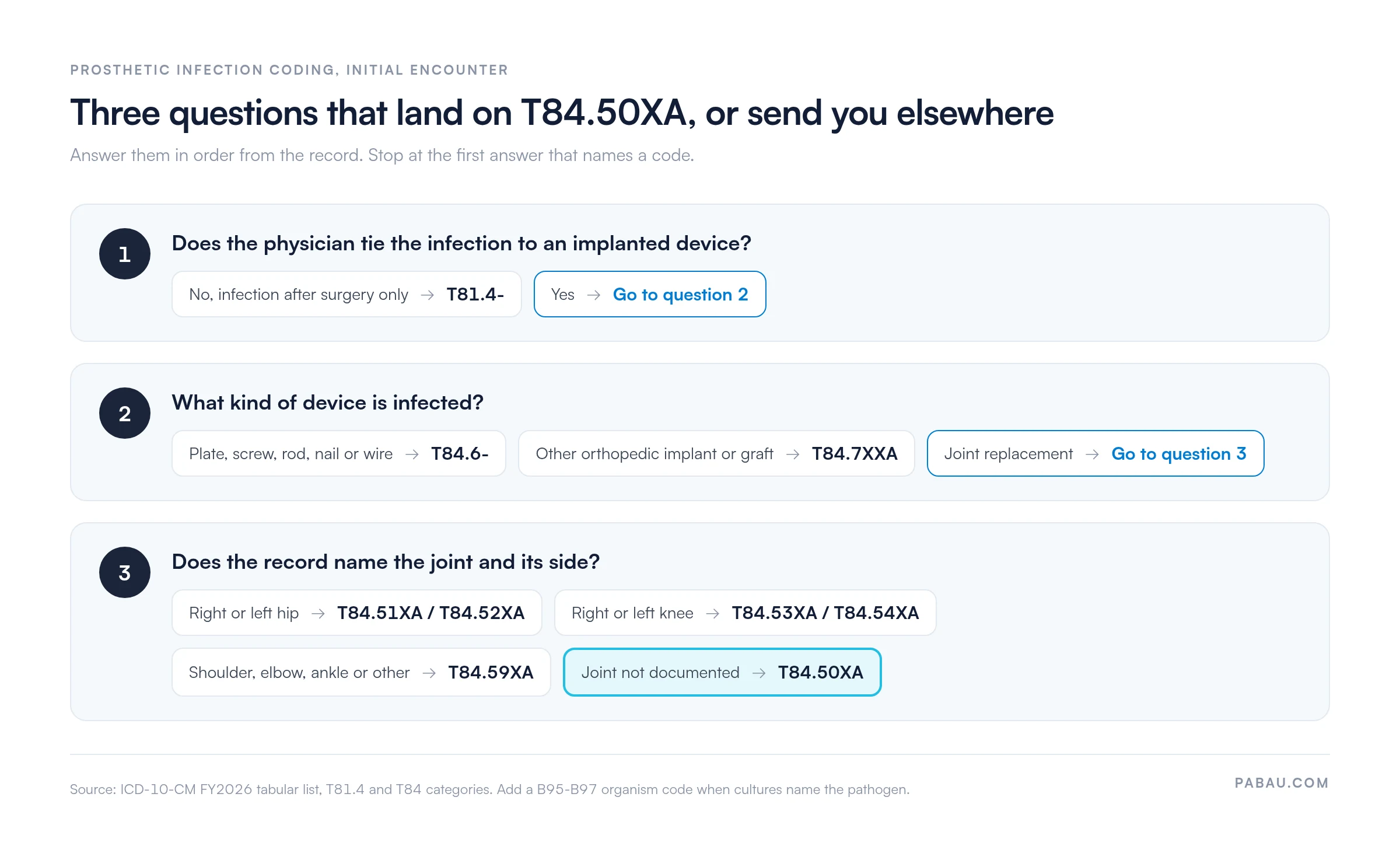
Here’s a quick example. A hip hemiarthroplasty is a joint prosthesis, while a dynamic hip screw is a fixation device. An infection around the first goes to T84.5-, and an infection around the second goes to T84.6-.
Laterality matters just as much. A documented right total knee infection belongs to T84.53XA, and payer edits flag T84.50XA when the operative note names the joint.
The instructions that matter here sit at the parent levels, not on T84.50XA itself. Two of them change how you report the code.
There is no “code first” instruction at T84.50XA. When the prosthetic infection is the reason for the encounter, T84.50XA can be sequenced as the principal diagnosis.
T81.4- (infection following a procedure) carries its own Excludes2 note for infections due to prosthetic devices, listing T84.5-T84.7. That note is why a prosthetic joint infection is coded to T84.5- rather than to T81.4-.
Auditors check a T84.50XA claim against five elements in the medical record. Together, they form the base of medical billing compliance for prosthetic infection claims.
T84.50XA appears most often with joint aspiration, open drainage, prosthesis removal with a spacer, and revision arthroplasty. Each CPT code must match the documented procedure, and the record must support medical necessity for it.
Staged revisions span weeks or months, so one infection can generate a string of claims. A typical sequence looks like this.
Both surgeries are active treatment for the infection, so both encounters normally keep A as the 7th character. Each procedure also needs a physician note that ties it to the infected prosthesis. A revision code paired with T84.50XA, with no documented joint or infection workup, is a common denial pattern.
On an inpatient claim, T84.50XA needs a present on admission (POA) indicator. A patient admitted with a painful, draining joint replacement already has the infection, so the indicator is Y.
When the infection is first diagnosed during the stay, the indicator may be N, and the case can feed into quality reporting. The physician’s note decides which indicator is supportable, so document the admission findings clearly.
Medicare and commercial payers scrutinize prosthetic joint infection claims because revision surgery is expensive. Before you schedule surgery, check the Local Coverage Determinations for your Medicare contractor. The CMS Medicare Coverage Database lists current LCDs and articles by contractor.
Commercial payers and Medicare Advantage plans often require prior authorization for revision arthroplasty or prosthesis removal. Start the request as soon as surgery is planned, so the authorization number is ready when the claim goes out.
Prior authorization is most often required for prosthesis removal (CPT 27091 or 27488) and revision arthroplasty (CPT 27134 or 27487). Requests tied to T84.50XA usually need supporting evidence such as the following.
Some plans also ask for an infectious disease consultation before they approve a staged revision.
Payers expect a specific documentation package with T84.50XA, so denials tend to follow the same five patterns. Each has a simple fix, and denial management in healthcare works best when those fixes happen before submission.
A short pre-submission review catches the patterns above before a payer does. Work through it for every T84.50XA claim.
Flag T84.50XA claims for a second coder review before batch submission. An unspecified joint prosthesis code, an organism code requirement, and 7th-character sensitivity make it worth a 60-second double-check.
The full code path helps coders find related codes and apply instructional notes at the right level. From the broadest ICD-10-CM chapter down to T84.50XA, the structure runs as follows.
The “use additional code” note at T84.5 governs every code from T84.50 to T84.59, and the fixation-device branch at T84.6 carries its own copy. Coders who read only the T84.50XA entry miss these parent-level notes. That is a common source of missing organism code denials.
The ICD List code lookup tool and the CDC/NCHS ICD-10-CM web tool both show parent-level notes alongside the child code. To compare T84.50XA with other codes in its chapter, browse our diagnostic code library.
A prosthetic joint infection often means several claims over months, from aspiration to follow-up. Each one needs the right 7th character, organism code, and authorization number. A slip on any of them sends the claim back.
Pabau, the practice management platform we build for clinical teams, pre-fills each claim from the patient record. Diagnoses on the patient’s problem list seed the ICD-10 fields. Built-in ICD-10-CM and CPT lookup libraries then help coders confirm each code.
Before a claim can be sent, Pabau’s error-checking claims management software confirms that required fields such as authorization codes are complete. US claims then go through Claim.MD with real-time eligibility checks, claim-status tracking, and ERA posting. Your team spends less time reworking rejections as a result.
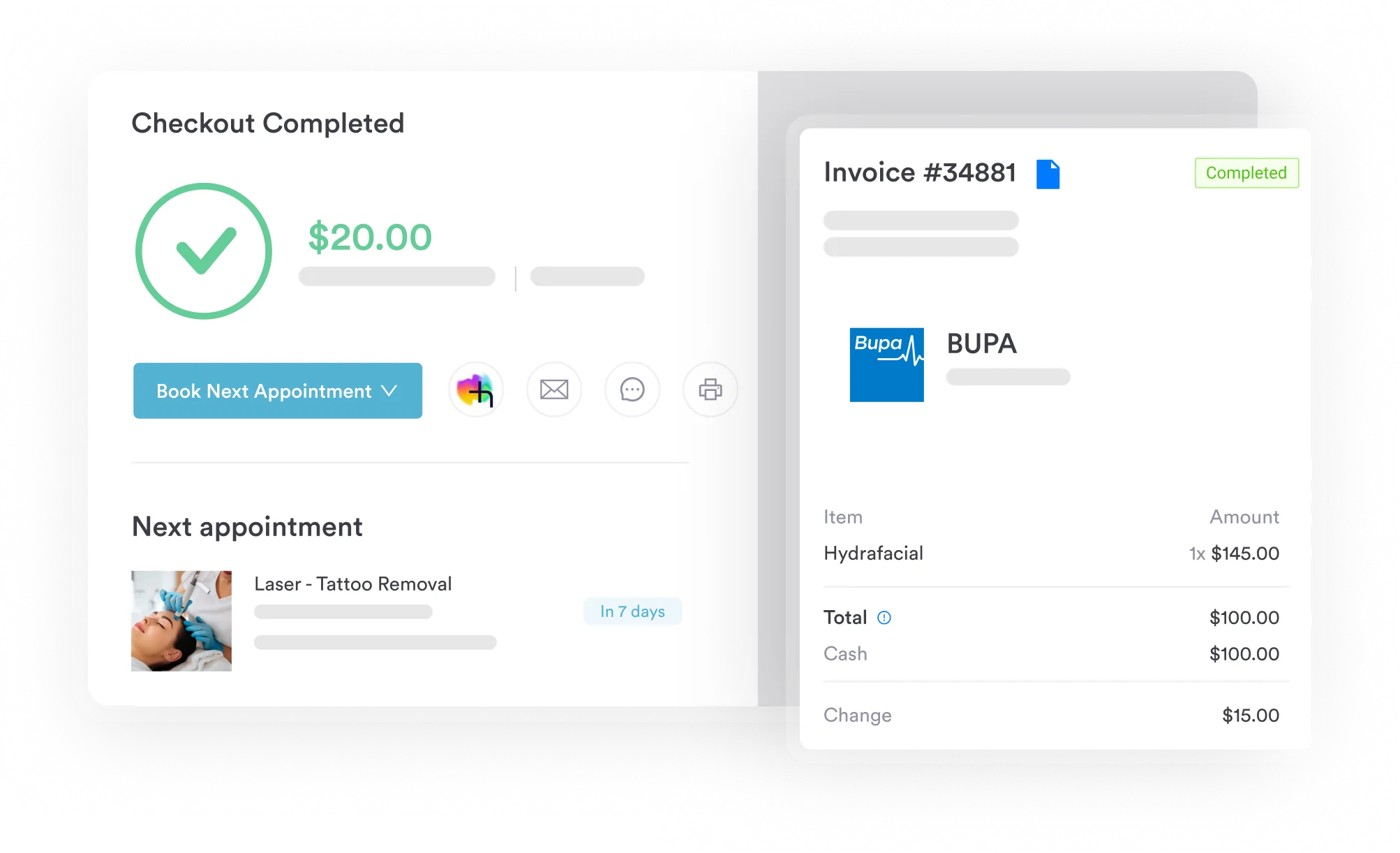

Pabau pre-fills claims from the patient record, checks required fields, and sends them through Claim.MD with eligibility checks and ERA posting.

T84.50XA is a narrow code, and claims go wrong when coders treat it as a catch-all. If the chart names the joint, the code changes. If the hardware is fixation, the branch changes.
So when the joint or side is unclear, query the surgeon before the claim leaves. One question to the physician costs far less than a denied revision claim months later.
Want to see how Pabau carries a staged revision from aspiration to reimplantation without a rejected claim? Book a demo and our team will walk you through it.

Need to understand how medical billing denials are tracked and resolved? Denial management in healthcare covers the denial lifecycle from root cause analysis to appeals workflow.
Coding broken fixation hardware rather than an infected joint? ICD-10 code T84.119D explains how to report a broken internal fixation device at a subsequent encounter.
Looking for a complete overview of what medical billing involves? Medical billing workflow explains how ICD-10 codes, CPT codes, and payer rules interact across the revenue cycle.
Want to see how Pabau submits ICD-10 coded claims electronically? Claim.MD clearinghouse integration details how Pabau routes claims through real-time eligibility checks and ERA remittance processing.
The ICD-9-CM predecessor is 996.66, infection and inflammatory reaction due to internal joint prosthesis. ICD-9 had no laterality or encounter character, so one code covered every joint and every visit.
Aseptic loosening goes to T84.03-, mechanical loosening of internal prosthetic joint. Use T84.50XA only when the physician attributes the loosening to infection.
A superficial incisional infection that doesn’t involve the prosthesis goes to T81.41XA. Move to T84.5- only when the physician documents that the infection reaches the joint replacement.
Not on its own. Postprocedural fever with no infection diagnosis goes to R50.82. Assign T84.50XA only once the physician documents an infection of the prosthesis.
Yes. It applies to outpatient encounters such as an office aspiration, as long as the record documents active treatment or workup of the infection. POA indicators apply to inpatient claims only.