

HCPCS Code E0272: Foam rubber mattress billing guide
HCPCS Code E0272: official descriptor and code overview HCPCS Code E0272 is the ...

Last Updated: Nov 6, 2026
27428 is the CPT code for ligamentous reconstruction (augmentation), knee; intra-articular (open). It covers an open rebuild of a ligament inside the knee joint, most often the anterior or posterior cruciate ligament.
The approach decides the code. An arthroscopically aided ACL reconstruction is reported with 29888, and a PCL one with 29889. When the surgeon also reconstructs a structure outside the joint in the same session, 27429 replaces 27428.
Let Pabau's smart automation suggest the right codes, reduce claim denials, and keep your practice compliant—effortlessly.
Automate repetitive tasks and focus on what matters most—your patients.
Reduce coding errors and ensure compliance with the latest regulations.
Clean claims, fewer denials, and faster reimbursements.
Powerful insights and reporting to help your practice thrive.
HIPAA compliant SOC 2 certified GDPR-compliant Trusted by 4,000+ clinics worldwide

CPT code 27428 covers open intra-articular ligament reconstruction of the knee, most often an open ACL or PCL reconstruction.
Use 27427 for an extra-articular reconstruction on its own, and 27429 when intra-articular and extra-articular work happen in the same session.
Arthroscopically aided cruciate reconstruction has its own codes, 29888 for the ACL and 29889 for the PCL, so the approach decides the code.
The code carries a 90-day global period, so related follow-up visits inside that window are not billed separately.
Pabau, the practice management platform we build, keeps the operative note and the claim in one record, so the code matches what the surgeon documented.
CPT code 27428 is the procedure code for ligamentous reconstruction (augmentation), knee; intra-articular (open), as published by the American Medical Association. Two words in that descriptor decide the code. “Intra-articular” means the graft is placed inside the knee joint. “Open” means the surgeon works through an arthrotomy rather than with arthroscopic assistance.
In practice, 27428 is most often an open reconstruction of the anterior cruciate ligament (ACL) or posterior cruciate ligament (PCL). Open cruciate reconstruction is less common than the arthroscopic route today. It still turns up in revision cases, in multiligament knee injuries, and where the surgeon needs direct access to the joint.
The AMA maintains the CPT code set. Check the current-year codebook for the definitive descriptor and any parenthetical notes that limit how the code is used.
Coders who work only from a diagnosis code and a procedure name often pick the wrong code from this family. The operative steps are what settle it.
In an open intra-articular reconstruction, the surgeon opens the joint, prepares the femoral and tibial attachment sites, and passes a tendon graft through bone tunnels. The graft is then tensioned and fixed with screws, buttons, or staples. The graft runs inside the joint, in the position of the ligament it replaces.
The operative report should reflect this. Language such as “arthrotomy,” “femoral tunnel,” “tibial tunnel,” and “intra-articular graft passage” fits 27428. What moves the case to another code is the approach and the extent of the work, not the tunnel wording. If the note describes an arthroscopically aided reconstruction, the code is 29888 for the ACL or 29889 for the PCL. If the surgeon also reconstructs a structure outside the joint in the same session, the code is 27429.
Multiligament knee injuries, often after a knee dislocation, are where code selection errors cluster. The surgeon may rebuild one or both cruciates and also address collateral or posterolateral structures in one session. Each component has to be named in the operative report before the coder can choose between 27428 and 27429.
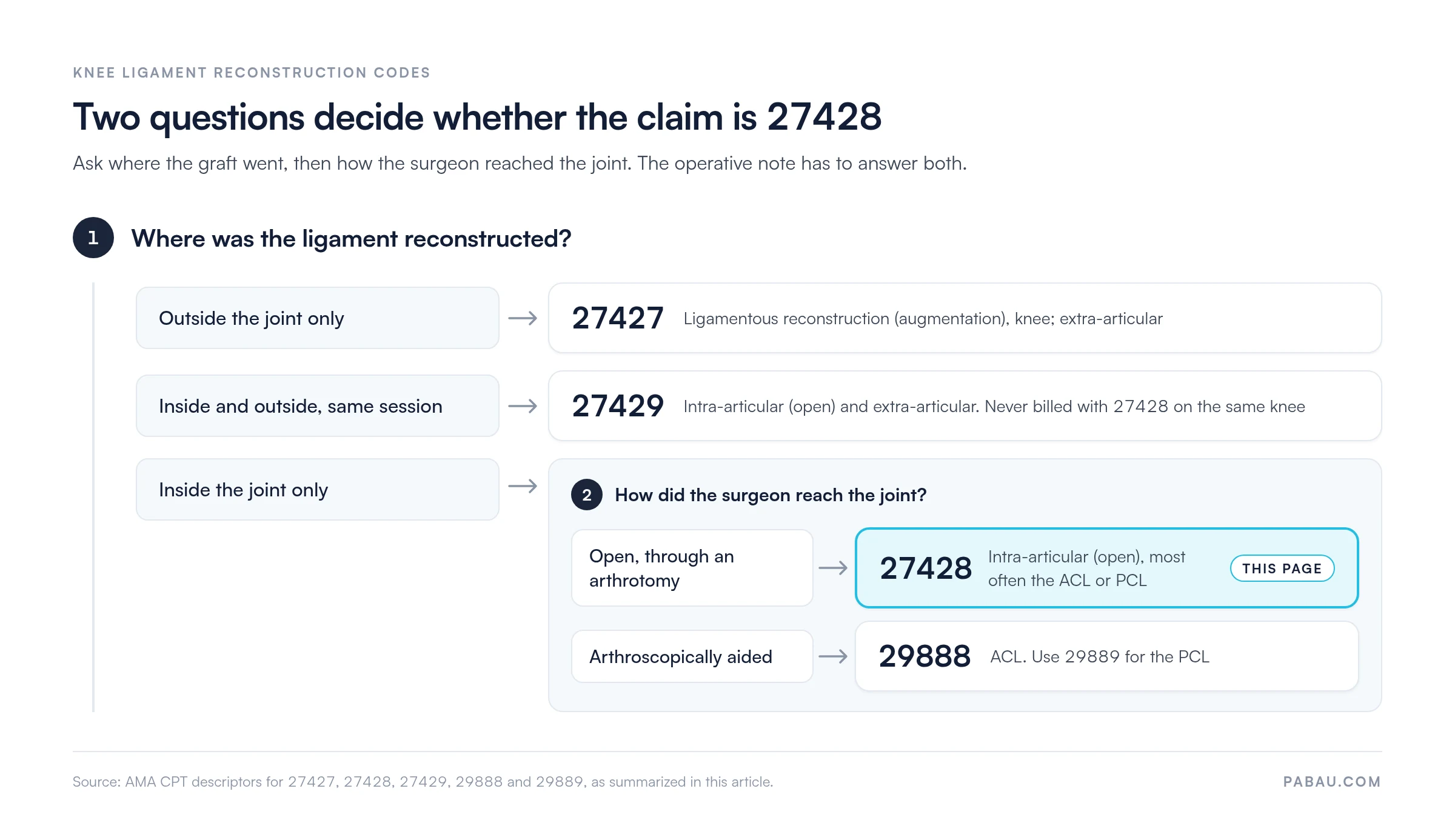
The knee ligament reconstruction family has three open codes that coders often confuse, plus an arthroscopic code that competes with 27428 for the same ligament. The differentiator is where the reconstruction happens and how the surgeon reaches it, not the ligament name or the diagnosis.
The most common error in this family is approach mismatch. A coder sees “ACL reconstruction” and reaches for 27428 when the surgeon used arthroscopic assistance, which is 29888. The second is a split claim. Billing 27428 and 27427 together for one knee overstates the work when 27429 describes the combined procedure.
Both errors go away when the coder asks two questions in a fixed order, as the decision path below shows.
Payers need a diagnosis code that justifies the reconstruction. For CPT code 27428, the usual ICD-10-CM codes fall into three groups: Cruciate ligament injury, chronic knee instability, and knee dislocation.
The 7th character “A” applies while the patient is receiving active treatment, which includes the reconstruction itself. Laterality matters too. Most commercial payers and Medicare Advantage plans flag codes with unspecified laterality for extra documentation. Confirm the operative side from the surgical consent and the operative note before coding.
The operative report is the billing record for CPT code 27428. Without the right elements, payers have grounds to deny or downcode the claim on audit. Medical billing documentation for surgical codes has to be both complete and specific, because a vague operative note is an audit liability.
These elements should be documented explicitly to support 27428:
If the coder cannot tell from the operative report whether the approach was open or arthroscopic, the note is incomplete. Query the surgeon before the claim is built, not after a denial arrives.
Medicare pays CPT code 27428 through the Medicare Physician Fee Schedule (MPFS). CMS assigns three relative value units (RVUs) to the code: Work, practice expense, and malpractice. The total is adjusted by the Geographic Practice Cost Indices for your locality and multiplied by the annual conversion factor.
CMS publishes new RVUs and a new conversion factor every year, so any figure copied from an older source can be wrong. Look up the current values for 27428 in the CMS Physician Fee Schedule Look-Up Tool, choosing your rate year and Medicare locality. Commercial payers set their own rates under contract, often as a percentage of the Medicare amount.
Orthopedic practices billing 27428 through Pabau can send claims electronically through Claim.MD, the US clearinghouse that Pabau integrates with. When several surgeons bill through one practice, each claim is still built from the same record as its operative note.
Check the RVU values for CPT code 27428 each January, when the new Medicare Physician Fee Schedule takes effect. The conversion factor changes from year to year and directly affects what you are paid. An annual fee schedule review in your billing calendar prevents silent underpayment for the rest of the year.
CPT code 27428 carries a 90-day global surgical period under Medicare, as is standard for major musculoskeletal reconstruction. During those 90 days, most postoperative services are bundled into the procedure payment and cannot be billed separately.
Sound revenue cycle management for orthopedic surgery tracks the global period from day one. A routine follow-up visit billed inside the 90-day window without a modifier will be denied.
Key global period rules for 27428:
The National Correct Coding Initiative (NCCI) publishes procedure-to-procedure edits every quarter. Each edit names a pair of codes that cannot be reported together for one patient on one day. Some edits allow a modifier when the documentation supports it. Check the current table on the CMS NCCI edits page for any code you plan to report alongside 27428.
Some pairs are settled by the descriptors themselves. 27429 already includes open intra-articular reconstruction, so it is never reported with 27428 for the same knee. An open and an arthroscopic reconstruction of the same ligament are also alternatives, not additions. For other arthroscopic knee codes, such as the meniscectomy codes 29880 and 29881, the quarterly table decides whether a modifier can apply.
Modifier 59, or the more specific XS for a separate structure, may unbundle a distinct arthroscopic procedure only when:
Most commercial payers treat CPT code 27428 as major musculoskeletal surgery that needs prior authorization. Traditional Medicare does not require prior authorization for most surgical procedures. Medicare Advantage plans run by commercial insurers set their own requirements, which vary by plan.
Log every request as it goes out, with the submission date, the approval number, and the clinical criteria you sent. A missing approval number is a common source of post-service denials.
Standard clinical documentation for a 27428 prior authorization request:
Payer policies differ on what counts as enough conservative treatment before reconstruction, and some waive it for acute injuries in active patients. Check the payer’s current clinical policy before you counsel patients on surgical timelines.
CPT code 27428 denials cluster around a predictable set of errors. Knowing them in advance is the most efficient way to raise your first-pass acceptance rate on these claims.
A structured denial management workflow catches bundling errors and incomplete operative notes before submission. Reviewing the common denial codes alongside your 27428 claims gives billing teams a targeted pre-submission checklist.
Multi-procedure sessions are where 27428 billing gets genuinely complex. The rules depend on which codes sit alongside it and whether an NCCI edit applies.
A clean claim on the first pass depends on knowing these pairing rules before the claim is built.
Reconstruction of both cruciates in one open session is the case most likely to need a second 27428 line. AMA guidance in CPT Assistant addresses how to report the second ligament, so check it and your payer’s policy for the modifier they expect. Where two separately reportable procedures appear on one claim, Medicare’s multiple procedure rule usually pays the second at 50% of its fee schedule amount. That reduction is expected and accounts for the shared operative time.
Run your 27428 claims through an NCCI edit check before submission every quarter, not just when you add a new procedure type. The edit tables update quarterly, so a code pair that was separately billable last quarter may be bundled now.
In most practices the details that decide this code make two journeys. The surgeon records the approach and the structures rebuilt in the operative note. Days later, someone at the billing desk reads that note and picks a code. Anything ambiguous becomes a judgment call, and the open-versus-arthroscopic line is exactly where those calls go wrong.
In Pabau, operative detail sits in the same clinical record the claim is built from. The ligament, the side, and the approach are recorded once and reused. Pabau’s claims management software then carries the code and its diagnosis pairing onto the claim. The billing desk reads a field instead of interpreting a narrative.
The result is a claim that agrees with the note it came from. Every Pabau subscription includes the full feature set, so documentation, billing, and reporting sit in one place.

Pabau connects your clinical documentation to your billing workflow. CPT code 27428 claims leave the practice complete, correctly coded, and paired with the right ICD-10 codes.

CPT code 27428 hangs on two words in its descriptor: Intra-articular and open. Get both right in the operative note and the code follows. Get either wrong and the claim drifts to 27427, 27429, or 29888, usually without anyone noticing until a denial or an audit.
The fix is upstream of the billing desk. When the approach and every structure rebuilt are stated plainly at the point of care, coding becomes a lookup rather than an interpretation. To see how Pabau links surgical documentation to the claim in an orthopedic or sports medicine practice, book a demo with the Pabau team.

Need a framework for managing surgical claim denials? Denial management in healthcare covers the structured workflow for tracking, appealing, and preventing claim denials across surgical specialties.
Looking to understand how clearinghouse submissions work? Medical claims clearinghouse guide explains how EDI transmission, payer routing, and real-time eligibility checks reduce rejection rates on first submission.
Want to benchmark your billing compliance process? Medical billing compliance outlines the documentation and audit-readiness standards that protect orthopedic practices from post-payment recovery reviews.
CPT code 27428 is the procedure code for ligamentous reconstruction (augmentation), knee; intra-articular (open). It covers an open reconstruction of a ligament inside the knee joint, most often the ACL or PCL. The AMA maintains it as part of the CPT code set.
27427 covers an extra-articular reconstruction, outside the joint capsule. 27428 covers an open intra-articular reconstruction, such as an open ACL or PCL reconstruction. 27429 covers both in the same session. Because 27429 already includes the intra-articular work, 27428 is not billed with it for the same knee.
No. An arthroscopically aided ACL reconstruction is reported with 29888, and a PCL reconstruction with 29889. 27428 applies only when the surgeon reconstructs the ligament through an open approach. The operative note must say which approach was used.
CPT code 27428 carries a 90-day global surgical period under Medicare. Routine postoperative visits related to the reconstruction are bundled into the global payment. Visits for unrelated problems in that window take modifier 24, with documentation showing the visit did not address the surgical site.
Most commercial payers require prior authorization for CPT 27428 as major musculoskeletal surgery. Traditional Medicare does not require it for most surgical procedures, but Medicare Advantage plans set their own rules. Check with the individual payer before scheduling surgery.
The most frequent reason is billing 27428 for an arthroscopic case. Others are picking the wrong code within the 27427 to 27429 family and splitting work that 27429 covers. Other common causes are NCCI bundling with an arthroscopic code, missing prior authorization, unspecified laterality, and operative reports that omit the approach or graft details.
Not for the same ligament, because open and arthroscopic reconstruction are alternatives. Another arthroscopic procedure, such as a meniscectomy, may be billable if it treated a separate structure. The current NCCI edit must also allow modifier 59 or XS. Check the quarterly edit table before billing the pair.




