

HCPCS code J2690: Procainamide units and billing guide
What HCPCS code J2690 covers, and what it does not HCPCS code J2690 reports R...

Last Updated: Oct 30, 2026
27385 is the CPT code for suture of quadriceps or hamstring muscle rupture; primary. It covers acute, direct suture repair of a ruptured quadriceps or hamstring muscle or tendon, done before the tissue retracts or scars.
The code sits in the femur and knee joint range (27000-27599) and carries a 90-day global period. Delayed repair, or reconstruction with a fascial or tendon graft, is reported with CPT 27386 instead.
Let Pabau's smart automation suggest the right codes, reduce claim denials, and keep your practice compliant—effortlessly.
Automate repetitive tasks and focus on what matters most—your patients.
Reduce coding errors and ensure compliance with the latest regulations.
Clean claims, fewer denials, and faster reimbursements.
Powerful insights and reporting to help your practice thrive.
HIPAA compliant SOC 2 certified GDPR-compliant Trusted by 4,000+ clinics worldwide

CPT code 27385 covers primary (acute) suture repair of a quadriceps or hamstring muscle rupture under a single descriptor.
CPT 27386 covers secondary repair or reconstruction with a graft, and billing the wrong one of the two is a common denial trigger.
Spontaneous ruptures pair with M66.251/M66.252 (quadriceps, extensor tendons) or M66.351/M66.352 (hamstring, flexor tendons), while traumatic injuries use the S76 series.
The 2026 Medicare national rate is about $588 from 17.62 total RVUs, and the code carries a 90-day global period.
Pabau’s claims management software sends claims through the Claim.MD clearinghouse, which checks CPT and ICD-10 pairings before submission.
CPT code 27385 covers suture of quadriceps or hamstring muscle rupture performed as a primary repair, meaning the repair is done acutely following injury.
The American Medical Association (AMA), which maintains the CPT code set, publishes the full descriptor as: Suture of quadriceps or hamstring muscle rupture; primary.
The single descriptor covers both the quadriceps and the hamstring muscle group, so you don’t need a separate code for each muscle. It does not cover reconstruction with a fascial or tendon graft, or repair with augmentation material. If the op note mentions a graft, query the surgeon before submitting, because CPT 27386 covers secondary reconstruction with a graft.
Op report language points to the right code once you know how these injuries happen. A quadriceps tendon rupture typically follows sudden eccentric loading of the knee, such as landing from a jump, stumbling on stairs, or direct trauma. Hamstring ruptures occur at the proximal or distal attachment after explosive hip flexion against resistance.
For orthopedic groups, these repairs are routine surgical cases, and timing decides the code more often than anatomy does. Primary repair means the surgeon closes the rupture acutely, before the tendon retracts and before fibrosis makes direct suture impractical.
Most clinical sources place this window within about two to three weeks of injury, though the AMA descriptor sets no day limit. Op report phrases that signal primary repair include “direct end-to-end repair,” “acute tear,” “minimal retraction,” and “primary suture closure.”
CPT 27385 (primary repair) and CPT 27386 (secondary repair) form a classic CPT pairing, where the same anatomical procedure is coded differently based on timing. Selecting the wrong one is a common reason claims for this surgery are denied or downcoded.
When timing is ambiguous, such as when a patient delayed seeking care, the operative report is the deciding document. Look for significant scar tissue requiring mobilization, or a tendon that could not be approximated without tension. Either finding makes 27386 more defensible, whatever the days elapsed. The three checks below run in the order a coder should apply them.
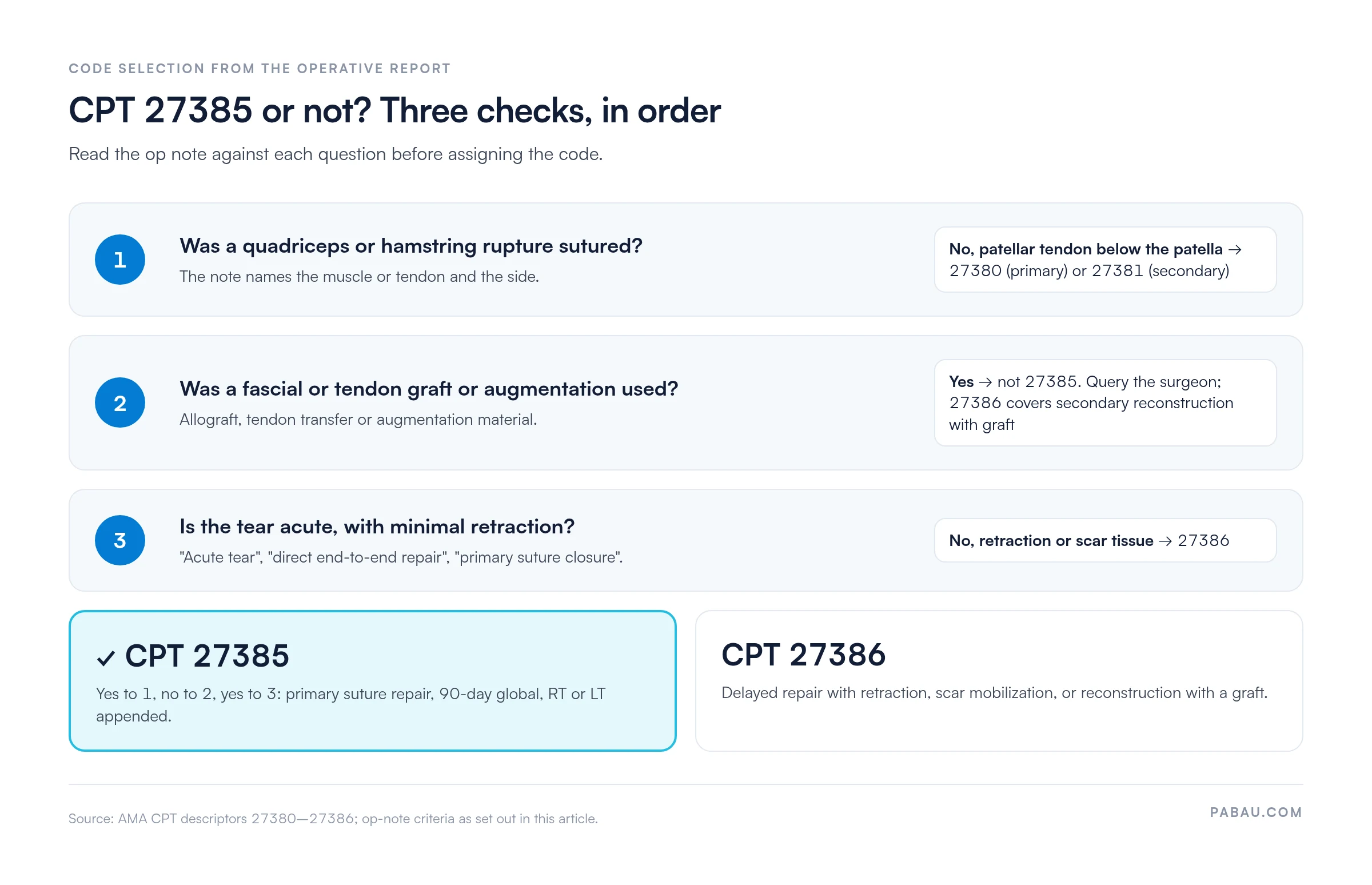
Several neighboring codes cover knee and thigh tendon repairs. Choosing the wrong one, particularly 27380, triggers NCCI bundling conflicts or medical-necessity denials because the anatomical site differs from what 27385 covers.
Every CPT 27385 claim requires a paired ICD-10-CM diagnosis code that establishes medical necessity. The CPT-to-ICD-10 crosswalk shows two primary code families: M66 for spontaneous (non-traumatic) ruptures and S76 for traumatic muscle injuries. A code from the wrong family, or a parent code without the laterality digit, causes a medical-necessity denial. The ICD-10-CM code library lists both families with full descriptors.
Always use the 7th character “A” (initial encounter) on S76 codes for the active surgical visit. Traumatic hamstring injuries sit in their own subcategory, S76.3-, which covers the posterior muscle group at thigh level. Pairing a spontaneous-rupture code (M66) with a narrative that describes trauma, or the reverse, is an inconsistency that payer audit systems flag automatically. Verify current laterality subcodes each year in the CDC/NCHS ICD-10-CM web tool, because codes update every October.
Medicare reimbursement for CPT code 27385 is calculated from the CMS Physician Fee Schedule (MPFS). Rates vary by location through a geographic practice cost index (GPCI) multiplier. The national average below is a planning reference, not a guarantee of what your practice will receive.
These are national values from the 2026 MPFS. Use the FastRVU lookup tool or the CMS MPFS Look-Up Tool to confirm current-year values for your locality. Commercial payers typically reimburse at a percentage of MPFS, anywhere from 100% to 150% depending on your contract.
Run your expected Medicare payment for CPT code 27385 through the CMS MPFS Look-Up Tool at the start of each calendar year. The conversion factor changes every year. A practice that budgets on the prior year’s rate misstates revenue for its high-volume orthopedic months.
CPT code 27385 carries a 90-day global surgery period under CMS policy. Most physician services related to the repair are bundled into the single surgical fee for 90 days after surgery. Billing a separate E&M visit or follow-up within that window without a modifier results in a denial or recoupment.
What the 90-day global period includes:
What can still be billed separately within the 90-day window:
Modifier selection for CPT code 27385 is straightforward on most claims, but laterality and NCCI-related modifier errors cause many of its denials. The table below covers the modifiers most often required or questioned for this code.
Prior authorization (PA) requirements for CPT code 27385 vary by payer and plan type. Maintaining medical billing compliance means checking authorization rules per payer, rather than assuming a Medicare policy applies to a commercial plan.
A PA request for this surgery commonly needs:
Running insurance eligibility verification before the procedure date confirms active coverage and surfaces plan-level PA requirements before they turn into denials. A claim submitted without a required PA is typically non-payable, and under most commercial contracts the practice cannot bill the patient for it.
The National Correct Coding Initiative (NCCI) edits define which code combinations CMS always bundles (column 1/column 2 pairs) and which a modifier can override. Checking the NCCI table before billing CPT code 27385 with any other same-session code prevents automatic rejection. A grounding in medical billing fundamentals helps coders read NCCI logic correctly.
Key NCCI considerations for 27385:
Always verify against the current NCCI Policy Manual for Medicare Services. CMS updates the edit tables quarterly, so a code pair that was payable last quarter may be bundled today.
A complete operative report is the primary audit defense for CPT code 27385. Coders should check the op note against this list before assigning the code. If any element is missing, query the surgeon before submission rather than coding from an incomplete record.
Incomplete op notes are among the most preventable causes of surgical denials, so denial management in healthcare starts before the claim is built. A standard post-op note checklist gives coders the same six elements to look for on every case. Submitting a clean claim for a surgical code like 27385 starts with the operative note, not the billing screen.
Claims for CPT code 27385 are denied for a predictable set of reasons. Each one has a fix that belongs in the practice’s pre-submission workflow.
Without connected software, a coder reads the op note, chooses between 27385 and 27386, and adds RT or LT. Then the claim is re-keyed into a separate payer portal. Each hand-off is another chance to drop a modifier or a laterality digit.
Pabau, the practice management platform we build, keeps the op note, the diagnosis codes and the claim in one patient record. Its orthopedic claims management tools build the claim from that record, so the codes match the documented side and diagnosis.
Claims then go out electronically through Claim.MD, Pabau’s US clearinghouse partner. As the Claim.MD clearinghouse integration guide explains, it scrubs each claim for CPT and ICD-10 pairing errors and NCCI conflicts before the payer sees it.
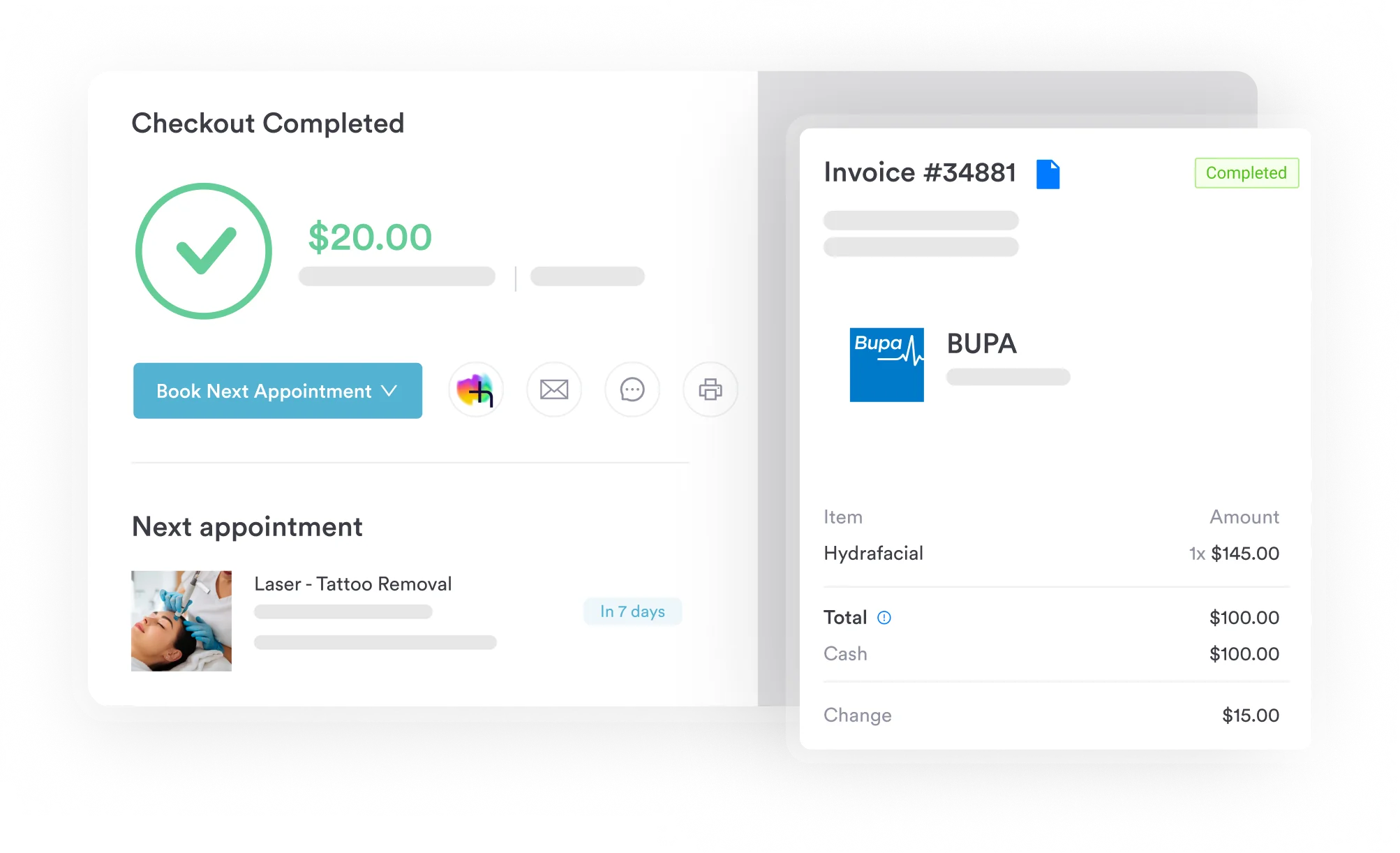
The billing team then spends its time on payer disputes worth fighting, instead of resubmitting claims rejected for a missing modifier.

Pabau keeps the op note, diagnosis codes and claim in one patient record. Claims go out through Claim.MD, which checks CPT and ICD-10 pairings before submission.

For CPT 27385, the operative note decides the claim. A note that documents an acute tear, direct suture, no graft and a named side holds up to audit. If any of those is missing, query the surgeon before submission rather than after a denial.
The trade-off is a few minutes of review per case against a 90-day global package worth about $588 at the Medicare national rate. Book a demo to see how Pabau carries the op note through to a clean orthopedic claim.

Need to understand how denial codes map to specific claim errors? Denial codes in medical billing explains the most common CARC denial reason codes and how to respond to each one.
Want to see how a clearinghouse reduces rejection rates for surgical codes? Pabau’s Claim.MD clearinghouse integration covers how real-time claim scrubbing catches NCCI and ICD-10 errors before they reach the payer.
Looking for a complete revenue cycle management reference? What is revenue cycle management walks through the end-to-end billing process from eligibility verification through payment posting.
CPT code 27385 is the procedure code for primary (acute) suture repair of a quadriceps or hamstring muscle rupture. It covers direct tendon-to-bone or end-to-end suture done shortly after injury, before significant retraction occurs. The American Medical Association (AMA) publishes it in the musculoskeletal section of the CPT code set.
CPT 27385 covers primary (acute) repair performed shortly after injury. CPT 27386 covers secondary repair or reconstruction, done weeks or months later when retraction and fibrosis are present. Select the code from the tissue findings in the operative report, not just the days since injury.
Spontaneous ruptures pair with M66.251 or M66.252 for the right or left quadriceps (extensor) tendons. M66.351 or M66.352 cover the flexor tendons of the right or left thigh (hamstring). Traumatic quadriceps or hamstring injuries use the S76 series, with the 7th character “A” for the initial encounter.
CPT 27385 carries a 90-day global surgery period. Routine post-operative visits related to the repair are bundled into the surgical fee for 90 days. Unrelated services, new conditions, and separate surgical procedures within that window can still be billed separately using the appropriate modifier.
Prior authorization requirements depend on the payer. Traditional Medicare generally does not require PA for 27385, but Medicare Advantage and many commercial plans do. Verify with each payer before scheduling. A claim submitted without a required PA is typically non-payable and cannot be billed to the patient.
No. CPT 27385 and CPT 27386 are mutually exclusive under NCCI edits, because they describe the same repair at different stages of timing. Billing both for the same session results in denial, even with a modifier.


