ICD-10 Code S42.444P: Medial epicondyle fracture, right humerus
ICD-10 Code S42.444P: full descriptor and code validity ICD-10 Code S42.444P car...

Last Updated: Oct 13, 2026
Billable Code Specific Code
S72.024A is the billable ICD-10-CM code for nondisplaced fracture of epiphysis (separation) (upper) of right femur, initial encounter for closed fracture.
Orthopedic, emergency, and inpatient teams reach for S72.024A when a patient presents for the first active treatment of this right-sided injury. The left femur takes a different code, S72.025A, so laterality is the first thing to confirm. Wrong laterality, a missing 7th character, or a femoral neck code used in place of an epiphysis code all lead to denials and audit flags.
Let Pabau's smart automation suggest the right codes, reduce claim denials, and keep your practice compliant—effortlessly.
Automate repetitive tasks and focus on what matters most—your patients.
Reduce coding errors and ensure compliance with the latest regulations.
Clean claims, fewer denials, and faster reimbursements.
Powerful insights and reporting to help your practice thrive.
HIPAA compliant SOC 2 certified GDPR-compliant Trusted by 4,000+ clinics worldwide

In short, S72.024A is a billable ICD-10-CM code for a nondisplaced fracture of the upper epiphysis of the right femur, initial encounter for closed fracture.
Laterality and displacement are separate decisions, so the left-side match is S72.025A and the displaced right-side code is S72.021A.
Category S72 allows 16 different 7th characters. In fact, six of them describe closed fractures, and A covers the whole active treatment phase.
The upper epiphysis is not the femoral neck, so a note reading only right hip fracture cannot support S72.024A.
So, practice management software like Pabau submits and tracks claims through Claim.MD, using the codes already recorded in the patient chart.
The table below contains the core reference data for ICD-10 Code S72.024A. In fact, all values reflect the 2026 ICD-10-CM edition, effective October 1, 2025.
S72.024A describes a nondisplaced fracture of the upper femoral epiphysis on the right side, coded at the initial encounter for a closed fracture. Indeed, each term in the description carries a distinct coding obligation.
All five elements must appear in the physician’s documentation for the code to be assigned correctly. Instead, a note stating only right hip fracture, without displacement status or fracture location, cannot support S72.024A.
The upper femoral epiphysis is the rounded head of the femur that articulates with the acetabulum to form the hip joint. So, understanding its anatomical boundaries prevents the most common coding error for this code: confusing an epiphysis fracture with a femoral neck fracture.
Epiphyseal separations are most common in skeletally immature patients, where the physeal plate is still open. In contrast, adults fracture the same anatomical region differently. In fact, the ICD-10-CM term separation applies whenever the documentation uses it, regardless of patient age.
S72.024 requires a 7th character to become billable. In fact, the character encodes the clinical phase of care and whether the fracture is open or closed. Category S72 carries 16 possible extensions, and picking the wrong one is a common reason for claim rejection.
Six of the 16 describe a closed fracture, so these are the characters that apply to a nondisplaced closed injury like S72.024A.
The remaining ten characters describe open fractures and follow the Gustilo classification. So, they split every treatment phase into type I or II injuries and type IIIA, IIIB, or IIIC injuries.
Character A applies for the full duration of active treatment, not just the first visit. For instance, a patient who returns for hardware removal or a cast change while still in active treatment keeps A, not D.
Displacement status splits the S72.02 epiphysis fractures into two separate code families, each with distinct billing effects. Indeed, nondisplaced fractures of the upper right femoral epiphysis often call for a different surgical approach than displaced ones. So, payers use that distinction to validate medical necessity for specific procedure codes.
When physician documentation does not specify displacement status, ICD-10-CM guidelines instruct coders to query the provider rather than default to displaced or nondisplaced. Instead, assigning S72.024A without documented nondisplaced status is a coding error that a payer audit can flag. In short, ICD-10-CM documentation standards require the treating physician to capture this detail at the time of diagnosis.
S72.024A sits within a structured hierarchy of femur fracture codes. So, knowing the sibling and parent codes prevents misassignment when laterality, displacement, or fracture subtype changes. Also, the wider diagnostic codes library covers the other anatomy-based families a trauma coder works through.
Excludes notes also apply to the S72 category, and the two types behave differently. The category carries one Excludes1 note, for traumatic amputation of hip and thigh (S78.-), which is never coded alongside S72.024A. In fact, the Excludes2 list carries three codes. Those are periprosthetic fracture of a hip prosthesis (M97.0-), fracture of the lower leg and ankle (S82.-), and fracture of foot (S92.-). So, all three may be reported together with S72.024A when the patient has both injuries.
For inpatient admissions, S72.024A maps into CMS Medicare Severity Diagnosis Related Groups (MS-DRGs) that determine hospital reimbursement. In short, the specific DRG depends on what else is documented for the same admission. In fact, whether the record carries a major complication or comorbidity (MCC), a complication or comorbidity (CC), or neither decides the grouping.
These DRG assignments apply when S72.024A is paired with the relevant operative procedure codes. In short, a medical claims clearinghouse edit check is the last place to catch a grouping that does not match the documented comorbidities.
Document all secondary diagnoses fully for S72.024A admissions. For instance, conditions like diabetes, heart failure, or anticoagulation therapy qualify as MCCs or CCs. As a result, they shift the DRG from 482 to 481 or 480, which greatly changes reimbursement. So, a hospitalist note that captures these comorbidities at admission is as important as the fracture documentation itself.
Accurate assignment of ICD-10 Code S72.024A depends on five specific elements in the treating physician’s note. So, missing any one of them creates a query that delays coding and may push billing past timely-filing limits. Instead, a documentation template that prompts for all five at the point of care removes most of those queries.
In short, those five elements, read in sequence, resolve into four decisions, with fracture type and encounter type both settled by the 7th character.
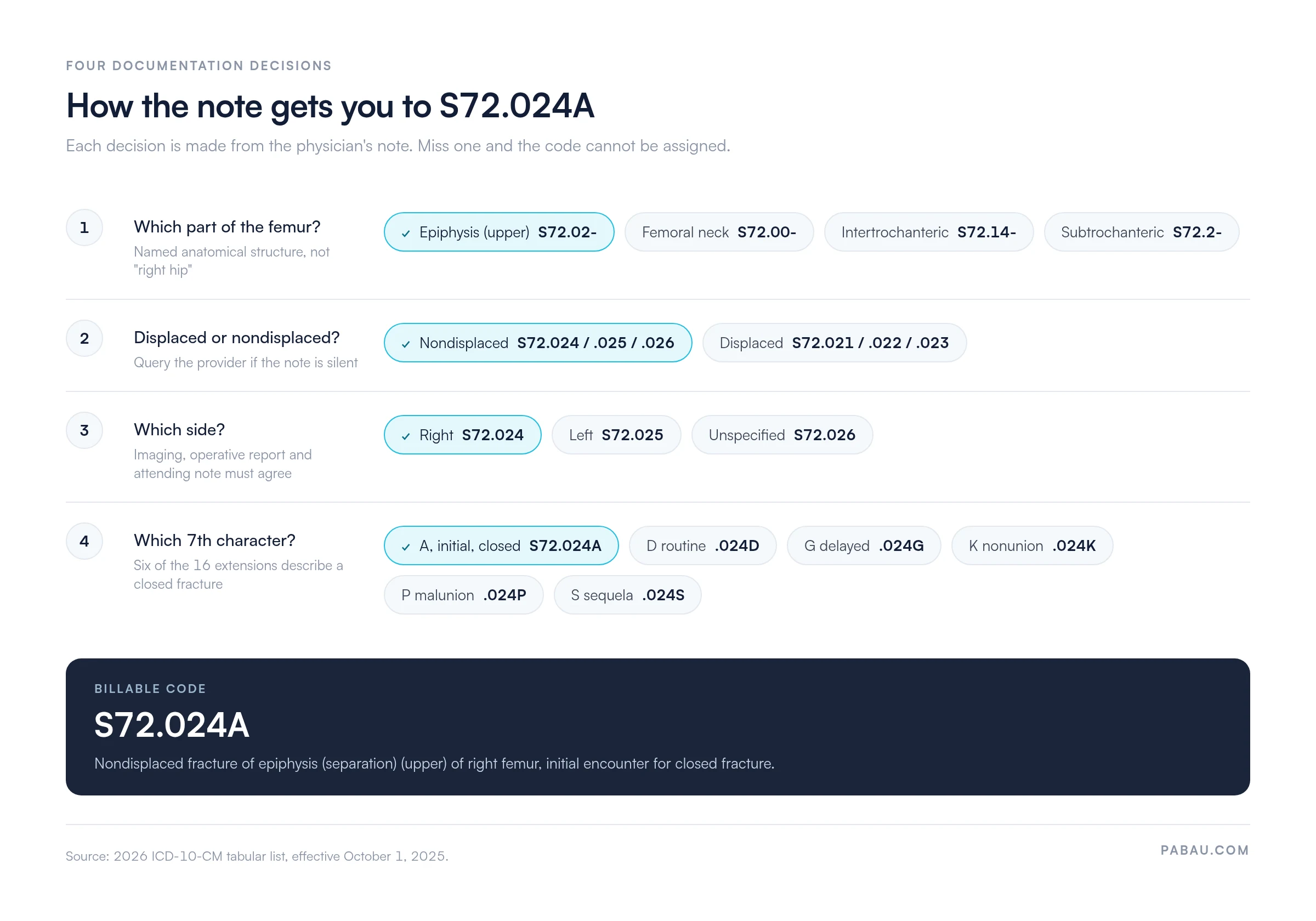
So, applying the same five checks at every encounter type reduces query volume and supports cleaner first-pass claim rates.
Several coding mistakes appear again and again on claims involving ICD-10 Code S72.024A. In fact, each one below has a denial attached to it. So, spotting the pattern before the claim goes out costs far less than reworking it after the payer sends it back.
So, coding accuracy on trauma claims starts with consistent documentation at the point of care rather than corrections at the billing stage.
Billing an orthopedic fracture case takes a system that carries documentation through to claim submission without manual re-entry. In fact, practice management software like Pabau keeps the encounter note, the recorded codes, and the claim in one place. As a result, nobody retypes S72.024A into a separate billing tool.
Pabau’s claims management software submits and tracks claims through its Claim.MD integration, using the diagnosis and procedure codes already stored on the patient record. Instead, Pabau does not choose the diagnosis code for you, and it does not assign laterality or displacement status. So, those decisions stay with the clinician and the coder, exactly where the ICD-10-CM guidelines put them.
The re-keying and the chasing go away. As a result, claim status comes back into the same record the note lives in. So, your billing team can see which fracture claims are paid, pending, or rejected without opening a second system.

Pabau carries your clinical documentation and its recorded codes straight into claim submission and tracking, so fracture claims leave the practice without manual re-entry.

Accurate assignment of ICD-10 Code S72.024A turns on four documentation elements. In fact, those are the fracture location (epiphysis, not neck), the laterality (right), the displacement status (nondisplaced), and the matching 7th character. Miss one of them and the claim either rejects outright or invites a DRG-level audit.
The side is the easiest detail to get wrong, because S72.024A and S72.025A differ by a single digit. Read the operative report before you code, and confirm that the imaging and the attending note name the same femur.
Pabau keeps the clinical note, the recorded codes, and claim submission in one connected workflow. As a result, what your coder assigns for S72.024A is what reaches the payer. Book a demo to see how orthopedic teams move a fracture claim from the note to the payer without re-entry.

Need guidance on billing for orthopedic claims? In fact, Clean claim submission checklist covers the documentation and coding elements that prevent first-pass denials on orthopedic and trauma claims.
Looking to reduce claim denials on fracture codes? So, Medical billing compliance guide outlines the payer-level requirements that affect S72 and similar musculoskeletal code submissions.
Want to understand ICD-10 code updates each year? Indeed, Superbill creation and management explains how annual ICD-10-CM revisions affect the codes that populate your billing forms and encounter records.
ICD-10 Code S72.024A is the billable diagnosis code for a nondisplaced fracture of the epiphysis (separation) (upper) of the right femur. In fact, the 7th character A covers the initial encounter for a closed fracture. Also, the code is valid under the 2026 ICD-10-CM edition, effective October 1, 2025.
Yes, S72.024A is billable and specific. In fact, it can be submitted on claims for reimbursement and is valid for HIPAA-covered transactions. Instead, the parent code S72.024, without a 7th character, is not billable on its own.
In short, S72.024A maps to DRG 480 (with MCC), DRG 481 (with CC), or DRG 482 (without CC/MCC) when paired with hip and femur procedure codes. The assigned DRG sets the inpatient payment under Medicare, so documenting every comorbidity at admission directly affects reimbursement.
Category S72 carries one Excludes1 note, for traumatic amputation of hip and thigh (S78.-). Indeed, an Excludes1 note means the two conditions are never coded together. In contrast, periprosthetic fracture of a hip prosthesis (M97.0-), fracture of the lower leg and ankle (S82.-), and fracture of foot (S92.-) are Excludes2 notes. So, all three can be reported alongside S72.024A when the patient has both injuries.