

CCSD code XR940: Radiology billing guide for UK private practice
CCSD code XR940 is a UK private healthcare radiology procedure code used to bill...

Last Updated: Nov 26, 2026
25215 is the CPT code described as "Carpectomy; all bones of proximal row." It reports an open proximal row carpectomy, in which the surgeon removes the scaphoid, lunate, and triquetrum to salvage an arthritic or collapsed wrist.
The operative report must name all three bones. A report that names fewer can trigger a payer review or a downcode to 25210, the single-bone code. CMS assigns 25215 a 90-day global period.
Let Pabau's smart automation suggest the right codes, reduce claim denials, and keep your practice compliant—effortlessly.
Automate repetitive tasks and focus on what matters most—your patients.
Reduce coding errors and ensure compliance with the latest regulations.
Clean claims, fewer denials, and faster reimbursements.
Powerful insights and reporting to help your practice thrive.
HIPAA compliant SOC 2 certified GDPR-compliant Trusted by 4,000+ clinics worldwide

CPT code 25215 reports an open proximal row carpectomy, in which the surgeon removes the scaphoid, lunate, and triquetrum.
The operative report must name all three bones, or payers can review the claim or downcode it to CPT 25210.
For 2026, CMS assigns 25215 a 90-day global period and 17.30 total RVUs, about $578 nationally before locality adjustment.
Append LT or RT, because payers commonly deny or review a 25215 claim line that carries no laterality modifier.
Pabau, a practice management platform with insurance billing, sends claims through Claim.MD and tracks prior authorization on the patient’s case.
CPT code 25215 reports an open proximal row carpectomy, in which the surgeon removes the scaphoid (navicular), lunate, and triquetrum. CMS’s 2026 relative value file lists 25215 as an active, payable code with a 90-day global period. In addition, the official descriptor from the American Medical Association (AMA) reads “Carpectomy; all bones of proximal row.”
All three bones must come out for 25215 to apply. In contrast, removing a single carpal bone falls under CPT 25210, the one-bone carpectomy code.
The code sits in the musculoskeletal system subsection of the CPT surgery section, under Forearm and Wrist (25000-25999). Hand and finger procedures use the 26000 series instead. In addition, CMS classifies 25215 as major surgery with a 90-day global period.
CPT 25210 reports carpectomy of one bone, and CPT 25215 reports carpectomy of all bones in the proximal row. The distinction is binary, because the operative report either documents removal of all three named bones or it does not.
Billing 25215 without documented removal of all three bones is a compliance risk. Payers audit carpectomy claims, so an operative note that is silent on one or more bones can trigger a downcode. Therefore, the chart below maps what the report documents to the code it supports.
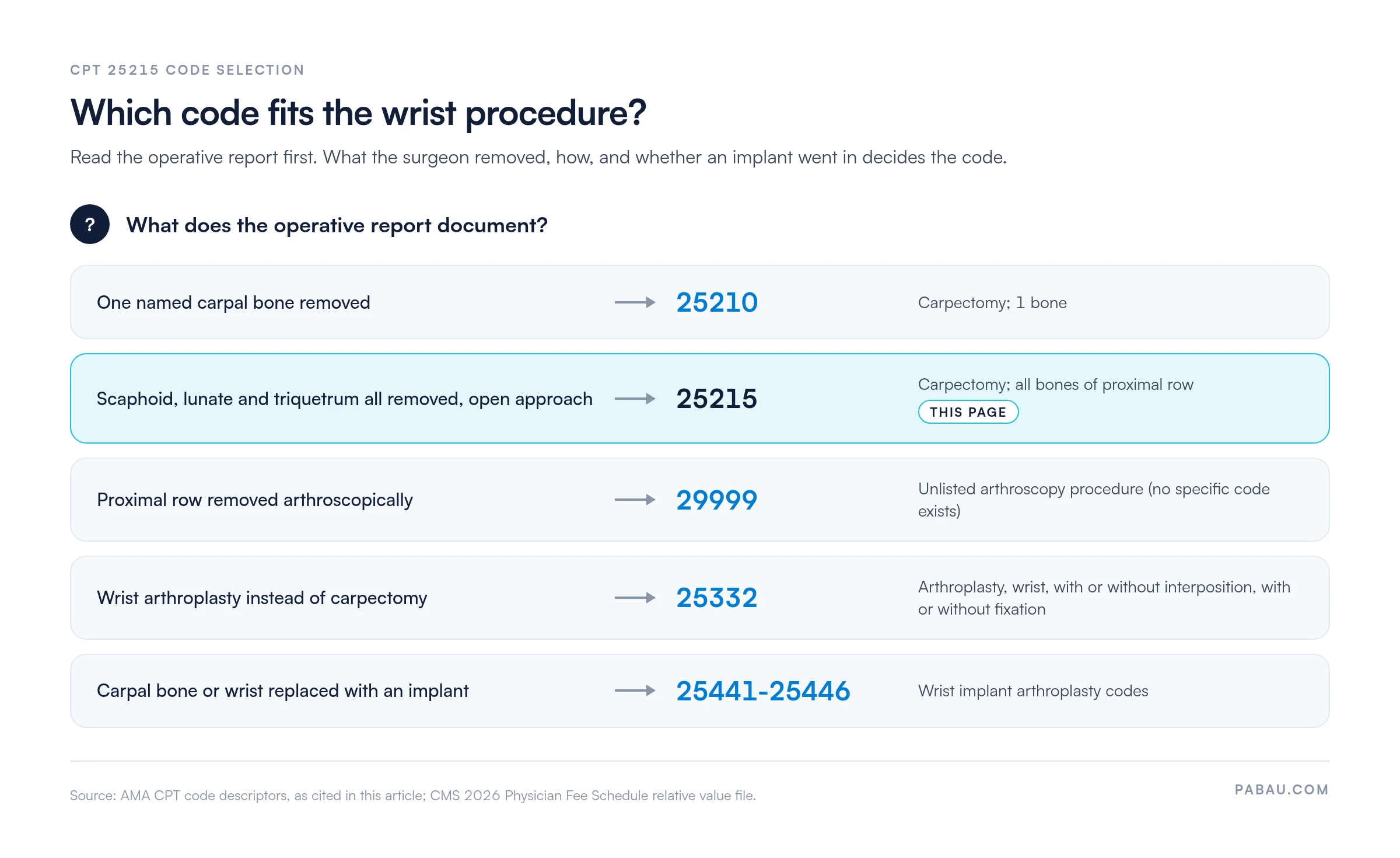
Several wrist procedure codes appear in the same operative session as CPT 25215 or are often confused with it. As a result, the table below gives coders a quick reference for the most common adjacencies.
Medical necessity for proximal row carpectomy needs support from a matching ICD-10-CM diagnosis code. For this reason, orthopedic and hand surgery practices billing CPT 25215 usually pair it with degenerative and traumatic wrist pathology codes. In addition, payers reviewing claims expect the diagnosis to reflect failed conservative treatment before the salvage procedure.
ICD-10-CM codes update each October, so verify current code validity through the CDC/NCHS ICD-10-CM web tool before submission.
Code symptoms and fractures at full specificity. For example, a wrist pain code such as M25.531 belongs on the claim only as a secondary diagnosis. Similarly, a scaphoid fracture code carries side, site, and displacement, as S62.011A does for a displaced distal pole fracture.
Always include a secondary diagnosis code showing failed conservative treatment (such as physical therapy or corticosteroid injections) when submitting CPT 25215, because many payers require evidence of non-surgical care for 3-6 months before approving salvage wrist surgery. In fact, a missing link is a common cause of medical necessity denials.
For 2026, CMS assigns CPT 25215 17.30 total relative value units (RVUs) in both facility and non-facility settings. At the $33.4009 conversion factor, that is about $578 nationally before locality adjustment. Next, use the CMS MPFS Look-Up Tool to retrieve your locality’s rate before you submit claims or set patient estimates.
Figures come from the CMS 2026 Physician Fee Schedule relative value file, October release. CMS flags the non-facility amount for 25215 as not applicable, so both settings carry the same values. However, Medicare Advantage plans may pay differently from traditional Medicare, so confirm contracted rates with each plan.
Pabau also sends claims through Claim.MD to thousands of US payers. Then electronic remittance advice comes back into Pabau, so each 25215 claim shows the paid amount next to the billed one.
The operative report is the billing team’s primary evidence that CPT 25215 is correct. A clean claim submission for proximal row carpectomy depends on documentation that is specific about which bones were removed and how. However, generic language like “carpectomy performed” does not distinguish 25215 from 25210.
A CPT 25215 claim line usually carries a laterality modifier, and sometimes more. Payers commonly deny or review a claim without LT or RT, so check laterality first.
CMS assigns CPT 25215 a 90-day global surgical period. This period defines which services are included in the surgical package and which may be billed separately.
CMS publishes each code’s global period in the Physician Fee Schedule relative value files. However, related post-operative visits billed separately within the 90-day window, without an appropriate modifier, are denied as bundled into the surgical payment.
Prior authorization requirements for CPT 25215 vary by payer and plan type, so no universal rule applies. However, proximal row carpectomy is elective surgery, and many commercial payers require pre-authorization for it.
Payers usually ask for the following items with an authorization request.
Medicare Advantage plans may require prior authorization even when traditional Medicare does not. Therefore, verify requirements with the patient’s specific plan before scheduling surgery, because a missing or mismatched authorization number is a common reason these claims deny.
Knowing where CPT 25215 claims fail saves appeals time. Sound denial management workflows for surgical codes start by sorting root causes before reworking each claim. For that reason, the table below maps six common denial triggers to their fixes.
A structured approach to denial codes in medical billing cuts rework. Categorize denials by root cause each month. Then the patterns show which front-end workflow changes would stop them at submission.
Run a monthly denial report for CPT 25215 claims, grouped by CARC (Claim Adjustment Reason Code). Two or more laterality denials in a month mean the workflow needs fixing. In that case, a scrubbing rule that holds any musculoskeletal procedure code without LT or RT catches the omission before the claim leaves.
A proximal row carpectomy claim draws on the prior authorization, the patient’s insurance details, and the claim itself. Pabau’s claims management software keeps them on one patient record, so billing staff aren’t chasing a spreadsheet before the surgery date.
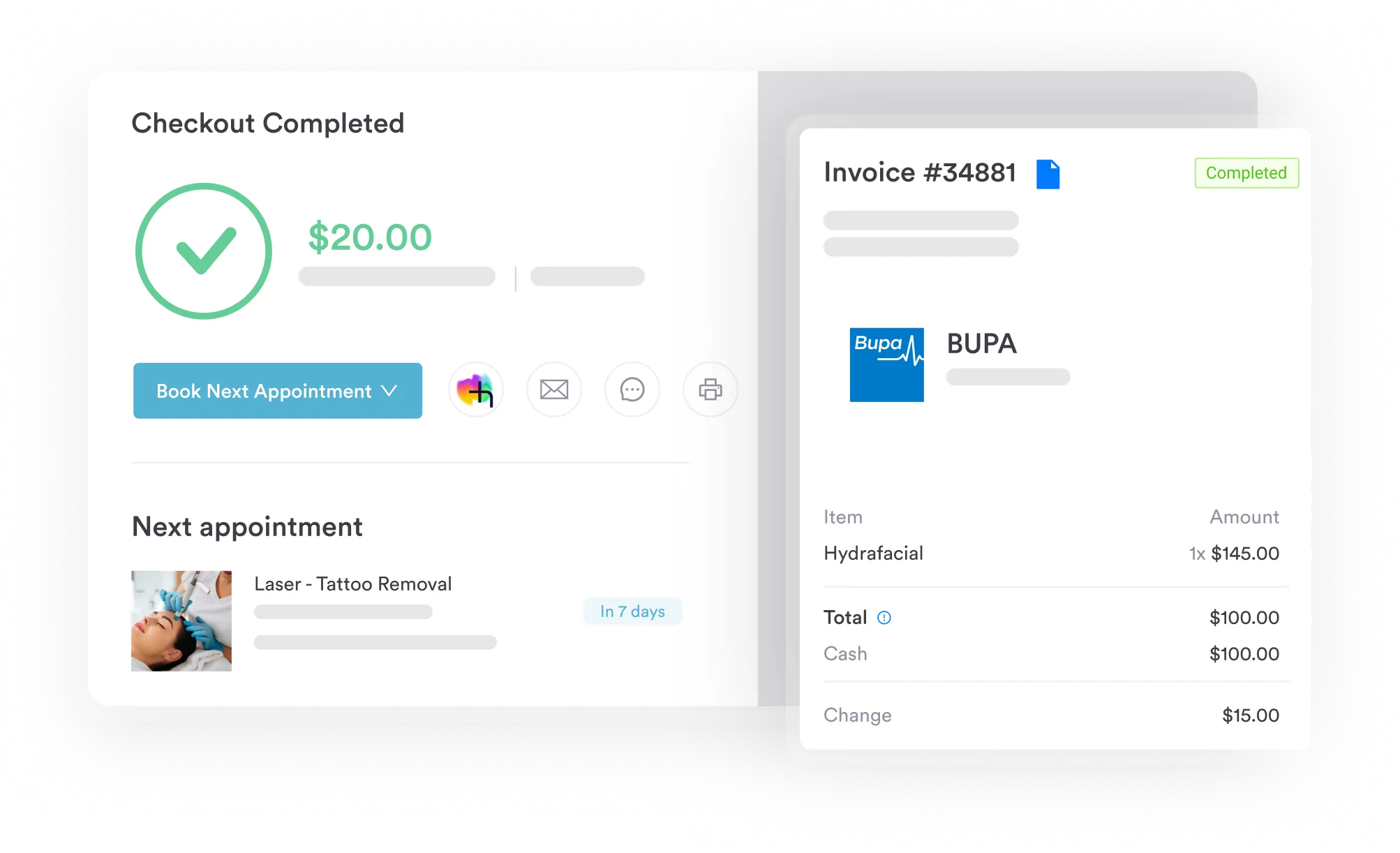

Pabau tracks prior authorization on the patient’s case and warns you when one is missing. It sends CPT 25215 claims through Claim.MD, with eligibility checks and ERA posting on the same record.

CPT 25215 is paid on what the record proves. First, put the three bone names and the open approach into the operative report template. Next, append LT or RT to every claim line. Finally, confirm prior authorization before the surgery date.
Each of those checks costs minutes before surgery. In contrast, skipping one costs an amended report, an appeal, and a payment that waits on both.
Book a demo to see how Pabau keeps prior authorizations, Claim.MD submissions, and remittances for surgical claims on one patient record.

Need a clearinghouse for surgical claims? Claim.MD clearinghouse explains how the clearinghouse routes claims and returns remittance advice.
Looking to understand common medical billing denials? Medical billing compliance covers the documentation and workflow standards that keep orthopedic claims clean.
Want to see how the 837 file works for surgical submissions? The 837 electronic claim file explains the transaction format used by clearinghouses including Claim.MD when submitting CPT procedure codes.
CPT code 25215 is the procedure code for carpectomy of all bones of the proximal row, which means the scaphoid, lunate, and triquetrum. The procedure is also called proximal row carpectomy. It is a wrist salvage operation used when degenerative disease or avascular necrosis has destroyed the proximal row beyond preservation.
CPT 25210 reports carpectomy of one bone. CPT 25215 reports carpectomy of all three proximal row bones. The operative report decides which applies. If it names the scaphoid, lunate, and triquetrum as excised, 25215 is correct. If fewer than all three are removed, 25210 applies for each bone excised.
Prior authorization requirements for CPT 25215 vary by payer and plan. Many commercial payers require pre-authorization for proximal row carpectomy as an elective surgical procedure. Medicare Advantage plans may require authorization even when traditional Medicare does not. Always verify with the specific plan before scheduling.
For 2026, CMS assigns CPT 25215 17.30 total RVUs in both facility and non-facility settings. At the $33.4009 conversion factor, the national Medicare payment is about $578, before locality adjustment. Use the CMS MPFS Look-Up Tool for your locality’s rate before submitting claims.
Yes, CPT 25215 can be billed alongside wrist arthroscopy codes (29840-29848) when the procedures are clinically distinct and separately documented. NCCI edits may bundle them without modifier 59. Append modifier 59 and document the separate clinical indication and procedural components for each code to prevent bundling denials.



