CCSD Code H0480: Abdominal revision of restorative proctocolectomy
What is CCSD Code H0480? CCSD Code H0480 is the procedure code for abdominal rev...

Last Updated: Oct 15, 2026
24650 is the CPT code for closed treatment of a radial head or neck fracture without manipulation. It covers nonoperative care of a fracture at the top of the radius, just below the elbow, when the provider does not reduce the fragments.
The manipulation split decides the code. If the provider performed any fracture reduction, the claim belongs under 24655, not 24650. Open treatment through an incision is 24665, or 24666 when the radial head is replaced.
Let Pabau's smart automation suggest the right codes, reduce claim denials, and keep your practice compliant—effortlessly.
Automate repetitive tasks and focus on what matters most—your patients.
Reduce coding errors and ensure compliance with the latest regulations.
Clean claims, fewer denials, and faster reimbursements.
Powerful insights and reporting to help your practice thrive.
HIPAA compliant SOC 2 certified GDPR-compliant Trusted by 4,000+ clinics worldwide

CPT code 24650 covers closed treatment of a radial head or neck fracture when the provider performs no manipulation (reduction).
A reduction moves the claim to 24655, and open treatment through an incision moves it to 24665 or 24666.
The 90-day global period bundles routine follow-up and the first cast or splint, so only a replacement cast is billed separately.
Many payers require RT or LT on this paired-site code, so check payer policy and match the modifier to the documented side.
The 2026 Medicare national rate is about $302 non-facility and $259 facility, from 9.03 and 7.74 total RVUs.
CPT code 24650 carries the official AMA descriptor: Closed treatment of radial head or neck fracture; without manipulation. “Closed” means no surgical incision was made. “Without manipulation” means the provider did not perform a fracture reduction. If either condition is absent, a different code applies.
The radial head sits at the proximal end of the radius, just below the elbow joint. Fractures here are among the most common elbow injuries, typically from a fall on an outstretched hand. CPT code 24650 applies when the provider confirms the fracture, judges it stable enough for conservative care, and treats it without repositioning the fragments.
The clinical decision point between 24650 and 24655 is manipulation. Manipulation means the provider physically repositioned the fracture fragments during the encounter. The clinical note must explicitly state whether manipulation was or was not performed.
Upcoding to 24655 when the note only documents observation, splinting, and return-to-care instructions is a billing error that payers and auditors flag. Billing 24650 when the note describes a reduction under-bills the visit. The documentation must settle the question on its own, with no inference required.
The two questions below settle the choice in order, starting with whether the fracture site was opened.
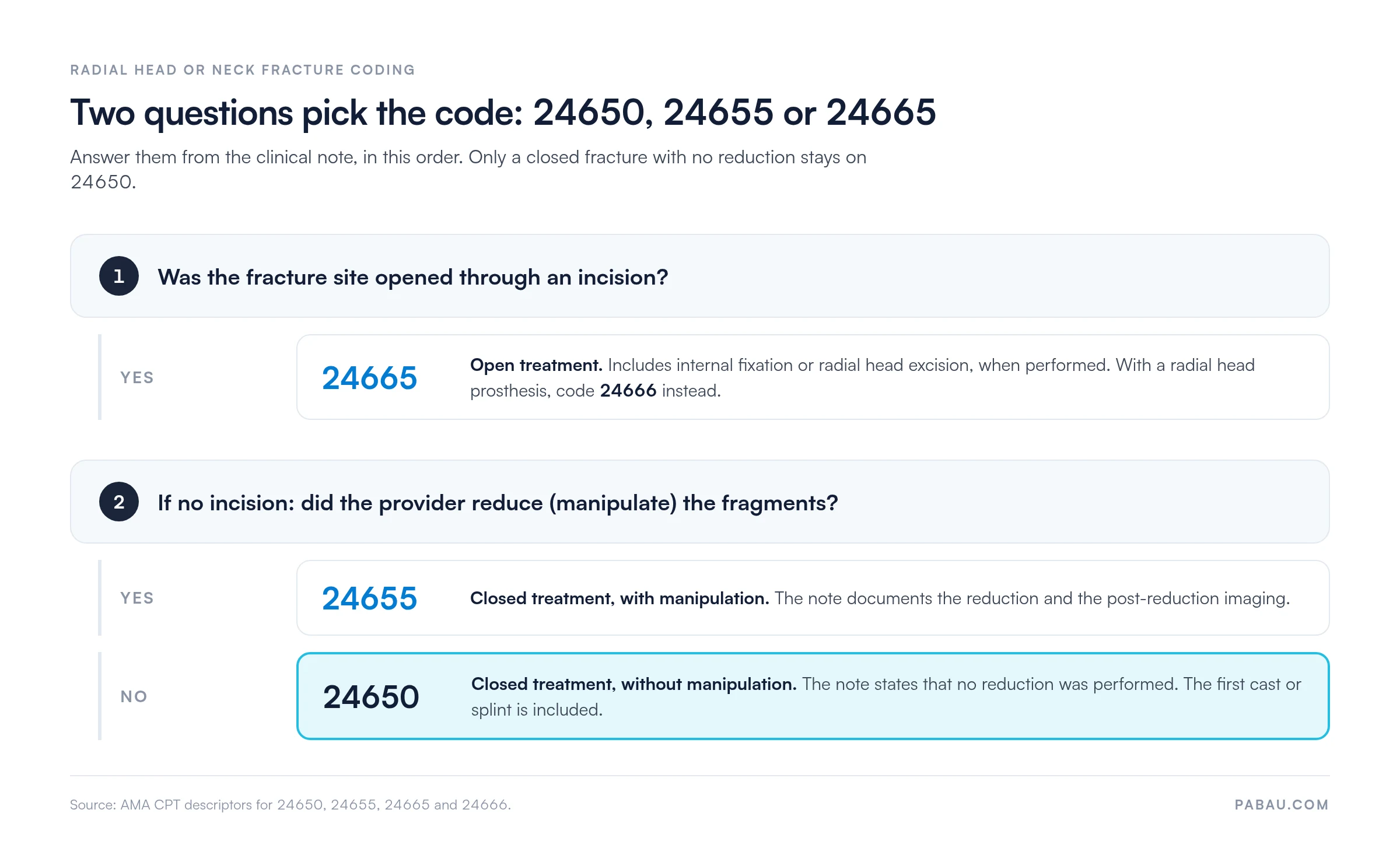
CPT code 24650 is a global fracture care code. It bundles the initial fracture assessment and routine follow-up within the 90-day global period into a single payment, so knowing its boundaries prevents unbundling errors.
Included in the 24650 global bundle:
Excluded and separately billable (when documented appropriately):
Document the first splint or cast as part of the fracture care, because 24650 already pays for it. A replacement cast later in the global period is billed with its own cast code. A provider who applies the initial cast but does not treat the fracture bills the cast code instead of 24650.
Modifier selection for CPT code 24650 affects whether the claim is accepted. Start with laterality, then check the modifiers below against the clinical context.
A note on modifier -25: payers require that the medical record for the same-day E&M clearly documents the separate problem. A visit note that only documents the fracture and then bills an E&M alongside 24650 will be denied or reversed on audit. The separate problem needs its own documented assessment and plan.
CPT fracture treatment codes include the application of the first cast or splint, so the initial cast is not billed alongside 24650. Cast codes come into play only for a replacement cast during the 90-day global period. They also apply when the provider applying the cast does not treat the fracture.
Before billing a replacement cast, check the current NCCI edit pair for 24650 with 29075 or 29125. CMS updates the NCCI edit tables every quarter.
Every CPT code 24650 claim needs an ICD-10-CM diagnosis code that confirms a radial head or neck fracture. Radial head fractures sit in S52.12-, and radial neck fractures sit in S52.13-. The 7th character for the encounter type is mandatory, and a claim without it or with the wrong one will reject.
Use 7th character A while the patient receives active treatment for the fracture. Switch to D for routine-healing follow-up visits during the global period. Character S is for sequelae, the late effects that remain after the fracture itself has healed. The S52.00- codes describe the upper end of the ulna, so they never support a radial head claim.
CPT code 24650 reimbursement varies by place of service, geographic locality, and the annual CMS conversion factor. The figures below are 2026 Medicare national values, priced with the $33.4009 conversion factor for clinicians outside a qualifying APM. Verify current rates in the CMS Physician Fee Schedule lookup tool before billing, as rates change each year and differ by locality.
The non-facility rate is higher because practice expense RVUs are larger when the procedure is performed in the physician’s office. In hospital outpatient and ASC settings, the facility rate applies and the facility bills separately for overhead. Use a current RVU lookup tool to confirm values for your billing year.
The global surgery period for CPT code 24650 is 90 days under CMS rules, beginning the day after the procedure date. This global period bundles routine follow-up care into the original payment, so separate billing for included services will be denied.
Weak documentation sits behind many CPT code 24650 denials. Each element below maps to a specific denial risk when it is missing. A clearinghouse can catch format errors, but it cannot add a missing no-reduction statement to the note.
CPT code 24650 denials cluster around a predictable set of errors, and most are preventable before the claim goes out. Effective denial management workflows track these patterns by code and payer, so staff can fix root causes instead of reworking individual claims. Review common denial codes to understand payer messaging on remittance advice.
Build a pre-billing checklist for 24650 that your billing staff runs before submission. Confirm the laterality modifier, the ICD-10 7th character, the no-manipulation language in the note, and that no cast code covers the first cast. Two minutes of review costs less than reworking a denied claim.
Traditional Medicare fee-for-service generally does not require prior authorization for closed fracture care under CPT code 24650. Medicare Advantage plans follow their own authorization rules, and requirements vary by plan and region. Commercial payers and state Medicaid managed care organizations have even more variable policies.
With payer rules this varied, a clean claim on the first submission depends on preparation. Check authorization, laterality and the 7th character before the claim goes out.
In many orthopedic practices, a 24650 claim passes through three hands. The provider writes the fracture note, and a coder reads it for reduction status and laterality. A biller then rekeys the codes into a separate clearinghouse portal. Each handoff is a chance for RT to become LT or for the no-reduction statement to go unchecked.
Pabau, the practice management platform we build, keeps the appointment, the clinical note and the invoice in the same patient record. Its orthopedic claims software handles electronic claim submission and tracking through Claim.MD, so your team sends and follows each claim without leaving Pabau.
The coder reviews the documentation where it lives. A missing laterality or reduction statement surfaces before submission, not after a denial lands.

Pabau keeps scheduling, clinical notes and invoices in one patient record. Your team submits and tracks claims electronically through Claim.MD.

Code 24650 only when the note says, in plain words, that no reduction was performed. A documented reduction makes the claim 24655, and an incision moves it to 24665 or 24666. That single sentence in the note decides which code, and which payment, the claim can support.
Build your pre-billing check around it. Confirm RT or LT where the payer asks for it, and an S52.12- or S52.13- code with the right 7th character. Then make sure no cast code charges for the first cast.
Book a demo to see how Pabau keeps the fracture note and the claim in one record, so your coder checks both before submission.

Coding a fracture lower down the radius? CPT code 25600 covers closed treatment of a distal radial fracture without manipulation.
Want to understand what happens after a claim denies? Denial management in healthcare explains how to build a systematic appeals process that recovers revenue on fracture care codes.
Looking for a billing compliance reference? Medical billing compliance covers documentation standards, audit triggers, and payer contract alignment for orthopedic and musculoskeletal billing.
CPT code 24650 covers closed treatment of a radial head or neck fracture without manipulation. The fracture is managed without surgery, and the treating provider performs no reduction. The code bundles the initial fracture care visit, the first cast or splint, and routine follow-up within the 90-day global period.
The 2026 Medicare national rate is approximately $302 in a non-facility setting and approximately $259 in a facility setting. These figures use the $33.4009 conversion factor for clinicians outside a qualifying APM. Rates vary by locality, so verify current rates in the CMS Physician Fee Schedule lookup tool before billing.
Not for the first cast or splint. CPT fracture treatment codes include the initial cast or splint, so 29065, 29075 or 29125 is not billed separately for that application. A replacement cast applied later in the 90-day global period can be billed with its cast code. Check the current NCCI edits and payer policy first.
Frequent causes include a missing or mismatched RT/LT modifier, an incorrect ICD-10 7th character, and a same-day E&M billed without modifier -25. Upcoding flags, such as billing 24655 when 24650 was appropriate, also cause denials. So does a cast code billed for the first cast. Each has a preventable root cause at the documentation or charge-entry stage.