

CCSD code G5100: Bypass of duodenum billing guide
CCSD code G5100 bills a bypass that leaves the duodenum in place CCSD code G5100...

Last Updated: Oct 16, 2026
23615 is the CPT code for open treatment of a proximal humeral (surgical or anatomical neck) fracture. It includes internal fixation and repair of tuberosity(s) when performed.
Denials on this code usually trace to a few predictable errors. The common ones are wrong code selection (23615 versus 23616 when a prosthesis is placed) and a missing laterality modifier. Another is internal fixation billed as a separate line item, when the code already includes it.
Let Pabau's smart automation suggest the right codes, reduce claim denials, and keep your practice compliant—effortlessly.
Automate repetitive tasks and focus on what matters most—your patients.
Reduce coding errors and ensure compliance with the latest regulations.
Clean claims, fewer denials, and faster reimbursements.
Powerful insights and reporting to help your practice thrive.
HIPAA compliant SOC 2 certified GDPR-compliant Trusted by 4,000+ clinics worldwide

CPT code 23615 covers open treatment of a proximal humeral surgical or anatomical neck fracture. Internal fixation and tuberosity repair are included when performed and are not separately billable.
Use CPT 23616 instead when the surgeon places a proximal humeral prosthesis. The intraoperative decision, recorded in the operative note, drives the code.
A 90-day global period bundles routine post-op visits, cast removal, and suture removal. Unrelated E&M visits (modifier -24) and returns to the OR for complications (modifier -78) are billed separately.
Pabau’s claims management software runs validation checks before a claim is sent, confirming the insurer details the payer needs are in place.
CPT code 23615 belongs to the American Medical Association’s CPT code set. Its descriptor reads: Open treatment of proximal humeral (surgical or anatomical neck) fracture, includes internal fixation, when performed, and includes repair of tuberosity(s), when performed.
The code sits within the CPT range for surgical procedures on the shoulder (23000-23929). It applies when the surgeon treats a fracture at the surgical or anatomical neck of the proximal humerus through an open approach. Closed and percutaneous methods fall outside it.
Two anatomical sites are covered. The surgical neck sits just below the greater and lesser tuberosities and is the most common fracture site in this region. The anatomical neck runs between the articular surface and the tuberosities. Both are captured under 23615 when treated open.
Open treatment of a proximal humeral fracture follows a consistent operative sequence. The surgeon makes a deltopectoral or anterolateral incision, exposes the fracture, reduces the bone fragments, and stabilizes the construct.
Fixation options include locking plates and screws, intramedullary nails, or suture constructs depending on fracture pattern and bone quality. When the greater or lesser tuberosity is displaced, the surgeon reattaches it to the humeral shaft as part of the same procedure.
The AMA descriptor bundles internal fixation and tuberosity repair into 23615 whenever they are performed. Billing either as a separate CPT code on the same claim date is an NCCI bundling violation.
CPT 23615 is the correct code when the surgeon reduces and stabilizes the fracture with or without internal fixation. CPT 23616 applies when the surgeon replaces the humeral head with a proximal humeral prosthesis during the same procedure. The intraoperative decision determines the code, not the pre-operative plan.
When pre-op planning calls for 23615 but the surgeon converts to prosthetic replacement intraoperatively, the operative note must document the reason. Typical reasons are comminution beyond fixation, avascular necrosis risk, or poor bone quality. That documentation supports the switch to 23616 and protects the claim in a medical necessity audit.
Every claim for CPT code 23615 requires a supporting ICD-10-CM diagnosis code that establishes medical necessity. Laterality is required on all S42 codes for initial encounters. The CMS ICD-10-CM code files confirm the valid 7th characters for encounter type.
Non-displaced fractures (S42.214A, S42.215A) require strong documentation to support open treatment. Payers may question why an open approach was chosen over conservative management. The operative note must explicitly state the reason. Common reasons include vascular compromise, neurovascular injury, failed closed reduction, or patient-specific factors such as osteoporotic bone that cannot be managed non-operatively.
Correct modifiers on CPT code 23615 prevent automatic rejections before a human reviewer sees the claim. Missing or incorrect modifiers are a frequent denial trigger in orthopedic medical billing, and shoulder procedures are no exception.
CPT code 23615 carries a 90-day global period under the CMS global surgery package. The global period begins the day after the procedure date. All routine post-operative services related to the surgery are bundled into the surgical payment for 90 days.
Billing an unrelated office visit inside the global window without modifier -24 is a frequent orthopedic billing error. The payer bundles the visit into the surgery and denies it, and the appeal can take weeks.
Medicare reimbursement for CPT code 23615 is calculated using the Medicare Physician Fee Schedule (MPFS). It varies by geographic location through the Geographic Adjustment Factor (GAF). Rates below reflect 2026 national benchmarks (facility and non-facility RVUs are equal for 23615). Use the CMS MPFS lookup tool to verify current rates for a specific locality before quoting expected reimbursement.
Once a payment posts, compare the amount received with the expected MPFS figure for your locality. A shortfall that repeats across 23615 claims points to a systematic underpayment worth raising with the payer before it becomes a write-off.
Before submitting CPT 23615, run the claim through your clearinghouse’s eligibility check for the specific plan. Medicare Advantage plans vary significantly in their payment rates and prior authorization requirements for major orthopedic surgery. What applies to traditional Medicare Part B may not apply to the patient’s MA plan.
Every element of the operative note for CPT code 23615 maps directly to a denial risk. Billing compliance requirements for major surgical codes require the operative report to document what was done and why each component of the procedure was performed.
For non-displaced fractures, the medical necessity rationale is particularly important. Document failed closed reduction attempts, neurovascular compromise, associated rotator cuff tear requiring open repair, or inability to maintain adequate closed reduction given fracture pattern.
Traditional Medicare (Parts A and B) generally does not require prior authorization for inpatient major surgical procedures, including CPT 23615, under standard fee-for-service coverage. Other payer types set their own rules.
Running insurance eligibility verification before scheduling surgery identifies whether the patient’s plan requires authorization and what documentation the payer expects.
Good denial management workflows catch CPT 23615 denials before submission, because the causes below repeat from claim to claim. When one slips through, the remittance names it with a reason code, explained in our guide to payer denial codes.
Laterality modifiers and bundled services in the table above need a coder’s review against the operative note before submission. A clean claim submission avoids the days in A/R that denial appeals add to the revenue cycle.
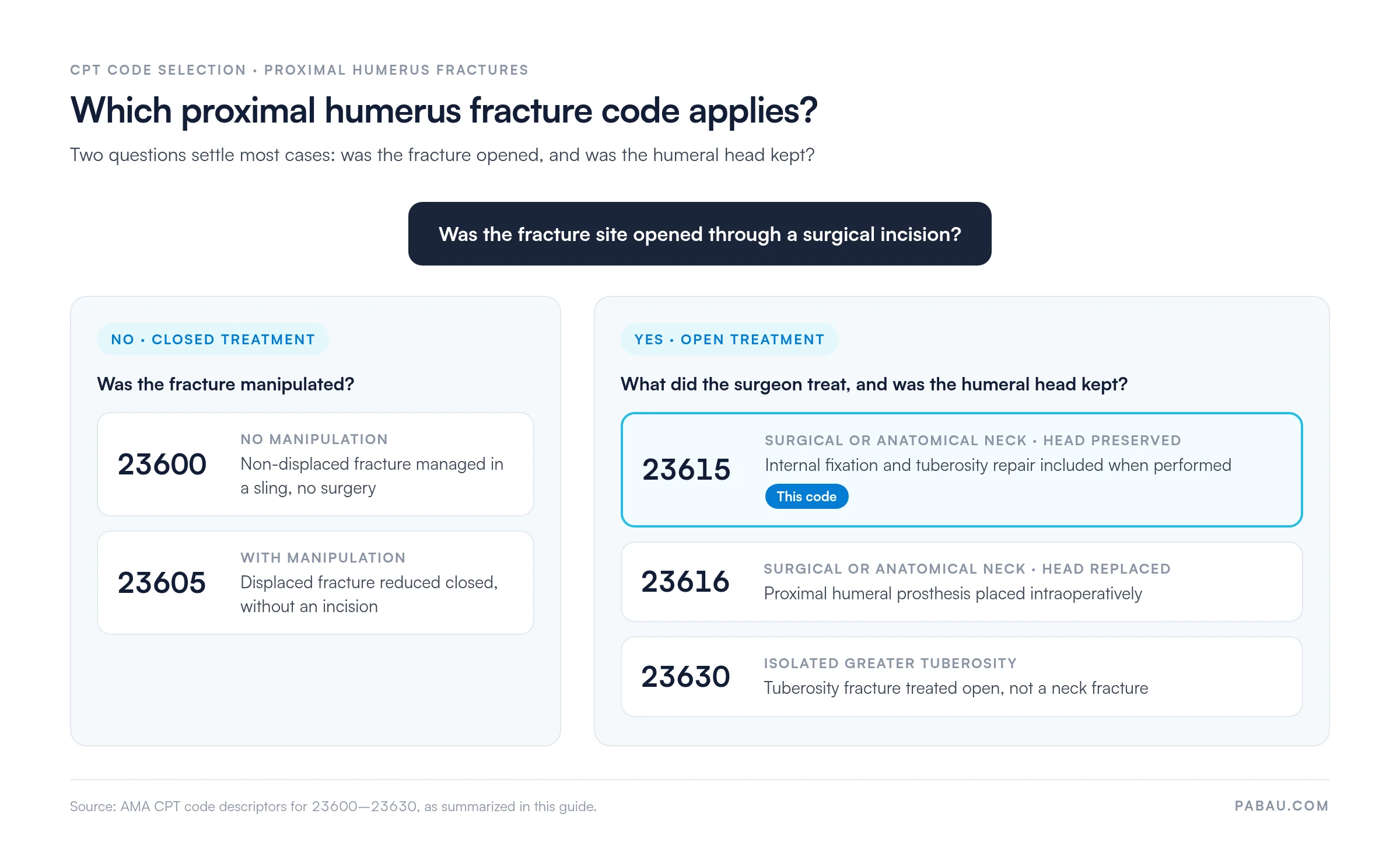
Coders working with proximal humerus fractures regularly compare CPT 23615 against adjacent codes. The table below maps the most-compared shoulder procedure codes to their distinct clinical scenarios, using the AAPC CPT code reference as a crosswalk guide. If the surgeon reduces a displaced fracture without an incision, report CPT 23605 instead.
Read as a decision, the choice comes down to two questions. Was the fracture site opened, and did the humeral head stay in place?
The anesthesia code typically crosswalked to CPT 23615 is 01630. It covers anesthesia for open or surgical arthroscopic procedures on the humeral head and neck and shoulder joint, not otherwise specified. Anesthesia is billed separately by the anesthesiologist or CRNA using time-based units and does not conflict with or duplicate the 23615 surgical claim. The surgical team and anesthesia team submit independent claims to the payer.
When auditing CPT 23615 claims, pull the operative note and check three things. First, the code reflects the intraoperative finding, not the pre-op plan. Second, internal fixation and tuberosity repair are not billed on separate lines. Third, the laterality modifier matches the documented surgical side. These three checks target the denial causes covered in this guide.
In many orthopedic practices, the billing team builds the 23615 claim after the operative note is signed and re-keys insurer details into a clearinghouse portal. A missing membership number or authorization code then surfaces only when the claim comes back.
Pabau keeps those details on the patient record, and its validated claims management checks them before the claim is sent. Validation confirms that the insurer details the payer needs, such as membership numbers and authorization codes, are in place.
The claim then goes out as a CMS-1500 through Pabau’s Claim.MD integration, which reaches thousands of US payers. Fewer claims bounce for missing insurer data, so coders can spend their review time on laterality, bundled services, and the 23615 versus 23616 decision.

Pabau runs validation checks before a claim is sent, confirming the insurer details the payer needs are in place. Claims for CPT 23615 and similar high-value surgical codes reach the payer complete.

Code 23615 from the signed operative note, never from the surgical booking. The intraoperative finding decides between 23615 and 23616, and the note has to say why.
The trade-off worth accepting is a short pre-submission review on every case. Checking laterality, bundled components, and authorization takes minutes, while an appeal on a 90-day global case can hold payment for weeks.
Book a demo to see how Pabau checks insurer and authorization details before your orthopedic claims go out.

Need to understand how clearinghouse claim submission works end to end? Medical claims clearinghouse guide explains how 837P files are validated and routed to payers before payment is issued.
Tracking underpayments on surgical codes after claims are paid? Electronic remittance advice (ERA) explained covers how to read 835 remittance files and identify systematic underpayments by CPT code.
Got a reason code back on a 23615 claim? Denial codes in medical billing maps common CARC denial reason codes to their appeal pathways.
Treating the fracture closed instead? CPT code 23605 covers closed treatment of a proximal humeral fracture with manipulation.
Is the fracture limited to the greater tuberosity? CPT code 23620 covers closed treatment of a greater humeral tuberosity fracture with manipulation.
CPT code 23615 covers open surgical treatment of a proximal humeral fracture at the surgical or anatomical neck. Internal fixation and tuberosity repair are included when performed. The code is used when the surgeon treats the fracture through an open incision rather than a closed or percutaneous approach. The humeral head is preserved rather than replaced with a prosthesis.
CPT 23615 is used when the surgeon repairs the proximal humeral fracture with or without internal fixation while preserving the humeral head. CPT 23616 is used when the surgeon replaces the humeral head with a proximal humeral prosthesis during the same procedure. The code selection is determined by the intraoperative finding, not the pre-operative plan.
CPT code 23615 has a 90-day global period. Routine post-operative visits, suture removal, cast changes, and dressing changes are bundled into the surgical payment for 90 days following the procedure. E&M visits for unrelated conditions during this window must be billed with modifier -24 to be separately reimbursed.
Yes. The AMA descriptor explicitly states that CPT 23615 includes internal fixation when performed. Billing internal fixation as a separate CPT code on the same claim date is an NCCI bundling violation and will trigger a denial. The fixation is only separately billable when performed at a distinct anatomical site in a separate procedure.
The most commonly required modifier is -LT or -RT to indicate laterality, which most payers require and will auto-reject claims without it. Modifier -22 applies when substantially increased surgical complexity is documented in the operative note. Modifier -51 is applied to secondary procedures on the same date, not to 23615 itself when it is the primary code. Modifier -62 is used when two surgeons of different specialties each perform distinct portions of the procedure.
Common ICD-10-CM codes paired with CPT 23615 come from the S42.2xx range. They include S42.211A/S42.212A (unspecified displaced fracture of surgical neck of right/left humerus, initial encounter) and S42.221A-S42.242A for 2-part, 3-part, and 4-part fracture patterns. The 7th character A (initial encounter) is required on all fracture codes at the time of surgical treatment. Laterality must match the operative documentation and the laterality modifier on the claim.



