

CCSD code G5100: Bypass of duodenum billing guide
CCSD code G5100 bills a bypass that leaves the duodenum in place CCSD code G5100...

Last Updated: Oct 16, 2026
21556 is the CPT code for excision, tumor, soft tissue of neck or anterior thorax, subfascial (e.g., intramuscular); less than 5 cm.
Coders frequently misassign this code because three decision points — anatomical site, tissue depth, and tumor size — must all align before 21556 is the right choice. Get any one wrong and you are looking at a denial, a query, or a compliance risk.
Let Pabau's smart automation suggest the right codes, reduce claim denials, and keep your practice compliant—effortlessly.
Automate repetitive tasks and focus on what matters most—your patients.
Reduce coding errors and ensure compliance with the latest regulations.
Clean claims, fewer denials, and faster reimbursements.
Powerful insights and reporting to help your practice thrive.
HIPAA compliant SOC 2 certified GDPR-compliant Trusted by 4,000+ clinics worldwide

CPT code 21556 applies to subfascial excision only, while subcutaneous lesions use 21555 (under 3 cm) or 21552 (3 cm or more).
The tumor must measure less than 5 cm, and subfascial lesions of 5 cm or more move to CPT 21554.
CPT 21557 and 21558 are radical resection codes, such as for sarcoma, not size upgrades of 21556.
Site, subfascial depth, and a size under 5 cm must all appear in the operative note to survive audit.
Pabau’s claims tools pre-fill the claim from the patient record and check required fields, such as authorization codes, before submission.
CPT code 21556 reports excision of a soft tissue tumor below the fascia of the neck or anterior thorax. The tumor must measure less than 5 cm.
The American Medical Association descriptor reads: Excision, tumor, soft tissue of neck or anterior thorax, subfascial (e.g., intramuscular); less than 5 cm. Three criteria define the code. The operative report has to show all three before you bill it.
In the CPT manual, 21556 sits in the musculoskeletal system section, under Neck (Soft Tissues) and Thorax. Its excision codes run from 21550 to 21632. Our CPT code reference lists the neighboring codes in that range.
The code carries a 90-day global surgical package. Routine follow-up visits in that window are paid as part of the procedure.
Codes 21552 to 21558 sort neck and anterior thorax tumors on two axes. The first is depth, and the second is size. Each depth tier has its own size threshold, which trips up many coders.
21555 vs. 21556: These two differ on depth and on size threshold. 21555 covers subcutaneous tumors under 3 cm, while 21556 covers subfascial tumors under 5 cm. If the note never documents subfascial dissection, a payer may reassign the claim to 21555. The surgeon’s note controls the code, not the coder’s assumption.
21556 vs. 21554: This is the size split for subfascial tumors. A lesion of exactly 5.0 cm goes to 21554. Codes 21557 and 21558 describe a different procedure, radical resection of tumors such as sarcoma.
21555 vs. 21552: Above the fascia, the threshold drops to 3 cm. A subcutaneous tumor of 3 cm or more is reported with 21552.
Take a patient with a firm mass in the right anterior neck. Ultrasound places it inside the sternocleidomastoid muscle. The surgeon incises the deep cervical fascia and removes the mass in one piece.
The operative note records a 3.8 cm tumor, margin included. Now read the grid below in two steps. Find the depth row first, then the size column.
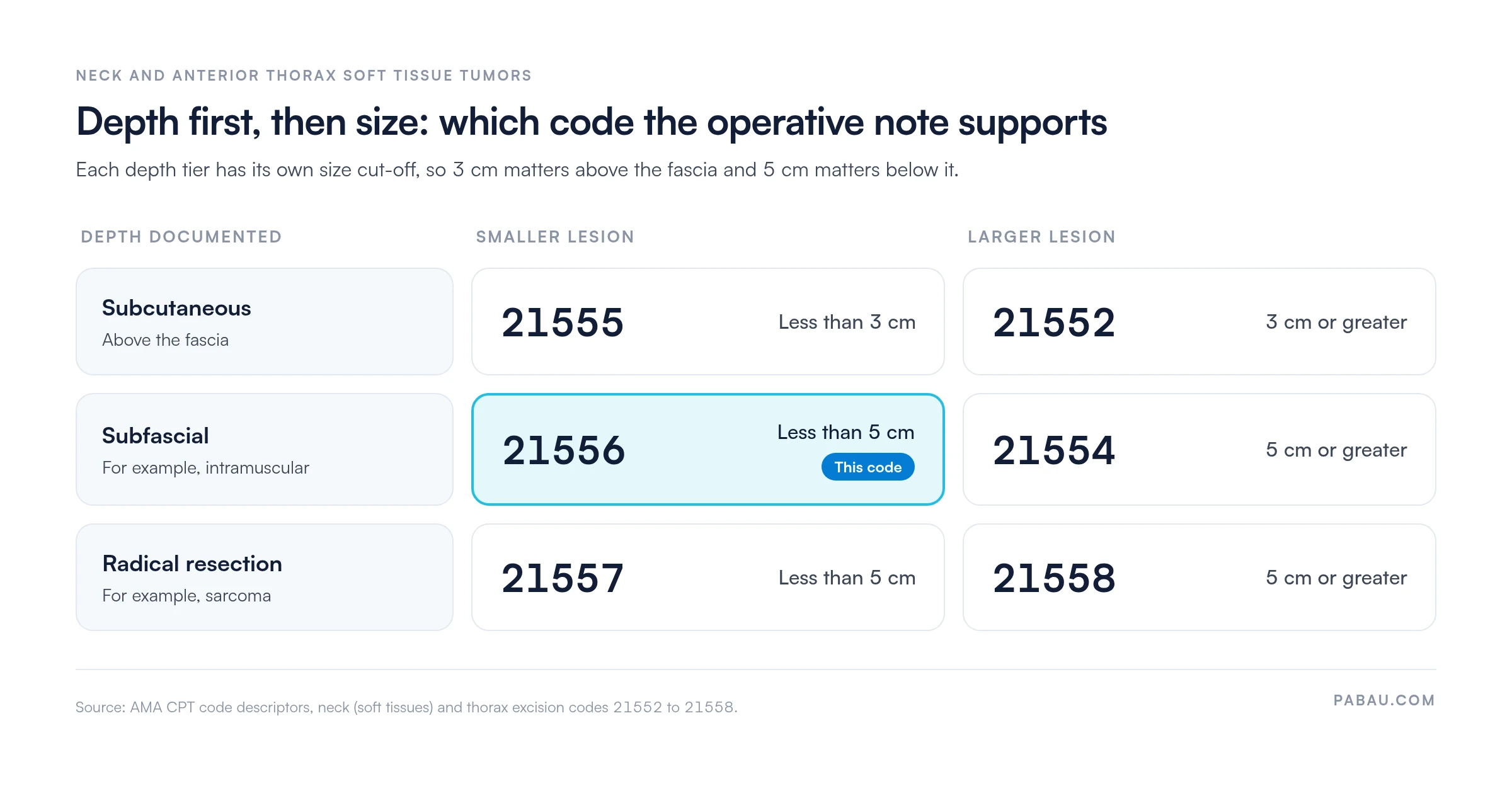
Subfascial depth and a 3.8 cm size land on 21556. If the same tumor had sat in the fat above the fascia, the 3 cm threshold would apply. That would change the code to 21552.
Now imagine the note said only “deep mass excised.” A reviewer could confirm neither the depth nor the size. That claim is likely to come back with a records request.
Subfascial excision passes through the fascial layer to reach the tumor. Payers will not infer that depth from the lesion type, so the note must state it. Each item below supports 21556 on audit.
A missing item does not guarantee a denial. Still, each omission makes a query, a records request, or a downcode on audit more likely.
Ask surgeons to add a one-line depth statement to every neck mass operative note. For example: “The tumor lay below the deep cervical fascia and was excised completely, measuring X cm with margins.” That sentence covers depth, size, and complete excision at once.
The ICD-10-CM code has to support medical necessity for the excision. It should also match the lesion type confirmed before or during surgery.
Update the diagnosis once final pathology arrives, if it differs from the working diagnosis. Billing R22.1 after pathology confirms D21.0 is incorrect and can draw a post-payment audit. For a malignant result, review the coding rules for C49.0.
Codes change each fiscal year. Check validity in the CDC/NCHS ICD-10-CM lookup tool before each code year begins.
Most 21556 claims follow the same six handoffs. Knowing them shows where errors creep in.
A problem at step 1 usually surfaces at step 5, weeks later. That delay is why documentation review belongs before submission. Our guide to clean claim requirements covers the fields payers check at that stage.
Prior authorization rules for 21556 vary by payer, plan, and state. Many commercial insurers require it for elective soft tissue excisions. Traditional Medicare does not require prior authorization for 21556.
Documentation that usually supports approval:
Submit the request with the ICD-10-CM code you plan to bill, not a vague “neck mass” description. Payers match the approval to that diagnosis. A mismatch between the authorized and billed codes is a separate denial trigger.
Medicare sets payment for 21556 through the CMS Physician Fee Schedule. The figures below come from the CMS 2026 relative value file, as listed by FastRVU. Locality adjustments then move the amount up or down.
Before quoting a patient’s cost share, look up 21556 in the CMS fee schedule tool. Select your MAC and locality, then pick the facility or non-facility rate. Rates reset each January, so check the current year before you quote.
National Correct Coding Initiative (NCCI) edits, maintained by CMS, define which services bundle into 21556. Those services cannot be billed separately on the same date without a valid modifier. The 90-day global package also limits what you can report after surgery.
Services typically bundled into 21556:
A distinct E/M service for an unrelated problem may be billable with modifier 25 on the E/M code. Modifier 59, or the more specific XE, XS, XP, or XU, applies when a bundled procedure is genuinely distinct. Check current NCCI edit pairs before adding any modifier. Our denial management guide covers how to track and appeal bundling denials.
Most 21556 denials trace back to the operative note or the paperwork around it. The table pairs each common trigger with its fix.
Work through these items before each 21556 claim goes out. One missing item rarely triggers an automatic denial. Across a caseload, though, missing items steadily raise audit risk.
Building this list into the pre-submission routine works better than reviewing it after a denial. Coding knowledge is rarely the weak point on 21556. The usual culprit is an operative note that leaves depth or size unstated.
Many surgical practices still build a 21556 claim by hand. Staff copy codes from the note into a claim form, then check payer fields from memory.
Pabau, the practice management platform we build, includes claims software for practices that pre-fills the claim from the patient record. The CPT code attached to the service lands on the charge line. ICD-10 slots draw on the patient’s recorded problem list, with CPT and ICD-10 lookup libraries for search.
Before a claim can be sent, Pabau checks that required fields are complete, such as authorization codes and membership numbers. US claims then go through Claim.MD, with eligibility checks and claim-status tracking. Fewer claims bounce back for missing fields, while the surgeon’s note still decides the code.

Pabau pre-fills claims from the patient record and checks required fields, such as authorization codes, before sending. US claims go through Claim.MD with eligibility checks and status tracking.

CPT code 21556 rewards precision in the operative note. Three words, “below the fascia,” often decide whether the claim pays as billed. The size figure decides the rest.
So start with the note, not the claim form. Agree on a standard depth-and-size sentence with your surgeons, and check it before coding. That habit protects 21556 and its five sibling codes alike.
Book a demo to see how Pabau pre-fills surgical claims and checks required fields before they reach the payer.

Need a framework for reducing claim denials practice-wide? Denial management in healthcare covers the denial categories that cost surgical practices the most and how to address each one.
Submitting claims through a clearinghouse for the first time? How a medical claims clearinghouse works explains the path from practice to payer and where claims fall off.
Want to understand the 837 file your clearinghouse sends? 837 file format guide breaks down the EDI transaction set and what each loop carries.
New to the revenue cycle? What is medical billing walks through each stage, from patient intake to payment posting.
Yes, if the lipoma sits below the fascia and measures less than 5 cm. An intramuscular lipoma meets the depth test by definition. A lipoma in the fat above the fascia uses 21555 or 21552 instead. Pair the procedure with a D17 lipoma code that matches the documented site.
CPT uses the tumor’s greatest diameter plus the narrowest margin needed to remove it. The surgeon should record that figure in the operative note. Specimens often shrink in formalin, so the pathology size can read smaller.
Usually not. Cysts and other lesions of skin origin use the benign lesion excision codes, 11420 to 11426 for the neck. Code 21556 is for soft tissue tumors that sit below the fascia.
Simple and intermediate closure are included in 21556. Complex repair can be reported separately when the operative note documents it. Check the NCCI edit pair before you submit.
Report 21556 once for each separate tumor that meets the criteria. Add modifier 59 or XS to the second line to show a separate site. Document each tumor’s location, depth, and size on its own.



