



HCPCS code E0198: Water pressure pad billing guide
HCPCS code E0198 is a water pad for a standard mattress HCPCS code E0198 is the ...

Last Updated: Oct 13, 2026
CPT code 21555 covers excision of a soft tissue tumor from the neck or anterior thorax, subcutaneous layer, under 3 cm. Two variables separate it from the five codes around it: the tumor’s greatest dimension, and whether it sat above or below the deep fascia.
Both live in the operative note, so a line reading “mass excised from neck” cannot carry the claim, whatever the pathology report says later. The rest of this page works through code selection, modifiers, 2026 Medicare rates, diagnosis pairings, and the closure rules that catch people out.

CPT code 21555 covers subcutaneous soft tissue tumor excision in the neck or anterior thorax for lesions under 3 cm.
Two variables pick the code: the tumor’s greatest dimension, and whether it sat above or below the deep fascia.
Simple and intermediate closure is bundled into the 90-day global package, so only complex repair is ever separately reportable.
CPT 13132 covers complex repair of the neck at 2.6 cm to 7.5 cm. It is not a trunk code, so the anterior chest takes the 13100 series.
Pair 21555 with a billable diagnosis: D48.19 rather than the D48.1 header, and D17.0 rather than D21.0 for a lipoma.
CPT code 21555 reports removal of a soft tissue tumor from the neck or anterior thorax. The tumor has to sit in the subcutaneous layer and measure less than 3 cm.
The American Medical Association (AMA) publishes it under Excision Procedures on the Neck or Thorax, in the Musculoskeletal System chapter.
“Subcutaneous” is doing the heavy lifting in that descriptor. It places the tumor above the fascial plane, in the layer between skin and deep muscle fascia. A tumor that dips below that boundary, or sits inside the muscle, belongs to a different code in the same family.
Small subcutaneous masses are the common case on a neck, so 21555 comes up more often than its siblings. The rest only apply once the note pushes past a threshold.
The neck and anterior thorax excision family runs to six codes, and the pathology finding does not choose between them. Depth and size do. The grid below maps every combination, and the thresholds are not the same in each row.
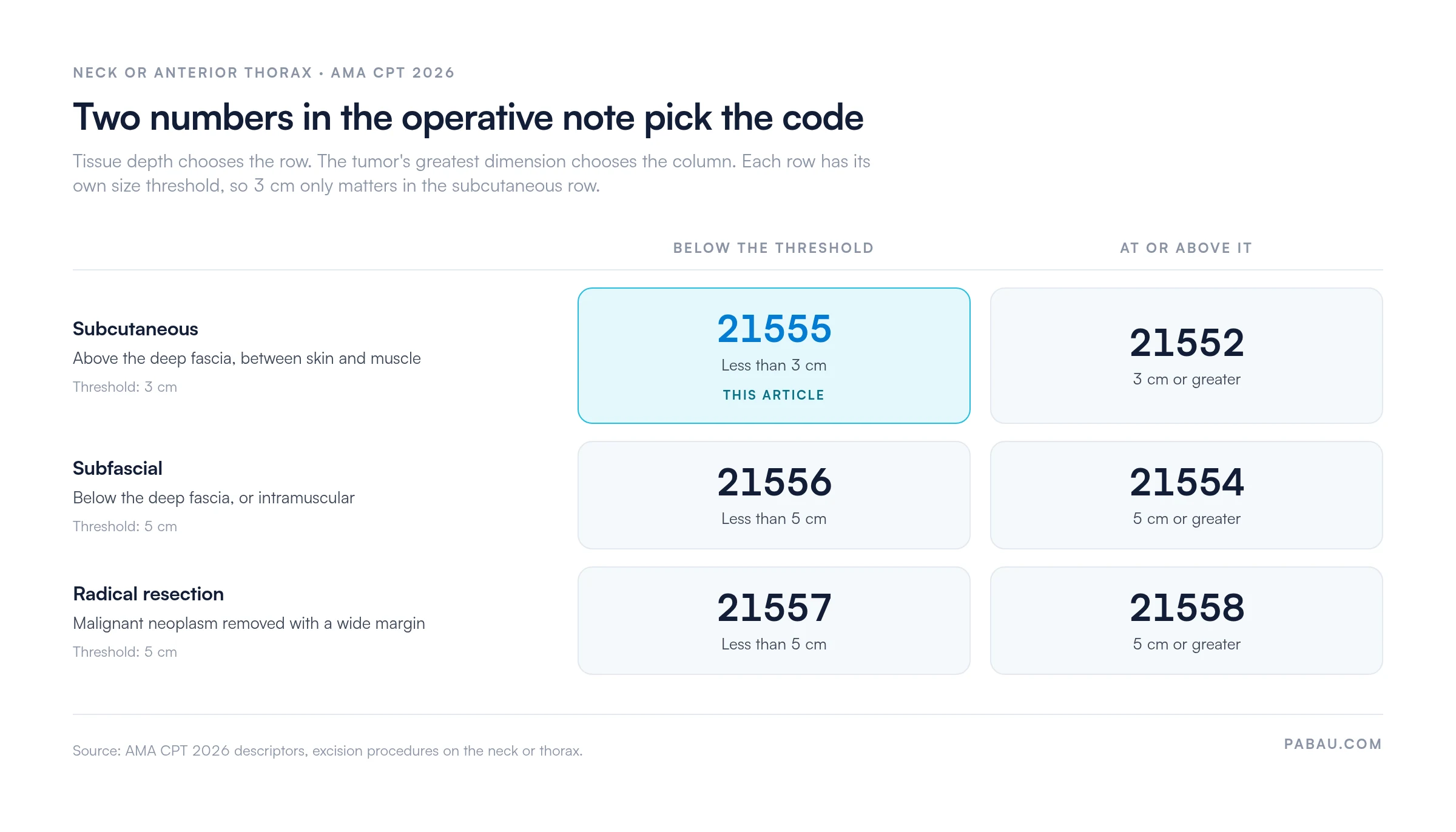
Measuring the tumor. Size means the greatest dimension of the tumor itself, taken from the operative note or the pathology report. It is not the length of the skin incision, and it is not the specimen with its margin attached.
Confirming the depth. The operative note has to say whether the tumor was above or below the deep fascia. “Subcutaneous” on its own is acceptable. “Above the fascial plane” is better, because it leaves an auditor no room to argue. Payers read the surgeon’s intraoperative finding, not the preoperative imaging estimate.
Six modifiers come up regularly on this code. Which of them a payer accepts varies, so confirm the policy before the claim goes out rather than after it bounces.
Check the current NCCI edits before you use -59 or -XS to break a bundling pair. CMS revises these edits quarterly, so a combination that paid cleanly last year can trip an audit flag under the current logic.
Medicare pays roughly $462 in a non-facility setting and roughly $298 in a facility setting for 21555 in 2026. Those figures come from the Medicare Physician Fee Schedule (MPFS), built from a work RVU of 3.86 and a conversion factor of $33.4009. Your locality will land above or below the national number.
Both figures are national averages. Actual payment moves with the Geographic Practice Cost Index (GPCI) for your locality. Run the code through the CMS Physician Fee Schedule lookup tool before you quote a number to anyone. Commercial contracts are negotiated separately and usually sit above the Medicare allowable.
One habit worth building: read the remittance against the fee schedule every time. A short payment on a 90-day global code is easy to miss. Leave the adjustment unworked and it becomes a write-off once the appeal window closes.
Documentation separates a paid 21555 claim from a denied one more often than any coding decision does. The note and its supporting records have to carry all three selection variables: site, depth, and size.
Here is what a defensible record contains.
If your intake or charge-capture template lets a coder save without a size and a depth, fix the template. Making both fields mandatory at the point of capture costs less than reworking the claim three weeks later.
The diagnosis has to support medical necessity for the excision, and it has to be a billable code rather than a category header.
Check an unfamiliar code against the FY2026 tabular list on the CMS ICD-10 codes page. Our ICD-10-CM code library keeps the common pairings in one place.
Two traps hide in that table. The first is D48.1, a category header that no payer will accept on a claim line, which is why D48.19 is the code you want. The second catches more people: D21.0 carries an Excludes1 note for lipomatous neoplasms.
A lipoma is the single most common mass taken off a neck, and it belongs to D17.0, never D21.0. Use the trunk equivalent, D17.1, when the lesion is on the anterior chest, and C49.3 when a thoracic sarcoma is confirmed.
Code to the highest specificity you can support on the day you bill. Where histology is still pending, R22.1 is a legitimate placeholder, though holding the claim until the report lands usually costs less than correcting it afterwards.
Yes, but only in narrow circumstances. Simple and intermediate closure is already inside the global surgical package for 21555, so neither is separately billable. Only complex repair sits outside the package, and even then the anatomy has to match.
CPT 13132 is complex repair of the forehead, cheeks, chin, mouth, neck, axillae, genitalia, hands or feet, measuring 2.6 cm to 7.5 cm.
Two points follow from that descriptor. It is a neck code, not a trunk code, so a complex repair on the anterior chest wall reports under the 13100 series instead. And 1.1 cm to 2.5 cm belongs to 13131, not 13132.
When 13132 is the right code, three conditions still have to hold together.
Improper unbundling is the risk worth naming. A practice that appends a complex closure code to most of its excisions builds a claim pattern, and CMS and commercial payers both review patterns.
Document each instance on its own merits, and confirm the current edits on the CMS National Correct Coding Initiative page before you submit.
Before you bill a repair code with any excision, look up the Column 1 and Column 2 pair in the current NCCI Policy Manual. CMS publishes updates quarterly. What was separately payable in Q1 can be bundled by Q3 of the same year.
Errors on this code repeat themselves. These six account for most of the rework in neck and anterior thorax excision billing.
A denied 21555 is usually preventable at the desk, before the file leaves your office. Run these five in order and the claim usually clears first time.
Those five checks are really one habit: verify the claim carries what the payer will ask for. That is the difference between a clean claim and a file your team touches three times.
In most surgical practices the operative note lives in one system and the charge sits in another. The denial then arrives days later, by post or portal. Someone re-reads the note to find a size that should have been captured at the point of charge. Every pass through that loop eats the margin on a 21555.
Practice management software like Pabau keeps the note, the charge and the claim in one record. Our claims management software sends CMS-1500 and 837P claims through Claim.MD, which reaches thousands of US payers.
Real-time eligibility comes back for around 400 of them. Remittance arrives as an 835 with CARC denial reason codes attached, so your biller opens a stopped claim and sees why.
The practical result is fewer rounds of correction on surgical codes. Coders read the note and the claim side by side. Denials surface with a reason rather than a status, so nobody reconstructs a three-week-old excision from memory.
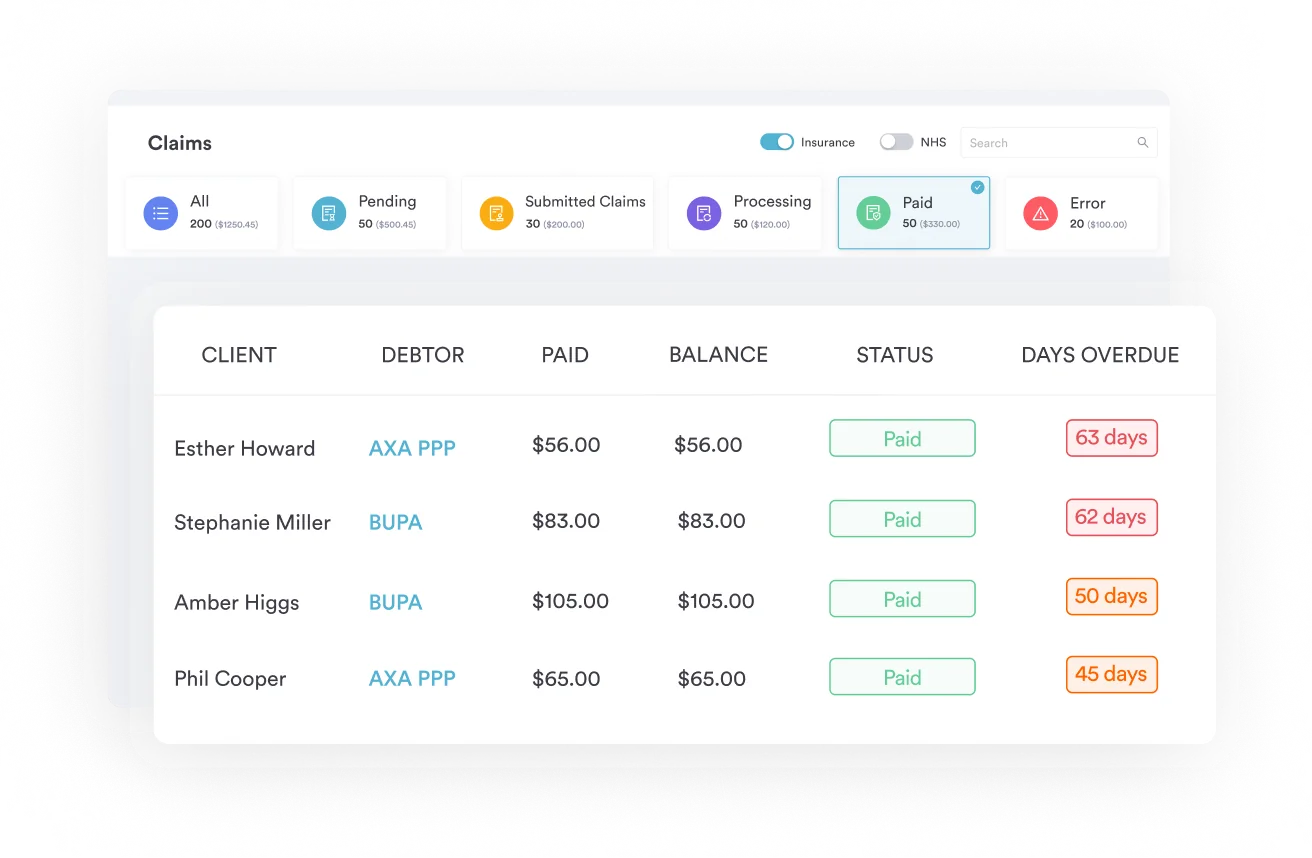

Pabau connects scheduling, operative notes and claims in one record. Submit CPT 21555 through Claim.MD, see denial reasons the moment they arrive, and keep size and depth on the charge where your coders need them.

CPT code 21555 rewards a precise operative note and punishes a vague one. Two measurements decide it, and the surgeon writes both in the minutes after the excision. No amount of billing skill can supply them afterwards.
So the fix sits upstream of the billing desk. Rework the operative note template, make size and depth mandatory at charge capture, and keep D17.0 in front of whoever codes lipomas. Do that and this code stops generating rework. Leave it alone and you will keep paying for the same claim twice.
If your practice bills soft tissue excisions regularly, book a demo. You will see the note, the charge and the claim status on one screen.

Want the denial reason decoded before you appeal? Common denial codes in medical billing explains the CARC and RARC codes that come back on an 835 remittance.
Building a surgical charge slip that captures size and depth? What a superbill needs to include covers the fields that have to be mandatory rather than optional.
Checking a payment against the fee schedule? How electronic remittance advice works shows how to read an 835 and catch short payments before they age out.
Preparing for a payer audit on surgical codes? Billing compliance requirements for medical practices sets out the documentation standards and policy review cadence to keep.
Yes. Each tumor excised through its own incision is reported separately, with its own documented size and depth. Append -59 or -XS to the additional line where an NCCI edit applies.
It does, when the lipoma is subcutaneous and under 3 cm. Pair it with D17.0, not D21.0. D21.0 carries an Excludes1 note for lipomatous neoplasms, so the two never appear together.
Routine follow-up visits, wound checks and suture removal related to the excision. Care for an unrelated problem in those 90 days is still billable, reported with modifier -24 on the office visit.
Medicare does not require prior authorization for 21555. Commercial plans vary, and several ask for it when the record suggests the mass is asymptomatic. Check the policy before the date of service.
The procedure code usually stands, since 21555 describes the excision performed. Submit a corrected claim carrying the confirmed diagnosis rather than leaving a benign code on the record for an auditor to find.



