CPT code 93503: Swan-Ganz catheter billing and modifiers
CPT code 93503: Official descriptor and procedure overview In the AMA CPT code s...

Last Updated: Oct 23, 2026
20220 is the CPT code for biopsy, bone, trocar, or needle; superficial (e.g., ilium, sternum, spinous process, ribs).
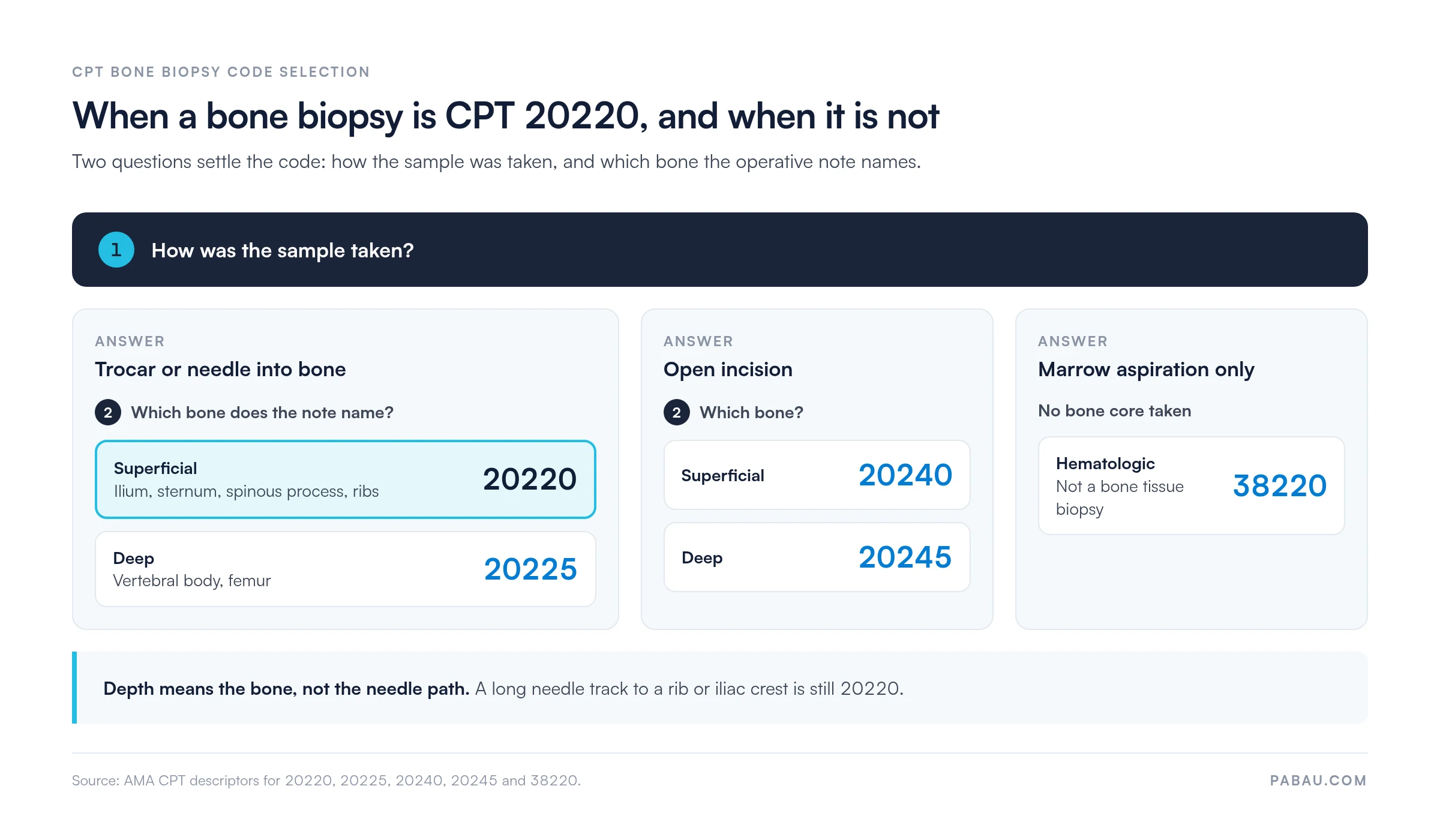
20220 applies to superficial bone sites; deeper sites such as the vertebral body or femur use 20225. Open bone biopsy and bone marrow aspiration alone are reported with other codes.
Let Pabau's smart automation suggest the right codes, reduce claim denials, and keep your practice compliant—effortlessly.
Automate repetitive tasks and focus on what matters most—your patients.
Reduce coding errors and ensure compliance with the latest regulations.
Clean claims, fewer denials, and faster reimbursements.
Powerful insights and reporting to help your practice thrive.
HIPAA compliant SOC 2 certified GDPR-compliant Trusted by 4,000+ clinics worldwide

CPT code 20220 covers a trocar or needle biopsy of superficial bone, such as the ilium, sternum, spinous process or ribs. Open biopsy and marrow aspiration alone use other codes.
Anatomical depth decides the code: superficial sites use 20220, while deep sites such as the vertebral body or femur use CPT 20225.
Imaging guidance (77002, 77012, 76942) may be separately reportable with CPT code 20220. It needs its own documentation, and a modifier only where the current NCCI edit allows one.
For CY2026, 20220 carries 6.68 non-facility RVUs, about $223 nationally at the non-QP conversion factor, and a 000-day global period.
Pabau, the practice management platform we build, pulls existing record data into a pre-filled claim and submits and tracks it through Claim.MD.
CPT code 20220 is defined by the American Medical Association as: Biopsy, bone, trocar, or needle; superficial (e.g., ilium, sternum, spinous process, ribs). The code sits in the Musculoskeletal System section of CPT, in the Excision range of the General subsection (20150-20251).
Three elements decide whether 20220 applies to a visit:
The examples in the descriptor are only a guide, not a full list. So, for a site the descriptor does not name, the operative note must name the bone and the approach. That way, a reviewer can check the depth call.
CPT 20220 captures one specific mix of technique and target. Therefore, knowing what falls outside the code helps you avoid under- and over-coding.
The distinction between 20220 and 20225 is anatomical depth confirmed in the operative report. A coder cannot make this call from the procedure name alone. Instead, the operative note must record the site reached and the approach used.
The upcoding risk to flag in audits: a note describing “deep needle insertion” at a rib or iliac crest does not make 20225 correct. In fact, “deep” in everyday surgical talk often means the needle passed through soft tissue to reach bone. It does not mean the bone itself is deep. Thus, the bone location sets the depth, not how far the needle traveled. The diagram below maps each technique and site to its code.
A complete operative note for CPT code 20220 must show medical need and confirm the elements that support the code. For this reason, payers check these elements on pre-payment review and on post-payment audits. Pabau’s claims management software pulls existing record data into a pre-filled claim and submits and tracks it through Claim.MD. Even so, the note itself still has to carry the elements below.
To send a clean claim for 20220, the operative note must include all of the following:
CPT code 20220 accepts several standard surgical modifiers. However, choosing the wrong modifier, or leaving off a required one, is a top denial trigger.
Bone biopsies are often done under imaging guidance to confirm needle placement. For example, CT guidance for needle placement is reported with 77012. These guidance codes may be billed on their own with CPT code 20220. However, NCCI bundling edits and note requirements decide when that billing is valid.
Key rule for imaging guidance billing: you cannot report the guidance code when the procedure descriptor already includes imaging guidance. CPT 20220’s descriptor does not include guidance, so you may bill it separately when the note supports it. Still, add modifier 59 (or an X{EPSU} modifier) only if the current NCCI edit for the pair has a modifier indicator of 1. In addition, the note must support a distinct service. Check the current AAPC code reference and NCCI edit table before billing.
Before appending modifier 59 or an X{EPSU} modifier to a guidance code, check the current NCCI edit for the 20220 pair. A modifier indicator of 1 allows a modifier when documentation supports a distinct service, and 0 never does. CMS updates the NCCI edit files quarterly, so check the file in force on the date of service.
The diagnosis code paired with CPT code 20220 must match the recorded reason for the biopsy, not the suspected finding. For orthopedic and sports medicine practices, the most common ICD-10-CM pairings fall into three groups: suspected malignancy, infection workup, and metabolic bone disease evaluation.
These pairings are examples of common cases, not a strict list. Rather, the ICD-10-CM code must match the reason for the biopsy recorded at the visit, using the most specific code available. For suspected osteomyelitis, M86.9 fits only when the note documents no type or site.
Medicare pays CPT code 20220 at different rates depending on where the procedure takes place. The CMS Physician Fee Schedule lookup tool is the best source for local rates. The national figures below come from the CMS CY2026 RVU file. As a result, your MAC locality rate will differ.
The non-QP amounts use the $33.4009 conversion factor, and qualifying APM participants are paid at $33.5675. Both are national amounts before Geographic Practice Cost Index (GPCI) adjustment. GPCIs then adjust the rate by MAC locality. For instance, a practice in Manhattan is paid a different amount than one in rural Montana for the same 20220 claim.
Medicare fee-for-service does not always require prior authorization for CPT code 20220. However, many Medicare Advantage plans and commercial payers do. Rules vary by plan, contract, and state, so check with each payer before scheduling.
CPT code 20220 claims deny for a familiar set of reasons. Fortunately, each one maps to a fix you can build into your pre-submission workflow.
A medical claims clearinghouse with real-time claim scrubbing catches many of these issues before they reach the payer. As a result, it cuts avoidable denials on musculoskeletal procedure codes.
CPT code 20220 carries a 000-day global period in the CY2026 Medicare Physician Fee Schedule, the same as 20225. Confirm it in the CMS MPFS file each year, since CMS can change global assignments.
With a 000 global, the main risk sits on the biopsy date itself. Specifically, an E/M billed that day needs modifier 25 and a note showing separate work. Good medical billing workflows flag same-day E/M visits for modifier review before claim submission rather than after a denial.
A bone biopsy claim often stalls between the signed procedure note and the claim form. Staff rekey the CPT code, the ICD-10 pairing and the patient details. Each rekey, in turn, is a chance for error.
Pabau pulls existing record data into a pre-filled claim and submits and tracks it through Claim.MD, our US clearinghouse partner. Your coder still checks the depth code, modifiers and place of service against the operative note. Then the claim goes out without retyping.
As a result, you get fewer typing errors and a visible status on every 20220 claim once it leaves the practice.

Pabau pulls existing record data into a pre-filled claim and submits and tracks it through Claim.MD. See how orthopedic and musculoskeletal practices bill CPT 20220 in Pabau.

CPT code 20220 is a straightforward percutaneous bone biopsy code. Its most common billing problems stem from one failure: operative notes that do not clearly show anatomical depth. Fortunately, a structured pre-submission review can prevent many depth-related 20220 denials. To start, make the bone site, the approach and any saved guidance images required fields in the procedure note. Then the choice between 20220 and 20225 becomes a quick check.
Pabau pulls existing record data into a pre-filled claim and submits and tracks it through Claim.MD, so a complete note becomes a claim without rekeying. That said, your coder still owns the final code check. Book a demo to see how orthopedic and musculoskeletal practices bill CPT code 20220 in Pabau.

Need to understand how clearinghouse scrubbing works before claims reach Medicare? Pabau’s Claim.MD clearinghouse guide explains real-time eligibility, 837P submission, and ERA processing for musculoskeletal procedures.
Want a framework for managing denials when CPT 20220 claims are rejected? Electronic remittance advice and ERA processing covers how to read 835 remittance files and use CARC denial reason codes to appeal rejected bone biopsy claims.
Looking to verify insurance coverage before scheduling a bone biopsy? Insurance eligibility verification outlines how real-time eligibility checks reduce same-day denial rates for procedural codes including 20220.
CPT code 20220 covers a trocar or needle bone biopsy at a superficial site, such as the ilium, sternum, spinous process, or ribs. It does not cover open bone biopsy, marrow aspiration alone, or biopsies at deep sites such as the vertebral body or femur.
CPT 20220 applies to percutaneous bone biopsy at superficial sites. CPT 20225 applies to the same technique at deep sites such as the vertebral body or femur. The distinction is the anatomical location of the target bone, confirmed in the operative report, not the depth of needle insertion through soft tissue.
Accepted modifiers include LT/RT for laterality and 52 for reduced services. Modifier 59 (or an X{EPSU} modifier) applies to a guidance code only if the current NCCI edit for the pair allows it. Medicare’s bilateral indicator for 20220 is 0, so a bilateral biopsy gets no 150% adjustment. Modifier 51 rules vary by payer.
The top denial triggers are a 20225 claim for a superficial site, a missing operative report, and a missing MA or commercial prior authorization. Others are a same-day E/M without modifier 25, an incorrect place-of-service code, and a guidance code billed against an NCCI edit that bundles the pair.
CPT 20220 carries a 000-day global period in the CY2026 CMS MPFS file, so confirm it there each year. The global covers the procedure day only. A significant, separately identifiable E/M on the same day needs modifier 25.