CPT code 92521: Speech fluency evaluation billing guide
CPT code 92521: Definition and clinical scope CPT code 92521 is defined by the A...

Last Updated: Oct 5, 2026
HCPCS code S0310 is the Level II code for hospitalist services (list separately in addition to code for appropriate evaluation and management service). It's an add-on, so it sits on the same claim as the hospital E/M visit it supplements, usually 99221 to 99223 or 99231 to 99233.
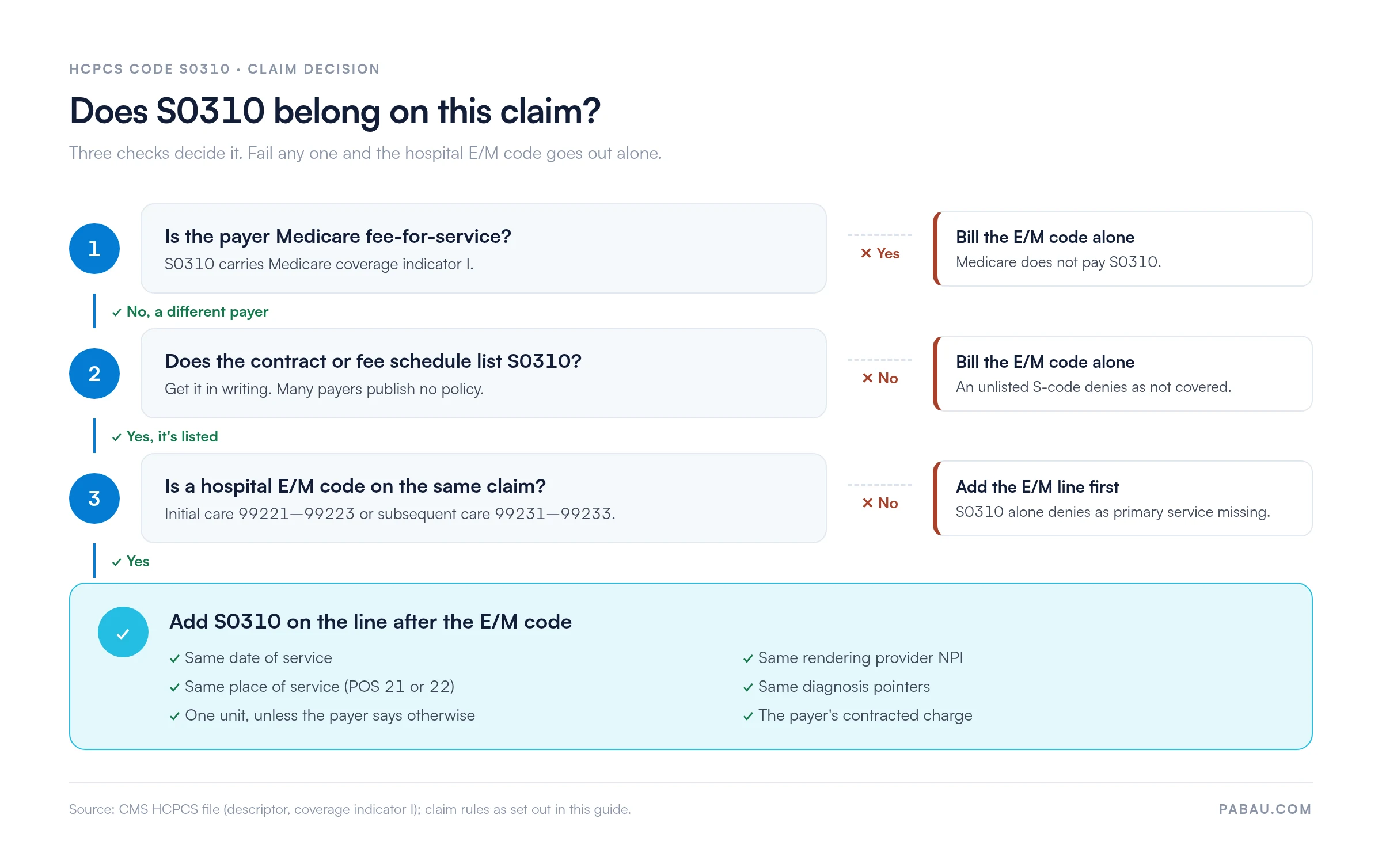
The first thing to check is the payer. Medicare doesn't pay S0310, and each payer that accepts it sets its own policy and rate. Sent to the wrong payer, the line denies and costs staff time to clear. The sections below cover the payer check, the claim setup and the denials to plan for.
Let Pabau's smart automation suggest the right codes, reduce claim denials, and keep your practice compliant—effortlessly.
Automate repetitive tasks and focus on what matters most—your patients.
Reduce coding errors and ensure compliance with the latest regulations.
Clean claims, fewer denials, and faster reimbursements.
Powerful insights and reporting to help your practice thrive.
HIPAA compliant SOC 2 certified GDPR-compliant Trusted by 4,000+ clinics worldwide

HCPCS code S0310 is a hospitalist services add-on, reported on the same claim as the hospital evaluation and management (E/M) visit it supplements.
It never stands alone. Pair it with an inpatient or observation E/M code such as 99221 to 99223 or 99231 to 99233.
Medicare does not pay S0310 (coverage indicator I), and there is no national fee schedule, so each accepting payer sets its own policy and rate.
The diagnosis on the S0310 line follows the primary E/M service, so point it to the same ICD-10-CM codes that support the visit.
Confirm in writing that the payer recognizes S0310 before you add it, because many payers publish no policy for it.
HCPCS code S0310 is a Level II temporary national code for hospitalist services. It is listed separately in addition to the hospital evaluation and management (E/M) code for the same visit. It is an add-on, so it adds a payer-specific hospitalist charge to an E/M service and never describes a visit by itself.
S-codes are created for private payers and are not payable by Medicare. They are published by the Centers for Medicare & Medicaid Services (CMS) as part of the national HCPCS file. S0310 sits in the S0199-S0400 range of HCPCS Level II codes for miscellaneous provider services. The table below covers what a coder checks before adding it to a claim.
The official long descriptor for S0310 reads: “Hospitalist services (list separately in addition to code for appropriate evaluation and management service).” The parenthetical is the coding instruction. S0310 sits on its own claim line, and the E/M code for the encounter sits on the line beside it.
A hospitalist is a physician or advanced practice provider whose practice centers on patients admitted to the hospital. The E/M code carries the clinical work of the visit. S0310 signals to a payer that the visit was furnished by a hospitalist, where that payer’s contract recognizes the role.
Check the descriptor in the AAPC HCPCS code listing for S0310 or the current CMS HCPCS file before you build a fee schedule around it. Some payers add their own notes on frequency or eligible provider types.
Only payers that have chosen to recognize S0310 accept it, and Medicare is not one of them. S-codes originate with private payers. A national panel led by the Blue Cross Blue Shield Association requests them, and each payer decides whether to adopt a given S-code.
Coder discussion on AAPC reports that acceptance is limited, so do not assume a payer pays S0310 because it pays other S-codes. Ask the payer’s provider relations team whether the code is on your contract, and keep that answer on file.
S0310 is reported on the professional claim for the hospitalist visit, directly after the E/M line it depends on. Hospitalist groups that bill their own professional services use the CMS-1500 or its electronic 837P equivalent. Three checks decide whether the line belongs on the claim at all, as the flow below shows.
No modifier is specific to S0310. Modifiers on the E/M line follow the normal E/M rules for that payer. Add one to the S0310 line only where the payer’s policy asks for it.
Here’s how one short stay plays out on the claims. A hospitalist admits a patient on Monday and sees them again on Tuesday. The patient’s commercial plan lists S0310 in its fee schedule.
Now change one detail. Tuesday’s S0310 line was keyed under a different rendering NPI from the E/M line. The payer pays the visit and denies the add-on as a line mismatch. A corrected claim with matching NPIs clears it.
Once the claim lines are set, the note has to back them up. The documentation that supports S0310 is the hospitalist’s note for the E/M visit. Good medical billing compliance means each S0310 line can be traced to a signed note for the same patient, date and provider.
S0310 has no diagnosis list of its own. It takes the ICD-10-CM codes that support the primary E/M service, because the add-on only describes who furnished that visit.
Sequence the condition that drove the admission or the day’s visit first, then any conditions that changed the work of the encounter. Point both claim lines to those codes. A diagnosis pointer missing from the S0310 line is a common reason for the add-on to reject while the E/M line pays.
S0310 sits beside other S-code add-ons and the CPT hospital care codes it supplements. Choosing the wrong neighbor, or billing S0310 without a primary code, leads to a denial on that line.
The CPT codes carry the visit, and Medicare and most other payers pay them. The first day of a stay bills on a code such as 99221, and later days on a code such as 99231. S0310 adds nothing to a claim for a payer that does not list it.
With the code and its neighbors sorted, the next question is what S0310 pays. There is no national CMS fee schedule amount for it. The basics of medical billing explain why: Medicare does not cover S-codes, so no relative value units are published for them. Every payer that accepts S0310 sets its own rate.
Track the S0310 allowed amount separately for each payer. A drop on one payer’s remittance is easier to catch when the add-on is reported apart from the E/M line.
A quick check before the claim goes out catches the causes behind the denials in the next section. Work down the list for every claim that carries S0310.
Most S0310 denials come from payer acceptance or from a mismatch with the primary E/M line. Denial management starts with sorting each rejection into one of the causes below.
Independent hospitalist groups often bill their professional claims outside the hospital’s own system. That usually means rekeying each visit, checking payer lists by hand and chasing add-on lines that reject without the E/M code beside them.
Pabau, the practice management and billing platform we build, keeps that work in one place. Its claims software for hospitalists pre-fills the CMS-1500 from the patient record and includes searchable CPT, HCPCS and ICD-10-CM code libraries. It also blocks the send until required claim fields are complete.
For US payers, claims go out through Claim.MD with eligibility checks, claim status tracking and ERA posting. Your team can see which payers paid S0310 and at what rate, and which lines need a corrected claim.

Pabau pre-fills each professional claim from the visit record and checks required fields before you send it. Built-in HCPCS, CPT and ICD-10-CM lookups keep codes like S0310 a search away.

S0310 earns money only where a payer has agreed to pay it, so the contract decides whether the code belongs on a claim. Settle that once per payer and record the answer, and the add-on stops generating denials that cost more to work than they return.
Where a payer does accept it, treat S0310 as a copy of the E/M line’s date, provider and diagnoses. Where it does not, leave it off and bill the hospital care code alone. Book a demo to see how Pabau keeps hospitalist claims complete and tracks every add-on line through to payment.

Coding the first day of a hospital stay? CPT code 99221 explains the initial hospital inpatient and observation care levels that S0310 is added to.
Billing follow-up visits during the stay? CPT code 99231 covers subsequent hospital care and how its levels are chosen.
Want fewer add-on lines left unpaid? What is revenue cycle management walks through the process from eligibility to payment posting.
Indicator I means the code is not payable by Medicare. CMS publishes it in the national HCPCS file, so original Medicare claims carry the hospital E/M code without S0310. Other payers follow their own contracts, not the indicator.
Only where the payer’s policy allows it. Hospitalist teams often include advanced practice providers, but each payer decides which provider types qualify for the add-on. Check the policy before you bill S0310 under an NP’s or PA’s NPI.
It depends on the plan. Original Medicare never pays S0310, but each Medicare Advantage plan keeps its own code list and contract terms. Ask the plan directly and file its written answer with your payer records.
Only if the payer confirms it. The descriptor says ‘appropriate evaluation and management service’ without naming codes, so the payer defines which ones qualify. Get that in writing before pairing S0310 with discharge codes 99238 and 99239 or critical care codes.
Usually not. Report one unit per qualifying E/M service unless the payer’s policy states a different limit. Some payers cap the add-on per day or per stay, and extra units deny as a frequency limit.