



CCSD code G5100: Bypass of duodenum billing guide
CCSD code G5100 bills a bypass that leaves the duodenum in place CCSD code G5100...

Last Updated: Oct 16, 2026

CPT Code 19318 describes reduction mammaplasty, the surgical removal of excess breast tissue, fat, and skin.
Medicare pays 19318 differently by setting, with non-facility rates above facility rates. Verify your locality on the current CMS Physician Fee Schedule.
Coverage needs documented functional symptoms, a tissue weight that meets the payer’s threshold, and a failed trial of conservative treatment.
File N62 as the primary diagnosis where function is impaired. Z41.1 signals cosmetic intent and will not support approval.
Practice management software like Pabau tracks prior authorization, stores operative documentation, and submits 19318 claims from one billing workflow.
CPT Code 19318 is the billing code for reduction mammaplasty, the surgical removal of excess breast tissue, fat, and skin. It is a unilateral code, so a bilateral reduction performed in one session carries modifier 50.
Most commercial payers and state Medicaid programs treat the procedure as cosmetic until the record proves functional impairment. That one rule shapes the diagnosis code you file and the measurements the operative note has to carry. It also shapes the authorization you secure before the patient reaches the OR.
CPT Code 19318 describes reduction mammaplasty. The procedure reduces the size and weight of the breasts by removing excess glandular tissue, fat, and skin. According to the American Medical Association (AMA), which maintains the CPT code set, the official descriptor is: Reduction mammaplasty.
The code sits within the Repair and/or Reconstruction of Breast subsection of the Integumentary System chapter (codes 19316-19396). It is a unilateral code by convention. Each breast reduced in a separate operative session takes its own line item, while a same-session bilateral reduction takes modifier 50.
Clinically, the procedure removes a wedge or pattern of tissue from each breast, repositions the nipple-areolar complex, and reshapes the remaining tissue. The amount removed is a billing variable as much as a clinical one. Payers who apply the Schnur sliding scale use body surface area to set the minimum tissue weight that qualifies as medically necessary. That figure must appear in the operative note.
Medicare reimbursement for 19318 is calculated from the Medicare Physician Fee Schedule (MPFS), which the Centers for Medicare and Medicaid Services (CMS) updates annually. The non-facility rate applies to an office-based operating room, the facility rate to a hospital or ambulatory surgery center. The non-facility rate is higher because it includes a practice expense component that is otherwise paid to the facility.
Geographic Practice Cost Index (GPCI) adjustments mean that the same code pays materially different amounts in San Francisco versus rural Mississippi. Always verify your locality-specific rate using the CMS MPFS lookup tool before you quote a figure to a patient or a referring practice.
Commercial payers typically reimburse at a multiple of the Medicare rate. Reported ranges run from 110% to 180% of MPFS, depending on the contract and the geographic market. The table below shows representative benchmarks. Verify the current numbers against your own payer contracts, since a national average will not match a negotiated rate.
Submitting 19318 electronically through a clearinghouse speeds up remittance and surfaces eligibility problems before the day of surgery. Both matter on a procedure that is usually booked weeks ahead of the operative date.
Modifier selection for CPT Code 19318 directly affects claim adjudication. Using the wrong modifier, or omitting one where required, is one of the leading causes of 19318 payment delays. Verify all modifier combinations against current National Correct Coding Initiative (NCCI) edits before submission.
Bilateral billing tip: Some payers prefer modifier 50 on a single line at 1 unit; others require two separate lines with LT and RT modifiers. Check each payer’s modifier policy before claim submission to avoid automatic downcoding.
The documentation burden sits with the operating surgeon, and thin clinical notes are the biggest reason 19318 claims reach the denial stage. Payers are not asking the surgeon to justify the operation. They are asking the record to show the functional impairment that made it necessary.
N62 records hypertrophy of breast and supports medical necessity. Z41.1 records an encounter for cosmetic surgery and does not. Filing Z41.1 where the record supports a functional diagnosis costs the practice the claim, and doing it systematically raises compliance concerns.
The table below pairs each element the record has to carry with the denial that follows when it is absent.
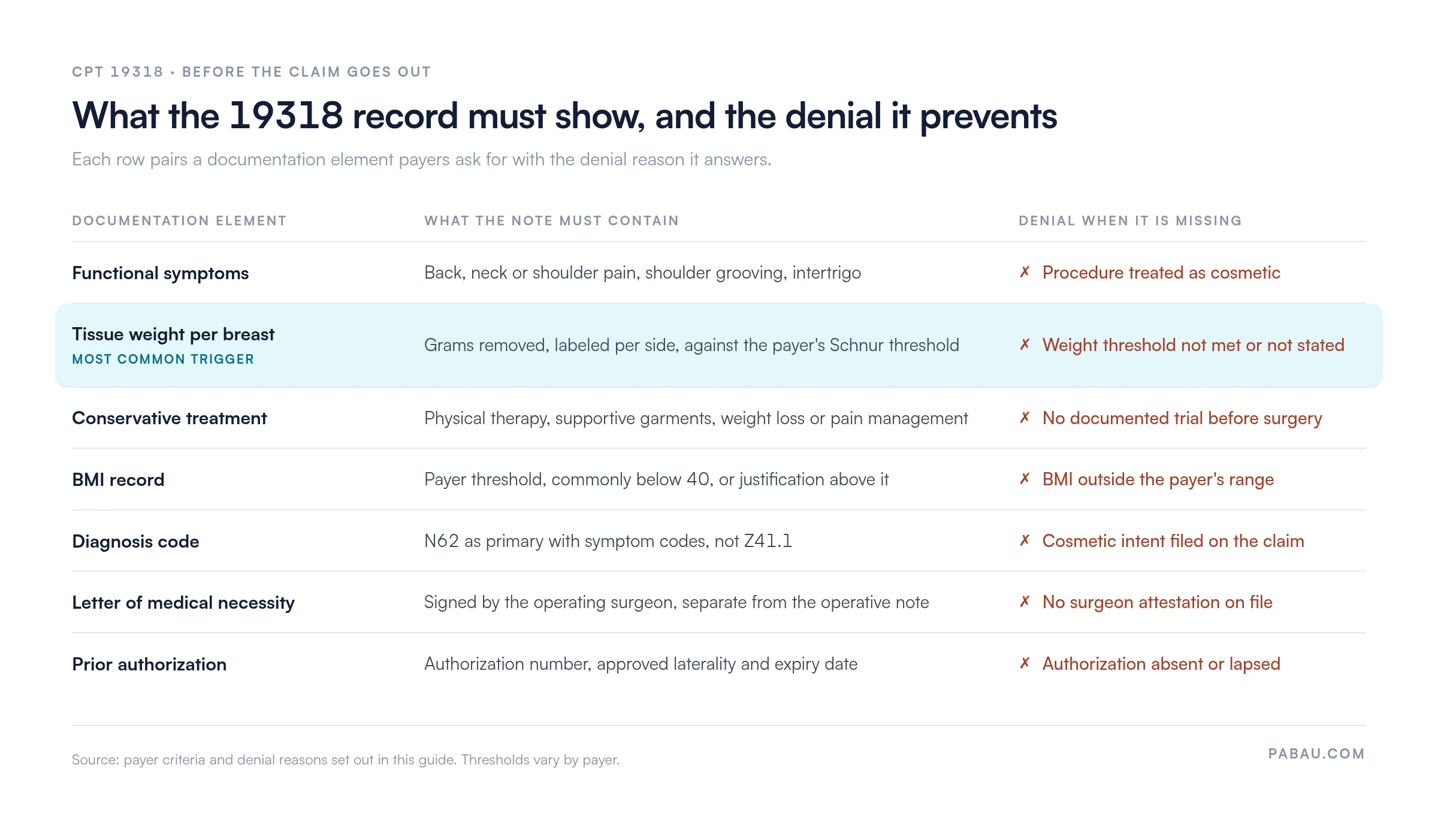
Document the specific grams of tissue removed per breast in the operative note. Payers applying the Schnur sliding scale will deny the claim if tissue weight is absent or non-specific. Include it as a labeled line item: ‘Right breast: [X] grams removed; Left breast: [Y] grams removed.’
Coverage for 19318 varies by payer, plan type, and geographic market, and no blanket rule applies. One BCBS plan may approve a patient outright. A different BCBS plan in the same state may send the case to medical necessity review with its own gram threshold.
Confirm coverage and prior authorization requirements against the specific plan before you put the procedure on the schedule. Verifying eligibility at that point surfaces the limitation while the date can still be moved.
Prior authorization is commonly required for reduction mammaplasty, and the requirements differ by payer. The sequence below reflects how major commercial payers handle the request, but confirm the timeline and the document list with each plan.
Common denial reasons for 19318:
Four of those five are decided before the patient is anesthetized.
The diagnosis code is how a 19318 claim signals medical necessity to the payer’s adjudication system. According to the CMS ICD-10 coding guidance, code selection reflects the physician’s documented clinical judgment rather than a coverage-friendly assignment. Full descriptors for the codes below sit in our ICD-10-CM codes reference.
N62 as the primary code, supported by secondary codes reflecting the documented symptoms, gives the claim its strongest medical necessity argument. Filing Z41.1 as the primary code when N62 is clinically supported by the record is a coding error with direct financial and compliance consequences.
CPT Code 19318 is frequently confused with adjacent breast procedure codes. Understanding the distinctions prevents unbundling errors and supports accurate claim submission. The AAPC CPT code lookup provides descriptor comparisons that coders can reference for real-time code selection.
The line between 19316 and 19318 is where billing errors most commonly occur. A mastopexy reshapes and lifts without the volume of tissue removal that defines reduction mammaplasty. Where the surgeon removes significant glandular tissue and reshapes the breast, 19318 is the correct code. Where only a lift is performed with minimal resection, 19316 applies. Billing both together is generally unsupported and draws NCCI edit scrutiny.
A clean 19318 claim is built across the whole episode, from the day the procedure is booked to the day the operative note is signed. A practice that runs billing inside dedicated claims management software narrows the distance between what the surgeon records and what the biller submits.
These are the most frequent mistakes coders and surgeons make with 19318 claims, drawn from the denial patterns that recur across reduction mammaplasty submissions.
Run the payer-specific documentation checklist at scheduling rather than at submission. Once the operative note is signed and the patient has gone home, a missing tissue weight cannot be added to the record.
Surgical practices usually assemble a 19318 claim from three separate places on the day it goes out:
Practice management software like Pabau keeps all three on the patient record instead. The surgeon’s note, the uploaded attestation, and the authorization details attach to the same encounter, so the biller reads one screen rather than three. Missing items show up while the surgery date can still be moved.
Claims then leave through Claim.MD, our clearinghouse integration, which reaches thousands of US payers. Eligibility responses and remittance advice post back to the same record. Your billing team sees a rejected 19318 line the day it lands rather than at month end.

Pabau tracks prior authorization status and holds operative documentation on the patient record. Plastic surgery and reconstructive practices submit clean 19318 claims from one billing workflow.

A 19318 claim is decided by the record, not by the operation. The claim needs tissue weight in grams and a functional diagnosis code. It also needs a documented conservative treatment failure and a live prior authorization, all before submission.
Every one of those is captured before or during the procedure, which is the argument for treating 19318 documentation as a scheduling task. Fixing it at the billing stage means appealing rather than collecting.
Book a demo to see how Pabau holds the operative note, the authorization, and the claim for a 19318 case on one patient record.

Need to understand denial patterns on surgical claims? Denial management in healthcare covers the workflow for tracking, appealing, and preventing claim denials across procedure types.
Looking for guidance on medical billing compliance for surgical practices? Medical billing compliance outlines the documentation standards and audit readiness practices that reduce exposure.
Want to understand how clearinghouses process surgical claims? Medical claims clearinghouse guide explains how 837P files move from practice to payer and what happens when they’re rejected.
Want fewer surgical claims coming back for rework? Clean claim sets out what a payer accepts on first submission and what sends it into the rejection queue.
Checking benefits before a booked procedure? Insurance eligibility verification shows how to confirm coverage and authorization rules at the point of scheduling.
CPT Code 19318 is the billing code for reduction mammaplasty. The procedure removes excess breast tissue, fat, and skin to reduce the size and weight of the breasts. It covers the full surgical procedure including tissue excision, nipple-areolar complex repositioning, and breast reshaping in a single operative session. It does not include mastopexy performed without significant tissue removal (that is CPT 19316).
Coverage depends on the specific payer and plan. Most major commercial insurers cover 19318 where medical necessity is documented. That usually means functional symptoms such as back pain, skin rash or postural problems. It also means a tissue weight threshold met and a failed trial of conservative treatment. Cosmetic-only cases coded with Z41.1 are not covered. Always verify with the patient’s specific plan before scheduling.
Modifier 50 covers a bilateral procedure, with both breasts reduced in the same session. LT and RT mark left and right laterality, and payers that reject modifier 50 usually want those two on separate lines. Modifier 22 flags increased complexity. Modifier 59 marks a distinct procedural service performed alongside 19318. Verify current modifier requirements against NCCI edits and each payer’s specific policy.
Prior authorization is commonly required for reduction mammaplasty claims under CPT 19318, but requirements vary by payer and plan. Most commercial insurers and many state Medicaid programs require prior authorization with supporting documentation submitted before the procedure. Check the patient’s specific plan every time. Never assume authorization is unnecessary, and never assume an approval for another patient or date covers this case.



