CCSD Code C3115: Surgical correction of squint, other vertical muscles
CCSD Code C3115: Definition and schedule context CCSD Code C3115 carries the des...

Last Updated: Oct 5, 2026
19300 is the CPT code for mastectomy for gynecomastia, the excision of glandular breast tissue in males. It is not used for oncologic, prophylactic or female breast surgery, which other codes in the 19301-19307 range cover.
Payment turns on whether the payer classes the surgery as reconstructive or cosmetic. Without an N62 diagnosis and documented medical necessity, payers often deny this code. This guide covers modifiers, the CY2026 Medicare fee schedule, companion codes and the documentation an operative report needs.
Let Pabau's smart automation suggest the right codes, reduce claim denials, and keep your practice compliant—effortlessly.
Automate repetitive tasks and focus on what matters most—your patients.
Reduce coding errors and ensure compliance with the latest regulations.
Clean claims, fewer denials, and faster reimbursements.
Powerful insights and reporting to help your practice thrive.
HIPAA compliant SOC 2 certified GDPR-compliant Trusted by 4,000+ clinics worldwide

CPT 19300 covers mastectomy for gynecomastia (excision of glandular breast tissue in males), not oncologic or prophylactic mastectomy.
ICD-10 N62 (hypertrophy of breast) is the primary pairing diagnosis, and cosmetic-only cases are typically denied.
Modifier 50 applies for bilateral procedures, but payer payment methodology varies (150% vs. 100%/50%).
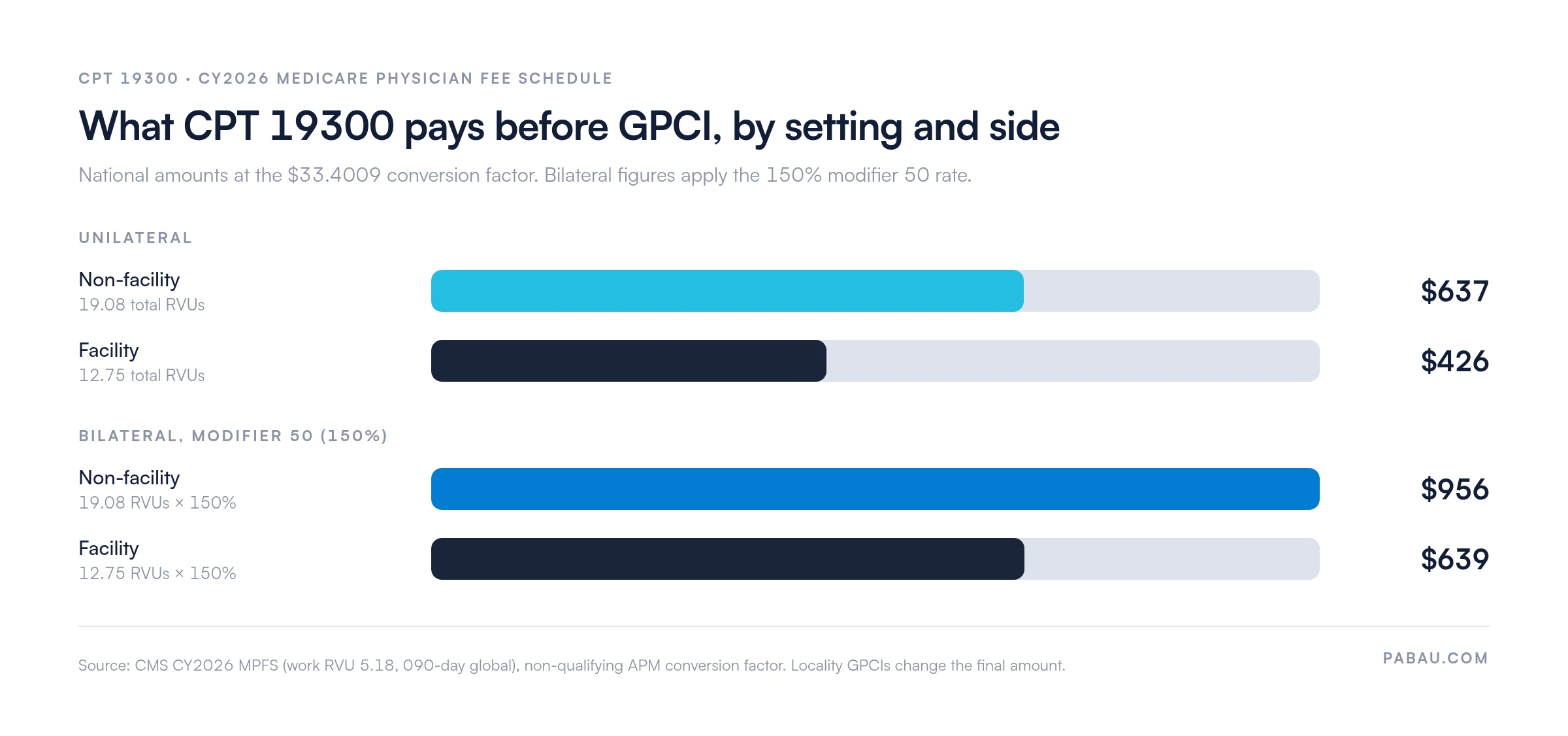
Under the CY2026 Medicare fee schedule, 19300 pays about $637 non-facility and $426 facility before GPCI.
Pabau’s claims management software pulls record data into a pre-filled claim and submits and tracks it through Claim.MD.
CPT code 19300 is defined by the American Medical Association as “Mastectomy for gynecomastia.” It describes the excision of glandular breast tissue in males. Surgeons typically work through a periareolar or inframammary incision and preserve the overlying skin and nipple-areola complex. That technique is not part of the code definition.
This code sits within the 19300-19307 mastectomy family but is the only one specific to gynecomastia. It is not used for oncologic mastectomy, risk-reduction (prophylactic) mastectomy, or female breast surgery.
Coders and surgeons who cross into 19301 or 19303 are miscoding the case, since those codes carry different RVUs and describe different procedures. The table below compares selected codes in the family.
The common error is billing 19304 for gynecomastia on the grounds that it also preserves the nipple. The 19300 descriptor, not 19304, is the gynecomastia-specific code.
CPT 19300 is billed when gynecomastia surgery is medically necessary, and coverage varies by payer. Some policies cover it for symptomatic, higher-grade gynecomastia with documented medical necessity, and others, such as Aetna, treat it as cosmetic. Purely cosmetic cases are excluded by most commercial and government payers.
Commercial payer policies typically require ASPS Grade II or higher (Simon grading is also used), with documented symptoms and failed conservative management. The Simon system sorts cases into four grades:
Supporting indications that strengthen a medical necessity argument include:
Cases driven by bodybuilding or anabolic steroid use frequently face heightened scrutiny. Payers may classify them as elective even when they are symptomatic.
The ICD-10 pairing is one of the first checks a payer runs on a 19300 claim. N62 is the primary code for most cases.
Verify N62 and N64.89 in the current fiscal-year ICD-10-CM release (FY2027 from October 1, 2026) before submitting. The CDC/NCHS publishes annual updates effective October 1, and the CDC ICD-10-CM web tool confirms current validity.
Modifier selection determines whether a claim pays at 100%, 150%, or gets denied. These are the four modifiers used most often with CPT code 19300.
Bilateral billing is the most contested area. Under the Medicare Physician Fee Schedule, modifier 50 on CPT code 19300 is paid at 150% of the single-procedure rate. Some Medicare Advantage plans and commercial payers instead pay 100% for the first side and 50% for the second.
Always check the payer’s specific policy before submitting. Appending modifier 50 without verifying payer methodology is a common source of partial payments that coders then chase as underpayments.

Medicare reimbursement for CPT code 19300 is calculated from the CMS Physician Fee Schedule. Relative value units (RVUs) are multiplied by the annual conversion factor and adjusted by a geographic practice cost index (GPCI). The CY2026 Medicare conversion factor is $33.4009 for non-qualifying APM participants ($33.5675 for qualifying APM participants).
The CY2026 MPFS gives CPT 19300 a work RVU of 5.18 and a 090-day global period. Total RVUs are 19.08 non-facility and 12.75 facility, which works out to about $637 non-facility and $426 facility before GPCI. Facility payments are lower because the practice expense shifts to the facility, and the setting matters more than the side, as the chart shows.
Commercial payer contracts typically pay between 110% and 180% of Medicare rates for this code. Some plans with cosmetic-exclusion language deny coverage entirely, regardless of RVU value. Practices submitting electronic claims through Claim.MD can run real-time eligibility checks before the patient reaches the OR, reducing post-service billing surprises.
Check your MAC’s GPCI values for the procedure setting before finalizing any patient quote for CPT 19300. A surgeon in San Francisco’s locality will receive materially more than the national average; a surgeon in a rural locality may receive significantly less. The CMS MPFS search tool returns locality-specific amounts when you enter your MAC’s payment locality code.
Prior authorization is required by most commercial payers and many Medicare Advantage plans for CPT code 19300. Original Medicare Part B does not require pre-authorization for this code. The claim still has to show medical necessity when it is reviewed after submission.
When submitting a prior authorization request, the clinical package typically needs to include the following. Missing items commonly lead to a denial or pend at the PA stage.
Track prior authorization status alongside the appointment in your billing workflow. That way the billing team knows whether auth is in place before the case is added to the schedule. Procedures performed without an in-place prior auth often cannot be retro-authorized and may result in a full write-off.
A clean claim for CPT code 19300 begins with an operative report that documents every element payers check during a post-payment audit. The following checklist covers the minimum documentation standard for most MAC jurisdictions and commercial payers.
Submitting a clean claim with pathology and tissue weight data materially reduces the rate of cosmetic-exclusion denials. Payers auditing 19300 claims look for this data because it separates medically necessary gynecomastia surgery from elective chest contouring coded as mastectomy. Maintaining medical billing compliance standards in your documentation workflow reduces audit exposure across the whole practice.
CPT code 19300 claims are often denied because the code sits between reconstructive and cosmetic criteria. These are the five most common denial triggers, with an appeal pathway for each. The claim denial codes on the remittance tell you which one you are facing.
Effective denial management workflows should flag 19300 denials for a medical necessity letter on first-level appeal. A resubmission without new evidence usually meets the same denial. An appeal letter that cites the documented grade and the payer’s own policy language gives the reviewer a reason to reverse it.
Gynecomastia surgery often involves more than glandular tissue excision. When additional procedures are performed at the same session, they may be billed separately, subject to NCCI bundling edits. Confirm each edit pairing is current before submitting.
Confirm the 15839 pairing with 19300 against the current NCCI procedure-to-procedure edits before billing. Excess-skin excision in a Grade III case is the usual reason to add it. The operative note must describe that resection separately from the glandular excision.
Do not report 15847 for chest skin. It is an add-on code for excess skin and subcutaneous tissue of the abdomen, such as abdominoplasty. Check the AAPC CPT code reference and your payer’s policy before adding a skin excision code to the claim.
Surgical billing teams often build a 19300 claim by hand, copying the diagnosis, modifier and case details from the chart into a separate billing system. Each re-keyed field is another chance for the claim to drift from the operative note.
Pabau, the practice management platform we build, pulls data from the patient record into a pre-filled claim through its surgical practice claims software. Your coder still selects the codes and modifiers. Pabau then submits the claim and tracks it through Claim.MD.
The claim goes out matching the chart it came from, after a real-time eligibility check before the patient reaches the OR. Payment status stays visible, so a short-paid bilateral claim gets chased while the appeal window is still open.

Pabau’s claims management software pulls record data into a pre-filled claim, then submits and tracks it through Claim.MD. Your billing team follows every 19300 claim without re-keying the case.

A 19300 claim is won or lost before the first incision. The grade, symptom history, hormonal workup and photographs decide the payer’s cosmetic-versus-reconstructive call, and they are far harder to assemble after a denial.
Read the payer’s written gynecomastia policy for every case before you book it. Where that policy treats the surgery as cosmetic, settle the patient’s financial responsibility in writing up front. An appeal is the weakest point to discover the exclusion.
Keeping the operative note, photographs and claim in one patient record makes that pre-surgery work easy to prove. Book a demo to see how Pabau handles surgical claims for plastic surgery practices.

Coding a partial mastectomy instead? CPT code 19301 covers lumpectomy and partial mastectomy billing, with its own modifiers and documentation.
Removing excess chest skin in the same session? CPT code 15839 explains when excess-skin excision of other areas is separately reportable.
Billing the pathology on the excised tissue? CPT code 88305 covers Level IV surgical pathology and when it applies to breast specimens.
Need guidance on surgical billing compliance for your practice? Medical billing compliance covers the documentation standards and audit-readiness framework every surgical practice needs.
Want to understand how electronic claim submission works end-to-end? What is medical billing explains the full claim lifecycle from charge capture to ERA posting.
CPT code 19300 covers mastectomy for gynecomastia, the excision of glandular breast tissue in male patients. Surgeons usually work through a periareolar or inframammary incision. The code does not cover liposuction, excess skin excision, or oncologic mastectomy, which are billed separately under different CPT codes.
Coverage varies by payer. Some policies cover it for symptomatic, higher-grade gynecomastia with documented medical necessity, and others, such as Aetna, treat it as cosmetic. A hormonal workup, a documented grade and a complete operative report support the medical necessity case.
Yes. Append modifier 50 for bilateral gynecomastia excision performed at the same operative session. Medicare pays 150% of the single-side rate with modifier 50. Some commercial payers require LT/RT on separate line items instead, so verify the payer’s bilateral billing policy before submitting.
The five most frequent denial triggers are cosmetic exclusion, missing prior authorization and an incorrect bilateral modifier. Insufficient clinical notes and NCCI bundling of companion procedures without modifier 59 complete the list. Each needs a different appeal approach. A blanket resubmission that ignores the specific denial reason typically fails.