ICD-10 code S61.201A: Open wound of left index finger without nail damage
ICD-10 code S61.201A covers a left index finger wound of unstated type ICD-10 co...

Last Updated: Oct 16, 2026
Billable Code Specific Code
N62 is the billable ICD-10-CM code for hypertrophy of breast.
Accurate coding of N62 depends on documentation the code itself cannot carry. Laterality, functional impairment, patient sex, and clinical indication all belong in the chart, because N62 has no sub-codes to hold them. That is what payers read when they assess medical necessity.
Let Pabau's smart automation suggest the right codes, reduce claim denials, and keep your practice compliant—effortlessly.
Automate repetitive tasks and focus on what matters most—your patients.
Reduce coding errors and ensure compliance with the latest regulations.
Clean claims, fewer denials, and faster reimbursements.
Powerful insights and reporting to help your practice thrive.
HIPAA compliant SOC 2 certified GDPR-compliant Trusted by 4,000+ clinics worldwide

ICD-10 Code N62 is a billable ICD-10-CM diagnosis code for hypertrophy of breast, valid for HIPAA-covered transactions from October 1, 2025
N62 covers both female presentations (macromastia, gigantomastia, virginal breast hypertrophy) and male gynecomastia under a single code with no sub-codes
N62 has no laterality sub-codes, so document unilateral versus bilateral involvement in the clinical note rather than in the code
Practice management software like Pabau builds those documentation fields into the consultation form, so the note supports the claim
ICD-10 Code N62 is the official ICD-10-CM diagnosis code for Hypertrophy of breast. It is a billable, specific code valid for HIPAA-covered transactions. The 2026 edition of ICD-10-CM N62 became effective on October 1, 2025, and it sits in the code block N60-N65 (Disorders of breast).
N62 is a diagnosis-type code rather than a procedure code. It describes the patient’s condition for reimbursement purposes. Pair it with the appropriate CPT procedure code whenever a surgical or clinical intervention is billed. According to the Centers for Medicare and Medicaid Services (CMS), N62 is valid in the principal or secondary diagnosis position, depending on clinical context.
The ICD-10-CM tabular list includes several approximate synonyms for N62. Knowing them matters for two reasons. A coder searching by clinical term needs to land on the right code, and any of these terms in the chart maps to N62. The CDC/NCHS ICD-10-CM web tool confirms the synonyms below sit in the official index.
Any of these terms, documented in the clinical note and mapped through the ICD-10-CM alphabetic index, directs the coder to N62. None of the subtypes has a separate code.
N62 applies across a range of clinical presentations. The common thread is excess breast tissue volume, whether in a female or male patient, and whether congenital, hormonal, or idiopathic in origin.
Female patients: Macromastia presents with breast tissue disproportionate to the patient’s frame. It often produces chronic back and neck pain, skin breakdown in the inframammary fold, difficulty with physical activity, and psychological distress.
Gigantomastia refers to severe, sometimes rapidly progressive enlargement. Virginal breast hypertrophy appears in adolescent females, typically without an identified hormonal driver, and may need early surgical intervention.
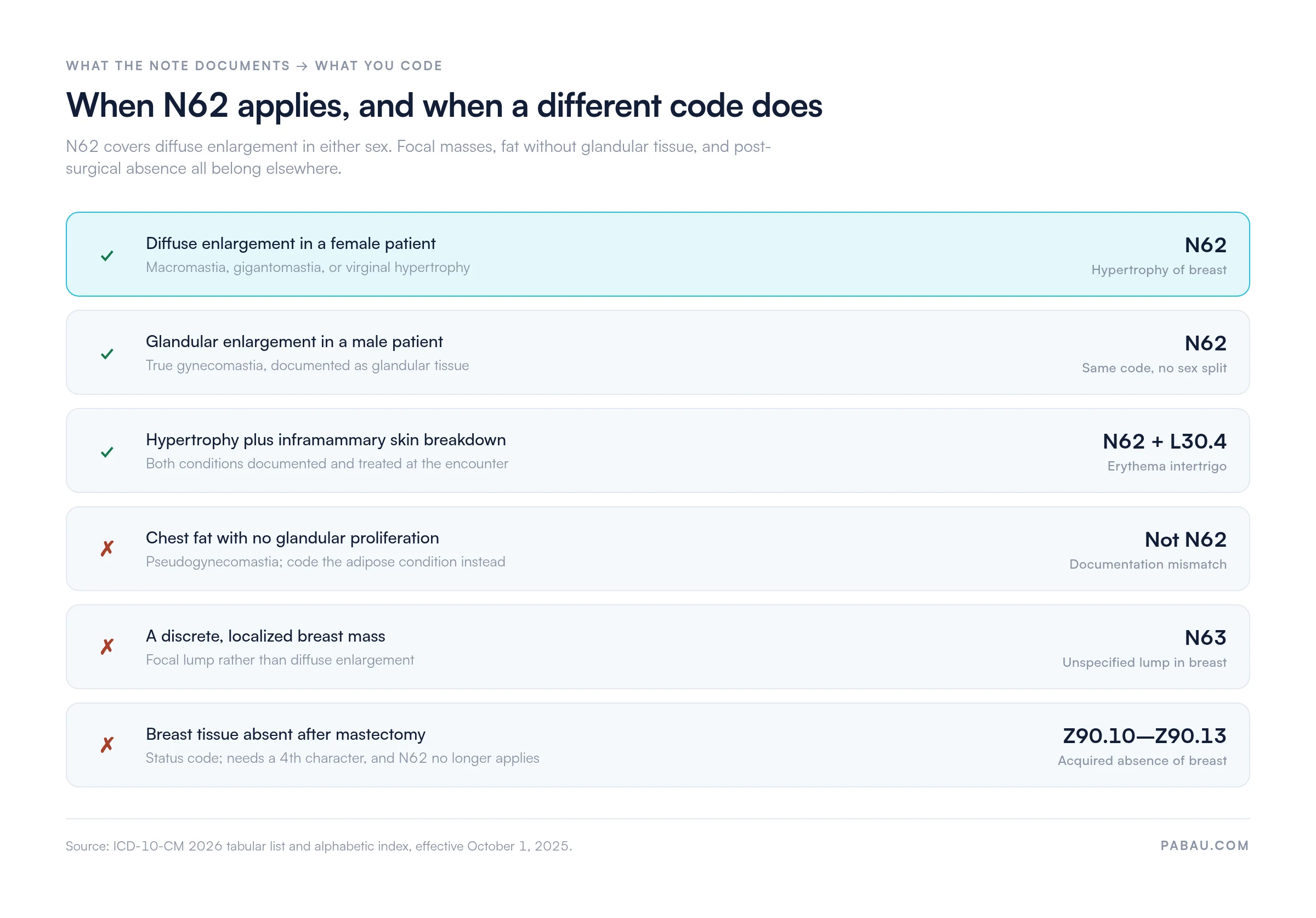
Male patients: Gynecomastia involves glandular breast tissue enlargement in males. It is distinct from pseudogynecomastia, which is fat deposition without glandular proliferation. The distinction decides whether N62 is the correct code, because pseudogynecomastia does not map to it.
Functional impairment is the documentation factor that decides insurance coverage. Payers routinely require evidence that the condition causes physical symptoms before approving surgery. Intertrigo, chronic pain, nerve impingement, and restriction of daily activities all qualify.
Nerve symptoms sometimes prompt sensory nerve conduction threshold testing, billed as HCPCS G0255. Medicare does not cover that test anywhere in the country, so plan for a denial and a signed waiver.
N62 is a single code with no laterality sub-codes and no sub-categories by sex or subtype. That simplicity at the code level puts the documentation burden entirely on the clinical note. Payers assess medical necessity through the chart, because there are no code refinements to assess instead. Building the required fields into the consultation form keeps them from being left to free text.
The following checklist covers what providers must include in the medical record to support N62:
Document functional impairment in measurable terms: pain scale scores, shoulder grooving depth, or specific activities the patient cannot perform. Vague language such as ‘patient has large breasts causing discomfort’ is routinely flagged by reviewers.
The ICD-10-CM Official Guidelines for Coding and Reporting govern how N62 is assigned. Three rules matter most for this code.
The ICD-10 code for gynecomastia is N62. Male patients with gynecomastia use the same code as female patients with macromastia, and there is no sex-specific sub-code. Coders rely on the provider’s documentation to confirm the diagnosis is true gynecomastia rather than pseudogynecomastia. Pseudogynecomastia is not coded under N62. Use the appropriate obesity or lipomatous tissue code instead. The AAPC ICD-10-CM code set lists N62 as the designated code for gynecomastia without further specification.
All three subtypes map to N62. Gigantomastia is not assigned a higher severity code, and remains N62 however extreme the presentation. Virginal (juvenile) breast hypertrophy is confirmed as an approximate synonym in the official tabular, so it is also N62. Document the specific subtype in the note for clinical context, but the code does not change.
N62 has no laterality sub-codes. Many musculoskeletal and breast disorder codes in ICD-10-CM distinguish left, right, and bilateral, but N62 is a single-code category. The coder cannot capture laterality through the code, so it must sit in the clinical note. Reviewers notice the omission during pre-authorization and audit.
N62 sits within the N60-N65 block. Knowing the adjacent codes prevents miscoding and gives you a clear answer when a claim comes back for code clarification.
When a patient with macromastia also has inframammary intertrigo (L30.4), report both codes if both were documented and treated at the encounter. The map below sets out which documented finding takes N62 and which takes another code.
N62 is a diagnosis code, so it pairs with a CPT procedure code whenever an intervention is billed. The pairings below are the common ones in aesthetic and reconstructive practice. Verify payer-specific coverage policy before submission.
A pairing is not a coverage decision. Individual payer policies and local coverage determinations (LCDs) govern reimbursement for each one. For the procedure side of the pairing, see the reference page for CPT 19318. Practice management software like Pabau submits claims electronically and checks eligibility ahead of the procedure date, so coverage problems surface before a denial arrives.
These are the errors that produce avoidable denials on N62 claims. Each one has a documentation fix rather than a coding fix. If you are working backwards from a rejection, the published denial codes explain what each one means.
Insurers treat reduction mammoplasty as cosmetic unless the chart demonstrates functional impairment. Submitting N62 with CPT 19318 and no documented physical symptoms is the fastest route to a medical necessity denial. Fix: use a documentation template that prompts clinicians to record pain scores, posture findings, skin breakdown, and activity limitations.
Pseudogynecomastia is fat deposition in the male chest without glandular proliferation, and it does not map to N62. Assigning N62 where the provider documented “chest fat” or “lipomatous tissue” creates a documentation-to-code mismatch that auditors flag on review. Fix: confirm the provider explicitly documented glandular breast tissue before assigning N62 for a male patient.
N62 has no sub-codes for left, right, or bilateral. Coders sometimes assume that because the code does not require laterality, the note does not need it either. Payers conducting medical necessity reviews want to know which side was treated and why. Unilateral gynecomastia raises different clinical questions than bilateral macromastia. Fix: build laterality into every N62 documentation template. Pabau’s software for billing teams keeps the diagnosis documentation attached to the claim it supports.
N63 (unspecified lump in breast) applies to a discrete, localized mass. Diffuse breast enlargement is N62. When a provider documents “palpable mass” without saying whether the presentation is focal or diffuse, coders sometimes default to N63. Fix: return the note for clarification before assigning the code. The distinction changes both the code and the clinical picture the insurer evaluates.
Accurate N62 claims are decided in the clinical note, well before the billing queue sees them. When the documentation is specific, coding is straightforward. When notes are vague, every downstream step gets harder.
Pabau lets plastic surgery and aesthetic medicine practices build N62-specific fields into the consultation template. Laterality, functional impairment scores, conservative treatment history, and surgical intent become structured fields rather than free-text afterthoughts. The note then satisfies payer documentation requirements before the claim is submitted.
Claims then go out electronically with eligibility already verified, so a coverage problem shows up before the patient’s procedure date. That matters most where N62 appears across both cosmetic and reconstructive case mixes.

Pabau’s digital forms and clinical records capture the documentation payers require for N62 claims. Functional impairment, laterality, and surgical intent are recorded as structured fields at the consultation.

N62 is one code doing the work of several diagnoses, which means the code choice is rarely where a claim goes wrong. What decides payment is whether the chart carries laterality, functional impairment, patient sex, and clinical indication. None of those appear in a sub-code, so none of them are optional in the note.
The practical move is to stop leaving N62 documentation for the coder to chase after the visit. Put the fields in the consultation template and the chase never starts. Book a demo to see how Pabau structures clinical notes for procedure-heavy practices.

Managing denials on surgical claims? Denial management in healthcare covers the strategies practices use to reduce and appeal denied claims.
Need a clean claim checklist? What makes a clean claim outlines the documentation and coding requirements payers expect before processing a claim.
Pairing procedure codes with diagnoses? What a superbill records explains how each encounter captures the CPT and ICD-10 pairing a payer expects.
Auditing your coding process? Medical billing compliance sets out the checks that keep documentation and code assignment defensible on review.
ICD-10 Code N62 is the billable ICD-10-CM diagnosis code for hypertrophy of breast. It covers macromastia and gigantomastia in female patients, gynecomastia in male patients, and virginal breast hypertrophy in adolescents. The code documents the diagnosis for reimbursement when a patient is evaluated or treated for breast hypertrophy.
Yes, N62 is a billable and specific ICD-10-CM code valid for HIPAA-covered transactions. It became effective on October 1, 2025 as part of the 2026 edition of ICD-10-CM. It can be used in the principal or secondary diagnosis position.
The ICD-10 code for gynecomastia in males is N62. There is no sex-specific sub-code. The same N62 code applies to gynecomastia in male patients and macromastia in female patients. Coders should confirm that the provider documented true glandular gynecomastia rather than pseudogynecomastia, which does not map to N62.
Yes. Virginal breast hypertrophy, also called juvenile or pubertal macromastia, is an approximate synonym listed in the ICD-10-CM official tabular for N62. Coders document the specific subtype in the clinical note for context, but the assigned code remains N62.
The diagnosis code supporting breast reduction surgery is N62 (hypertrophy of breast). The procedure itself is billed with CPT 19318 (reduction mammoplasty). N62 provides the medical necessity diagnosis that payers evaluate when considering coverage for the procedure.