

HCPCS code J2690: Procainamide units and billing guide
What HCPCS code J2690 covers, and what it does not HCPCS code J2690 reports R...

Last Updated: Oct 30, 2026
12004 is the CPT code for simple repair of superficial wounds totaling 7.6 cm to 12.5 cm. It covers the scalp, neck, axillae, external genitalia, trunk and/or extremities, including hands and feet. The length is the total of every simple repair in that group during one session.
It is the third step of the 12001-12007 simple repair series, between 12002 (2.6-7.5 cm) and 12005 (12.6-20.0 cm). Medicare gives it a 0-day global period, so follow-up visits on later days are not bundled into the repair.
Let Pabau's smart automation suggest the right codes, reduce claim denials, and keep your practice compliant—effortlessly.
Automate repetitive tasks and focus on what matters most—your patients.
Reduce coding errors and ensure compliance with the latest regulations.
Clean claims, fewer denials, and faster reimbursements.
Powerful insights and reporting to help your practice thrive.
HIPAA compliant SOC 2 certified GDPR-compliant Trusted by 4,000+ clinics worldwide

CPT code 12004 reports simple, single-layer repair of superficial wounds totaling 7.6-12.5 cm on the scalp, neck, axillae, external genitalia, trunk or extremities.
Add together every simple repair in the 12001-12007 anatomic group from one session, then choose the code that matches the total.
Short wounds rarely reach 12004: 1.8 cm plus 1.0 cm is 2.8 cm, which is 12002.
Medicare lists 12004 with a 0-day global period and 1.40 work RVUs, about $162 nationally in an office in 2026.
The intermediate counterpart, 12034, needs documented layered closure and carries a 10-day global period.
CPT code 12004 is simple repair of superficial wounds of the scalp, neck, axillae, external genitalia, trunk and/or extremities, 7.6 cm to 12.5 cm.
Hands and feet count as extremities. The length is the combined total of every simple repair in that anatomic group during one session.
The American Medical Association (AMA) maintains the CPT code set, and payers match each claim against its descriptor. The code sits in the Repair (Closure) subsection of the Integumentary System chapter. “Simple” is a defined CPT term. It means a superficial wound in the epidermis, dermis or subcutaneous tissue, closed in one layer.
CPT code 12004 covers simple closure of superficial wounds whose summed length falls between 7.6 cm and 12.5 cm at the listed body sites. Sutures, staples and tissue adhesive all count, as long as the closure is a single layer.
Included under CPT code 12004:
Excluded from CPT code 12004 (use a different code):
Tissue adhesive needs one payer check. Medicare asks for HCPCS G0168 when adhesive is the only closure material, rather than a 12001-12007 code. Many commercial payers accept the CPT repair code, so confirm each contract before billing.
Wound length for CPT code 12004 is the sum of every simple repair in the 12001-12007 anatomic group performed in one session. You report one code for that total, never one code per wound. Measure and add first, because the total decides the code.
The last rows show where 12004 most often disappears. Splitting one session’s repairs by site or by complexity can leave no group long enough to reach 7.6 cm. Code each group from its own total, even when the combined length of every wound looks like a 12004.
Work RVUs and global periods come from the CMS 2026 Physician Fee Schedule relative value file (RVU26D, October 2026 release). All six codes cover the same body sites.
Three variables separate 12004 from its neighbors: the summed length, the anatomic group and the repair classification. Change any one of them and the code changes. To check a neighbor’s descriptor, look it up in our CPT code library.
The step up to intermediate repair is the one auditors watch. It needs documented layered closure of deeper subcutaneous tissue and superficial fascia. A single-layer closure of a heavily contaminated wound needing extensive cleaning also qualifies. Length alone never justifies it.
Which intermediate code matches 12004 depends on the site. A trunk or forearm repair moves to 12034, while a neck, hand, foot or genital repair moves to 12044. Both carry a 10-day global period, so the upgrade also changes how follow-up visits are billed. The chart below maps all four outcomes for a total in this range.
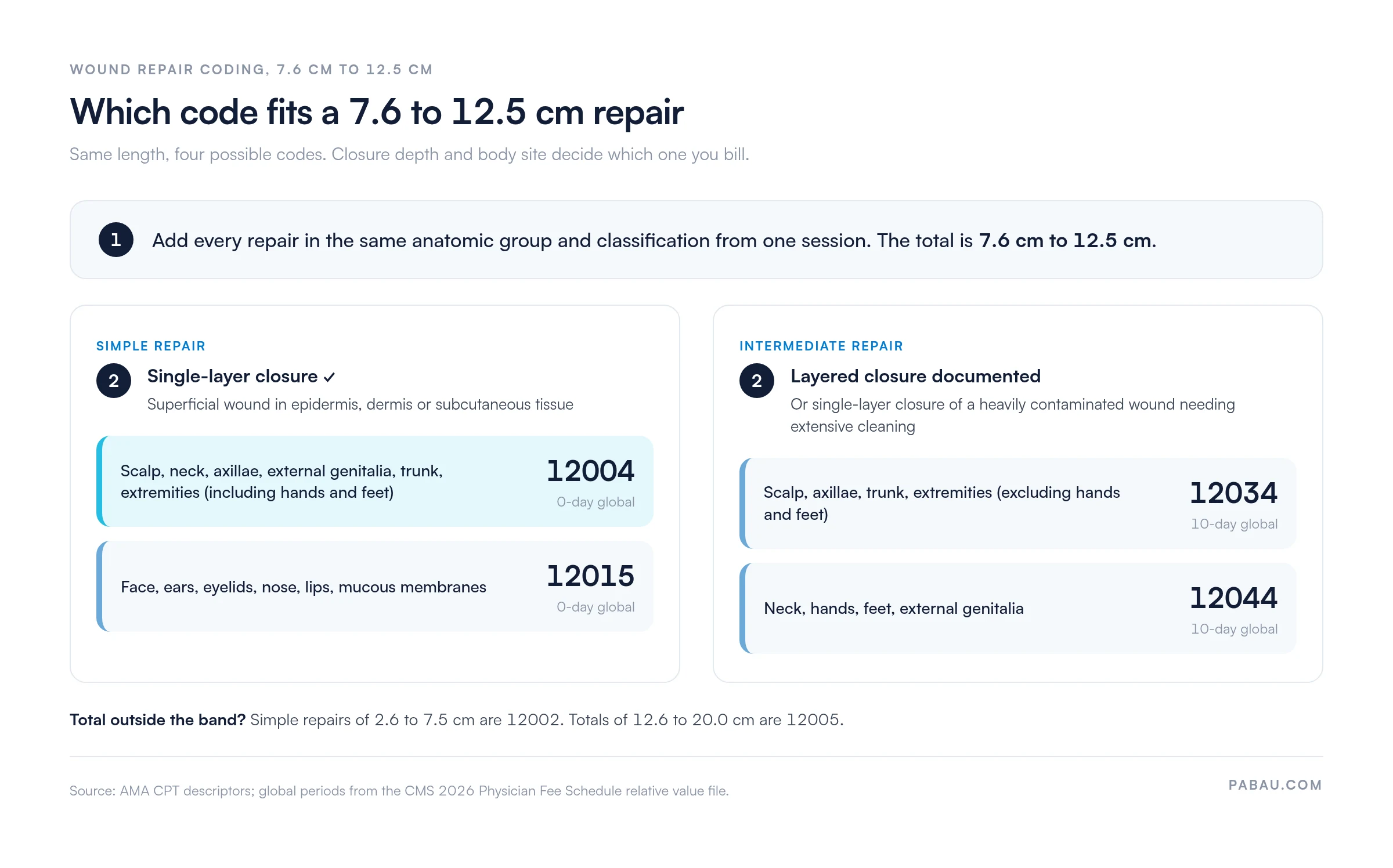
Simple repair is a one-layer closure of a superficial wound, with no significant involvement of deeper structures. Payer auditors apply that definition literally, so the note has to show it.
The closure technique decides the code. A clean 8 cm laceration on the back of the hand closed with one layer of 4-0 nylon is 12004. The same wound needing deep sutures because subcutaneous fat was disrupted is intermediate repair, 12044. Document the technique so an auditor reaches the same conclusion without calling the provider.
Record the number of suture layers and the depth of closure in every procedure note. ‘Single-layer closure with 4-0 nylon, epidermis and dermis’ lets an auditor confirm simple repair. ‘Wound closed’ does not.
Payers expect specific documentation to support CPT code 12004. A missing element is grounds for denial or a post-payment audit. Build these fields into the procedure note template for every wound repair.
A superbill documentation workflow that ties procedure codes to note fields keeps the measurement attached to the charge. When the coder cannot find the wound length in the note, the claim waits or comes back.
CPT code 12004 takes modifiers depending on what else happened at the visit. A wrong or missing modifier is one of the most common reasons repair claims are denied.
Modifier 25 is the one most often misapplied. It goes on the E/M code, never on 12004. A patient who comes in only for a laceration repair does not support a separate E/M. Reviewing vitals or medications does not change that.
Medicare pays CPT code 12004 from relative value units (RVUs) in the Physician Fee Schedule. The CMS 2026 relative value file gives 12004 1.40 work RVUs and 0.33 malpractice RVUs. Practice expense is 3.12 RVUs in an office and 0.43 RVUs in a facility.
The national amounts use the 2026 conversion factor of $33.4009, before geographic adjustment. Qualifying APM participants use $33.5675, which gives $162.80 and $72.51. Check your own locality in the CMS Physician Fee Schedule lookup tool.
Commercial rates depend on each contract, so compare them against your own fee schedule rather than a rule of thumb. Place of service changes the amount too. An office repair (POS 11) and an emergency department repair (POS 23) pay differently from the same payer.
CPT code 12004 has a 0-day global period, listed as 000 in the Medicare Physician Fee Schedule. Only care on the day of the repair is bundled into its payment. The AAPC notes that Medicare moved simple repairs from a 10-day to a 0-day global period in 2011.
Bundled into 12004 on the day of the repair:
Billed separately:
Older references still describe a 10-day global for this code. Holding follow-up claims for ten days, or adding modifier 24 to a later visit, follows a rule that no longer applies to 12004. Intermediate and complex repairs still carry a 10-day global, so check the code before applying either habit.
Most denials for CPT code 12004 trace back to the note or the arithmetic. Denial management starts with spotting these patterns before claims leave the practice.
Submitting a clean claim for CPT code 12004 depends on a front-end check. Confirm the site against the descriptor, the measurements and total in the note, and any modifier the visit needs.
Audit your wound repair codes each month. Pull the prior month’s 12004 claims and check five notes for each measurement, the summed total, the body site and modifier use.
Medicare covers CPT code 12004 when the repair is medically necessary and the note supports the code. CMS sets the national rules, and Medicare Administrative Contractors (MACs) can add local coverage determinations (LCDs).
Place-of-service considerations:
Medicaid programs and commercial plans set their own rules for repair codes and tissue adhesive. Medical billing compliance for wound repair rests on a note that matches the code billed. The AAPC Codify CPT lookup helps confirm code relationships and bundling edits when you prepare an audit response.
Most CPT code 12004 denials start between the note and the claim. The provider documents the repair, but the measurements never reach the biller, and the claim goes out with the wrong length code.
Pabau, our practice management and billing software, keeps the procedure note, the invoice and the claim in one patient record. Its claims management software builds the CMS-1500 claim from the invoice. Pabau’s Claim.MD integration sends it to thousands of US payers and runs real-time eligibility checks before the visit.
Payments come back as electronic remittance advice matched to the claims they settle. Your team sees an underpaid 12004 line without matching remittances by hand. The billing workflow stays audit-ready because the note behind each code is one click away.

Pabau links procedure notes, invoices and claim submission, so a 12004 claim leaves with the measurements behind it. Eligibility checks and remittance matching run in the same system.

Choosing 12004 comes down to arithmetic plus one clinical check. Measure every wound, group by site and classification, add, then read off the code. If the total lands between 7.6 and 12.5 cm and every closure was single-layer, 12004 is right.
Some older references still list a 10-day global for 12004, which is wrong. Update your coding cheat sheets and charge descriptions before an audit finds it.
Book a demo to see how Pabau carries wound measurements from the procedure note onto the claim.

Need to understand how claims reach payers? Medical claims clearinghouse guide explains how the clearinghouse layer works between practice and payer.
Want to reduce claim rejections before submission? Revenue cycle management overview covers the end-to-end billing workflow that catches errors before they become denials.
Credentialing affecting your reimbursement? Insurance credentialing guide walks through the steps to get properly enrolled with Medicare and commercial payers.
CPT code 12004 covers simple repair of superficial wounds totaling 7.6 cm to 12.5 cm. The wounds sit on the scalp, neck, axillae, external genitalia, trunk or extremities, including hands and feet. The closure is a single layer of sutures, staples or tissue adhesive.
Under the CMS 2026 Physician Fee Schedule, 12004 carries 4.85 total RVUs in an office, about $161.99 nationally before geographic adjustment. In a facility it carries 2.16 RVUs, about $72.15. Your locality and payer contracts change the final amount.
CPT code 12004 has a 0-day global period, listed as 000. Only same-day care is bundled into the repair. A later wound check or suture removal visit can be billed as an E/M when the note supports one. It needs no modifier 24.
Measure each wound in centimeters, then add every simple repair in the 12001-12007 anatomic group from the same session. Two 1.5 cm trunk wounds total 3.0 cm, which is 12002. The total must reach 7.6 cm to 12.5 cm for 12004.
Length is the only difference. 12002 covers simple repairs totaling 2.6-7.5 cm, and 12004 covers 7.6-12.5 cm, at the same body sites. The number of wounds never changes the code, only their summed length.
Use 12004 when every wound in the total was closed in a single layer. Use 12034 when the note documents layered closure, or extensive cleaning of a heavily contaminated wound. 12034 covers the same length on the scalp, axillae, trunk and extremities, excluding hands and feet.
Yes, when the E/M is significant and separately identifiable from the wound repair. Append modifier 25 to the E/M code, not to 12004, and document the separate reason for the visit. Without that documentation, the E/M is denied as part of the repair.
Yes, Medicare covers CPT code 12004 when the repair is medically necessary and the note supports the code. When tissue adhesive is the only closure material, Medicare asks for HCPCS G0168 instead. Check your MAC for any local coverage determination.


