CCSD Code D1010: Radical mastoidectomy including meatoplasty
CCSD Code D1010: Definition and clinical scope CCSD Code D1010 is the UK private...

Last Updated: Nov 25, 2026
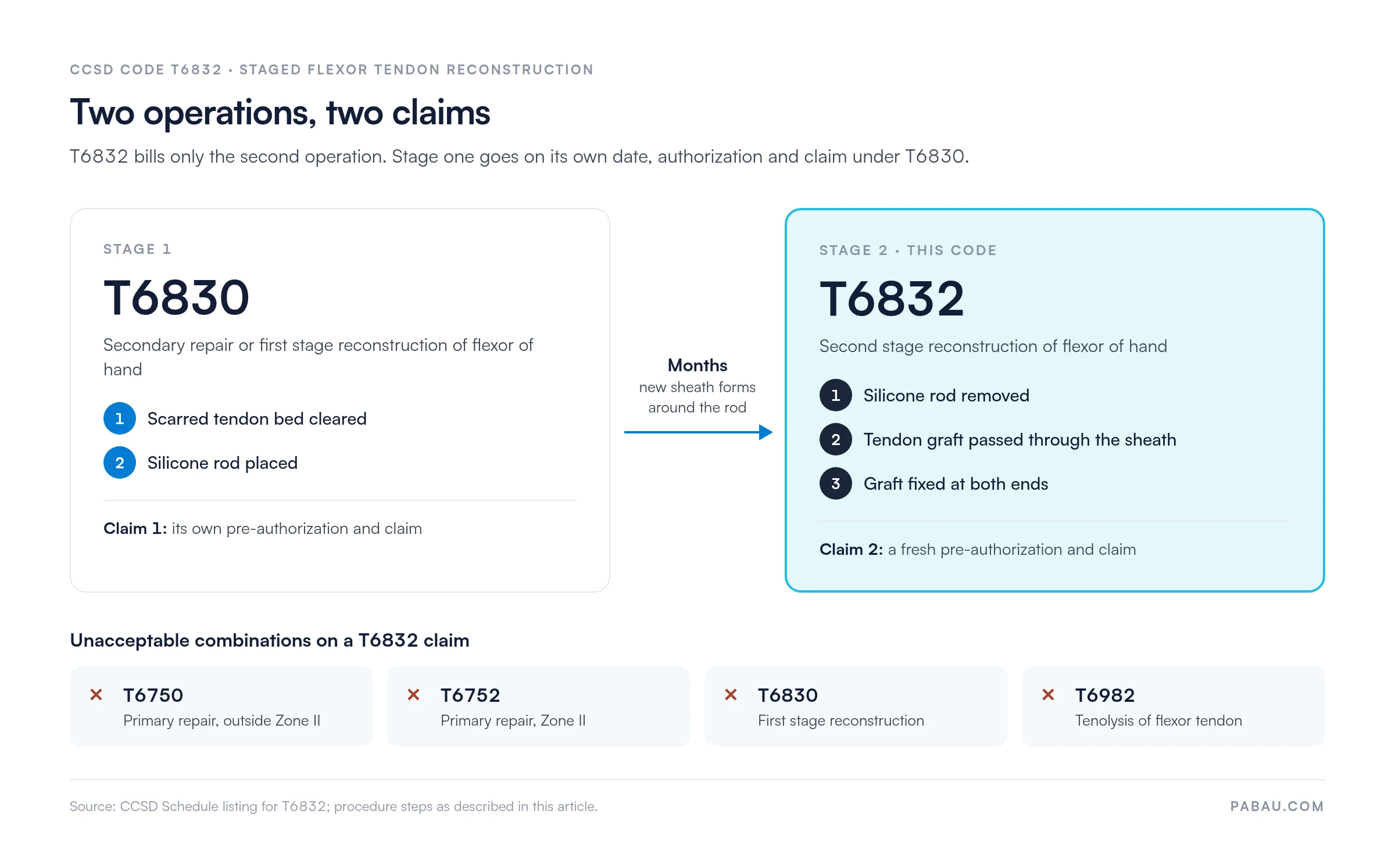
T6832 is the CCSD code for second stage reconstruction of a flexor tendon of the hand. In this operation, the surgeon removes the silicone rod placed at stage one and passes a tendon graft through the new sheath.
It follows T6830, which covers the first stage, usually months earlier. Each stage needs its own pre-authorization and its own claim. T6750, T6752, T6830 and T6982 can't share a claim with T6832. Pair it with a WHO ICD-10 diagnosis code, never a US ICD-10-CM one.
Let Pabau's smart automation suggest the right codes, reduce claim denials, and keep your practice compliant—effortlessly.
Automate repetitive tasks and focus on what matters most—your patients.
Reduce coding errors and ensure compliance with the latest regulations.
Clean claims, fewer denials, and faster reimbursements.
Powerful insights and reporting to help your practice thrive.
HIPAA compliant SOC 2 certified GDPR-compliant Trusted by 4,000+ clinics worldwide

CCSD code T6832 covers second stage reconstruction of a flexor tendon of the hand, in Chapter 16, section 16.6.2.
It follows T6830, the first stage, where a silicone rod is placed to build a new tendon sheath.
The T6832 listing names T6750, T6752, T6830 and T6982 as unacceptable combinations on the same claim.
UK private insurers expect a WHO ICD-10 diagnosis code, such as S66.1, never a US ICD-10-CM code.
Treat stage two as its own pre-authorization request and its own claim, even when stage one was approved.
CCSD code T6832 is how UK private insurers pay for the second stage of a two-stage flexor tendon reconstruction in the hand. It’s listed in the CCSD Schedule of standard codes for the UK private healthcare sector. In this operation, the surgeon removes a silicone rod and passes a tendon graft through the sheath the rod created.
Why stage the repair at all? A late presentation, a ruptured primary repair or a lost tendon segment can each call for a grafted reconstruction. A systematic review protocol on secondary flexor reconstruction lists these triggers. Because the two stages happen months apart, each one needs its own code, authorization and claim.
The CCSD schedule is the shared code set that Bupa, AXA Health, Aviva, Vitality and other UK insurers use for private procedures. Its code pages sit behind a login on the CCSD schedule search, so check the live listing before you bill. For how the wider schedule is organized, see our guide to CCSD codes.
Stage two only makes sense next to stage one. In the first operation, billed as CCSD code T6830, the surgeon clears the scarred tendon bed. A silicone rod then goes in where the tendon used to run. Over the following months, the body forms a smooth new sheath around that rod.
T6832 is the return trip. Once the hand is supple and the sheath has matured, the surgeon:
Hand therapy follows for several months. That matters for billing, too, because therapy sessions and follow-up consultations go on separate claims, not under T6832.
The CCSD listing for T6832 names four unacceptable combinations. Each one describes work that either comes before the second stage or overlaps with it. The diagram shows where each stage sits and which codes stay off the second claim.
For the primary repair listings, see CCSD code T6750 and CCSD code T6752. Secondary repair or reconstruction of an extensor tendon in the hand or forearm is billed under CCSD code T6820 instead.
One caveat applies to the whole list. CCSD principles aren’t exhaustive, and each insurer decides whether to adopt a given combination rule. So a pairing the schedule allows may still be refused by one insurer. When in doubt, ask the insurer before surgery, not after the rejection.
Think of T6832 as the surgeon’s fee for the second operation itself. Here’s how the work usually splits.
If adhesions form after the graft and a later tenolysis is needed, that’s a new operation on a new date. Check with the insurer how they want it coded and authorized.
UK insurers want the diagnosis in the WHO version of ICD-10. US ICD-10-CM codes, with their extra characters, will be rejected. The right code depends on what the patient’s notes record.
Code from what the patient’s notes record. A diagnosis that doesn’t explain a tendon graft is one of the fastest ways to an insurer query.
Stage one’s pre-authorization rarely settles the question for stage two. Treat T6832 as its own request unless the insurer confirms in writing that both stages are covered. Also, the patient’s policy may have changed in the months between operations.
A complete request usually includes:
Keep the new authorization number with the booking. You’ll need it again on the claim.
Most UK private claims go to insurers electronically through Healthcode. Whichever route you use, the order of work stays the same.
Insurers also differ on surgeon recognition and fee rules. Our overview of Bupa CCSD codes shows how one large insurer applies the schedule.
An insurer that queries a T6832 claim usually wants proof of two things. First, that a first stage happened. Second, that this operation completed it. Your notes should show both.
Structured digital clinical forms make this easier. In Pabau, a practice management platform, each stage gets its own note and consent, saved to the same patient record.
Each row pairs a common rejection reason with the fix that clears it.
When a claim comes back, read the insurer’s reason first. Then correct the claim and resubmit it with the supporting note.
A staged reconstruction stretches across months, two operations and two claims. On paper or in spreadsheets, the stage one authorization ends up in one place and the stage two note in another. Claims software for practices brings them back onto one record.
Pabau sends private medical insurance claims through its Healthcode integration straight from the patient record. The CCSD code, diagnosis and authorization number sit on the claim beside the operative note. Each authorization code is tracked on the patient’s case, with a warning when one is missing.
So when stage two arrives, your team opens one record and sees what stage one billed. That makes the T6832 claim quicker to build and easier to defend.

Pabau sends CCSD claims to UK insurers through Healthcode, straight from the patient record. Each stage’s notes and authorization numbers sit on that same record.

T6832 rewards practices that treat a staged reconstruction as two separate jobs. Authorize it fresh, code it from the operative note and keep the blocked codes off the claim. Do that, and the second stage gets paid as cleanly as the first.
The trade-off is a little more admin between operations. It costs far less than chasing a rejected claim months after surgery. Book a demo to see how Pabau keeps each stage’s notes, authorization and Healthcode claim on one patient record.

Billing the first operation? CCSD code T6830 covers secondary repair and the first stage of a flexor tendon reconstruction.
Repairing a fresh Zone II injury? CCSD code T6752 explains primary flexor repair inside the digital sheath.
Repairing a flexor tendon outside Zone II? CCSD code T6750 covers primary repair in the other zones.
New to the CCSD schedule? Our guide to CCSD codes explains how chapters, sections and code rules fit together.
Billing Bupa patients? Bupa CCSD codes covers how the insurer applies the schedule to claims.
T6832 is the CCSD code for second stage reconstruction of a flexor tendon of the hand. The surgeon removes the silicone rod placed at stage one and passes a tendon graft through the new sheath.
T6830 covers secondary repair or the first stage, when the rod goes in. T6832 covers the second stage, when the rod comes out and the graft goes in. Bill each stage on its own claim.
No. The CCSD listing names T6982, tenolysis of flexor tendon, as an unacceptable combination with T6832. T6750, T6752 and T6830 are on the same list.
Plan for it. Ask the insurer before booking, because stage one approval may not cover stage two. Quote the new authorization number on the T6832 claim.
Use a WHO ICD-10 code that matches the notes. S66.1 fits a finger flexor tendon injury, S66.0 the thumb and M66.3 a spontaneous rupture.
Each UK insurer sets its own fee for T6832. Check the insurer’s current schedule, as fees and surgeon recognition rules differ.