CCSD Code S5535: Description, tariff, medical aid and claim requirements
CCSD Code S5535: Official description and procedure scope CCSD Code S5535 is a b...

Last Updated: Nov 20, 2026
S5524 is the CCSD code for burn excision (wound/scar) trunk & limbs (not more than 2% of body area).
Let Pabau's smart automation suggest the right codes, reduce claim denials, and keep your practice compliant—effortlessly.
Automate repetitive tasks and focus on what matters most—your patients.
Reduce coding errors and ensure compliance with the latest regulations.
Clean claims, fewer denials, and faster reimbursements.
Powerful insights and reporting to help your practice thrive.
HIPAA compliant SOC 2 certified GDPR-compliant Trusted by 4,000+ clinics worldwide

CCSD code S5524 sits within the S55xx series of the CCSD schedule and must be matched to the correct procedure descriptor before submission
Documentation must include a consultant operative note, clinical indication, and procedure date before the claim can be validated by any UK private insurer
Bupa, AXA Health, and Aviva each require pre-authorisation for procedures in this code family; approval timelines and evidence thresholds differ by insurer
Unbundling errors and missing pre-authorisation are the two most common denial triggers for S5524 claims
Pabau’s claims management tools support pre-auth tracking and digital documentation workflows for UK private practices billing CCSD codes
CCSD code S5524 is a billable procedure code in the S55xx series of the CCSD schedule, the standard coding framework used across UK private healthcare for surgical, surgical-adjacent, and diagnostic procedures. The S55xx series covers a defined cluster of related procedures; S5524 represents a specific intervention within that family, and its exact descriptor governs what can legitimately be billed under this code.
The CCSD schedule is maintained by the Clinical Coding and Schedule Development group and updated periodically. Any discrepancy between the descriptor in your practice management system and the current published schedule should be resolved before submission, as payers validate claims against the current schedule version.
Coders should verify the exact descriptor text against the current CCSD technical guide before each claim cycle. Descriptor language that was updated in a schedule revision but not reflected in legacy templates is a consistent source of payer rejections. For practices already billing Bupa-funded procedures, the Bupa CCSD code guidance on this site covers payer-specific rules alongside the schedule reference.
Understanding the scope of S5524 is the foundation of clean claim submission. Overbilling by including services already captured in the comprehensive code, or underbilling by missing a legitimately separate procedure, both create audit exposure.
When in doubt about scope, refer to the insurer’s own fee schedule documentation rather than the CCSD schedule alone. Payers sometimes apply narrower definitions of what a comprehensive code includes, which is why the same procedure can pass review with one insurer and be queried by another.
S5524 sits adjacent to S5523 and other codes in the S55xx series. These codes share a procedural family but represent distinct clinical interventions. Selecting the wrong neighbouring code is a common upcoding or undercoding error that payers flag during claim review.
The defining question is always the operative note: What procedure was actually performed, and does the descriptor of S5524 match it precisely? If the clinical record describes a procedure that sits squarely within S5523’s descriptor, billing S5524 constitutes upcoding regardless of intent. Where the descriptor genuinely fits S5524, using S5523 to avoid scrutiny is undercoding and leaves revenue on the table.
Before submitting a claim under any S55xx code, run a side-by-side comparison of the official CCSD descriptors for S5523 and S5524. If the operative note does not map clearly to one descriptor over the other, the consultant should annotate the record with their clinical rationale before submission.
Private insurers validate S5524 claims against the supporting clinical record. A clean claim requires specific documentation in the patient file before submission, not after a denial.
Documentation gaps are the leading cause of initial denials for S5524 claims. Payers that query a claim typically request the operative note first. If that document is absent, incomplete, or inconsistent with the code billed, the claim is suspended pending further evidence, often with a 28-day response window before it is declined. Digital clinical forms that are structured around the insurer’s documentation requirements reduce this risk by ensuring the correct fields are captured at the point of care rather than reconstructed later.
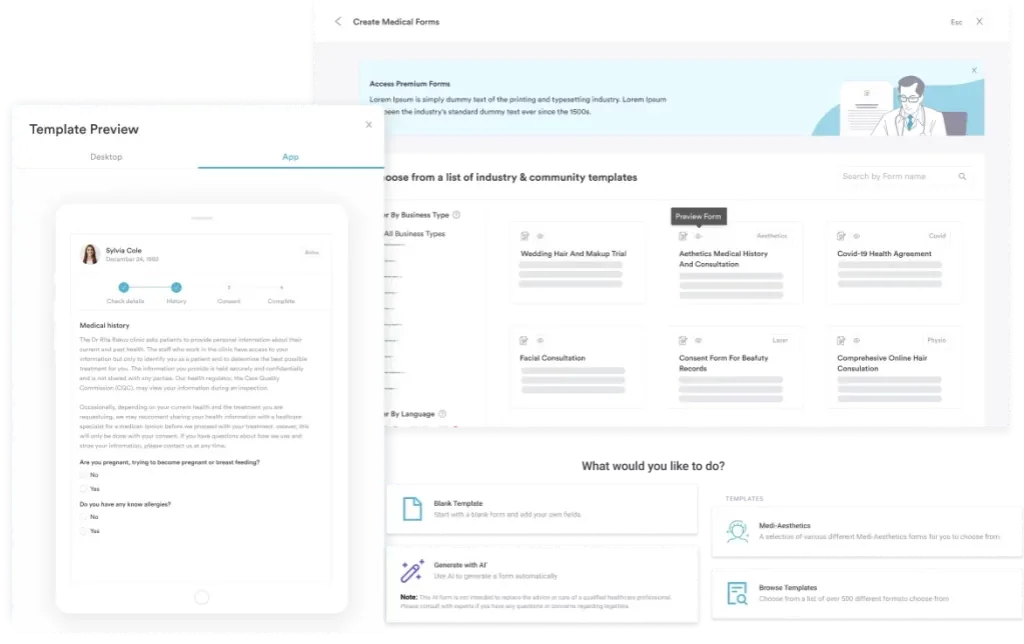

Pabau helps UK private practices capture clinical documentation, track pre-authorisation status, and submit clean claims for CCSD-coded procedures. See how it works for your clinic.

Pre-authorisation is required by most major UK private insurers before S5524 procedures are performed. Submitting a claim without prior authorisation is the fastest route to an automatic denial, regardless of documentation quality.
Approval is at insurer discretion and cannot be guaranteed in advance. Pre-authorisation confirms the insurer is aware of the planned procedure and has assigned a reference number; it does not constitute a guarantee of payment if the submitted claim contains errors or the documented procedure differs from what was authorised.
Most S5524 claim denials trace back to a small set of avoidable errors. Knowing the trigger before submission is worth more than understanding the appeal process after the fact.
S5524 can be billed on the same claim as other procedure codes in certain circumstances, but each pairing must pass the insurer’s concurrent coding rules. Getting this wrong in either direction, billing too many companion codes or missing a legitimately separate procedure, creates avoidable compliance risk.
When procedures are performed bilaterally, the insurer contract determines whether a bilateral modifier applies, whether the code is billed twice, or whether a reduced fee for the second side is expected. This varies between Bupa, AXA Health, Aviva, and smaller insurers, so check the specific provider agreement rather than assuming a uniform rule across payers.
Audit your practice’s S55xx claim history quarterly. Look for patterns of companion codes that appear on more than 20% of S5524 claims. If a companion code appears that often, either it is legitimately common for your patient cohort and you should document that rationale clearly, or it has become a default that may not always be clinically supported.
Manual CCSD billing workflows create gaps at every stage: Pre-auth references recorded in spreadsheets that do not follow the patient record, operative notes stored in one system while claims are submitted from another, and denial follow-ups tracked informally until they age past the appeal window. For private practices billing S5524 at volume, that fragmentation translates directly into lost revenue.
Pabau’s claims management software connects the clinical record to the billing workflow so the information needed for a clean S5524 claim is captured at the point of care. Pre-authorisation reference numbers can be logged against the appointment, digital consent and clinical forms are attached to the patient record, and the billing team has a single view of outstanding claims rather than chasing documentation across email threads. For aesthetic skin clinics and cosmetic surgery practices billing CCSD-coded procedures, this is particularly valuable because pre-auth timelines, documentation standards, and insurer-specific rules all vary in ways that are difficult to manage consistently through manual processes.
The key difference between a practice that gets paid on first submission and one that routinely manages denials is usually not code knowledge; it is whether the right information was captured at the right time and arrived on the claim in the right format. Private practice billing workflows that run through a connected system reduce the dependency on individual staff members remembering every insurer’s specific requirements.
Clean S5524 claims come down to three things: The right code matched to the right operative note, pre-authorisation obtained and referenced before submission, and documentation captured at the point of care rather than reconstructed after a denial. Each failure point is preventable.
Pabau’s clinical documentation and claims management tools help UK private practices build these checks into the workflow rather than relying on manual follow-up. If your practice bills CCSD-coded procedures and wants to reduce denial rates and administrative overhead, book a demo to see how Pabau handles the documentation-to-claim pipeline.

Need a full reference for Bupa CCSD codes? Bupa CCSD code guidance covers the Bupa-specific coding rules, fee schedule context, and submission requirements across the CCSD schedule.
Looking to reduce claim admin time? Claims management software from Pabau connects clinical documentation to billing submission so pre-auth references and operative notes travel with the claim.
Running a multi-insurer private aesthetic practice? Aesthetic skin clinic software from Pabau is built for UK clinics billing across Bupa, AXA, Aviva, and other private payers.
CCSD code S5524 is a procedure code covering a specific intervention within the S55xx series of the CCSD schedule, used for invoicing UK private insurers for that defined surgical or surgical-adjacent procedure. The exact scope is determined by the official descriptor in the current published CCSD schedule. Services integral to the procedure are included; separately listed procedures, consultations, and anaesthesia (where the insurer treats it as a distinct billable item) are excluded and must be invoiced separately.
S5524 and S5523 are adjacent codes in the S55xx series with related but distinct official descriptors. S5523 typically applies to a less extensive version of the same procedure family, while S5524 covers the more comprehensive intervention. The correct code is determined by matching the operative note to the official descriptor. Billing S5524 when S5523 is the accurate match constitutes upcoding; billing S5523 when S5524 is correct leaves revenue unclaimed.
A valid S5524 claim requires a signed consultant operative note naming the procedure performed, documentation of the clinical indication, the procedure date and location, and the insurer’s pre-authorisation reference number where applicable. The operative note must explicitly support the procedure described in the S5524 descriptor. Where a separate anaesthetic code is also billed, an anaesthetic record consistent with the operative note must also be on file.
Bupa, AXA Health, and Aviva all use the CCSD schedule and reimburse S5524-coded procedures subject to pre-authorisation and documentation requirements. WPA, Vitality, Cigna, Allianz Care, and Healix also operate on CCSD codes. Reimbursement rates, pre-auth thresholds, and invoicing requirements vary by insurer and by the terms of the individual consultant recognition agreement. Always confirm the applicable fee from the insurer’s current fee schedule before quoting patients.
The most common denial triggers for S5524 claims are missing or absent pre-authorisation, an incomplete or unsigned operative note, unbundling errors where component services are billed separately despite being included in S5524’s comprehensive descriptor, incorrect code selection where S5523 or another S55xx code was the accurate match, and invoiced amounts that exceed the insurer’s published schedule fee without a prior excess agreement in place. All five are preventable before submission.
Yes, in limited circumstances. Anaesthetic codes, consultation fees for separately attended appointments, and genuinely distinct procedures performed in the same session may be billed alongside S5524 where the payer’s concurrent coding policy permits it. Billing individual component steps of S5524 as separate codes is unbundling and will trigger denial. Bilateral procedures require specific documentation and may require a bilateral modifier or separate authorisation depending on the insurer contract.
Pre-authorisation must be obtained from the insurer before the procedure is performed. For Bupa, this is requested via the provider line or Bupa’s online portal, and the reference number must appear on the invoice. AXA Health requires online submission with supporting clinical evidence. Aviva publishes its requirements in its provider guidance documentation. Approval is at insurer discretion and does not guarantee payment if the claim contains errors or if the documented procedure differs from the authorised one.