HCPCS Code Q4175: Billing, coverage, and documentation guide
HCPCS code Q4175: Code description and product identity HCPCS Code Q4175 is the ...

Last Updated: Nov 20, 2026
S5520 is the CCSD code for burn excision of a wound or scar on the head, neck, hands, feet or genitalia, up to 9 cm². It covers both acute burn wound excision and excision of a healed burn scar.
The code sits in chapter 15 of the CCSD schedule, under Burns, scars and contractures, which UK private medical insurers use to identify procedures. Larger areas at these sites take S5522 or S5523, and burns on the trunk and limbs take S5524 to S5526.
Let Pabau's smart automation suggest the right codes, reduce claim denials, and keep your practice compliant—effortlessly.
Automate repetitive tasks and focus on what matters most—your patients.
Reduce coding errors and ensure compliance with the latest regulations.
Clean claims, fewer denials, and faster reimbursements.
Powerful insights and reporting to help your practice thrive.
HIPAA compliant SOC 2 certified GDPR-compliant Trusted by 4,000+ clinics worldwide

CCSD Code S5520 covers burn excision of a wound or scar on the head, neck, hands, feet or genitalia, up to 9 cm²
Larger areas at the same sites take S5522 (9 cm² to 25 cm²) or S5523 (over 25 cm²)
Burn excision on the trunk and limbs is coded by percentage of body area, from S5524 to S5526
Record the excised area in cm² and the exact body site, because together they decide the code
CCSD sets the codes for UK private medical insurers, but each insurer sets its own fee and pre-authorisation rules
CCSD code S5520 is the UK private healthcare code for burn excision of a wound or scar on the head, neck, hands, feet or genitalia. It applies when the excised area is up to 9 cm². The schedule wording is Burn excision (wound/scar) head, neck, hands, feet & genitalia, up to 9cm2.
Two facts decide the code: the body site and the excised area. Both have to match. A 6 cm² excision on the forearm is not S5520, because trunk and limb burns take a separate series. A 15 cm² excision on the hand is not S5520 either, because that area belongs to S5522.
S5520 sits in chapter 15 of the CCSD schedule, under Burns, scars and contractures. UK private medical insurers such as Bupa, AXA Health, Aviva and Vitality use CCSD codes to identify what was done. Bills usually reach them electronically through Healthcode.
Burn excision removes burned, non-viable or scarred tissue down to healthy tissue. On the face, hands, feet and genitalia, it prepares the wound bed for healing, grafting or reconstruction. The code covers both acute burn wound excision and excision of a burn scar. When the reconstruction uses a distant pedicle flap, that flap has its own code, S1900. A large island skin flap also has its own code, S2000.
The clinical steps usually run in this order:
CCSD groups the head, neck, hands, feet and genitalia into their own burn excision series. These sites carry high functional and cosmetic stakes, so excision there is coded by small fixed areas. Burns on the trunk and limbs are coded by percentage of body area instead. The smallest of those bands, not more than 2% of body area, is code S5524. Between 2% and 10% of body area, the trunk and limb excision moves up to S5525.
When one session treats a listed site and a trunk or limb site, each site needs its own code. Record the area at each site separately, so the insurer can match every line to the notes.
The excised area is what separates S5520 from S5522 and S5523. Get the figure wrong in either direction, and the insurer will query or reject the bill.
Measure the longest length of the area and the widest width at right angles to it, in centimetres. For irregular wounds, a grid tracing or digital planimetry gives a more defensible figure. Record the excised area, not the original burn area.
Three documentation rules protect the claim:
An excision of 9 cm² or less is S5520. An excision above 9 cm² and up to 25 cm² moves to S5522, and one over 25 cm² moves to S5523. The chart below sets those bands beside the trunk and limb series, so both decisions sit on one page.
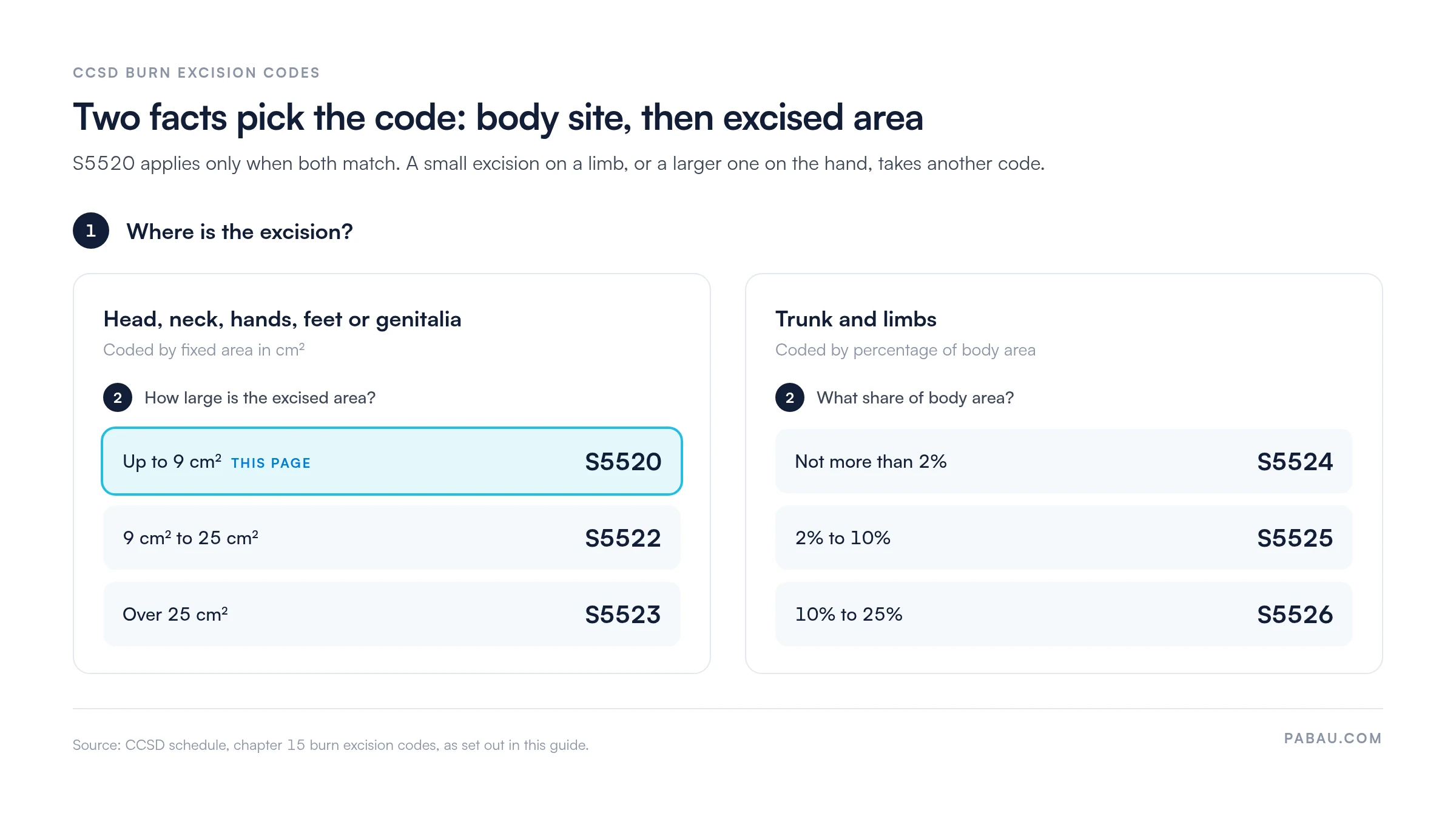
S5520 is the smallest band in a family of burn excision codes. The first three cover the head, neck, hands, feet and genitalia by area. The next three cover the trunk and limbs by percentage of body area.
Other codes sit around these. Burn dressings take their own codes, S5532 to S5535. The top band, for a dressing over 25% of body surface, is S5535. Release of burn scar contracture takes separate codes such as S5562. Scar revision takes S6040 to S6043, which the CCSD schedule lists as unacceptable combinations with the burn excision codes. Laser destruction of skin lesions is banded by treated area too, and a session over 25 cm² takes S0923.
Check the combination table for each code before you add a second line. Use the CCSD codes for insurers library to read a neighbouring code first.
Codes in the same burn excision series are also listed as unacceptable combinations with each other. Bill one band for one excised area, rather than splitting a wound across two bands.
Insurers check the operative note against the code descriptor. If the note cannot support each element of the descriptor, the bill is at risk.
A complete operative note for S5520 includes:
In Pabau, a practice management platform, digital forms let you build an operative note template with these fields. The area and site are then captured during the case, not reconstructed at billing time.
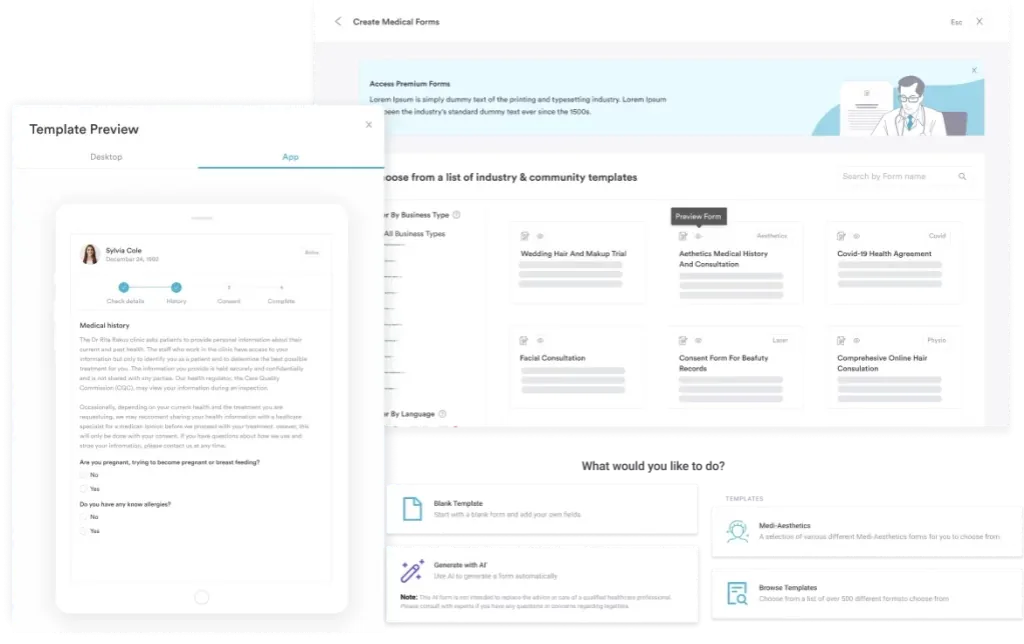
Add a measurement line to your operative note template: site, length and width in cm, calculated area in cm², and method. A note that says “hand burn excised” with no cm² figure will not support S5520.
UK insurers expect a diagnosis code alongside the CCSD procedure code. The UK uses the WHO ICD-10 classification (5th edition), not the US ICD-10-CM, so codes are four characters and carry no laterality digit. The right code depends on the site and on whether the tissue was an acute burn or a healed scar.
Match the diagnosis to the tissue described in the note. An acute burn code on a scar excision, or the reverse, prompts a query from the insurer. The WHO ICD-10 browser shows the full T20 to T25 structure.
CCSD sets the codes, and each insurer sets its own fee against them. CCSD does not set reimbursement, so no single fee applies to S5520 across the market.
Bupa, AXA Health, Aviva and Vitality each publish their own schedules. Our Bupa CCSD codes guide explains how the schedule maps to Bupa’s requirements. If the consultant charges more than the insurer pays, the patient faces a shortfall, so explain it in writing first.
Most UK private medical insurers expect pre-authorisation before elective burn surgery. Rules differ between insurers and policies, so confirm them for each patient before booking theatre.
The patient usually calls the insurer for an authorisation number, using the details in the consultant’s letter. Have these ready:
An authorisation does not guarantee payment. The insurer still checks the bill against the notes. If the excised area turns out larger than planned, tell the insurer and update the authorisation before you bill a different code.
Burn excision often comes with other work in the same theatre visit. The CCSD schedule has no modifier system like the US CPT one. The code choice and each insurer’s rules decide what can be billed together.
Code what the note describes. If the note records only surface tissue removal, a debridement code is correct, not S5520. The CCSD technical guide also says a common intervention should not routinely need more than one code.
When one session includes debridement of a second wound, record each wound against its own site and cm² figure. Billing both codes against the same wound will draw a duplicate-procedure query.
Most S5520 rejections trace back to the operative note or the code choice. The table lists the frequent reasons and the fix for each.
Plastic surgery practices billing S5520 need the site, the area in cm² and the authorisation number on every bill. Pabau keeps those details on one patient record, from the operative note to the claim.
Pabau’s private practice claims software submits UK insurance claims through Healthcode and tracks each one to payment. It works with the codes and details your team records, so a queried burn excision bill is found and corrected quickly.
Structured operative templates in Pabau capture the cm² figure and the site during the case. The details are on record before anyone builds the bill.
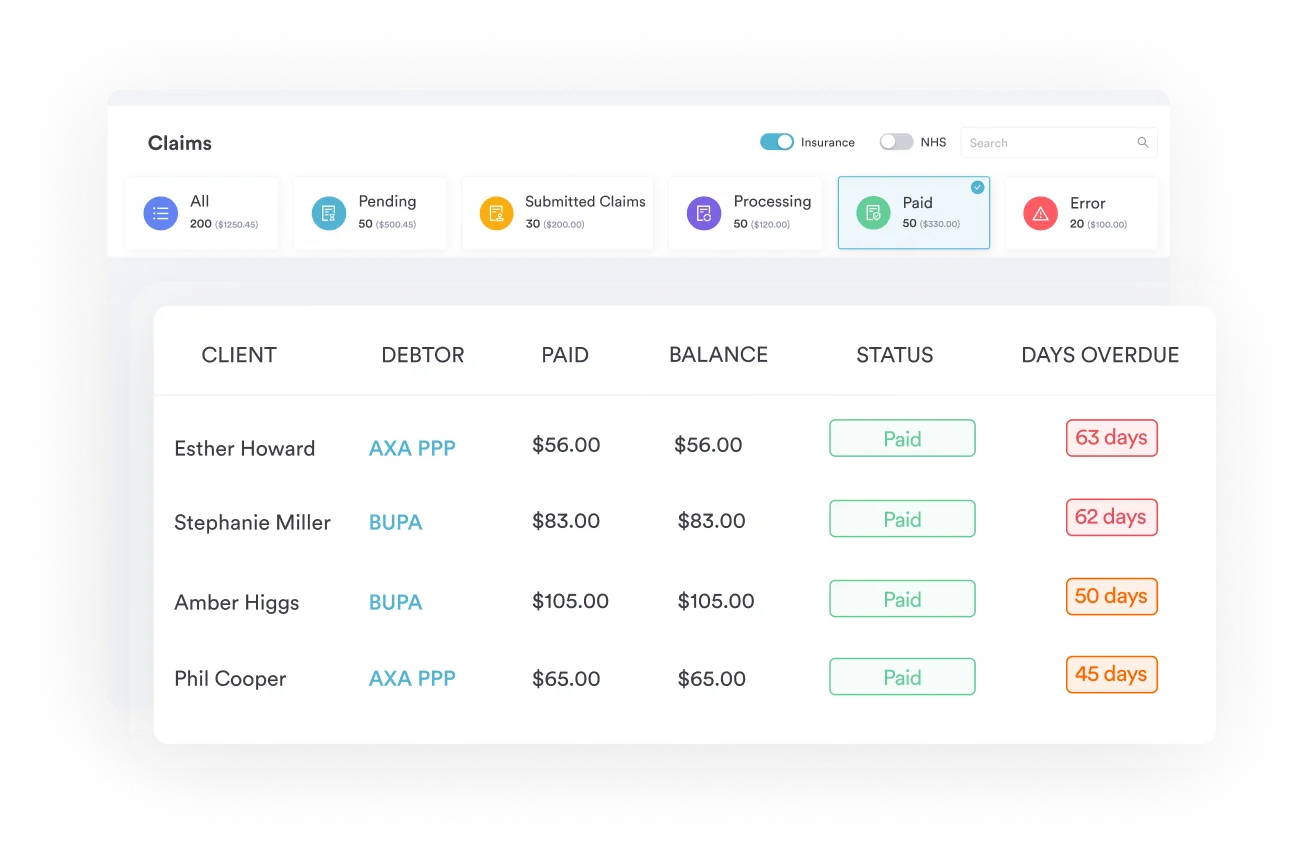

Pabau keeps operative notes, authorisation numbers and CCSD claims on one patient record. Claims go to UK insurers through Healthcode, with their status tracked to payment.

Two facts in the operative note decide S5520. The excision is on the head, neck, hands, feet or genitalia, and it covers 9 cm² or less. Get both on record, and the code follows.
Before each bill goes out, check the measurement, the WHO ICD-10 code and the authorisation number. Then check the insurer’s own fee, since schedules differ and CCSD does not set them.
Book a demo to see how Pabau keeps burn surgery notes and CCSD claims together for UK private practices.

Grafting the excised area on the trunk or limbs? CCSD code S3500 explains how a split autograft is coded by area.
Dressing a burn rather than excising it? CCSD code S5532 covers a burn dressing of the skin or subcutaneous tissue.
Debriding a large wound instead? CCSD code S5712 explains how wound debridement over 25 cm² is coded.
Billing other CCSD codes for UK private healthcare? Bupa CCSD codes guide explains how the CCSD framework applies to Bupa billing.
CCSD code S5520 covers burn excision of a wound or scar on the head, neck, hands, feet or genitalia, up to 9 cm². Both the body site and the excised area must match the descriptor for the code to apply.
At the same sites, an excision above 9 cm² and up to 25 cm² takes S5522, and an excision over 25 cm² takes S5523. Burn excision on the trunk and limbs is coded by body area instead, from S5524 to S5526.
Debridement removes dead tissue from the wound surface and has its own CCSD codes. Excision removes the burned or scarred tissue down to viable tissue. Do not bill both for the same wound in the same session.
Most UK private medical insurers, including Bupa, AXA Health, Aviva and Vitality, expect pre-authorisation before elective burn surgery. Rules vary by insurer and policy, so confirm the authorisation number before theatre.
A graft in the same session is a separate procedure with its own code, if the note documents it separately. Scar revision codes S6040 to S6043 are listed as unacceptable combinations with burn excision.
The operative note needs the exact site, the excised area in cm², whether the tissue was an acute burn or a scar, and the technique. Add the matching WHO ICD-10 code and the surgeon’s GMC and provider numbers.