HCPCS code J7178: Hyaluronidase injection billing guide (2026)
HCPCS code J7178: Official descriptor and 2026 updates HCPCS code J7178 carries ...

Last Updated: Nov 20, 2026
S0923 is the CCSD code for laser destruction of lesion(s) of skin over 25 cm² in area. Practices bill it to UK private medical insurers when a laser destroys one or more skin lesions in a session. The total area treated has to pass 25 cm².
A session of 25 cm² or less is billed as S0922 instead. CCSD lists S0922 and S1500, a skin biopsy, as unacceptable combinations with S0923, and each insurer decides how it applies those principles.
Let Pabau's smart automation suggest the right codes, reduce claim denials, and keep your practice compliant—effortlessly.
Automate repetitive tasks and focus on what matters most—your patients.
Reduce coding errors and ensure compliance with the latest regulations.
Clean claims, fewer denials, and faster reimbursements.
Powerful insights and reporting to help your practice thrive.
HIPAA compliant SOC 2 certified GDPR-compliant Trusted by 4,000+ clinics worldwide

CCSD code S0923 covers laser destruction of lesion(s) of skin over 25 cm² in area, in the schedule UK private medical insurers bill against.
The total area treated in the session decides the code, so a session total of 25 cm² or less is billed as S0922 instead.
CCSD lists S0922 and S1500, a skin biopsy, as unacceptable combinations with S0923.
Each insurer decides whether it adopts those principles and what it pays, so the patient’s policy and pre-authorization settle cover.
A measured area total, a matching diagnosis and the pre-authorization number on the record answer most insurer queries before they’re asked.
CCSD code S0923 is the UK private healthcare code for laser destruction of lesion(s) of skin, over 25 cm² in area. It comes from the Clinical Coding and Schedule Development Group, whose CCSD Schedules hold the standard procedure codes for the UK private healthcare sector.
The group is made up of representatives from four major private medical insurers, Aviva, AXA Health, Bupa and Vitality. You bill the code to whichever insurer covers the patient, alongside an ICD-10 diagnosis that explains why the lesions were treated.
In practice, S0923 turns up after a laser session that cleared a wide spread of lesions. Think extensive plantar warts across both soles, or a field of actinic keratoses on the scalp or back. Whatever the lesion type, the total area treated sets the code. Lesions cut out rather than lasered take an excision code instead. Four or more excised from the head and neck, for example, are billed as code S0642.
For neighboring procedures, our index of CCSD codes lists every code we cover. If Bupa insures the patient, our guide to Bupa CCSD codes shows how its schedule applies them.
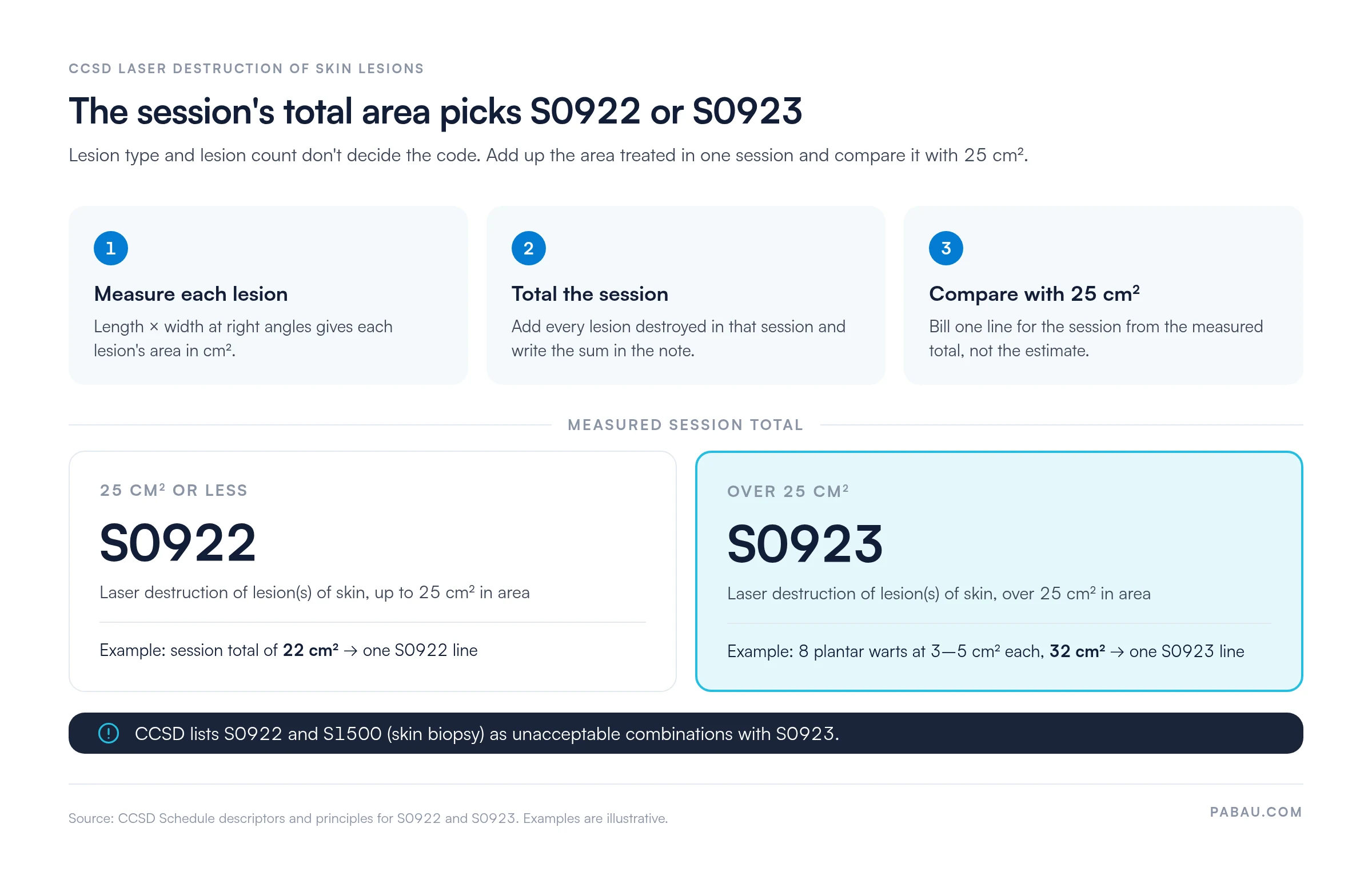
S0923 and its companion CCSD code S0922 describe the same procedure. The laser can be identical, and so can the lesion type. The only difference is the total area treated in the session, with 25 cm² as the dividing line.
Say a patient has plantar warts on both feet. The consultant measures each lesion’s length and its width at right angles, then multiplies the two for an area estimate. Eight lesions come out at 3 to 5 cm² each, and the session total lands at 32 cm².
That session is billed as one S0923 line. Had the total come to 22 cm², it would be one S0922 line. Write the calculation into the procedure note whenever the total sits near the line. That note is what an insurer reads if it queries the code.
The diagram below walks the same decision from tape measure to claim line.
The CCSD principles for S0923 list two codes as unacceptable combinations. Each one catches a different billing habit, so take them in turn.
Because the two codes split one session by area. Billing S0923 for the session and S0922 for a few extra lesions counts the same procedure twice. Splitting a 32 cm² session into two S0922 lines is the mirror-image error. Total the area once and pick one code.
CCSD code S1500 covers biopsy of skin or subcutaneous tissue, and CCSD lists it as unacceptable alongside S0923. CCSD’s listing suggests a sample taken in the same session is treated as part of it, so confirm that with the insurer.
A biopsy at an earlier, separate appointment is usually a separate episode of care. These are CCSD’s coding principles, and CCSD doesn’t determine classifications, reimbursement or fees. Each insurer decides whether it adopts a combination rule and how it applies it. AXA Health, for one, asks for codes that are within their intended purpose, as defined by the CCSD.
Every S0923 claim carries an ICD-10 diagnosis, and that code has to match the finding in the clinical notes. The table below is illustrative only. It shows diagnoses that often justify laser treatment of skin lesions, and none of them is tied to S0923 by CCSD or any insurer.
UK insurers work from the WHO edition of ICD-10, which stops at three characters for some of these diagnoses. Choose the code the clinical finding supports, never the one most likely to get paid.
A large-area claim invites a closer look, so the record has to show the size, the reason and who did the work. Structured digital forms in practice software such as Pabau make those fields hard to skip.

Keep these in the record for every S0923 session:
Photograph the treatment field before the session with a ruler in shot. When an insurer questions whether the area passed 25 cm², a dated photo settles it faster than any letter.
Good notes only pay off if the claim follows them. The claim itself is the last step, and most of the work happens before the patient is on the couch.
Cover is the step that catches people out. An insurer can decline a lesion it treats as cosmetic, even when the consultant sees a clinical reason. Bupa, for example, lists cosmetic surgery among its general exclusions, so state the clinical reason in its own sentence in the notes.
Run through this list before an S0923 claim leaves the practice. It takes a minute and covers the points insurers query most.
In many practices, lesion sizes sit in a free-text note and the pre-authorization number sits in an email. Someone keys in the claim days later and has to rebuild the area total. That is where S0923 and S0922 get swapped.
Pabau’s built-in claims management keeps those pieces on one patient record. A procedure-note template in its digital forms can ask for each lesion’s size, so the total is written once, at the point of care.
The pre-authorization code, dates and sessions are tracked on the patient’s case, with a warning when one is missing. Claims then go to UK insurers electronically through Healthcode or Bupa, so the code on the claim matches the note behind it.

Pabau records lesion sizes, pre-authorization codes and claims on one patient record. Your S0923 claims reach the insurer with the area total and diagnosis that support them.

S0923 is a measuring job first and a coding job second. Get the area total on the record, and the choice between S0923 and S0922 makes itself.
The rest comes down to the insurer. CCSD writes the principles, but each insurer decides what it adopts and what it pays. Confirm cover before the session, and keep the evidence where the person billing can see it.
Pabau keeps lesion measurements, pre-authorizations and insurer claims together for dermatology and laser practices. Book a demo to see how it fits a practice billing UK insurers.

Treated 25 cm² or less? CCSD code S0922 covers the same laser procedure for the smaller area.
Taking a biopsy at a separate visit? CCSD code S1500 covers biopsy of skin or subcutaneous tissue.
Removing a malignant lesion surgically instead? CCSD code S0602 covers primary excision of a malignant lesion on the head or neck.
Billing Bupa for the first time? CCSD billing codes for Bupa providers covers code structure, submission and fee schedules.
No. The S0923 descriptor specifies laser destruction, so lesions frozen, scraped or cauterized fall outside it. Look up the code for that method in the CCSD Schedule before you quote it to the patient.
Each insurer sets its own fee. CCSD doesn’t determine reimbursement or fees, so check the patient’s insurer schedule, such as AXA Health’s Schedule of Procedures and Fees, before quoting a price.
Per session. The descriptor reads lesion(s), so one S0923 line covers every lesion destroyed in that session once their combined area passes 25 cm². Ask the insurer before adding a second line.
Often, when there’s a clinical reason, such as pre-cancerous actinic keratoses or painful plantar warts. Treatment for appearance alone typically falls under the cosmetic exclusion, and the patient’s policy wording has the final say.