CPT Code 19361: Latissimus dorsi flap breast reconstruction
CPT code 19361: Official descriptor and payment basics CPT code 19361 is the Cat...

Last Updated: Nov 18, 2026
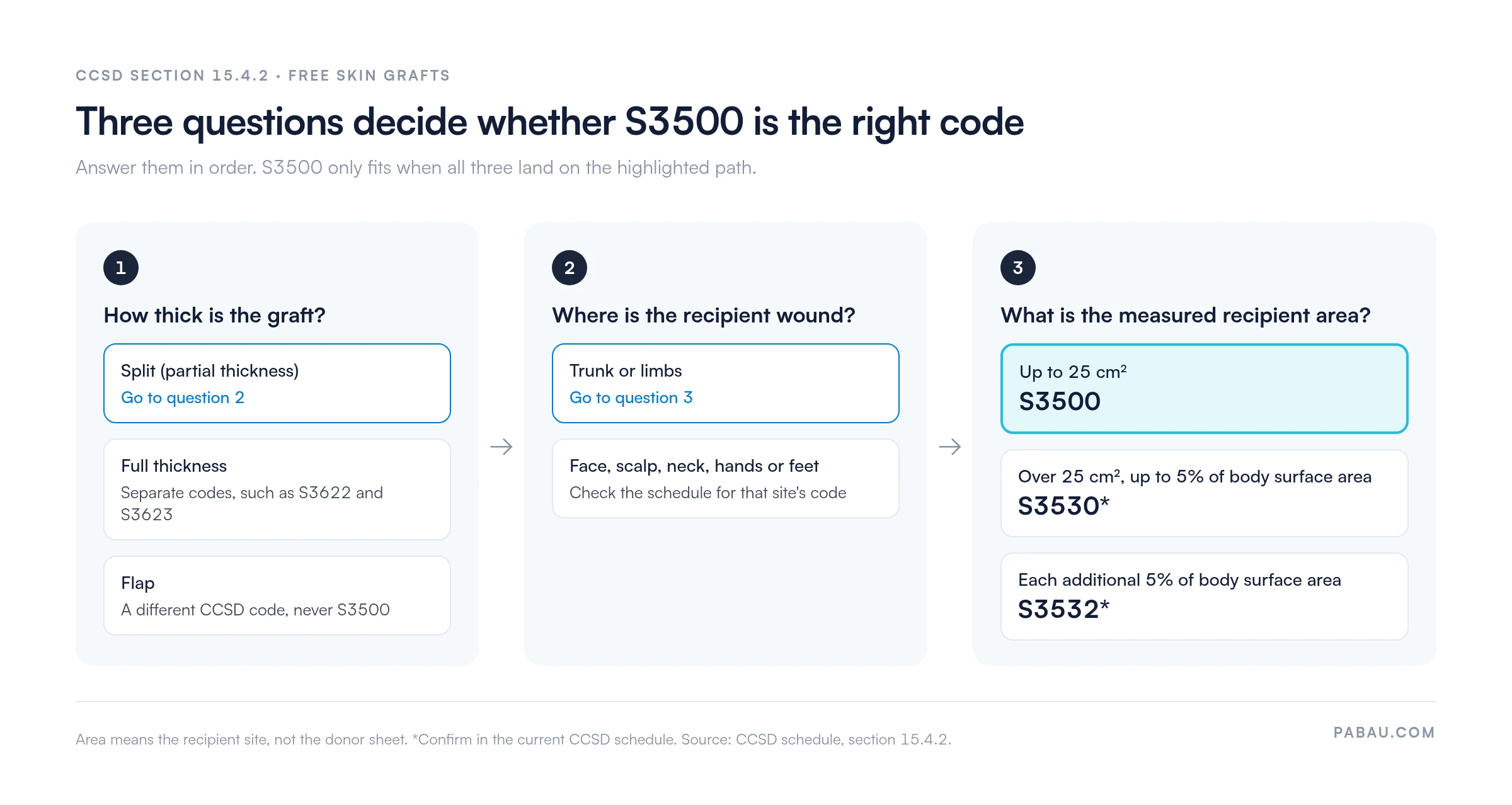
S3500 is the CCSD code for a split autograft of skin on the trunk and limbs, up to 25 cm² in recipient area. The surgeon harvests partial-thickness skin from the patient’s own donor site and grafts it onto a wound on the trunk, an arm or a leg.
The code sits in section 15.4.2 Free Skin Grafts of the CCSD schedule, which UK private medical insurers use to identify procedures on a bill. Larger areas, full thickness grafts and grafts to the face, hands or feet take other codes.
Let Pabau's smart automation suggest the right codes, reduce claim denials, and keep your practice compliant—effortlessly.
Automate repetitive tasks and focus on what matters most—your patients.
Reduce coding errors and ensure compliance with the latest regulations.
Clean claims, fewer denials, and faster reimbursements.
Powerful insights and reporting to help your practice thrive.
HIPAA compliant SOC 2 certified GDPR-compliant Trusted by 4,000+ clinics worldwide

CCSD Code S3500 is the UK private healthcare code for a split skin autograft on the trunk and limbs, up to 25 cm²
The recipient area must be measured and recorded in cm² in the operative note, since the area decides the code
Grafts over 25 cm² take a higher-area code such as S3530, not S3500 plus an add-on line
CCSD sets the codes, while each UK private medical insurer sets its own fees and pre-authorisation rules
Pabau, the practice management platform we build, submits UK insurance claims through Healthcode and tracks their status, using the codes your team records
CCSD Code S3500 describes a split autograft of skin on the trunk and limbs, up to 25 cm² in area. The Clinical Coding and Schedule Development (CCSD) group maintains the code for UK private healthcare. The patient’s own skin is harvested at partial thickness and applied to a wound at a separate recipient site. AXA Health’s schedule of procedures lists S3500 with the same descriptor and area limit.
The code sits in chapter 15 (skin and subcutaneous tissue), section 15.4.2 Free Skin Grafts, of the CCSD schedule. Our CCSD code reference covers the other procedures billed under that schedule.
UK private medical insurers such as Bupa, AXA Health, Aviva and Vitality use CCSD codes to identify the procedure on a bill. CCSD does not set fees or reimbursement. Each insurer applies its own fee schedule and rules to the code.
Body site and area both decide whether S3500 is correct. The clinical record has to support each one.
A split-thickness skin graft (STSG) takes the epidermis and part of the dermis from a donor site with a dermatome. The donor site heals by re-epithelialisation, while the graft carries enough dermis to take at the recipient wound bed.
Partial thickness separates S3500 from full thickness grafts, which take the whole dermis, and from flaps, which carry their own blood supply. Both sit under different CCSD codes. Full thickness grafts on the trunk and limbs, for example, are coded S3622 and S3623.
S3500 fits a trunk or limb wound of 25 cm² or less. The wound cannot close directly or heal well by secondary intention.
The descriptor names the trunk and limbs only. Grafts to the face, scalp, neck, hands or feet may be coded differently within section 15.4.2. Check the CCSD schedule before using S3500 for a wound at those sites, including a foot ulcer.
The 25 cm² limit refers to the recipient site area, not the size of the harvested donor sheet. Recording that figure correctly prevents the most common area-related rejection: billing S3500 for a defect larger than 25 cm².
A simple method multiplies the longest length by the widest perpendicular width of the wound bed in centimetres (L × W). Tracing or planimetry gives a better figure for irregular wounds. Record the measured number in the operative note, not an estimate.
Harvesting the graft and closing the donor site are normally part of the split autograft itself. S3500 describes the whole operation, including the donor site.
A donor site that needs its own separate procedure is a different matter. Ask the insurer before adding a second code, because a line it considers included will be rejected or recovered.
S3500 sits in section 15.4.2 Free Skin Grafts. The key variables are graft thickness, body site and recipient area, and coders check them in that order.
The table below sets out the related codes side by side.
Confirm each descriptor against the current CCSD schedule and the CCSD technical guide before you bill. Descriptors change over time, so billing from memory is a preventable error.
An S3500 claim stands or falls on the operative note. Insurers can audit graft claims against the record, so every claim needs a note that records the following.
Pabau’s clinical record tools let surgical teams build structured operative note templates. Those templates capture these fields the same way on every case.
UK insurers code diagnoses with WHO ICD-10, not the US ICD-10-CM. The diagnosis must describe a wound that justifies a split graft on the trunk or limbs.
Confirm the subcode in the WHO ICD-10 browser. Use the most specific code the clinical record supports.
CCSD sets the codes, and each insurer sets its own fee against them. The CCSD guidance does not set reimbursement, so no single fee applies to S3500 across the market.
Bupa, AXA Health, Aviva and Vitality each publish their own schedules. Our Bupa CCSD codes guide explains how the schedule maps to Bupa’s requirements. Check the patient’s insurer before quoting. A consultant who charges more than the insurer pays leaves the patient with a shortfall, so explain it in writing first.
Most UK private medical insurers expect pre-authorisation before an elective skin graft. Rules differ between insurers and policies, so confirm them for each patient before booking theatre.
The patient usually calls the insurer for an authorisation number, using the CCSD code and diagnosis from the consultant’s letter. Have these ready:
Ask for authorisation when the procedure is booked, not on the day of surgery. If the graft area turns out larger than planned, tell the insurer and update the authorisation before you bill a different code.
Urgent grafting after an unplanned admission still needs the insurer’s agreement. Contact the insurer as soon as possible, follow its own process, and record the clinical urgency in the notes.
The CCSD schedule has no modifier system like the US CPT one. Circumstances that would take a modifier in the US are handled by the code choice and by each insurer’s own rules.
The CCSD technical guide says a common intervention should not routinely need more than one code. Insurers also have their own contractual rules on multiple codes, so check both.
A reliable S3500 workflow runs from the clinical decision to payment. Each step below closes off one of the rejection reasons listed in the next section.
Most S3500 rejections trace back to the operative note or the code choice. The table lists the most frequent reasons and the fix for each.
Audit S3500 claims every quarter. Check that each operative note has a cm² figure, a named body site and a matched ICD-10 code. That three-point check catches most rejection-prone records before an insurer does.
Plastic surgery practices billing S3500 need the measured graft area, the code and the authorisation reference on every claim. Pabau keeps those details on one patient record, so nobody rebuilds them from paper notes at billing time.
Pabau’s claims software for private practices submits UK insurance claims through Healthcode and tracks each one from submission to payment. It works with the codes and details your team records, so a rejected graft claim is spotted and corrected quickly.
Plastic surgery practices also get structured operative templates and digital forms in Pabau. The cm² figure and the body site are captured during the case, before anyone builds the bill.
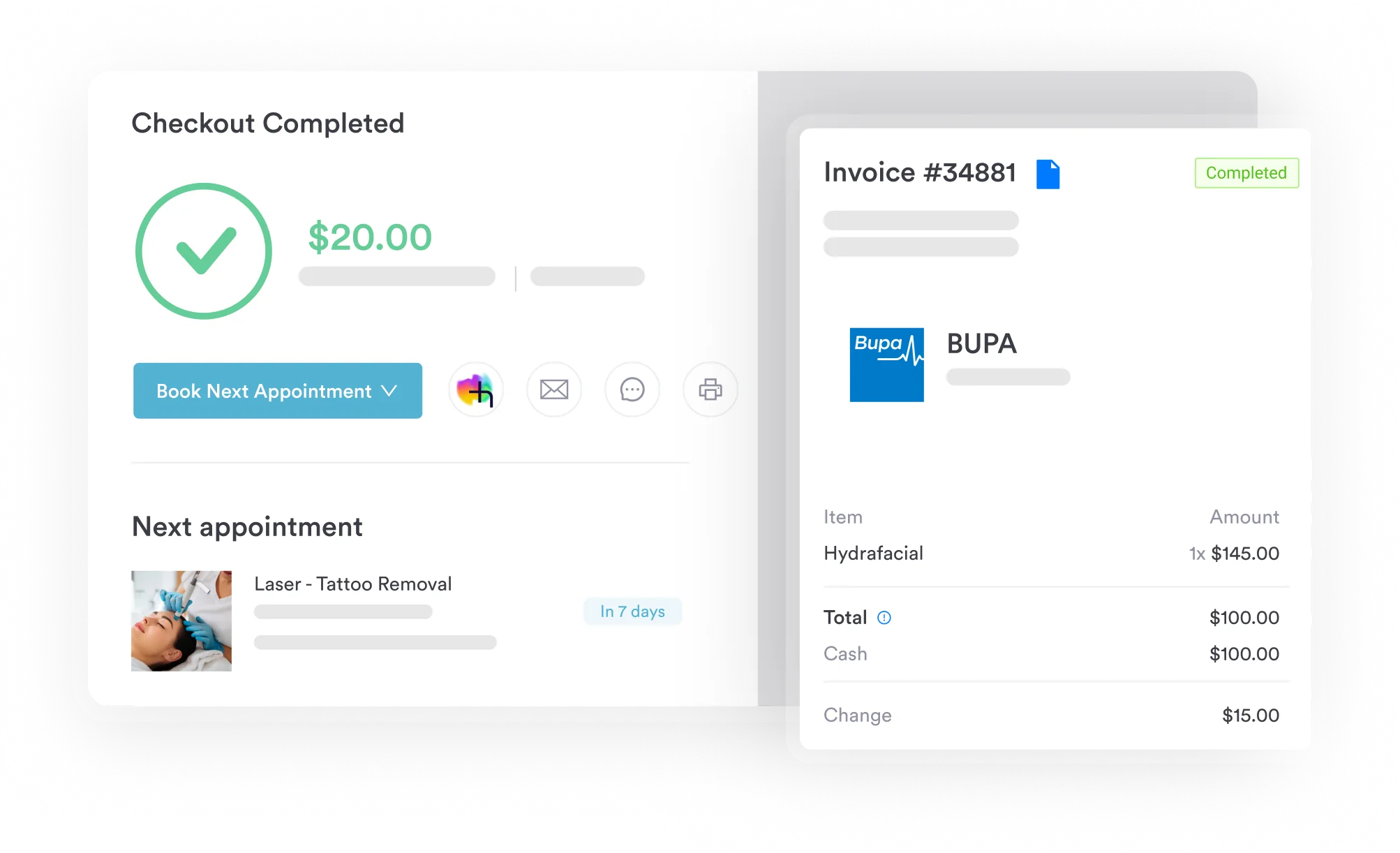

Pabau helps UK private surgical practices keep clinical documentation and insurance claims in one place. Claims go to insurers through Healthcode, with their status tracked to payment.

Two facts in the operative note decide S3500. The graft sits on the trunk or a limb, and it covers 25 cm² or less. Get both on record, and the code follows.
Before each bill goes out, check the measurement, the WHO ICD-10 code and the authorisation number. Then check the insurer’s own fee, since schedules differ and CCSD does not set them.
Book a demo to see how Pabau keeps graft notes and CCSD claims together for UK private practices.

Grafting full thickness skin instead? CCSD code S3623 explains how full thickness graft areas are counted on the trunk and limbs.
Billing other CCSD codes for UK private healthcare? Bupa CCSD codes guide explains how the CCSD framework applies to Bupa procedure billing.
Closing the defect with a flap instead? CCSD code S1700 covers distant flap delay, division and inset.
Billing burn care before the graft? CCSD code S5532 explains how a burn dressing of the skin or subcutaneous tissue is coded.
CCSD Code S3500 covers a split autograft of skin on the trunk and limbs, up to 25 cm² in recipient area. The patient’s own partial-thickness skin is harvested and applied to a wound on the trunk, arm or leg. Larger areas and other body sites take different codes.
S3500 stops at 25 cm². Larger areas on the trunk and limbs take a higher-area code, such as S3530 for over 25 cm² up to 5% of body surface area. S3532 covers each additional 5%. Confirm both in the current CCSD schedule before billing.
Multiply the longest length by the widest perpendicular width of the wound bed in centimetres. For irregular wounds, tracing or planimetry gives a better figure. Record the measured number in the operative note, because an approximate area will not support the claim.
Most UK private medical insurers, including Bupa, AXA Health, Aviva and Vitality, expect pre-authorisation before an elective skin graft. Rules vary by insurer and policy. The patient usually obtains an authorisation number using the CCSD code and diagnosis, so confirm it before theatre.
The usual reasons are a missing cm² figure, billing S3500 for an area over 25 cm², and a body site outside the trunk or limbs. Missing pre-authorisation, a non-matching WHO ICD-10 code and missing GMC or provider numbers also cause rejections. Each is fixed with the right documentation.
No. The CCSD schedule has no modifier system like the US CPT one. Larger areas take a higher-area code, and multiple sites or debridement follow each insurer’s own rules. Check the CCSD technical guide and the patient’s insurer before adding extra lines.