CPT Code 19361: Latissimus dorsi flap breast reconstruction
CPT code 19361: Official descriptor and payment basics CPT code 19361 is the Cat...

Last Updated: Nov 18, 2026
S4930 is the CCSD (Clinical Coding and Schedule Development) code for removal of skin expander or valve (not related to breast reconstruction). The surgeon removes a tissue expander, its fill valve, or both, from the scalp, trunk or a limb. AXA Health rates it Intermediate.
Expander removal after breast reconstruction is coded in chapter 7 Breast instead, with B-codes such as B3033. The neighbouring repair codes S4812, S4910 and S4911 cover inserting and adjusting a skin expander.
Let Pabau's smart automation suggest the right codes, reduce claim denials, and keep your practice compliant—effortlessly.
Automate repetitive tasks and focus on what matters most—your patients.
Reduce coding errors and ensure compliance with the latest regulations.
Clean claims, fewer denials, and faster reimbursements.
Powerful insights and reporting to help your practice thrive.
HIPAA compliant SOC 2 certified GDPR-compliant Trusted by 4,000+ clinics worldwide

CCSD code S4930 covers removal of a skin expander, its valve, or both, when the removal is not part of breast reconstruction.
Expander or prosthesis removal after breast reconstruction is coded in chapter 7 Breast, with B-codes such as B3033 or B3036.
The neighbouring repair codes are S4812 for inserting a skin expander, S4910 for volume adjustment and S4911 for positional surgical adjustment.
AXA Health rates S4930 as Intermediate, at £400 for the surgeon and £213 for the anaesthetist, and bars billing it with S4812 or S4910.
Pabau’s claims management software sends CCSD-coded claims to UK insurers such as Bupa through Healthcode, with the operative note on the same patient record.
CCSD code S4930 is the UK private healthcare code for removal of a skin expander or valve, not related to breast reconstruction.
AXA Health’s specialist code schedule lists it in chapter 15 Skin and subcutaneous tissue as an Intermediate procedure. The surgeon removes a subcutaneous tissue expander, its fill valve, or both, at a site other than a reconstructed breast.
CCSD stands for Clinical Coding and Schedule Development, the shared schedule of private insurer procedure codes in the UK. The CCSD Group of Bupa, AXA Health, Aviva and Vitality maintains it. Other UK private medical insurers use it too, and claims usually travel electronically through Healthcode.
Fees and bands change, so check the insurer’s current schedule before you quote a patient. Our Bupa CCSD codes reference lists the full schedule by chapter.
A skin expander is a silicone balloon placed under the skin and filled with saline over several weeks. It stretches the overlying tissue so the surgeon can cover a nearby defect. The fill valve is either built into the expander or sits in a separate port, joined by a tube. Some defects on the trunk or limbs are closed with a full thickness skin graft instead. That graft is billed as S3622, plus one CCSD code S3623 line for each 25 cm² beyond the first 9 cm². A split thickness graft of up to 25 cm² on the trunk or limbs is coded S3500.
Removal is a planned operation under local or general anaesthesia, depending on the size of the device and the site. A typical S4930 procedure follows this sequence:
S4930 also applies when only the valve comes out and the expander body stays in place. The operative note must state which components were removed, and why.
S4930 is used when a skin expander or its valve has to come out, at any site outside a breast reconstruction. Expanders are placed for scalp reconstruction after trauma or tumour excision, burn contracture release, scar revision and large skin defects on the trunk or limbs. Common reasons for removal include:
The clinical notes must name the indication. A claim that says only “expander removal”, with no reason, invites questions from the insurer’s claims team.
S4930 does not apply when the expander was placed as part of a breast reconstruction. That work is coded in chapter 7 Breast of the CCSD schedule, with B-codes. B3033 covers simple removal of a prosthesis from the breast, and B3036 covers removal and replacement of a prosthesis.
A common example is the staged reconstruction after mastectomy. The expander goes in under B3012 alongside the mastectomy, or under B3014 as a delayed reconstruction. Its later exchange for a permanent implant also belongs under chapter 7, never under S4930.
AXA Health also lists B3180, implantation of prosthesis into breast as sole procedure, as a code that cannot be billed with S4930.
Before you code, check two things: the indication in the operative note, and the diagnosis the surgeon assigned. A diagnosis such as C50 (malignant neoplasm of breast), Z90.1 (acquired absence of breast) or Z42.1 points to the breast chapter.
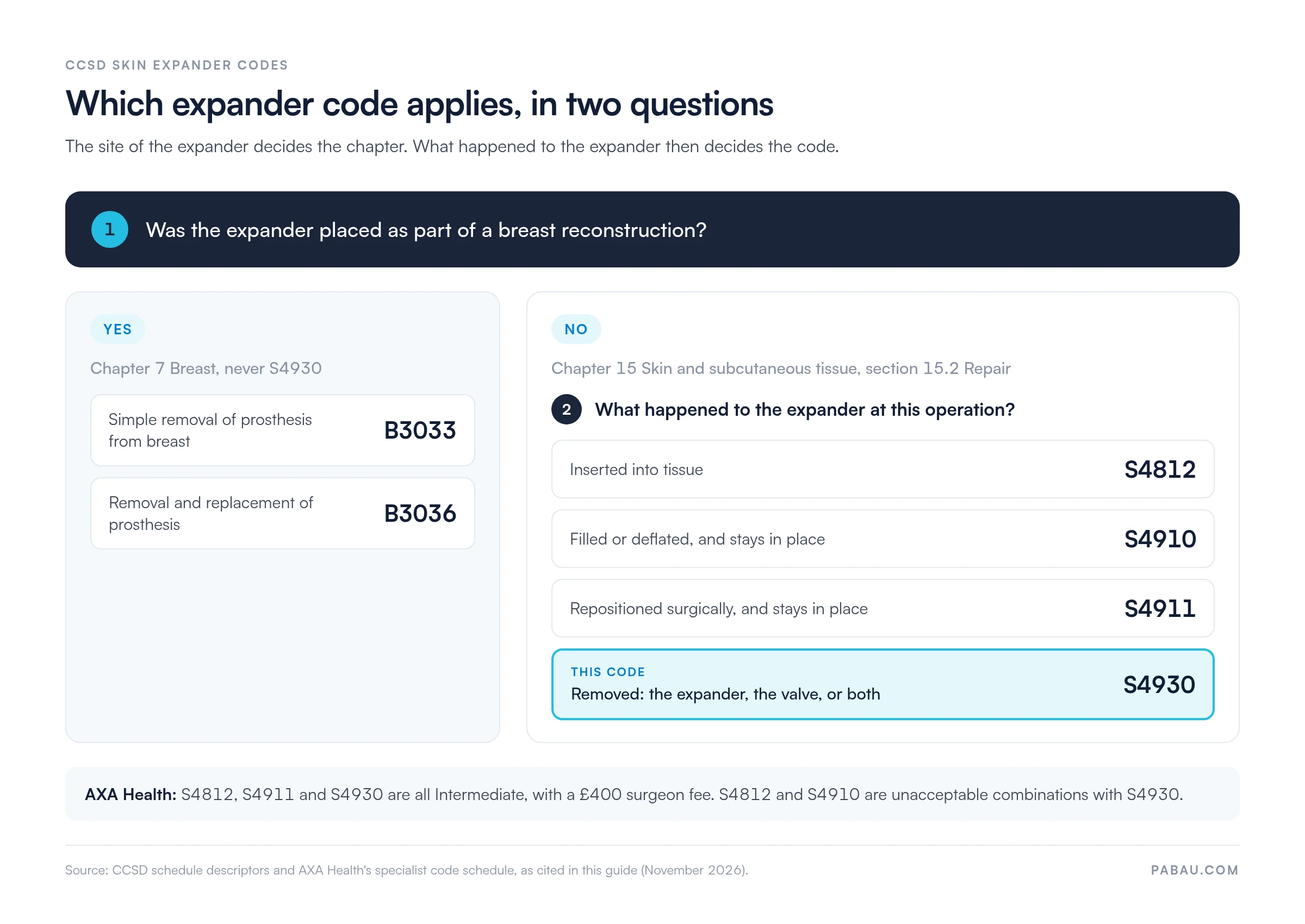
S4930 sits in section 15.2 Repair alongside three other skin expander codes. Each one describes a different stage of the same expansion programme, so the operative note decides which applies. Confirm the descriptors in the current CCSD schedule before you submit.
AXA Health rates S4812, S4911 and S4930 alike, as Intermediate with a £400 surgeon fee. The coding choice matters for accuracy and combination rules, more than for the fee. The chart below reduces the six codes to two questions, about where the expander sat and what happened to it.
UK insurers expect a diagnosis code from the WHO ICD-10 classification on each claim. US ICD-10-CM codes, with their extra digits, are not used. The table lists WHO codes often paired with S4930, by the reason for removal.
Use the code that matches the reason for removal and the site in the notes. Keep it consistent with the code on the pre-authorisation. T85.4, mechanical complication of breast prosthesis and implant, and Z42.1, plastic surgery of breast, point to the breast chapter instead.
Before you submit an S4930 claim, read the diagnosis again. If it mentions the breast, a mastectomy or a breast prosthesis, ask the surgeon whether a chapter 7 B-code applies instead.
CCSD sets the codes, and each insurer sets its own fee schedule against them. AXA Health rates S4930 as Intermediate, with a surgeon fee of £400 and an anaesthetist fee of £213. Bupa, Aviva and Vitality publish their own schedules, and Bupa’s code search shows its current figure.
A specialist who charges more than the insurer pays leaves the patient with a shortfall. Tell the patient about it in writing before the procedure.
Most UK private medical insurers expect pre-authorisation before a planned procedure. Requirements differ between insurers, policies and settings, so confirm them for each patient before you book.
When you request authorisation, have the following ready:
An infected or extruding expander may come out before authorisation is in place. Call the insurer as soon as possible, and ask whether it accepts a retrospective request.
Insurers ask for clinical notes when an S4930 claim raises a question, and the CCSD Technical Guide sets out the schedule’s coding rules. The claim file should hold:
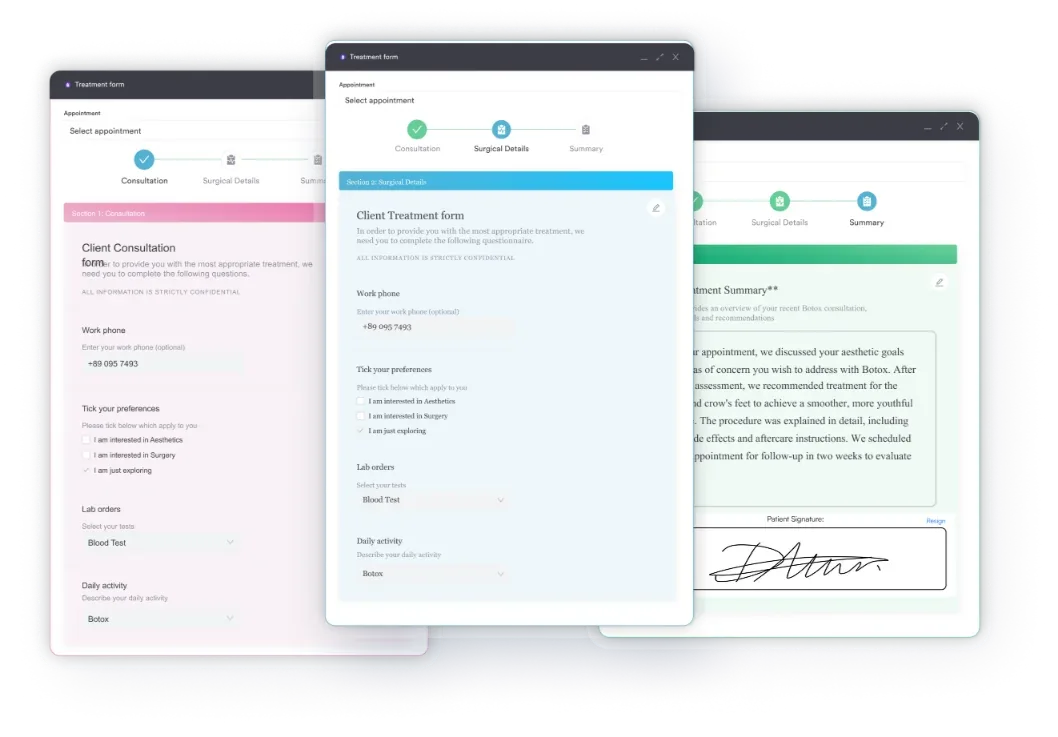
Capture these fields in digital clinical forms at the point of care. Structured notes let you pull the exact sentence an insurer asks for, without searching a paper file.
Whether another code goes on the claim depends on the setting and the insurer. CCSD has no CPT-style modifiers, so each situation follows the insurer’s own rules:
AXA Health’s list of unacceptable combinations for S4930 also includes S5210 and the breast codes B3180 and B3020. When you are unsure how an insurer handles a pair, ask its provider services team before you submit.
Most S4930 denials are predictable, and most can be caught before submission. The table maps each common reason to its fix.
If a claim is declined, raise it with the insurer’s provider services team first. A patient whose claim the insurer still refuses can use the insurer’s complaints process, then the Financial Ombudsman Service.
Plastic and reconstructive surgeons billing S4930 often bill the same patient three or four times across one expansion programme. Each invoice needs the right code for that stage and a note that supports it.
Pabau, the practice management platform we build, keeps the operative note and the invoice on one patient record. Its claims management software sends CCSD-coded claims to UK insurers such as Bupa through Healthcode. Your team then tracks each claim and reconciles the insurer’s payment in the same place.
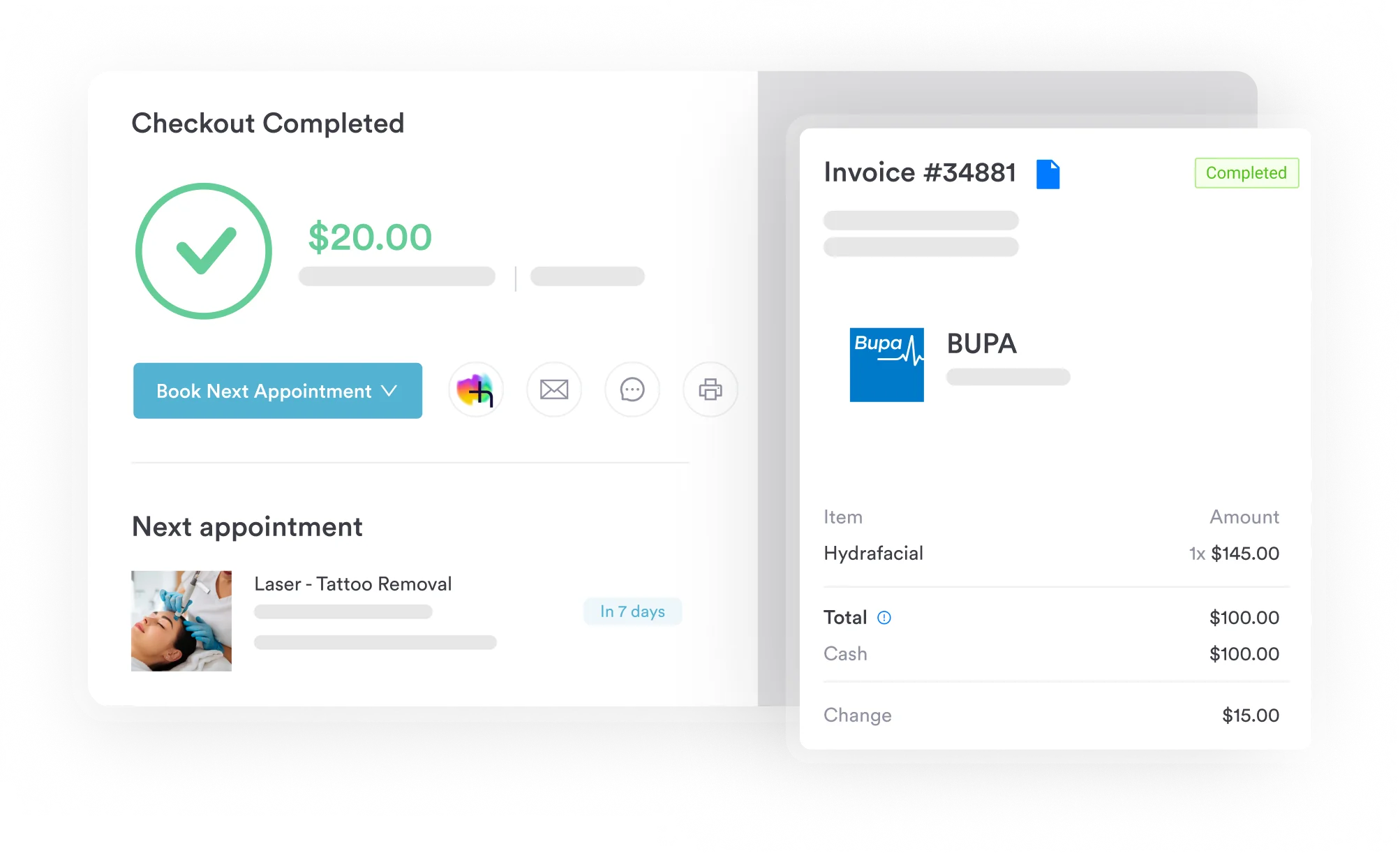
For plastic surgery practices, the expansion history sits in the record from insertion to removal. A coder can see at a glance whether the expander was placed for a breast reconstruction.

Pabau sends CCSD-coded claims to UK insurers such as Bupa through Healthcode, with the operative note and authorisation reference on the same patient record. Your S4930 invoices go out complete.

S4930 pays for taking a skin expander out, anywhere except a reconstructed breast. The code itself is simple. Claims for it usually fail on context, such as a breast history in the notes or no stated reason for removal.
Before the invoice goes out, check that the note names what was removed and why, and that no S4812 or S4910 sits beside it. Then confirm the insurer’s authorisation and its own fee, since AXA Health’s £400 is one schedule among several.
Book a demo to see how Pabau sends CCSD claims through Healthcode and keeps the operative note beside each one.

Moving from an expander to a permanent implant? CCSD code B3015 covers breast reconstruction using a fixed prosthesis in a single operative stage.
Billing a wound repair from the same chapter? CCSD code S4182 covers debridement and primary suture of a head and neck wound.
CCSD code S4930 covers surgical removal of a skin expander, its fill valve, or both, when the expander was not placed for breast reconstruction. UK private insurers such as Bupa, AXA Health, Aviva and Vitality use it. Typical sites include the scalp, trunk and limbs.
No. Removal after breast reconstruction is coded in chapter 7 Breast of the CCSD schedule. B3033 covers simple removal of a prosthesis from the breast, and B3036 covers removal and replacement of a prosthesis.
S4812 covers insertion of a skin expander into tissue, not related to breast reconstruction. S4910 covers volume adjustment, and S4911 covers positional surgical adjustment of a skin expander in subcutaneous tissue. AXA Health does not allow S4812 or S4910 on the same claim as S4930.
Most UK private medical insurers, including Bupa, AXA Health and Vitality, expect pre-authorisation before a planned procedure. Requirements vary by insurer and policy, so confirm them for each patient. Quote the authorisation reference on the invoice.
Use WHO ICD-10 codes, not US ICD-10-CM codes. Common pairings are T85.6 for device failure, T85.7 for infection and T85.8 for other device complications. Z42.0 to Z42.4 cover planned removal after expansion, by body site.
Yes, but not on the surgeon’s invoice. The anaesthetist invoices the insurer separately, and AXA Health lists an anaesthetist fee of £213 for S4930. Local anaesthetic given by the surgeon is part of the procedure.