CPT code 93503: Swan-Ganz catheter billing and modifiers
CPT code 93503: Official descriptor and procedure overview In the AMA CPT code s...

Last Updated: Oct 23, 2026
C1420 is the CCSD code for graft of skin to eyelid. It covers harvesting full- or split-thickness skin and fixing it over an upper or lower eyelid defect. Most cases follow tumor excision, trauma or scarring.
UK private insurers such as Bupa, AXA Health and Vitality pay it under their own CCSD schedules. Freedom pays £300 for it as an Intermediate procedure. Lid codes that already include a graft, such as C1513, are billed instead of C1420.
Let Pabau's smart automation suggest the right codes, reduce claim denials, and keep your practice compliant—effortlessly.
Automate repetitive tasks and focus on what matters most—your patients.
Reduce coding errors and ensure compliance with the latest regulations.
Clean claims, fewer denials, and faster reimbursements.
Powerful insights and reporting to help your practice thrive.
HIPAA compliant SOC 2 certified GDPR-compliant Trusted by 4,000+ clinics worldwide

CCSD code C1420 is the UK private medical insurance code for a graft of skin to eyelid, listed in chapter 4 (Eye and orbital contents).
Freedom Health Insurance pays C1420 as an Intermediate procedure, at £300 for the specialist and £213 for the anesthetist (January 2026).
Lid codes that already include a graft, such as C1513 and C1523, are billed instead of C1420, never alongside it.
Most UK private insurers expect pre-authorization before a planned eyelid graft, and the reference number belongs on the claim.
Pabau’s claims management software keeps the authorization reference, operative note and CCSD claim on one patient record.
CCSD code C1420 is the UK private medical insurance code whose official descriptor is “Graft of skin to eyelid.” It covers harvesting a skin graft and fixing it over a defect of the upper or lower eyelid.
The code sits in chapter 4 (Eye and orbital contents) of the schedule, in section 4.2, “Eyebrow and lid.” It belongs to the C-series of CCSD codes that ophthalmic and oculoplastic surgeons bill.
The schedule is maintained by the Clinical Coding & Schedule Development (CCSD) Group. Bupa, AXA Health, Vitality, Cigna, WPA and Aviva use it to invoice and reimburse private medical insurance claims across the UK. Each insurer then sets its own fee against the code.
The descriptor does not split full-thickness from split-thickness grafts. The operative note has to name the graft type, because insurers review it before they pay.
An eyelid skin graft is used when a defect is too large to close directly or to repair with local tissue alone. The usual reasons for a C1420 procedure are:
Record the indication in the operative note alongside the ICD-10 diagnosis code. Insurers judge medical necessity from the diagnosis and the surgical plan together.
Insurers also check that the graft is reconstructive. Freedom’s chapter 4 notes say it does not cover blepharoplasty, which must not be coded as eyelid reconstruction. If a graft repairs a lid that cosmetic surgery left unable to close, write the functional problem into the notes.
Knowing the surgical steps helps coders check that the operative note supports a C1420 claim.
The operative note should cover each step, name the donor site and state the graft type. A line such as “eyelid reconstruction performed” will not get through an insurer’s clinical review.
The donor site question causes many C1420 errors. Chapter 4 of the schedule lists no separate code for harvesting the graft, so a simple harvest and closure form part of C1420. The same rule runs elsewhere in the chapter. C4010 covers a mucosal graft to conjunctiva, and the donor harvest is part of that code.
The bigger risk runs the other way. Several lid codes already include a graft in their descriptor. Adding C1420 on top of one of them bills the same graft twice.
Check each insurer’s current schedule before you bill, because bundling rules are set insurer by insurer.
Four questions, asked in order, settle which code carries the graft. The flow below adds the Freedom fee each code earns.
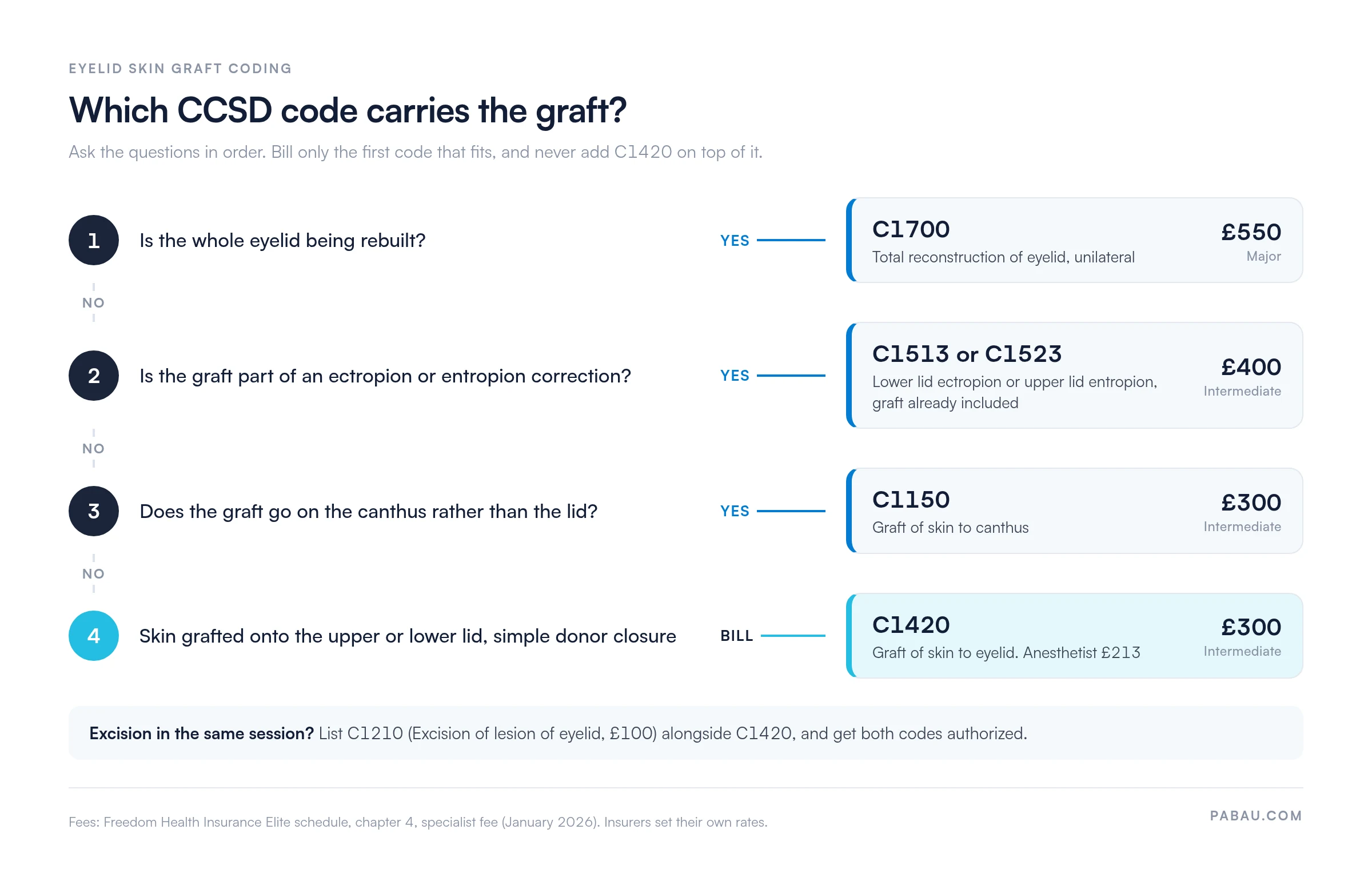
These chapter 4 codes sit closest to C1420. The Bupa CCSD codes guide lists the full descriptors for the ophthalmology chapter.
A temporary tarsorrhaphy is sometimes placed to protect a lower lid graft while it heals. It bills separately under its own code, C1640.
CCSD codes carry no national fee. Each insurer publishes its own schedule and sets what it pays for C1420.
Two published schedules give a benchmark. Freedom’s Elite schedule (January 2026) puts C1420 in its Intermediate band at £300 for the specialist and £213 for the anesthetist. National Friendly’s schedule (October 2025) pays £348.
Our guide to the Bupa fee schedule explains how Bupa structures its fees.
Some practices also bill international patients under US CPT coding, where a full-thickness eyelid graft usually maps to CPT 15260. The mapping below is approximate, because the two systems share no official crosswalk.
The main difference is size. CPT pays by graft area, while C1420 is a single code for the whole graft. UK insurers pay C1420 against their own CCSD schedules, never against CPT values.
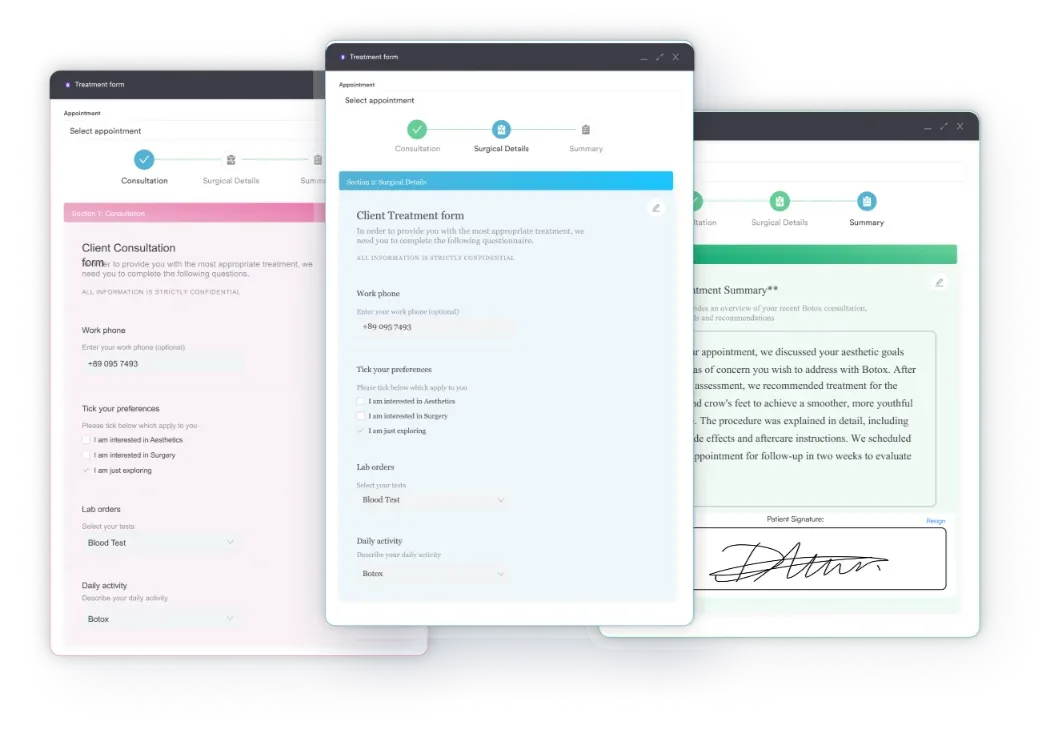
Complete documentation is the part of a C1420 claim the practice controls most. Digital intake and consent forms can build the required fields into consent, pre-op assessment and operative notes.
Every C1420 claim file should hold the following:
Check this list against your medical billing compliance routine, so notes are signed and attached before submission.
Add C1420 fields to your operative note template before the surgery list starts. Make defect size, graft type, donor site and donor closure mandatory, so nobody fills them in from memory when the claim is due.
Most major UK private insurers expect pre-authorization before planned eyelid surgery. Requirements differ by insurer, policy and urgency, so confirm with the insurer before you list the patient.
A pre-authorization request usually needs:
Plans sometimes change during surgery, for example when a planned C1420 becomes a C1700 reconstruction. Call the insurer and update the authorization, because a billed code that differs from the authorized one will usually be queried.
C1420 claims fail for a short list of reasons. Most of them are caught by claims management software that flags missing fields before submission.
A denial management workflow makes sure each rejection is investigated and resubmitted inside the insurer’s appeal window.
Excision followed by a graft is the most common pairing. List each procedure with its own CCSD code, for example C1210 and C1420, and get both authorized.
Insurers set their own rules on paying a second procedure in the same session. Read the insurer’s schedule notes before you assume both fees are paid in full. If both eyelids are grafted, ask the insurer how it wants the second side shown on the claim.
Eyelid grafts are done under general anesthetic or under local anesthetic with sedation. The anesthetist bills separately, so the anesthetic never goes on the surgeon’s claim.
Freedom lists a £213 anesthetist fee for C1420 in its January 2026 schedule. Make sure the anesthetist’s claim carries the authorization too, where the insurer requires it.
When a lesion excision and a C1420 graft happen in one session, put both codes on the pre-authorization request. Insurers pay what they authorized, so a graft added only at the claim stage is likely to be queried.
Many C1420 denials start with paperwork kept outside the billing system. The authorization reference sits in an email, or the operative note reaches the insurer after the claim does.
Pabau, the practice management platform we build, keeps those pieces on one patient record. The CCSD codes, membership number, authorization reference and operative note sit together, and Pabau checks the required fields before a claim can be sent.
Pabau connects to Healthcode, so the claim builds from the patient record instead of being typed again. Insurer remittances then match against each invoice, and your team can see which graft claims are paid and which need a chase.
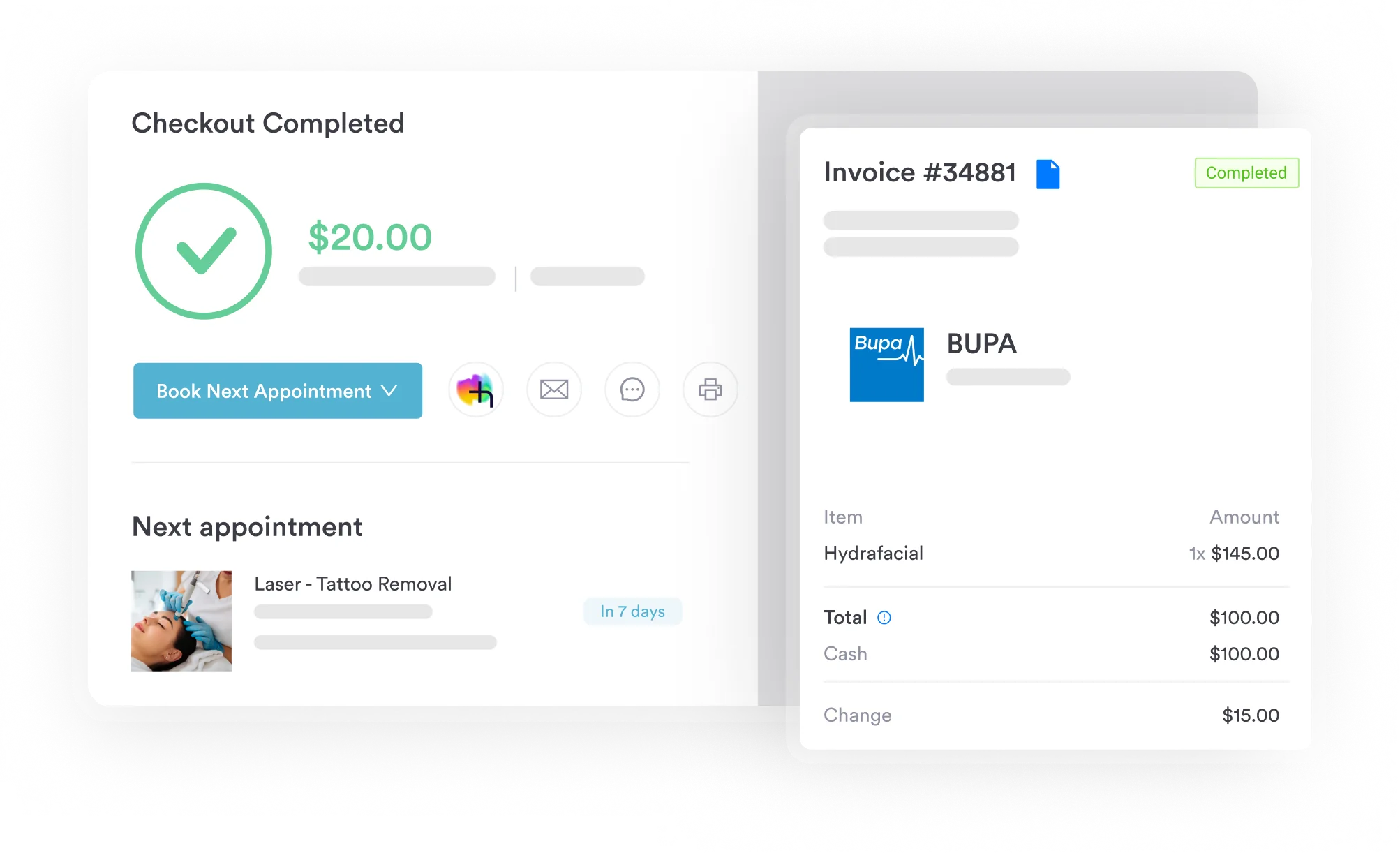

Pabau helps UK oculoplastic and ophthalmology practices track pre-authorization, attach operative notes to claims and send CCSD claims through Healthcode with fewer queries.

C1420 is an easy code to choose and an easy one to over-bill. The graft belongs to C1420 only when no other lid code already includes it.
Settle the code before surgery. Put every planned procedure on the authorization request, record the graft type and donor site in the note, and check the insurer’s current fee. Doing this before listing the patient protects the fee and avoids a query months later.
If the plan changes during surgery, update the authorization the same day. Book a demo to see how Pabau keeps authorization references, operative notes and CCSD claims on one patient record.

Billing a ptosis repair that needs a graft? CCSD code C1813: Fascia lata ptosis correction billing guide covers the graft and harvest-site detail insurers expect in the operative note.
Treating eyelid lesions before reconstruction? CCSD code C1230: Eyelid lesion curettage billing guide shows where neighboring eyelid codes trip up claims.
CCSD code C1420 covers a graft of skin to the eyelid. The surgeon harvests full- or split-thickness skin and fixes it over an upper or lower lid defect. It sits in chapter 4 (Eye and orbital contents), section 4.2, of the schedule maintained by the CCSD Group.
The CCSD schedule is the UK private healthcare coding schedule for procedures and diagnostics. Bupa, AXA Health, Vitality, Cigna, WPA and Aviva use it to invoice and reimburse private medical insurance claims. Each insurer sets its own fee against each code.
Yes, in most cases. Chapter 4 lists no separate harvest code, so a simple harvest and direct closure are part of C1420. If a large donor defect needs its own graft or flap, ask the insurer which code it accepts before billing.
Usually not. C1513 and C1523 already include a graft or flap in their descriptors, so adding C1420 bills the graft twice. Bill the combined code on its own.
Fees differ by insurer. Freedom Health Insurance pays £300 to the specialist and £213 to the anesthetist in its Intermediate band (January 2026). National Friendly pays £348 (October 2025). Check the Bupa code search portal for Bupa’s current rate.
Most major UK private insurers expect pre-authorization before planned eyelid surgery. Send the CCSD code, ICD-10 diagnosis, a clinical summary and photographs before you list the patient. Then put the authorization reference on the claim.
A full-thickness eyelid graft of 20 sq cm or less maps to CPT 15260. Add-on 15261 covers each additional 20 sq cm. A split-thickness eyelid graft maps to CPT 15120, with add-on 15121 for each additional 100 sq cm. No official crosswalk exists.