CPT code 85651: Erythrocyte sedimentation rate, non-automated
CPT code 85651: Definition, descriptor, and code summary CPT code 85651 is the p...

Last Updated: Nov 24, 2026
S3624 is the CCSD code for full thickness graft, head, neck, hands and genitalia – up to 9 cm2 in area.
Let Pabau's smart automation suggest the right codes, reduce claim denials, and keep your practice compliant—effortlessly.
Automate repetitive tasks and focus on what matters most—your patients.
Reduce coding errors and ensure compliance with the latest regulations.
Clean claims, fewer denials, and faster reimbursements.
Powerful insights and reporting to help your practice thrive.
HIPAA compliant SOC 2 certified GDPR-compliant Trusted by 4,000+ clinics worldwide

CCSD code S3624 covers full thickness grafts (epidermis plus full dermis) on the head, neck, hands, or genitalia where the defect is up to 9 cm2.
Area is measured at the recipient site. Accurate cm2 documentation in the operative report is mandatory for code selection and audit defence.
Missing pre-authorisation and cosmetic vs reconstructive misclassification are the two most common reasons medical schemes repudiate S3624 claims.
Pabau’s digital forms and claims management tools help plastic surgery and dermatology practices document graft area, track pre-auth status, and submit clean CCSD claims.
CCSD code S3624 is defined as a full thickness graft on the head, neck, hands, and genitalia, with a recipient site area of up to 9 cm2. The CCSD code set organises skin graft codes by graft depth, anatomical site, and size threshold. S3624 sits at the intersection of all three: It applies only when the graft is full thickness, the site is one of the four named regions, and the measured area does not exceed 9 square centimetres.
Getting any one of those variables wrong means submitting the wrong code. A graft that is split thickness belongs under S3620. A full thickness graft on the trunk or lower limb falls outside S3624 entirely. A defect larger than 9 cm2 on the same anatomical sites moves to S3625. The table below summarises the code’s key parameters.
A full thickness skin graft (FTSG) removes the complete skin thickness from a donor site: The epidermis and the full dermis. This distinguishes it from a split thickness graft (STSG), which harvests only the epidermis and part of the dermis. The fuller tissue mass of an FTSG produces better colour match, texture, and long-term durability, which is why it is preferred on cosmetically and functionally demanding sites such as the face, scalp, dorsal hand, and genitalia.
The procedure follows a standard sequence. The surgeon excises the wound bed, prepares the recipient site to receive the graft, harvests full-thickness skin from a donor site (commonly the retroauricular area, inner arm, or groin), and sutures or staples the graft to the wound edges. A bolster dressing is typically applied under pressure to promote adherence and prevent seroma formation beneath the graft.
Three anatomical zones dominate S3624 billing in South African private practice:
Every CCSD claim submission requires at least one ICD-10 diagnosis code paired with the procedure code. For S3624, the diagnosis must reflect a condition that makes full thickness graft reconstruction medically necessary – a defect that cannot be closed primarily or by healing by secondary intention without functional or cosmetic compromise. Verify all ICD-10 codes against the WHO ICD-10 browser before submitting, as codes must match the current release.
The ICD-10 code must match the operative indication precisely. A claim pairing S3624 with a vague or mismatched diagnosis – such as a traumatic wound code when the operative notes describe a planned excision for SCC – will trigger a medical scheme audit or repudiation. Code as specifically as the ICD-10 tabular list allows.
Area measurement determines whether S3624 or S3625 applies. The measurement is taken at the recipient site – the wound bed that will receive the graft – not at the donor site. This is a standard surgical coding principle: It reflects the clinical work at the defect, not the size of skin harvested, which may differ.
For an irregular wound, calculate area by measuring the longest dimension and multiplying by the widest perpendicular dimension. Record the result in cm2. If the product exceeds 9 cm2, S3625 applies; at or below 9 cm2, S3624 applies. Use the operative report to record the exact measurements rather than an approximate or range.
The operative report must contain all of the following for a defensible S3624 claim:
Missing any of these elements exposes the claim to medical necessity challenges. Medical schemes increasingly request operative notes before authorising payment, and an operative report that omits the measured area makes it impossible to validate the code selection.
Measure the recipient site before applying haemostasis solutions or tumescent infiltration. These can temporarily alter wound dimensions. Document measurements in the operative note as recorded before any such intervention to avoid discrepancy with post-operative measurements.
Choosing between CCSD skin graft and flap codes is a primary coding decision point. Each code has distinct eligibility criteria, and selecting the wrong one – particularly unbundling a graft from a flap on the same wound – will trigger a bundling query or repudiation.
The graft-versus-flap distinction matters clinically as well as for coding. A flap maintains its own blood supply via a pedicle; a free graft is avascular at the time of transfer and relies entirely on the recipient bed for revascularisation. Coding one as the other misrepresents the procedure and may constitute a fraudulent claim under South African medical scheme rules. Always verify adjacent codes against the current CCSD publication – S3620 and S3625 descriptors above are based on standard CCSD code family structure and should be confirmed before submitting.
See Pabau’s guide to CCSD billing conventions for a broader overview of how the code set is structured across surgical chapters.

Pabau helps plastic surgery and dermatology practices in South Africa track pre-authorisation, attach operative notes to claims, and submit accurate CCSD codes without the paperwork overhead.

Whether donor site closure can be billed separately from CCSD code S3624 depends on CCSD bundling rules and individual medical scheme policy. As a general principle, the harvesting and primary closure of a full thickness donor site using simple sutures is typically considered included in the graft code. The work of obtaining and closing the donor site is part of the procedure S3624 describes.
A separate billing charge may potentially be supported when the donor site requires a more complex closure than simple linear suture – such as a local advancement flap to close a large retroauricular donor defect, or a split thickness graft applied to the donor site itself. In those scenarios, the additional procedure code must be supported by operative notes that document the complexity of donor site management as a distinct surgical challenge. Verify the applicable bundling rule against the current CCSD technical documentation and confirm with the relevant medical scheme before billing a separate donor site code. Billing an included component separately constitutes unbundling and is a basis for claim repudiation and potential audit.
Medical aid pre-authorisation for full thickness skin graft procedures is standard practice in South African private healthcare. Most medical schemes treat surgical skin grafts as hospitalisation or day procedure events that require prior authorisation before the claim will be considered. Without pre-auth, the scheme may repudiate the full claim regardless of clinical justification or coding accuracy.
Pre-authorisation requirements vary by scheme and benefit option. The following reflects general expectations for major schemes, but practitioners must verify directly with Discovery Health, Bonitas, Momentum, Medihelp, Bestmed, and any other relevant fund before proceeding, as rules change with annual benefit updates:
Timing matters. Submit the pre-authorisation request well before the procedure date. Emergency or urgent situations may allow retrospective authorisation under scheme rules, but elective reconstruction on a known post-excision defect should always be pre-authorised. Keep a copy of the authorisation number and link it to the claim at submission.
Medical schemes in South Africa apply a reconstructive versus cosmetic classification to skin graft claims, and cosmetic procedures are excluded from most benefit schedules. A full thickness graft following excision of a skin malignancy on the nose or ear is reconstructive. The same graft performed to improve skin texture or appearance without an underlying pathological defect is cosmetic and will not be covered.
The distinction turns on the clinical documentation, not the procedure itself. Schemes look for two things: A diagnosis code that describes a pathological condition (SCC, BCC, trauma, burn) and clinical notes that describe a defect requiring reconstruction rather than a cosmetic concern. Language that triggers cosmetic reclassification includes phrases such as “patient wishes to improve appearance,” “aesthetic improvement,” or “elective revision.”
A strong medical necessity motivation includes:
Avoid subjective language about appearance. Keep the motivation focused on restoring function and normal anatomy following pathological tissue loss.
CCSD S3624 claims are denied for predictable, preventable reasons. Most repudiations fall into one of six categories, each with a corresponding fix.
Use this checklist before submitting any CCSD S3624 claim. It covers the documentation elements that medical schemes most commonly request on audit and that, when missing, trigger automatic repudiation. Practices using digital clinical forms can embed these fields directly into their operative note templates so nothing is omitted at the point of care.

Create a dedicated CCSD S3624 operative note template in your practice management system that includes fields for recipient site dimensions, graft type confirmation, anatomical site, and pre-auth number. Completing the template in theatre is faster than reconstructing the information from memory post-operatively – and reduces documentation errors that lead to claim denials.
CCSD billing for plastic surgery and dermatology practices involves coordinating pre-authorisation, operative documentation, code selection, and claim submission across multiple medical schemes with different rules. Most practices in South Africa rely on a combination of manual systems, spreadsheets, and scheme portals – which creates gaps where authorisation numbers get lost, documentation is incomplete, and claims arrive at schemes without the supporting evidence the scheme expects.
Practice management software built for private practice can close each of these gaps. Pabau allows practices to build structured operative note templates that include the required fields for CCSD S3624 claims – recipient site dimensions, graft type, anatomical site, and pre-auth number – so clinicians capture the right data at the point of care rather than reconstructing it from memory.
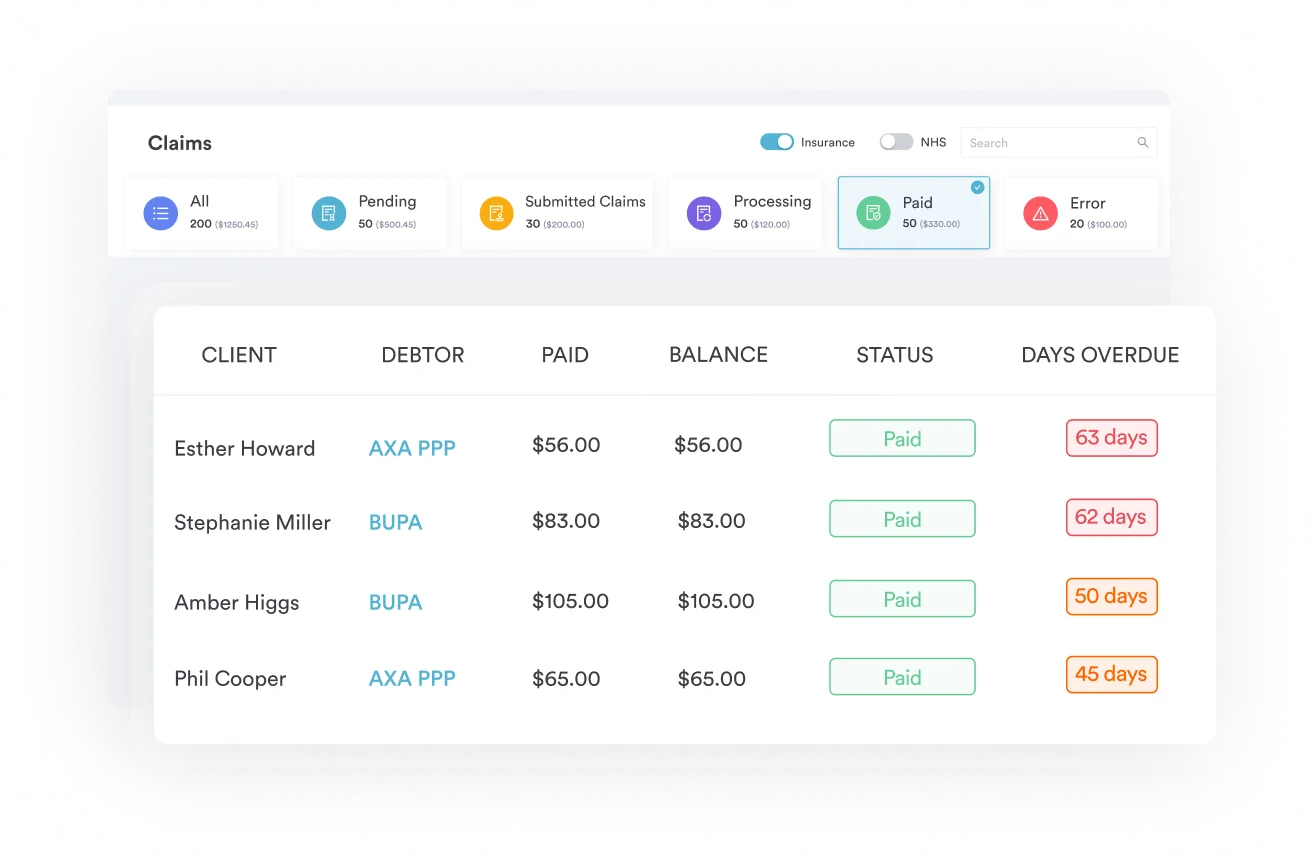
The claims management tools in Pabau help billing staff track claim status and identify outstanding documentation before submission, reducing the rejection rate on surgical claims.
For plastic surgery practices and dermatology practices managing a mix of excision, reconstruction, and graft procedures, having the documentation and billing workflow in one system also supports audit readiness. When a scheme requests clinical records to support a claim, the practice can retrieve the operative notes, pre-auth confirmation, and ICD-10 pairing from one place rather than searching across multiple files and systems.
Pabau is used by clinic practices in South Africa across dermatology and aesthetics specialties, with features designed around the documentation and workflow requirements of private practice billing.
CCSD code S3624 is a precise code with three hard eligibility criteria: Full thickness graft, one of four named anatomical sites, and a recipient area of up to 9 cm2. Meeting those criteria is not enough on its own. Medical schemes repudiate S3624 claims when pre-authorisation is absent, when ICD-10 pairing is imprecise, when the operative report does not state the measured area, or when the clinical notes leave room for a cosmetic reclassification. Each of those denial triggers has a documentation fix that can be built into the practice’s standard operating procedure.
Pabau’s clinical documentation and claims management tools help plastic surgery and dermatology practices capture the right information at the point of care and submit cleaner CCSD claims. Book a demo to see how the system supports private practice billing in South Africa.

Billing CCSD procedures across multiple specialties? Pabau’s guide to CCSD billing conventions explains how the code set is structured and how private health insurers apply it.
Need to manage skin clinic operations from one platform? Pabau’s skin clinic practice software covers scheduling, clinical notes, and billing for dermatology and aesthetics practices.
Looking for a practice management solution built for surgical specialties? Pabau’s plastic surgery EMR supports operative documentation, pre-auth tracking, and CCSD claim submission.
CCSD code S3624 covers a full thickness skin graft on the head, neck, hands, or genitalia where the recipient site area is up to 9 cm2. It applies when the graft includes both the epidermis and the full dermis layer, and only on the four named anatomical regions. Grafts on other body sites or exceeding 9 cm2 require a different code.
The area limit is 9 cm2, measured at the recipient site. If the wound bed exceeds 9 cm2, the procedure is coded under S3625, provided the site is still on the head, neck, hands, or genitalia. Area must be documented in the operative report as a measured figure in cm2, not estimated.
S3624 applies to full thickness grafts on the head, neck, hands, and genitalia where the recipient site is up to 9 cm2. S3625 applies to the same procedure on the same sites when the recipient area exceeds 9 cm2. The only differentiator is the measured recipient site area. Verify S3625 descriptors against the current CCSD publication before billing, as code descriptors are updated periodically.
Use S3624 when the wound is closed using a free skin graft harvested from a separate donor site and transferred without its own blood supply. Use a flap code when the closure uses adjacent tissue that retains a vascular pedicle. The two techniques are distinct procedures and cannot be used interchangeably on the same wound. Submitting a flap code for a free graft, or vice versa, misrepresents the procedure and may constitute fraudulent billing.
Straightforward primary suture closure of the donor site is generally considered included in S3624 and not separately billable. A separate code may be supportable when the donor site requires a materially more complex closure than simple linear suture. Confirm the applicable CCSD bundling rule and the relevant scheme’s policy before billing a donor site code alongside S3624.
A full thickness skin graft is reconstructive when it restores skin coverage following tissue loss from a pathological cause: Skin cancer excision, trauma, or burns. It is cosmetic when performed solely for aesthetic improvement without an underlying pathological defect. Medical schemes apply this distinction to their benefit coverage. The clinical notes and ICD-10 diagnosis code must clearly reflect the pathological indication to avoid cosmetic reclassification and claim repudiation.