HCPCS Code K0900: Customized DME billing and coding guide
HCPCS Code K0900: Official descriptor and code overview HCPCS Code K0900 is a CM...

Last Updated: Nov 18, 2026
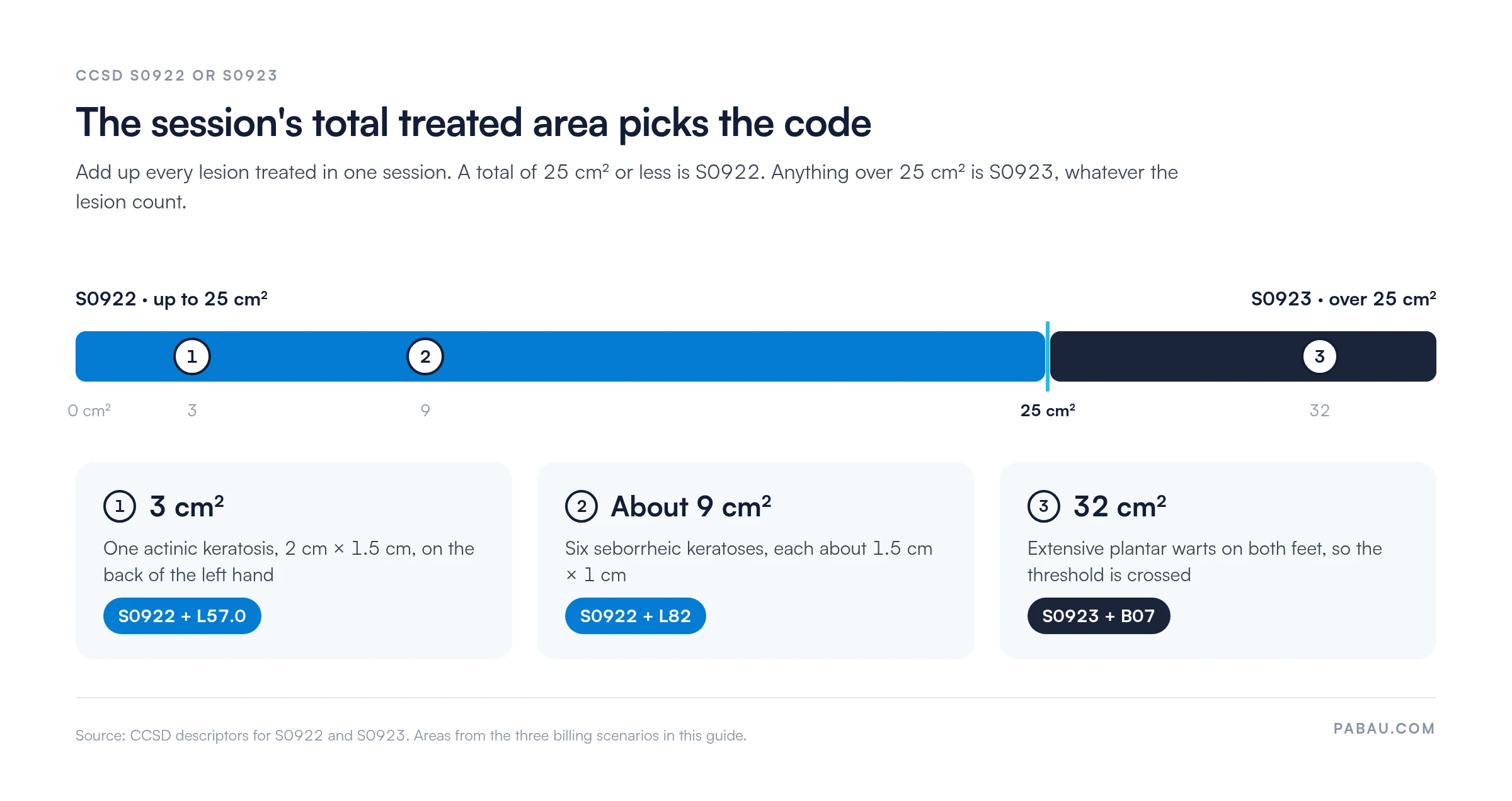
S0922 is the CCSD code for laser destruction of lesion(s) of skin – up to 25 cm² in area. UK private medical insurers such as Bupa and AXA Health bill laser treatment of one or more skin lesions in a single session against it.
The total area treated decides the code, not the lesion count. A session over 25 cm² is billed as S0923, and each claim pairs the code with an ICD-10 diagnosis.
Let Pabau's smart automation suggest the right codes, reduce claim denials, and keep your practice compliant—effortlessly.
Automate repetitive tasks and focus on what matters most—your patients.
Reduce coding errors and ensure compliance with the latest regulations.
Clean claims, fewer denials, and faster reimbursements.
Powerful insights and reporting to help your practice thrive.
HIPAA compliant SOC 2 certified GDPR-compliant Trusted by 4,000+ clinics worldwide

CCSD code S0922 covers laser destruction of lesion(s) of skin up to 25 cm² in area, in the schedule UK private medical insurers bill against.
A treated area over 25 cm² moves the claim to S0923. CCSD created the pair in 2010 to describe the size of area treated.
The patient’s policy decides whether the treatment is covered, and Bupa lists cosmetic surgery among its general exclusions.
Bupa and AXA Health ask members to pre-authorize planned treatment, so give the patient the code and its description before the session.
Pabau, the practice software we build, keeps lesion sizes, the pre-authorization number and the claim on one patient record.
CCSD code S0922 is the UK private healthcare code for laser destruction of lesion(s) of skin, up to 25 cm² in area. It is published by the Clinical Coding & Schedule Development Group (CCSD), whose CCSD Schedules hold the standard procedure codes for the UK private healthcare sector.
The CCSD Group is made up of representatives from four major private healthcare insurers. Bupa, AXA Health and Vitality all bill with CCSD codes, and AXA bases its Schedule of Procedures and Fees on the group’s work. Each claim pairs the code with an ICD-10 diagnosis.
The code applies whenever a laser destroys, vaporizes or ablates one or more skin lesions and the total treated area is 25 cm² or less. CCSD files the entry under reference Fo.011, and the code has been in the schedule since January 20, 2010.
Pabau’s index of CCSD codes lists the other procedure codes we cover. Our guide to CCSD codes for Bupa providers explains how Bupa’s schedule uses them.
CCSD created S0922 and S0923 on the same day in 2010, and its records say the pair exists to describe the size of area treated. The lesion type and the laser can be identical. Only the total area changes the code.
Measure each lesion’s length and its width at right angles, then multiply the two for an area estimate. Add the figures for every lesion treated in the session and record the total in the procedure note. When the total sits close to 25 cm², write the calculation out in full. Other CCSD skin codes use the same 25 cm² line, such as split autograft code S3500 on the trunk and limbs.
The descriptor reads lesion(s), so one S0922 line can cover several small lesions treated in the same session. Keep the combined area at 25 cm² or less. Insurers set their own rules on repeat lines, so check with the patient’s insurer before you submit more than one.
Code a session over 25 cm² as S0923. Splitting that area across two S0922 lines is unbundling, and insurers can query it on audit. The three billing scenarios later in this guide land on either side of that line.
S0922 is defined by technique. The lesion has to be destroyed with laser energy, so surgical excision and cryotherapy fall outside it. Primary excision of a malignant lesion on the head or neck, for example, is coded S0602. Whole-body phototherapy treats skin with UV light rather than destroying a lesion, and each session is billed as S0980.
A secondary excision of a malignant lesion on the trunk or limbs is billed under S0605 instead. A skin biopsy taken in the same session is a separate procedure, coded S1500.
CO2 lasers are ablative and vaporize tissue directly. They are often used on actinic keratoses, seborrheic keratoses and viral warts. Nd:YAG lasers work at a different wavelength and suit deeper pigmented lesions or lesions with a vascular component.
Lesions commonly treated under S0922 include:
A lesion removed for appearance alone, such as a benign mole, is usually treated as cosmetic. Whether an insurer pays then turns on the patient’s policy, covered in the section on cosmetic exclusions below.
Every S0922 claim carries an ICD-10 diagnosis that explains why the lesion was treated. The UK uses the WHO edition of ICD-10, which stops at three characters for some of these diagnoses. The US ICD-10-CM splits them further, so check which edition the insurer’s claim form expects.
These pairings are common, but none of them guarantees payment. The patient’s policy decides cover, whatever the diagnosis code. Never pick a code that overstates the clinical finding to get a claim paid.
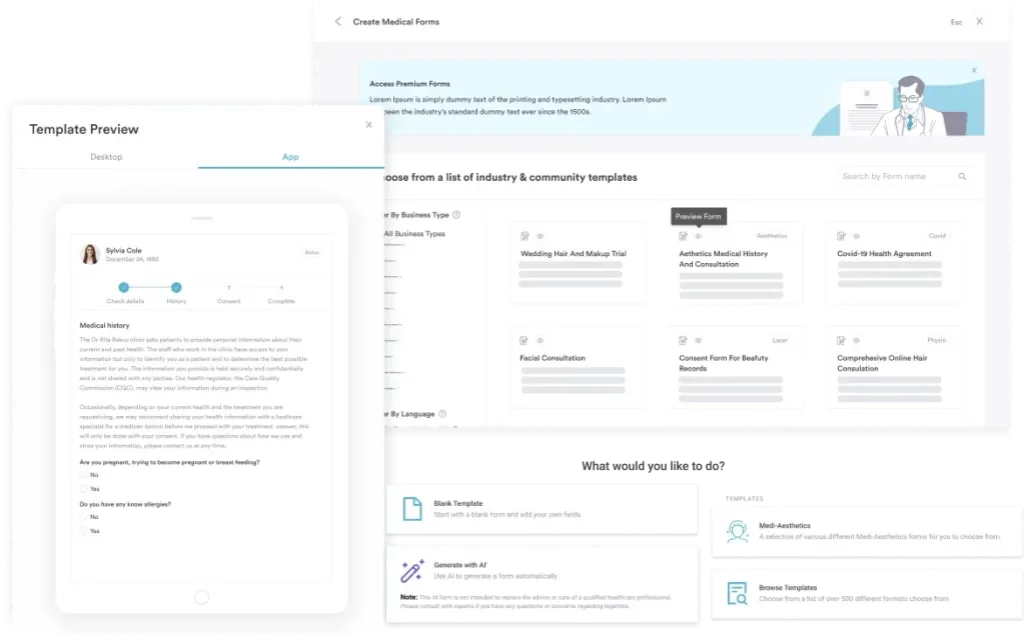
The clinical record has to support both the procedure and the reason for it before the claim goes out. Digital clinical forms for procedure notes cut omissions and leave a time-stamped audit trail.
Every S0922 claim should be backed by a procedure note that records:
When an insurer is likely to query the indication, a supporting letter from the treating consultant helps. It should state the diagnosis, explain why laser destruction is the right treatment and note any earlier treatment. It should also confirm that the procedure is not cosmetic in intent.
Record the total treated area in cm² in the procedure note before the claim is created. For five small actinic keratoses of about 1 cm² each, ‘5 lesions, total area 5 cm²’ takes seconds to write. It settles the S0922-or-S0923 question before anyone asks it.
Most UK private medical insurers expect planned treatment to be pre-authorized, and the patient’s policy decides what is covered. Bupa’s guide for healthcare professionals says it gives the patient a pre-authorization number. The consultant then uses that number when billing Bupa.
AXA Health’s specialist guide says most of its plans require members to call before they arrange treatment. That call lets AXA pre-authorize the treatment, confirm cover and say whether costs will be met in full.
Bupa also asks consultants to give the patient the procedure code and its description when recommending treatment. For S0922, have these ready before the patient calls the insurer:
An insurer can decline pre-authorization for a lesion it classes as cosmetic, even where the consultant sees a clinical reason. When that happens, the insurer’s own appeal process governs the next step, so follow its rules on evidence and timing. Keep the insurer’s decision and your reply on the patient’s record, so the evidence for an appeal sits in one place.
Cover for S0922 depends on the patient’s policy, not on the code. Bupa lists cosmetic surgery among its general exclusions, the treatments health insurance doesn’t usually cover. Each insurer words its exclusion in its own policy, so that wording sets the limit.
Bupa also notes that an uncovered treatment is not necessarily unnecessary. It simply falls outside the patient’s policy terms. AXA Health says its schedule contains the codes for procedures “where our policies provide benefit”, per its provider schedule page.
Near the boundary, write the clinical reason in its own sentence in the notes, not only in the diagnosis field. “Lesion treated for repeated trauma and bleeding on clothing contact, not for appearance” gives the insurer a concrete basis to approve.
Most S0922 rejections trace back to cover, coding or the notes. The table maps each reason to the step that prevents it.
Check fees and combination rules in the insurer’s own schedule. Healix’s CCSD fee schedule notes that a code’s inclusion does not necessarily mean it is eligible for cover. It also carries a column for unacceptable code combinations.
For work done alongside S0922, the insurer’s billing rules decide what is paid on top. Bupa’s procedure fees include the pre-operative assessment, the procedure and routine aftercare. A same-day follow-up consultation is covered separately only when the code is marked (ii) in Bupa’s Schedule of Procedures.
If a second procedure happens in the same session, such as a biopsy, check the insurer’s combination rules before both codes go on one claim. AXA Health asks for codes used “within their intended purpose, as defined by the CCSD”. Each code has to match what the note describes.
The three cases below show how area, diagnosis and cover shape an S0922 claim. Claims management software that links the CCSD and ICD-10 codes on each line catches most slips before submission.
A patient has one actinic keratosis, 2 cm × 1.5 cm, on the back of the left hand. The consultant vaporizes it with a CO2 laser. Total treated area: 3 cm².
Correct coding: S0922 with ICD-10 L57.0. Record the lesion size, site, laser type and indication. Get the insurer’s pre-authorization number before the session.
A patient has six seborrheic keratoses, four of them inflamed and repeatedly caught on clothing. Each is about 1.5 cm × 1 cm, so the total treated area is about 9 cm².
Correct coding: One S0922 line with ICD-10 L82. Record all six measurements, the clinical reason for each lesion and the total area. The two quiet lesions may count as cosmetic under the patient’s policy, so confirm cover for them at pre-authorization.
A patient has extensive plantar warts on both feet, and the treated lesions add up to 32 cm².
Correct coding: S0923, not S0922, with ICD-10 B07 (viral warts). The area threshold has been crossed, so record the measured total and use the larger-area code. Billing S0922 here would show up as a coding error on audit.
In many practices, lesion sizes sit in a free-text note and the pre-authorization number sits in an email. The claim gets keyed in later, and whoever codes it has to rebuild the area total. That is where S0922 and S0923 get swapped.
Pabau puts those pieces on one patient record. A procedure-note template in our digital forms can ask for each lesion’s size, so the area total is written once, at the point of care.
The insurer’s pre-authorization number and any appeal letters sit on the same record. Pabau then sends the claim electronically through Healthcode, so the code on the claim matches the note it came from.

Pabau records lesion sizes, pre-authorization numbers and claims on one patient record. Your S0922 claims reach the insurer with the area total and diagnosis that support them.

S0922 rewards practices that measure before they code. The 25 cm² line separates it from S0923, and the patient’s policy decides whether the insurer pays.
Put the area total, the diagnosis and the pre-authorization number on the record before the laser session. The questions an insurer asks about an S0922 claim are then answered before it asks them. That costs a minute more in the procedure note, far less than a rejected claim.
Pabau keeps lesion measurements, insurer correspondence and claims together for dermatology and laser practices. Book a demo to see how it fits a practice billing UK insurers.

Need a full reference for CCSD private practice billing? CCSD billing codes for Bupa providers covers code structure, submission rules and fee schedules for UK private healthcare.
Taking a biopsy before the laser session? CCSD code S1500 covers biopsy of skin or subcutaneous tissue, which is billed separately from S0922.
Removing a malignant lesion surgically instead? CCSD code S0602 covers primary excision of a malignant lesion on the head or neck.
CCSD code S0922 is the UK private healthcare code for laser destruction of lesion(s) of skin, up to 25 cm² in area. The Clinical Coding & Schedule Development Group (CCSD) maintains it. Insurers such as Bupa, AXA Health and Vitality bill against it, with an ICD-10 diagnosis on each claim.
S0922 applies when the total treated area is 25 cm² or less. S0923, laser destruction of lesion(s) of skin over 25 cm² in area, applies above that. CCSD created both codes in 2010 to describe the size of area treated. Billing S0922 for a larger area is a coding error that insurers can query.
Usually, yes. Most UK private medical insurers, including Bupa and AXA Health, expect members to pre-authorize planned treatment before it happens. The patient’s policy decides what is covered. Give the patient the code and its description, so they can quote both when they call their insurer.
Usually not. Cover comes from the patient’s policy, and Bupa lists cosmetic surgery among its general exclusions. S0922 is normally paid only when the record shows a clinical reason, such as actinic keratosis or a painful plantar wart. A lesion treated for appearance alone is usually declined.
Multiply each lesion’s length by its width at right angles, then add the figures for every lesion treated in the session. Record each measurement and the total in the procedure note. If the total exceeds 25 cm², use S0923 instead of S0922.
Common pairings are L57.0 (actinic keratosis), L82 (seborrheic keratosis), B07 (viral warts) and D23 (other benign neoplasms of skin). The WHO edition of ICD-10 used in the UK stops at three characters for B07 and L82, so a plantar wart is coded B07 there. In the US ICD-10-CM, the plantar wart code is B07.0. The code must match the documented finding.