CPT Code 19361: Latissimus dorsi flap breast reconstruction
CPT code 19361: Official descriptor and payment basics CPT code 19361 is the Cat...

Last Updated: Nov 18, 2026
S0280 is the HCPCS Level II code for medical home program, comprehensive care coordination and planning, initial plan. It reports the work of building a patient's first medical home care plan, and S0281 covers maintenance of that plan in later periods.
S0280 is a temporary national S-code used by private insurers and some Medicaid programs. Medicare does not recognize it, so the Physician Fee Schedule lists no rate. Each Medicaid program or plan sets its own payment, enrollment, and documentation rules.
Let Pabau's smart automation suggest the right codes, reduce claim denials, and keep your practice compliant—effortlessly.
Automate repetitive tasks and focus on what matters most—your patients.
Reduce coding errors and ensure compliance with the latest regulations.
Clean claims, fewer denials, and faster reimbursements.
Powerful insights and reporting to help your practice thrive.
HIPAA compliant SOC 2 certified GDPR-compliant Trusted by 4,000+ clinics worldwide

HCPCS Code S0280 reports the initial care plan in a medical home program. State Medicaid programs and some private plans pay it, while traditional Medicare does not.
S0280 covers the initial plan and S0281 covers maintenance. Payers generally expect S0280 first and S0281 for later periods, so check the payer’s policy.
Documentation must include a written care plan, identified care team members, documented coordination activities, and patient consent before the claim is submitted.
Payer acceptance, practice enrollment, prior authorization, and documentation all have to clear before an S0280 claim pays.
Pabau tracks prior authorization on the patient’s case and warns your team when the authorization code is missing.
HCPCS Code S0280 is a Level II S-code for care coordination and planning when a patient first enters a medical home program. The CMS alpha-numeric HCPCS file lists it as an active code with coverage code I, not payable by Medicare. It covers the initial, individualized care plan, from the patient assessment and care team to the coordination steps and the patient’s consent. S0280 is billed for the initial plan only, and S0281 takes over for later periods.
S-codes are temporary national codes used by private insurers and some Medicaid programs, not recognized by Medicare. They sit in the HCPCS Level II code set alongside codes Medicare does pay. Standard medical billing workflows that check only the Medicare Physician Fee Schedule find no national payment rate for S0280. State Medicaid programs and Medicaid managed care organizations (MCOs) accept it most often. Some commercial plans that use the patient-centered medical home (PCMH) framework pay it too.
The official CMS HCPCS descriptor for S0280 is Medical home program, comprehensive care coordination and planning, initial plan. The table below summarizes the key billing parameters.
S0280 captures one discrete service, the creation of a patient’s initial medical home care plan.
Included under S0280:
Excluded from S0280:
A frequent coding error in medical home billing is confusing which code applies after enrollment. S0280 is billed once (per payer policy), at the point the initial care plan is created. Later medical home visits and plan updates use S0281. Minnesota’s Health Care Homes program, for example, bills S0280 for the first month and S0281 for the months after it. The table below sets out the distinction.
Billers often compare S0280 to CPT chronic care management (CCM) codes 99490, 99491, and 99487 because both describe ongoing care coordination for complex patients. The two code sets are not interchangeable and serve different payer populations. Using a CPT CCM code when the payer expects S0280, or the reverse, is a fast route to denial.
Check the patient’s insurance card and verify benefits before selecting between S0280 and a CPT CCM code. If the primary payer is a Medicare Advantage or dual-eligible Medicaid plan, the plan’s specific contract determines which code set it accepts. Contact the payer’s provider services line to confirm before billing.
S0280 Medicaid billing is the most common use case. State Medicaid fee-for-service programs and Medicaid MCOs adopt this code most, often within PCMH incentive programs or enhanced primary care initiatives. Coverage varies significantly by state. Some programs require formal medical home enrollment before the code becomes payable. Others let any primary care practice bill it once the initial care plan is documented.
Payer acceptance breaks down by category as follows.
To verify coverage before submitting a claim, request the payer’s provider manual or fee schedule. You can also call the provider services line and ask whether HCPCS Code S0280 is a covered benefit under the patient’s plan.
Inadequate documentation is a leading reason S0280 claims are denied on audit. The chart must show that a formal initial care plan was created, not simply that a routine office visit occurred. Maintaining medical billing compliance for S0280 means meeting each of these requirements before the claim goes out.
The required documentation elements are:
Keep these records in a patient file that timestamps each entry and stores the consent form against the encounter date. When a payer requests supporting documentation, the whole set is then ready to send.
Many Medicaid MCOs require prior authorization before S0280 can be billed. Some also require the practice to be formally enrolled in the plan’s care management or PCMH program. These are two separate hurdles. Prior authorization is per patient, while program enrollment is per practice.
Steps to clear both requirements:
An S0280 claim needs payer eligibility, program enrollment, prior authorization, and documentation to align before reimbursement is approved. When one element is missing, the entire claim fails. The four checks below run in the order a billing team meets them.
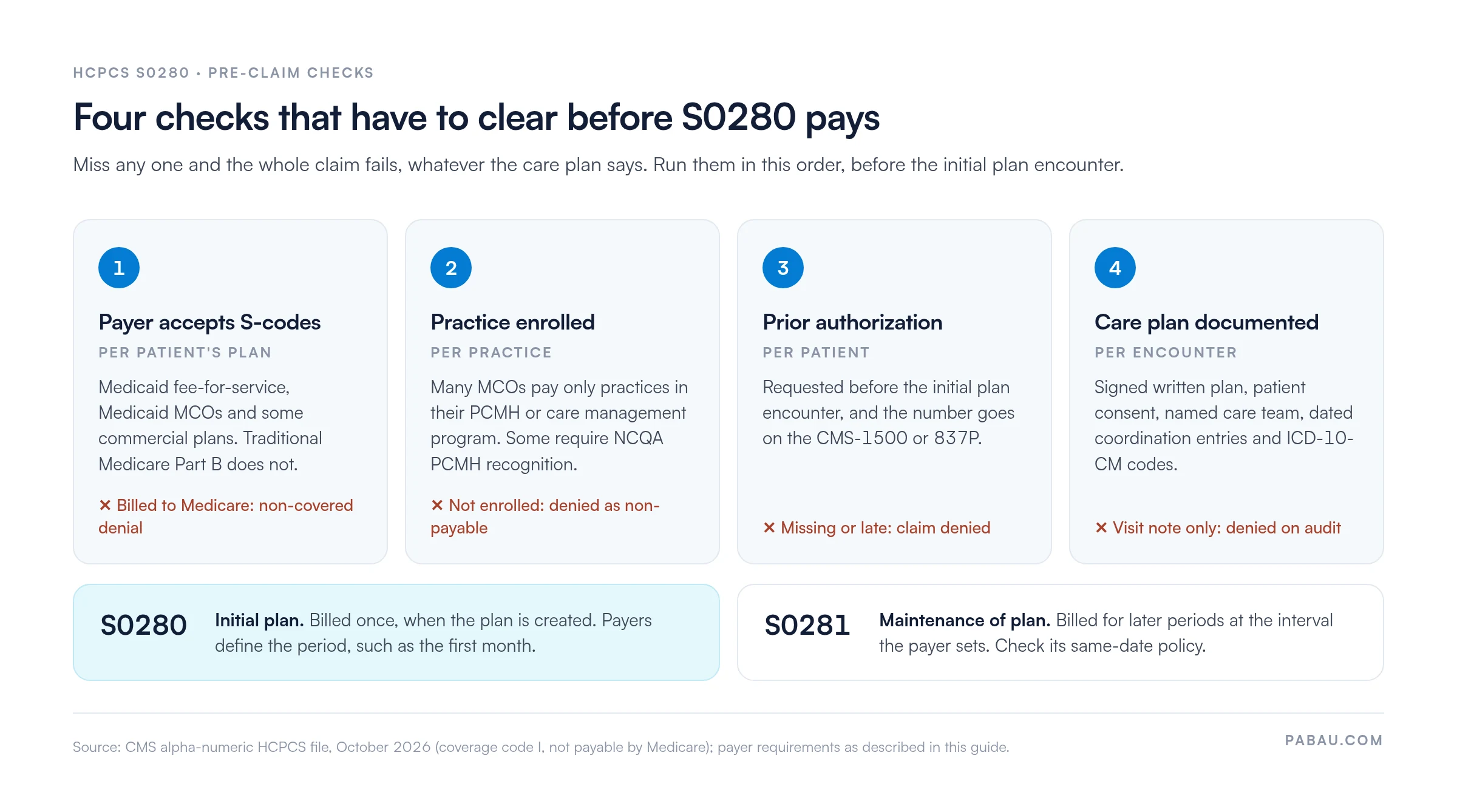
A structured approach to denial management processes catches most of these before submission. The most frequent denial reasons for HCPCS Code S0280 are:
When a denial arrives, the remittance advice remark code (RARC) or claim adjustment reason code (CARC) identifies the specific reason. Each code calls for a different response, and a generic resubmission usually gets denied a second time. Submitting a clean claim on the appeal means addressing the original denial reason specifically.
There is no national Medicare fee schedule rate for S0280. Each state Medicaid program or individual MCO sets the reimbursement. Payment for the same code can vary from under $50 to well over $100 by state and plan. That variation is a defining characteristic of HCPCS S-codes.
To find the rate that applies to your practice:
Because rates vary by state and plan, a single cached figure goes stale fast. Billing managers should build a payer-by-state rate reference into their revenue cycle management workflow.
Run a quarterly check on your Medicaid fee schedule rates. State Medicaid programs typically update their HCPCS S-code rates at the start of each fiscal year. An outdated rate assumption in your practice management system can cause underpayment to go undetected for months. Download the current state fee schedule and compare it against your system’s contracted rates every 90 days.
Most S0280 denials are set up at the front desk, before anyone writes the care plan. Staff confirm coverage by phone, note the authorization number somewhere, and hope it reaches the claim.
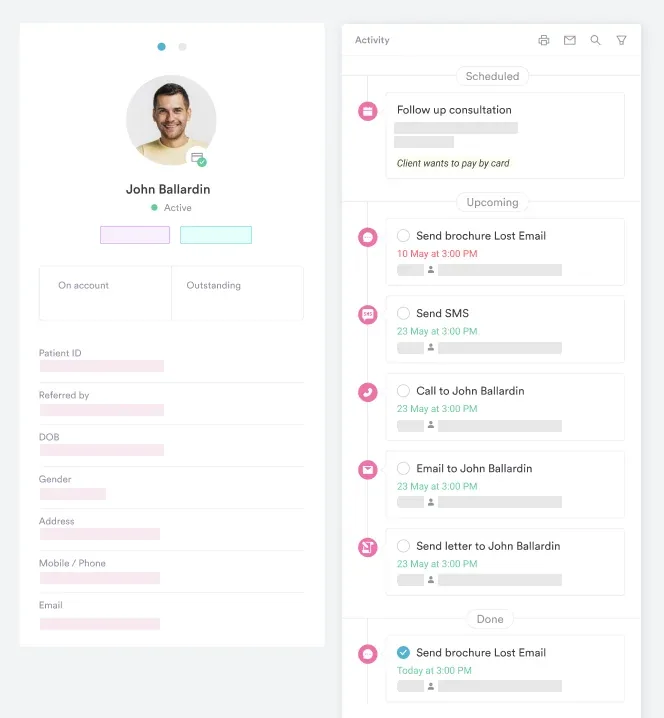
In Pabau, the practice management platform we build, the prior authorization code, its dates, and its sessions are tracked on the patient’s case. Your team sees a warning when the authorization code is missing, so nobody has to remember to check it.
US claims go out electronically as CMS-1500 or 837P files through our claims software for billers. Eligibility checks and ERA remittances sit in the same place, so the payer check and the authorization check happen in one workflow.
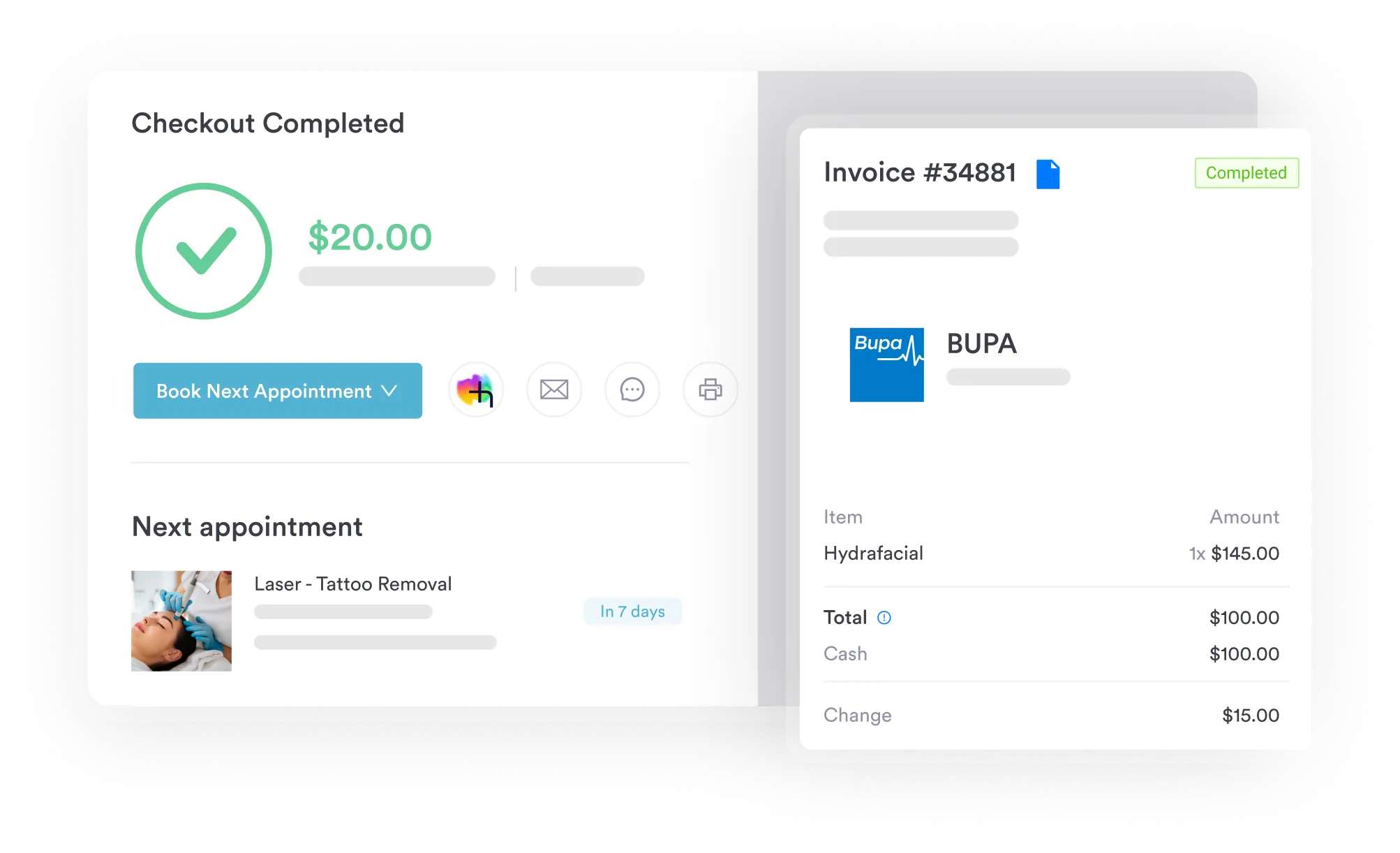

Pabau tracks the prior authorization code, dates, and sessions on the patient’s case and warns your team when the code is missing. Claims, eligibility checks, and remittances sit in the same system.

Treat S0280 as a front-loaded code. Its outcome is mostly decided before the encounter, when you confirm the payer accepts S-codes, the practice is enrolled, and the authorization is on file. A strong care plan cannot rescue a claim that fails one of those checks. S0260, the pre-op history and physical code, is decided the same way, before the visit.
The trade-off is a slower first visit in exchange for a claim that pays once and sets up S0281 for the periods that follow. Build the four checks into intake, and keep a rate reference for each payer you bill.
Book a demo to see how Pabau keeps prior authorization on the patient’s case and warns your team when the code is missing.

Billing the months after enrollment? HCPCS Code S0281 covers the maintenance plan that follows the initial S0280 encounter.
Need a compliant billing workflow for care coordination? Claims management software features explains how Pabau structures claims submission and tracks prior authorization on the case.
Documenting care coordination time? CCM documentation covers the records chronic care management claims need.
Billing a Medicare patient instead? CPT Code 99490 explains the monthly chronic care management code Medicare does pay.
HCPCS Code S0280 bills the creation of a patient’s initial care plan under a medical home program. It covers comprehensive care coordination and planning at enrollment. Most payers allow it once per program enrollment. Medicaid MCOs and select commercial payers accept it, while traditional Medicare Part B does not.
S0280 covers the initial care plan created when a patient first enrolls in a medical home program. S0281 covers maintenance of that plan in later periods. Payers generally expect S0280 first and S0281 for later periods, so check the payer’s policy before billing both. S0280 should not be rebilled at follow-up visits.
No. Traditional Medicare Part B does not cover HCPCS S-codes, including S0280. Submitting S0280 to Medicare Part B will result in a non-covered service denial. For Medicare patients needing care coordination billing, the relevant codes are the CPT chronic care management codes 99490, 99491, and 99487.
The chart must contain a written, signed care plan with documented goals and the patient’s consent to program enrollment. It also needs a named multidisciplinary care team with roles and contact information, dated coordination activity entries, and ICD-10-CM codes for every condition addressed. A routine visit note does not satisfy these requirements.
The most common denial triggers are billing Medicare Part B, missing prior authorization, and insufficient documentation such as a missing written care plan. Same-date bundling with an E/M code also causes denials where the payer treats S0280 as incidental. Billing S0281 out of the order the payer expects is another. Each denial reason has a specific appeal path based on the remittance advice remark code.