CPT Code 19361: Latissimus dorsi flap breast reconstruction
CPT code 19361: Official descriptor and payment basics CPT code 19361 is the Cat...

Last Updated: Nov 18, 2026
S0074 is the deleted HCPCS Level II code for injection, cefotetan disodium, 500 mg. CMS discontinued it effective September 30, 2025, so it is not valid for dates of service on or after October 1, 2025.
Bill cefotetan with J0525, injection, cefotetan disodium, 10 mg, from that date. One unit of S0074 equals 50 units of J0525, so a 2 g dose is 200 units. Keep S0074 for corrected claims on earlier dates of service only.
Let Pabau's smart automation suggest the right codes, reduce claim denials, and keep your practice compliant—effortlessly.
Automate repetitive tasks and focus on what matters most—your patients.
Reduce coding errors and ensure compliance with the latest regulations.
Clean claims, fewer denials, and faster reimbursements.
Powerful insights and reporting to help your practice thrive.
HIPAA compliant SOC 2 certified GDPR-compliant Trusted by 4,000+ clinics worldwide

HCPCS Code S0074 (injection, cefotetan disodium, 500 mg) was deleted effective September 30, 2025.
For dates of service on or after October 1, 2025, bill cefotetan with J0525, injection, cefotetan disodium, 10 mg.
One unit of S0074 equals 50 units of J0525, so a 2 g dose is 200 units of J0525.
Use S0074 only on corrected or late claims for dates of service through September 30, 2025.
Medicare never priced S0074, because Medicare does not pay S-codes.
HCPCS Code S0074 is the deleted Level II code for injection, cefotetan disodium, 500 mg. CMS discontinued it in the October 2025 quarterly HCPCS update, effective September 30, 2025. The Indiana Medicaid bulletin BT2025139 lists S0074 among that update’s discontinued codes, with J0525 as the alternate.
S0074 is not valid for any date of service on or after October 1, 2025. The replacement is J0525, injection, cefotetan disodium, 10 mg, effective that same day. The CMS HCPCS quarterly update page carries the official alpha-numeric code files.
The change does two things at once. It moves cefotetan from a temporary S-code into the permanent J-code series, the block of HCPCS Level II codes for injectable drugs. It also shrinks the billing unit from 500 mg to 10 mg, so every unit count on the claim grows by a factor of 50.
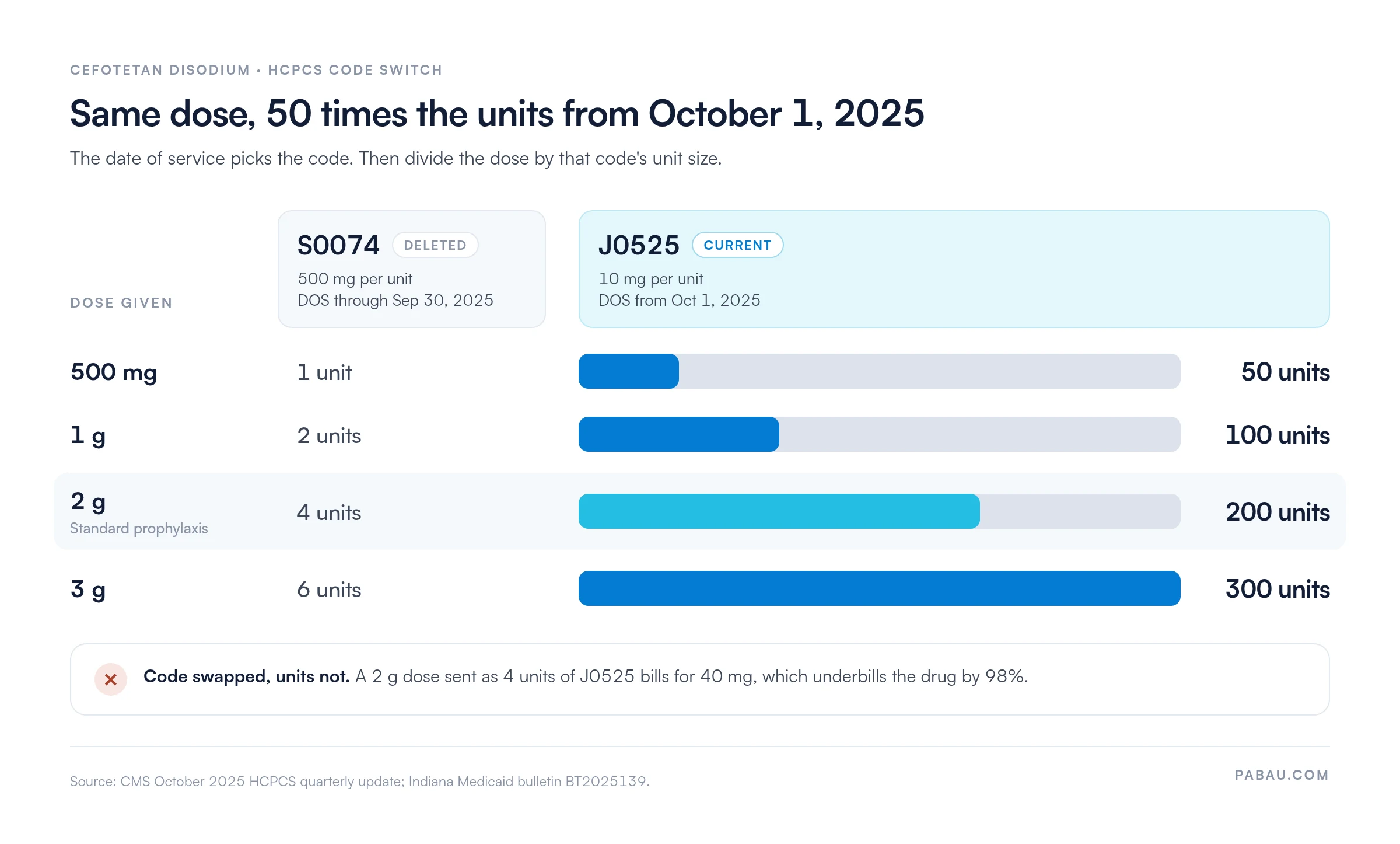
Divide the total dose in milligrams by 10 to get J0525 units. For a legacy S0074 claim, divide by 500 instead. The table shows the same doses under both codes.
A large unit count looks wrong to anyone used to S0074, but it is correct for J0525. If a payer caps units per line or per day, check its edits before you split or reduce the quantity. Where a payer asks for drug-waste reporting on single-dose vials, follow its JW or JZ modifier policy.
Update the charge master, the fee schedule, and every claim template that still lists S0074 at the same time. Change the code to J0525 and the unit multiplier from 500 mg to 10 mg in one edit. Swapping the code alone sends J0525 out at 1 unit per 500 mg, which underbills the drug by 98%.
Cefotetan disodium is a second-generation cephalosporin with activity against many gram-negative and anaerobic organisms. Its clinical uses decide which ICD-10-CM diagnosis codes support medical necessity on the claim, whichever drug code applies.
The indications coders see most often:
Confirm the documented indication matches a supporting diagnosis before you code the drug. A cefotetan line with no surgical, infectious, or gynecologic diagnosis behind it is likely to draw a medical necessity denial.
S0074 and J0525 both describe the drug only. Neither includes the administration service, the IV tubing, the diluent, or other supplies used during the infusion.
Setting-specific note: inpatient drug costs are usually covered by the facility’s per-admission payment rather than paid line by line. Check the payer’s inpatient policy before you report cefotetan as a separate charge on an inpatient claim. In hospital outpatient and office settings, the drug goes on its own line next to the administration CPT code.
You still need S0074 for a corrected claim, a late claim, or an appeal on a date of service before October 1, 2025. Use it only with payers that accepted S-codes at the time.
Each S0074 unit equals 500 mg, so the quantity is the total dose divided by 500. A 1 g dose is 2 units, and a 2 g surgical dose is 4 units.
Most Medicaid programs require the National Drug Code (NDC) next to the HCPCS drug code on every drug claim. Report it in the 11-digit 5-4-2 format. A missing or badly formatted NDC is a leading cause of Medicaid drug claim denials, on S0074 and J0525 alike.
On a CMS-1500, the NDC goes in the shaded area of field 24. On a UB-04, it goes on the drug line with the N4 qualifier. Record the lot number of the vial used too, because it supports the NDC at audit.
The drug code covers the drug only. Report the administration service on its own line with a CPT code from the drug administration family. The route and duration in the nursing record decide which code applies.
In hospital outpatient settings, the administration line usually carries revenue code 0260 (IV therapy). Check the payer’s outpatient billing manual, because revenue code rules vary by plan.
Confirm the administration time in the nursing notes before you choose 96374 or 96365. An IV push runs 15 minutes or less, and anything longer belongs in the infusion family. A code that does not match the documented duration is a common audit trigger on injectable antibiotic claims.
Two mix-ups recur with cefotetan. One is confusing it with cefoxitin, a similar second-generation cephalosporin. The other is treating S0073 as a cefoxitin code, when it was the old aztreonam code.
If an order reads “cefoxitin 1 g IV,” the code is J0694, not a cefotetan code. Aztreonam now bills as J0457, and S0073 is as retired as S0074. The NDC on the claim must match the drug dispensed, so a code for the wrong drug will not line up with it.
S0074 was never payable by Medicare, because Medicare does not price S-codes. Medicaid and commercial payers accepted it until the deletion. Sound revenue cycle management now means sending J0525 for current dates of service and checking how each payer handles the switch.
For state Medicaid rules, check your state agency’s provider bulletins or fee schedule lookup. For commercial plans, confirm whether the payer still accepts S0074 on late claims for earlier dates of service.
Prior authorization for cefotetan depends on the payer, the setting, and the indication, and no universal requirement exists. Many Medicaid plans require it for longer outpatient courses but not for a single prophylactic dose in a facility.
Situations most likely to trigger a prior authorization request:
An authorization issued under S0074 may not carry over to J0525 claims. Check with the payer and request an updated authorization if the code on file no longer matches.
Support each request with the order (drug, dose, route, and indication), the ICD-10-CM code, and notes confirming medical necessity. Add culture results if the payer asks for stewardship evidence. If a request is denied, most payers allow a peer-to-peer review within a set window, often 10 to 30 days.
Most cefotetan denials since October 2025 trace back to the code change. The table maps the most frequent reasons to their fixes.
Structured denial management processes make sure each denial is worked inside the payer’s appeal window rather than written off. Track denials by reason code to see whether a problem is systematic, such as a template still set to S0074.
Every cefotetan claim needs medical record documentation written at the time of care. It justifies the claim at audit and supplies the data the claim form asks for. Keeping medical billing compliance on injectable drug codes starts with the administration record.
Required documentation elements:
A clean claim submission needs all six elements before the claim leaves the practice. Missing any one can trigger a records request or a denial.
Surgical prophylaxis is the most common reason for cefotetan and the highest-volume billing scenario. It is also where bundling errors happen most, because the drug is often given in pre-op while the surgery bills from another department.
The usual prophylaxis dose is 1 g to 2 g, given within 60 minutes before the first incision. A 2 g dose is 200 units of J0525, or 4 units of S0074 on a pre-October 2025 claim. Record the infusion start time against the incision time, because auditors compare the two.
A deleted code turns into denials when it stays buried in templates, price lists, and staff habits. Pabau, the practice management platform we build, keeps the drug, the dose, and the claim on one patient record. The switch to J0525 then happens in one place.
In Pabau, stock carries a batch number and an expiry date, and the lot is recorded against the patient and the appointment. That gives you the lot behind the NDC on every cefotetan claim. Pabau’s claims management sends US claims through Claim.MD, runs eligibility checks, and posts ERA remittances.
When a payer rejects a stray S0074 line, the remittance shows it next to the visit. Your billers can fix the code and the units and resubmit, instead of finding the problem weeks later in aged receivables.

Pabau records the lot behind every injection, sends US claims through Claim.MD, and posts remittances against the visit. A deleted code like S0074 surfaces fast, and your team fixes it once.

S0074 is now a code for old claims, not new ones. Any cefotetan given on or after October 1, 2025 bills as J0525, at 10 mg per unit. The code swap is easy. The unit multiplier is where the money goes missing, because a 2 g dose jumps from 4 units to 200.
Fix it at the source. Change the charge master and the claim templates once, and keep S0074 for earlier dates of service only. Then check each payer’s grace period for late claims.
Book a demo to see how Pabau keeps drug lots, claims, and remittances on one record.

Need a broader HCPCS reference? Medical billing fundamentals covers how drug codes fit into the broader claim submission workflow.
Struggling with claim rejections? Denial management in healthcare outlines a structured process for tracking, appealing, and resolving billing denials.
Want cleaner first-pass submissions? Clean claim submission breaks down every element required to get a claim paid without additional follow-up.
HCPCS code S0074 was the Level II code for injection, cefotetan disodium, 500 mg. CMS deleted it effective September 30, 2025. It is valid only for dates of service through that date, so use it only on corrected or late claims.
J0525, injection, cefotetan disodium, 10 mg, replaced S0074 for dates of service on or after October 1, 2025. The billing unit changed from 500 mg to 10 mg, so update the unit multiplier as well as the code.
Multiply S0074 units by 50, or divide the dose in milligrams by 10. A 500 mg dose is 50 units of J0525, 1 g is 100 units, and 2 g is 200 units. Billing J0525 at the old 500 mg unit underbills the drug.
No. Medicare does not price S-codes, so S0074 was never payable by Medicare. Medicaid programs and many commercial payers accepted it until the deletion. For current dates of service, bill J0525 and check your Medicare contractor’s drug pricing.
Use CPT 96374 for an IV push of 15 minutes or less, or 96365 for an IV infusion up to 1 hour. Add 96366 for each additional hour. The route and duration in the nursing record decide the code.