CCSD Code C7920: Pars plana vitrectomy with tamponade, buckling and retinopexy
CCSD Code C7920: Definition and official descriptor CCSD Code C7920 is the CCSD ...

Last Updated: Nov 11, 2026
L4140 is the CCSD code for endarterectomy of renal artery. It covers the open operation in which a vascular surgeon removes atherosclerotic plaque from inside a renal artery and closes the vessel.
The code sits in section 9.3.0 Renal of the CCSD schedule, maintained by the UK's Clinical Coding & Schedule Development Group. UK private medical insurers such as Bupa and AXA Health use it on authorizations and specialist invoices.
Let Pabau's smart automation suggest the right codes, reduce claim denials, and keep your practice compliant—effortlessly.
Automate repetitive tasks and focus on what matters most—your patients.
Reduce coding errors and ensure compliance with the latest regulations.
Clean claims, fewer denials, and faster reimbursements.
Powerful insights and reporting to help your practice thrive.
HIPAA compliant SOC 2 certified GDPR-compliant Trusted by 4,000+ clinics worldwide

CCSD code L4140 covers open endarterectomy of the renal artery, not bypass, reconstruction, angioplasty or stenting.
CCSD is the UK procedure schedule that private medical insurers such as Bupa and AXA Health use, and it lists codes rather than fees.
L4140 sits in CCSD section 9.3.0 Renal under reference FI.018, beside L4190, L4292 and L4300.
ICD-10 code I70.1, atherosclerosis of renal artery, is the usual primary diagnosis on an L4140 claim.
Get the insurer’s authorization before admission, and quote the same code, diagnosis and authorization number on every invoice.
CCSD code L4140 is the UK private healthcare procedure code for “Endarterectomy of renal artery.” It covers the open operation in which a vascular surgeon clears atherosclerotic plaque from inside a renal artery and closes the vessel.
The code comes from the CCSD schedule, maintained by the Clinical Coding & Schedule Development (CCSD) Group. UK private medical insurers, including Bupa and AXA Health, use the schedule to identify procedures on authorizations and specialist invoices.
The CCSD schedule lists codes and descriptors, not fees. Each insurer sets its own fee for L4140, so check the current fee schedule of the insurer you are billing. Code lookups on the CCSD website need a login, which you can register for on the site.
Renal artery endarterectomy is an open vascular operation performed by a specialist vascular surgeon. The goal is to remove the atherosclerotic plaque narrowing the renal artery, restoring blood flow to the kidney without creating a new conduit.
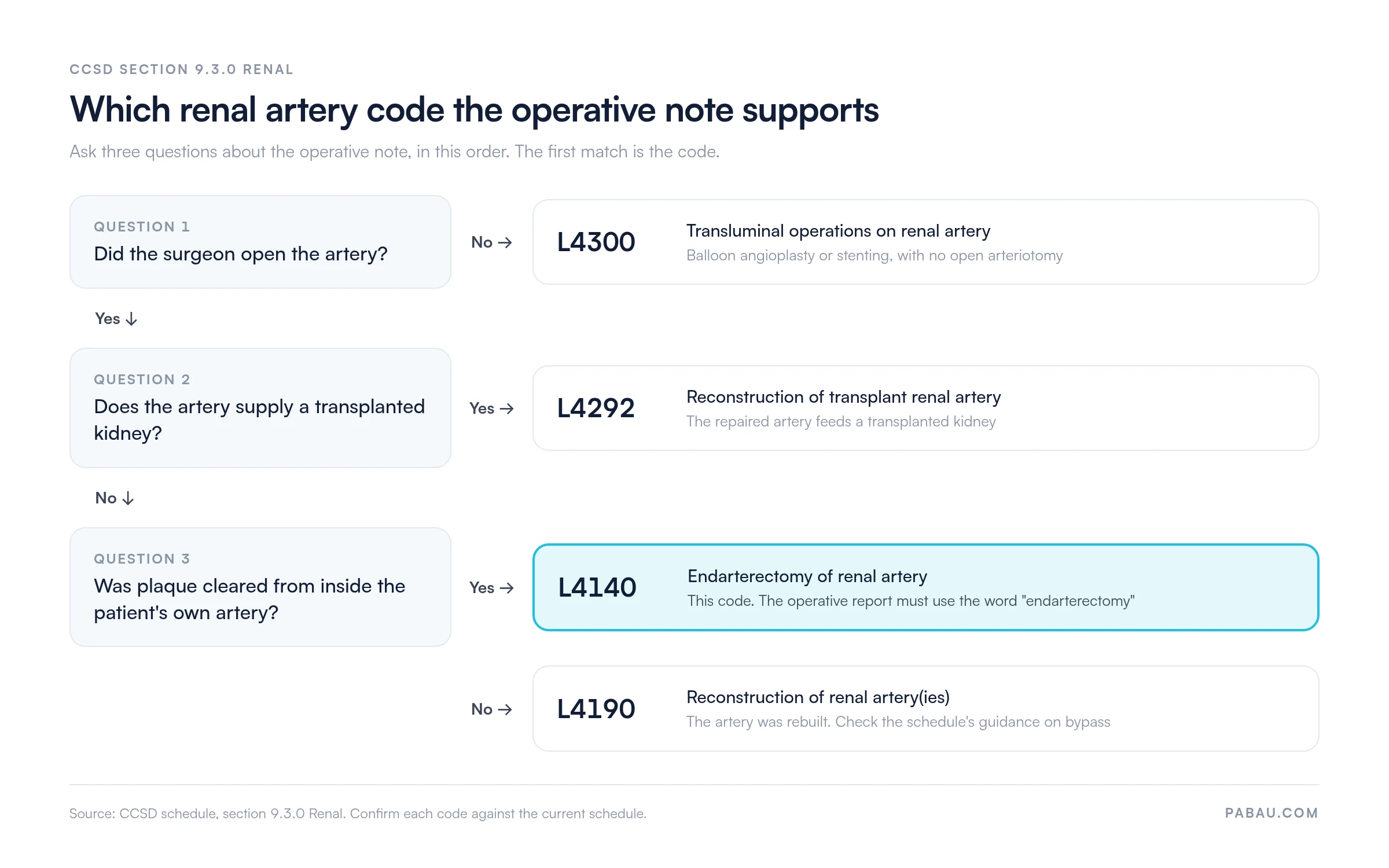
This procedure differs from percutaneous transluminal renal angioplasty (PTRA) and renal artery stenting, which are catheter-based and need no open arteriotomy. In section 9.3.0, that work falls under L4300, Transluminal operations on renal artery. L4140 applies only when an open endarterectomy is performed and documented in the operative report.
L4140 is appropriate when open endarterectomy is the chosen revascularization strategy for a patient with significant renal artery stenosis. The accepted clinical indications are:
Some findings point to a different procedure, and so a different code. Fibromuscular dysplasia often responds to PTRA. Severe chronic kidney disease may leave little function to recover. Plaque distribution can also make aorto-renal bypass the better option. Each of those alternatives carries its own CCSD code. Surgery on the artery of a transplanted kidney is billed under L4292 instead.
Before selecting L4140, confirm the operative report explicitly states that an open endarterectomy was performed. If the note describes catheter-based dilation, stent deployment or a bypass conduit, a different CCSD code applies. The word ‘endarterectomy’ must appear in the operative findings and procedure description.
Knowing what sits inside L4140 prevents both under-billing and rejected invoices from stacked codes. The table below shows what the code covers, what other clinicians bill, and what needs a different code.
Section 9.3.0 Renal of the CCSD schedule holds four codes. Picking the wrong one is an easy way to get a renal revascularization invoice queried. For how the wider schedule is organized, see Pabau’s guide to Bupa CCSD codes. Three questions about the operative note, asked in order, settle which of the four applies.
The CCSD record for L4140 also cross-references L7010, Open embolectomy of artery, and L6710, Biopsy of artery (including temporal) (as sole procedure). Read the schedule’s coding guidance before you bill either one alongside L4140.
Confirm every code against the current CCSD schedule before you submit. The CCSD Group revises codes and descriptors over time, and an old code list is a common source of rejected invoices.
Every L4140 authorization request and invoice should name the diagnosis that justifies the surgery. Where an insurer asks for a coded diagnosis, use the WHO edition of ICD-10 that the UK uses, not the US ICD-10-CM. Check each code in the WHO ICD-10 browser.
Use the same diagnosis codes on the authorization request and on the invoice. A mismatch between the two is one of the easiest insurer queries to avoid.
Renal artery endarterectomy is planned inpatient surgery. UK private medical insurers generally expect the patient to get authorization before admission, and an admission without it may not be paid. Requirements differ by insurer and policy, so confirm them before the date is booked.
If the surgeon changes technique during the operation, for example converting to a bypass, tell the insurer afterwards. Have the authorization amended so it matches the code on the invoice.
One admission produces several invoices. The surgeon, the anesthetist and the hospital each bill for the same operation, so each needs the same code, diagnosis and authorization number.
Check the insurer’s current fee for L4140 before each invoice. Fees differ between insurers and change over time. An invoice above the insurer’s fee leaves a shortfall the patient may have to pay, so tell the patient about it before surgery.
L4140 claims stall for a short list of repeating reasons. Each one can be caught before the invoice goes out.
CPT modifiers such as -50 don’t apply to CCSD codes. How bilateral or combined work is paid depends on the CCSD schedule’s guidance and on each insurer’s terms.
When both renal arteries are cleared in one operation, check the insurer’s rules for a second procedure before you invoice it. Ask for an authorization that names both arteries, and keep a record of what the insurer confirmed. If a line is later short-paid, that record supports an appeal.
L4140 is sometimes performed within a larger vascular operation, such as an aortic endarterectomy. The CCSD guidance and the insurer’s terms decide whether both codes are payable. The operative report must describe each procedure separately to support more than one code.
A vascular surgery claim usually stalls on paperwork. The authorization sits in an email, the operative note sits in the hospital system, and the invoice is typed up days later.
Pabau keeps those pieces on one patient record. You record the patient’s insurance policy, the authorization number and the diagnosis alongside the consent forms and clinical notes. Pabau’s claims management then sends the invoice to UK insurers through Healthcode and Bupa.
The result is fewer insurer queries about missing details, so your vascular surgery work gets paid sooner.

Pabau keeps the CCSD code, ICD-10 diagnosis, authorization number and clinical notes on one patient record. Invoices go to UK insurers through Healthcode with every detail attached.

L4140 is a narrow code. Bill it only when the surgeon opened the renal artery and cleared plaque from inside it, and the operative note says so.
The problems that hold up these claims sit around the code rather than in it. A missing authorization, a diagnosis that doesn’t match, or a reconstruction billed as L4140 will each stall payment. Settle all three before admission, and the insurer has little reason to query the invoice.
Book a demo to see how Pabau keeps each surgical invoice and its evidence on one patient record.

Need a broader view of how CCSD codes are structured? Bupa CCSD codes explains how the schedule’s chapters and code format work across procedure categories.
Billing an endarterectomy on a visceral artery instead? CCSD code L4530 covers endarterectomy and patch repair of a visceral branch of the abdominal aorta.
Billing renal artery work for a transplanted kidney? CCSD code L4292 covers reconstruction of the renal artery that supplies a transplanted kidney.
Was a biopsy taken from the artery as well? CCSD code L6710 explains when an arterial biopsy is billed as a sole procedure.
CCSD code L4140 covers open endarterectomy of the renal artery. The vascular surgeon opens the artery and removes atherosclerotic plaque from inside it, restoring blood flow to the kidney. It does not cover bypass, reconstruction, angioplasty or stenting, which have their own CCSD codes.
The Clinical Coding & Schedule Development (CCSD) Group publishes the CCSD schedule in the UK. UK private medical insurers such as Bupa and AXA Health use it to identify procedures. L4140 sits in section 9.3.0 Renal, under CCSD reference FI.018.
Endarterectomy removes the plaque from inside the existing renal artery, keeping the native vessel. Bypass builds a new conduit from a vein or synthetic graft, routing blood around the stenosis. They are distinct operations with different CCSD codes, so never bill one as the other.
I70.1, atherosclerosis of renal artery, is the usual primary diagnosis. Add I15.0, renovascular hypertension, when hypertension is the main indication. Add N28.0, ischemia and infarction of kidney, when ischemic nephropathy is documented. Check each code against the WHO edition of ICD-10 before you submit.
UK private medical insurers generally expect authorization before admission for planned surgery like this. Requirements differ by insurer and policy, so confirm them before the date is booked. Quote the authorization number on every invoice for the admission.
The usual reasons are a wrong code, such as a bypass or transluminal procedure billed as L4140, and a missing or mismatched authorization. An incomplete operative report, a diagnosis that differs from the authorization, and a fee above the insurer’s schedule also cause queries. A pre-submission check prevents each one.
Accepted indications are hemodynamically significant atherosclerotic renal artery stenosis and renovascular hypertension that resists maximal medical therapy. Ischemic nephropathy with potential for recovery, bilateral stenosis and stenosis to a solitary functioning kidney also qualify. The choice between endarterectomy and bypass depends on plaque anatomy, vessel caliber and surgeon preference.