HCPCS Code J1110: Dihydroergotamine mesylate injection billing guide
HCPCS Code J1110: Official descriptor and drug overview HCPCS Code J1110 is the ...

Last Updated: Oct 29, 2026
L7980 is the CCSD code for repair of wound of major artery or vein of abdomen, including the aorta and vena cava. Surgeons bill it when they repair an abdominal vessel injured by trauma or damaged during another operation.
CCSD is the procedure schedule UK private medical insurers use, and claims usually go through Healthcode. The operative note has to name the vessel and the repair method, because planned aneurysm and bypass surgery take other codes. The diagnosis code then comes from WHO ICD-10 category S35, matched to that named vessel.
Let Pabau's smart automation suggest the right codes, reduce claim denials, and keep your practice compliant—effortlessly.
Automate repetitive tasks and focus on what matters most—your patients.
Reduce coding errors and ensure compliance with the latest regulations.
Clean claims, fewer denials, and faster reimbursements.
Powerful insights and reporting to help your practice thrive.
HIPAA compliant SOC 2 certified GDPR-compliant Trusted by 4,000+ clinics worldwide

CCSD code L7980 covers repair of a wound to a major abdominal artery or vein, including the aorta and vena cava.
The operative note must name the injured vessel, describe the wound, state the repair method and explain the cause.
Pair the code with the WHO ICD-10 S35 subcode for the named vessel, because an unspecified aorta or vena cava codes to thoracic S25.
UK private medical insurance often excludes emergency care, so check the patient’s policy before you invoice the insurer.
Pabau’s claims management software sends CCSD claims to Healthcode straight from the patient record.
CCSD code L7980 is the UK private insurance code for repairing a wound of a major abdominal artery or vein. That includes the aorta and vena cava, and surgeons bill it when they repair a damaged major vessel inside the abdomen.
CCSD stands for Clinical Coding and Schedule Development. Its schedule is the procedure code set that UK private medical insurers such as Aviva, AXA Health, Bupa and Vitality use. Claims usually travel electronically through Healthcode.
The descriptor sets the limits of the code. It describes a wound, so it fits a vessel injured by trauma or damaged during another procedure. The vessel also has to be a major one inside the abdomen. The two checks below show where a case leaves L7980, and which S35 code follows when it stays.
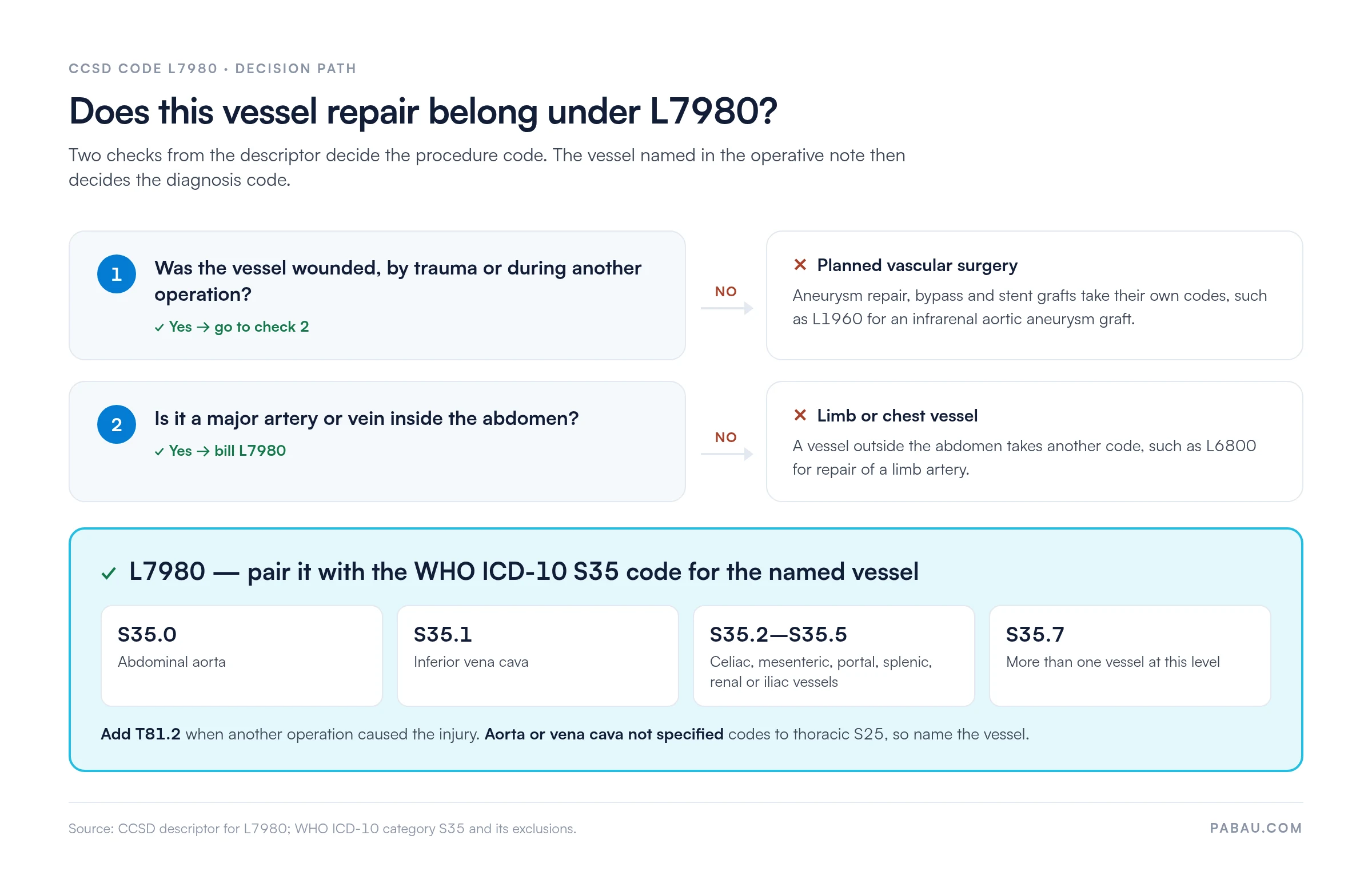
L7980 is for an injury to the vessel wall. Planned vascular surgery has its own entries in the CCSD code schedule, so check it before you claim any of these:
An infrarenal aortic aneurysm bifurcation graft, for example, takes L1960, and repair of a limb artery takes L6800. If a note mixes an injury repair with planned vascular work, the insurer’s reviewer will ask which code the operation supports. Write the note so the answer is clear on first reading.
Insurers pay L7980 on the strength of the operative note. A reviewer should be able to confirm the vessel, the injury, the repair and the reason without calling the surgeon.
Add the context the claim depends on, such as blood loss, transfusion and the time of surgery. Keep the consent form and anesthetic record in the same patient file, so you can send them if the insurer asks.
Write the vessel name in the operation title and the diagnosis line, not only in the narrative. Reviewers read those lines first, and a bare “aorta” there can pull the claim toward a thoracic diagnosis code.
Pair L7980 with an ICD-10 diagnosis code that describes the injury. In WHO ICD-10, wounds of abdominal vessels sit in category S35, injury of blood vessels at abdomen, lower back and pelvis level.
S35 covers more vessels than L7980 does. A matching diagnosis code does not prove the procedure code fits, so check the vessel against the CCSD descriptor as well.
Two exclusions catch coders out. S35.0 excludes aorta not otherwise specified, which codes to S25.0 in the thorax. S35.1 excludes vena cava not otherwise specified, which codes to S25.2.
Add an S36 code for any injured abdominal organ. Add an external cause code from chapter XX when the insurer asks how the injury happened.
A wounded abdominal vessel is usually an emergency, and UK private medical insurance policies often exclude emergency care. Check the patient’s policy terms and benefit limits before you invoice the insurer.
A private L7980 claim is more likely to follow a vessel injured during a planned private operation. In that case, tell the insurer early, quote the original authorization and record any new reference it issues.
Fees for L7980 depend on each insurer’s schedule and your recognition agreement with it. Look the code up in the insurer’s own tool, such as the Bupa code search, rather than relying on a figure published elsewhere.
When a vessel is damaged during another procedure, the claim may carry both the original procedure code and L7980. CCSD publishes unacceptable code combinations for each code, and the list for L7980 sits behind the CCSD login.
Check that list before you add L7980 to the claim. If the pair is allowed, the operative note should show the vessel repair as a separate, documented step with its own findings.
Each surgeon, assistant and anesthetist needs their own recognition with the insurer before they bill. Confirm it for every practitioner on the case, because an unrecognized practitioner’s claim comes back unpaid.
The table below pairs each likely reason for a query or denial with the step that prevents it.
A vascular injury claim stalls when the note, the codes and the insurer details live in separate systems. The billing team then rebuilds the claim by hand, weeks after the surgery.
Pabau, our practice management and billing platform, keeps the CCSD code and the diagnosis code on the patient’s record, next to the operative note. Its claims management tool sends the claim to Healthcode from that record.
Before it goes, Pabau checks that required fields such as membership numbers and authorization codes are complete. If the insurer queries an L7980 claim, your team answers from the same record, with the operative note and consent form in one file.

Pabau links each L7980 claim to the patient’s insurer details and operative record, then sends it to Healthcode. Your team answers insurer queries from the same record.

L7980 is a narrow code. It pays for repairing a wound to a major abdominal vessel, and the operative note has to prove that is what happened.
Settle three details before the claim leaves the practice: the named vessel, the S35 code that matches it, and cover for the admission. Get those right and the reviewer has little left to query.
Book a demo to see how Pabau carries a CCSD claim from the operative note to Healthcode without retyping.

Coding a limb vessel instead? CCSD code L6800 covers open repair of a limb artery and how to document it.
Billing planned aortic surgery? CCSD code L1960 walks through an infrarenal aortic aneurysm bifurcation graft claim.
Working on a bypass case? CCSD code L1620 explains how to bill an axillo-unifemoral bypass.
Billing Bupa patients? Bupa CCSD codes covers how Bupa uses the CCSD schedule and what it checks on a claim.
L7980 covers repair of a wound to a major artery or vein of the abdomen, including the aorta and vena cava. It is for injury repairs, not planned aneurysm or bypass surgery.
Use the WHO ICD-10 S35 subcode for the injured vessel, such as S35.0 for the abdominal aorta or S35.1 for the inferior vena cava. For an injury caused during another operation, consider T81.2.
Often not. Many UK policies exclude emergency treatment, so check the patient’s terms before invoicing. A claim is more likely when the injury happens during a planned private operation.
Sometimes. CCSD lists unacceptable combinations for each code behind its login, so check the list for L7980 first. If the pair is allowed, document the vessel repair as a separate step.
Name the injured vessel, describe the wound, state the repair method and explain the cause. Add blood loss, transfusion and the time of surgery.