

HCPCS Code L0472: Hyperextension TLSO billing guide
HCPCS code L0472: Official descriptor and device definition HCPCS code L0472 des...

Last Updated: Nov 5, 2026
L1810 is the CCSD code for repair of leaking aneurysm of ascending aorta. It covers open surgical repair of an ascending aortic aneurysm that has started to leak. The surgeon replaces the diseased segment with a graft while the patient is on cardiopulmonary bypass.
The code applies only to the ascending aorta and only to a leaking aneurysm. A planned repair of an intact ascending aneurysm is L1910. The arch, the rest of the thoracic aorta and aortic dissections have codes of their own.
Let Pabau's smart automation suggest the right codes, reduce claim denials, and keep your practice compliant—effortlessly.
Automate repetitive tasks and focus on what matters most—your patients.
Reduce coding errors and ensure compliance with the latest regulations.
Clean claims, fewer denials, and faster reimbursements.
Powerful insights and reporting to help your practice thrive.
HIPAA compliant SOC 2 certified GDPR-compliant Trusted by 4,000+ clinics worldwide

CCSD code L1810 covers open repair of a leaking aneurysm of the ascending aorta under the UK private-sector CCSD schedule.
The leak decides the code. A planned repair of an intact ascending aneurysm is L1910, and an aortic dissection repair is L1892 or L1992.
Under the CCSD single code principle, bypass and routine post-operative care are part of L1810, so they are not billed as extra codes.
Pair L1810 with WHO ICD-10 code I71.1, thoracic aortic aneurysm, ruptured, when the operative note confirms the leak.
Most UK health insurance policies exclude emergency treatment, so contact the insurer early and put the authorisation number on the Healthcode claim.
CCSD code L1810 is the code for repair of leaking aneurysm of ascending aorta. It belongs to the CCSD schedule, the procedure coding standard for UK private healthcare. The Clinical Coding and Schedule Development (CCSD) group maintains the schedule. UK private medical insurers such as Bupa, AXA Health, Aviva and Vitality use it to process claims.
L1810 sits in Chapter 8 of the schedule, Thorax and intra-thoracic organs, under Great Vessels. Its neighbours in the CCSD code library split aortic surgery by segment, by leak status and by pathology.
The code fits one clinical picture. The aneurysm is in the ascending aorta, it has started to leak, and the surgeon repairs it through an open operation. A contained leak or a periaortic haematoma on imaging points towards L1810, provided the operative record confirms it.
L1810 is not the code for surveillance of an aneurysm or for a planned repair of an intact one. It also does not fit an operation limited to the aortic root or the arch. Those scenarios carry other CCSD codes, set out below.
Repair of a leaking ascending aortic aneurysm is a high-acuity open heart operation. Knowing the steps helps coders check what the operative note must contain.
The surgeon opens the chest through a median sternotomy, a division of the breastbone. The patient then goes on cardiopulmonary bypass, which takes over heart and lung function. The heart is stopped with cardioplegic solution, so the surgeon works in a still, bloodless field.
The surgeon resects the diseased ascending aorta and replaces it with a synthetic tube graft. The proximal join sits at the aortic root or valve annulus. The distal join sits at the start of the arch, just before the first arch branch.
If the aneurysm reaches towards the arch, the team may use deep hypothermic circulatory arrest. The patient is cooled and circulation is paused briefly, so the distal join can be made in a clear field.
Three features in the record support L1810:
The CCSD Technical Guide sets a single code principle. One code describes the procedure from start to finish, including the components routinely performed with it. The guide names anaesthesia, intra-operative care, post-operative care and intensive care among them.
Two codes on one claim need care. The Technical Guide notes that each insurer has its own contractual rules on multiple codes, and it advises contacting the insurer first.
Several aortic codes sit close to L1810. They differ by leak status, aortic segment and underlying pathology.
CCSD also lists L1810 as an unacceptable combination with L2710 and L2720, both endovascular abdominal aortic repairs. These lists are not exhaustive, so apply the same logic to any second code.
Bupa grades L1810, L1880, L1890 and L1910 all at CMO 5, so the leak does not change Bupa’s fee. It still decides which code is accurate.
The costliest error is coding a Stanford type A dissection as L1810. Dissection has its own codes, L1892 and L1992, so confirm the pathology in the operative note first.
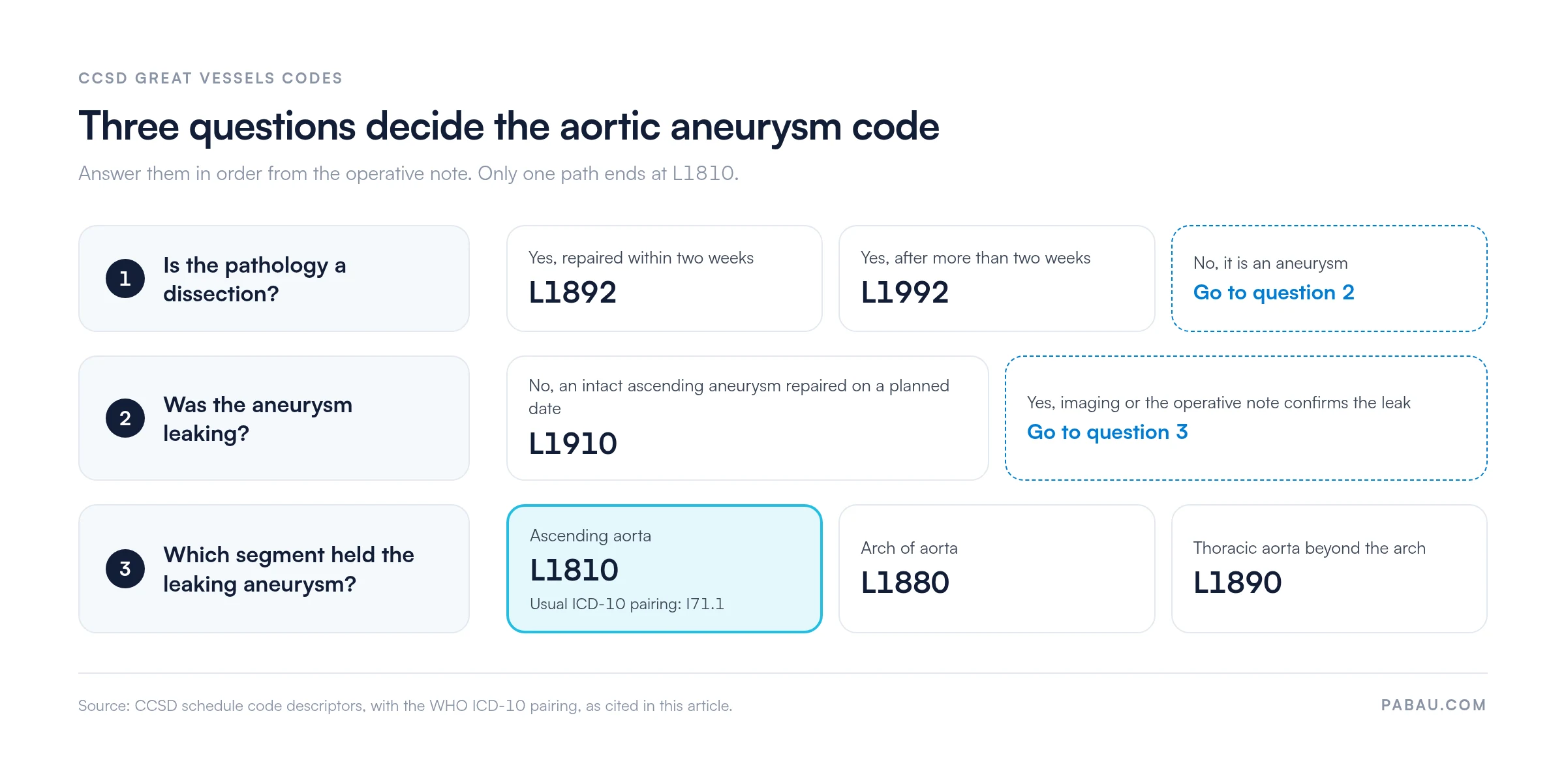
UK insurers expect a diagnosis code from WHO ICD-10, the edition used across the UK, alongside the CCSD code. For L1810, the diagnosis has to support the leak in the descriptor.
WHO ICD-10 has no code for an ascending aortic aneurysm as such. I71.1 and I71.2 cover the whole thoracic aorta, so the CCSD code carries the segment. Codes such as I71.01 come from the US ICD-10-CM and do not exist in the WHO edition.
A CT report describing a contained leak does not always say ruptured. Query the surgeon or radiologist before you assign I71.1, and code what the record documents.
Ask for the CT angiography report with the operative note when you code L1810. The imaging report is usually where contained leak or periaortic haematoma first appears. That wording supports both I71.1 and the leaking descriptor.
L1810 is a consultant cardiothoracic surgeon’s code. UK insurers expect the surgeon to hold GMC registration with a specialist registration in cardiothoracic surgery. Most also require the surgeon to be recognised by the insurer before they pay the claim.
The operation needs a hospital with a cardiac theatre, perfusion and critical care. Hospital charges for theatre time, perfusion, the graft and the critical care stay go on the hospital’s own account. The anaesthetist usually bills a separate account against the same procedure code, under the insurer’s rules.
A leaking ascending aneurysm is a surgical emergency. Most UK private medical insurance policies exclude emergency treatment, so many of these repairs take place in the NHS.
If the patient is treated privately, contact the insurer as early as possible. Each insurer sets its own rules on emergency admissions and on what it will fund afterwards. Never assume cover from an earlier authorisation for a different code.
L1810 claims need more evidence than elective work, because the leak must be shown rather than assumed. The operative note matters most, and it should contain the following.
A full operative note written on the day of surgery is far easier to defend than a later addendum.
Each insurer sets its own fee for L1810, in pounds sterling. Bupa’s February 2026 schedule grades L1810 at complexity band CMO 5 and lists a fee of £2,172. The Technical Guide says reimbursement is a matter for each funder and provider. Check the figure in the insurer’s own schedule, such as Bupa’s code search, before surgery.
Our Bupa fee schedule guide shows how one insurer prices each code.
Keep each insurer’s current fee for L1810 on file in the billing office. When a payment comes in below it, raise a query with the insurer before you bill the patient. Record every dispute and its outcome for audit.
An urgent aortic case leaves billing teams chasing theatre notes, emails and insurer portals. When surgery happens fast, the authorisation number and the imaging report are easy to lose.
Pabau, the practice management and billing platform we build, keeps the CCSD code, the ICD-10 diagnosis and the authorisation number on one claim record. Pabau’s claims management software submits the claim through Healthcode and tracks its status in the same place.
Pabau doesn’t choose the code for you, so the leak, segment and pathology checks above still apply. If the aneurysm turns out to be intact, L1910 covers the elective claim.

Pabau holds the CCSD code, the diagnosis and the insurer authorisation number on one claim record. Your team submits through Healthcode and tracks each L1810 claim to payment.

L1810 fits one operation: an open repair of a leaking aneurysm of the ascending aorta. Change the leak status, the segment or the pathology, and the code changes with it.
For UK private billing, cover is often the harder question. Most insurers leave emergency care to the NHS. A funded L1810 claim rests on early contact with the insurer and an operative note that proves the leak.
Settle the code, the diagnosis and the authorisation number before the claim leaves the practice. To see how Pabau keeps the whole claim in one place, book a demo.

Was the aneurysm intact at surgery? CCSD code L1910 covers planned repair of an ascending aortic aneurysm and the evidence an elective claim needs.
Did the leak involve the arch? CCSD code L1880 explains the leaking arch repair code and why it cannot sit on a claim with L1810.
Was the pathology a dissection rather than an aneurysm? CCSD code L1892 covers immediate repair of aortic dissection within two weeks of onset.
New to the CCSD schedule? Our Bupa CCSD codes guide explains how UK insurers use the schedule and where to find current codes.
Was the dissection repaired after two weeks? CCSD code L1992 covers delayed repair of aortic dissection more than two weeks after onset.
CCSD Code L1810 covers open surgical repair of a leaking aneurysm of the ascending aorta. It includes the graft replacement, cardiopulmonary bypass and routine post-operative care. Intact aneurysms, arch repairs and dissections use other CCSD codes.
L1810 is for a leaking ascending aneurysm. L1910 is the elective repair of an intact ascending aneurysm on a planned date. The operative note must show which one the surgeon found.
No. Under the CCSD single code principle, bypass is part of the L1810 operation. The hospital bills perfusion and theatre charges on its own account.
I71.1, thoracic aortic aneurysm, ruptured, is the usual pairing in WHO ICD-10. I71.2 suggests an intact aneurysm, and I71.0 is a dissection, which needs a different CCSD code.
The usual causes are a missing leak in the record, no authorisation number, and an I71.2 diagnosis. Billing L1810 with an unacceptable combination such as L1880 is another cause.



