CCSD Code C7920: Pars plana vitrectomy with tamponade, buckling and retinopexy
CCSD Code C7920: Definition and official descriptor CCSD Code C7920 is the CCSD ...

Last Updated: Nov 11, 2026
L2190 is the CCSD code for replacement of graft of thoraco-abdominal aneurysm. It covers open surgical repair of a thoracoabdominal aortic aneurysm. The surgeon replaces the aneurysmal segment, which spans the chest and abdomen, with a prosthetic graft.
CCSD files L2190 under Great Vessels in chapter 8 and under Thoracic in chapter 9, the Vascular System chapter. Endovascular repairs such as TEVAR and fenestrated EVAR take separate codes.
Let Pabau's smart automation suggest the right codes, reduce claim denials, and keep your practice compliant—effortlessly.
Automate repetitive tasks and focus on what matters most—your patients.
Reduce coding errors and ensure compliance with the latest regulations.
Clean claims, fewer denials, and faster reimbursements.
Powerful insights and reporting to help your practice thrive.
HIPAA compliant SOC 2 certified GDPR-compliant Trusted by 4,000+ clinics worldwide

CCSD code L2190 covers open replacement of a thoracoabdominal aortic aneurysm with a graft, never endovascular repair such as TEVAR or fenestrated EVAR.
The operative note must record the Crawford extent (I to IV), because it shows the insurer how much aorta the repair replaced.
UK private medical insurers routinely require pre-authorization before TAAA surgery, and claims without a valid reference number are often rejected outright.
Elective L2190 claims pair with ICD-10 code I71.6, while I71.5 is reserved for a ruptured thoracoabdominal aneurysm.
Pabau, the practice management platform we build, tracks pre-authorization codes on each case and submits UK insurer claims through Healthcode.
CCSD code L2190 covers open surgical replacement of a thoracoabdominal aortic aneurysm (TAAA). The surgeon excises the diseased segment of aorta that spans the chest and abdomen and replaces it with a prosthetic graft. The official descriptor in the CCSD schedule is “Replacement of graft of thoraco-abdominal aneurysm.” CCSD files the code under 8.10.0 Great Vessels in chapter 8 and under 9.2.0 Thoracic in chapter 9, the Vascular System chapter.
L2190 applies only to the conventional open approach. Endovascular alternatives take separate CCSD codes and must not be billed under L2190. Those alternatives include thoracic endovascular aortic repair (TEVAR), fenestrated endovascular aortic repair (FEVAR) and branched endovascular devices.
L2190 is a UK private healthcare code. It is not interchangeable with NHS tariff codes or with the CPT codes used in US billing. The operating surgeon’s practice submits the L2190 claim to the patient’s private medical insurer, and the hospital invoices its facility fees separately. For Bupa-insured patients, the Bupa CCSD procedure codes framework adds fee-schedule rules and unit-fee caps to check before invoicing. Related aortic procedures sit alongside it in the wider CCSD code library.
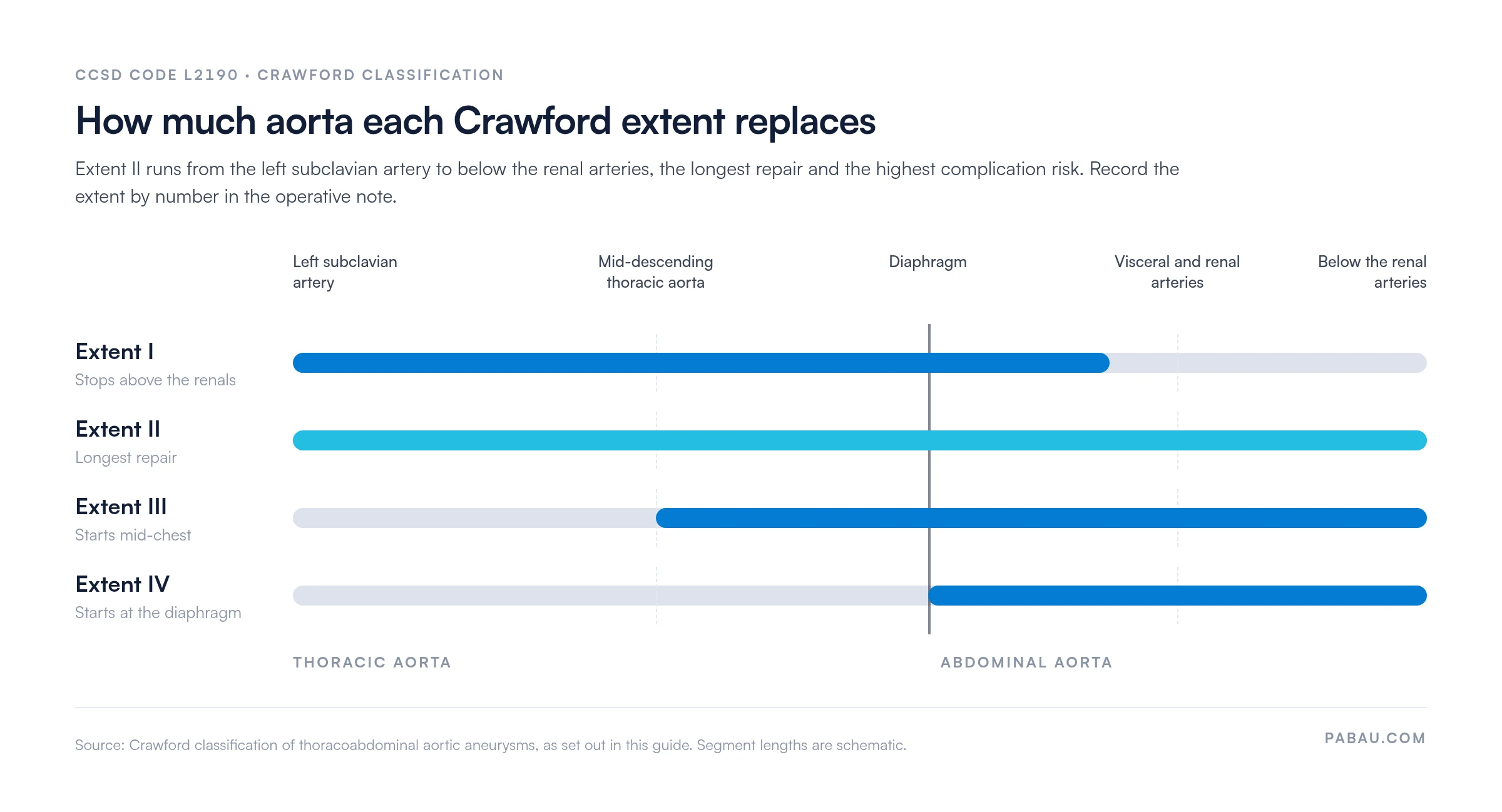
The Crawford classification divides thoracoabdominal aortic aneurysms into four anatomical extents, based on how much of the aorta is involved. The operative note must state the Crawford extent because it shows how complex the repair was. If the claim is queried, it also gives the insurer’s clinical assessor the evidence that open TAAA repair was necessary at that extent. The diagram maps each extent onto the aorta.
An L2190 claim whose operative note lacks the Crawford extent is a common audit trigger. Without it, the insurer cannot verify the anatomical complexity of the procedure. The claim is then likely to be queried or downgraded to a lower-complexity code.
Open TAAA repair is a major operation performed under general anesthesia, typically with one-lung ventilation to allow thoracic exposure. The surgeon makes a thoracoabdominal incision, often running from the left lateral chest through the diaphragm into the abdomen. After proximal and distal clamping of the aorta, the aneurysm sac is opened. The prosthetic graft, usually a Dacron tube or bifurcated graft, is then anastomosed proximally and distally.
Visceral and renal arteries are reimplanted into the graft or reperfused through temporary shunts. Spinal cord protection measures, such as cerebrospinal fluid drainage and hypothermia, reduce the risk of paraplegia. The operative note must reflect each of these steps. They distinguish open TAAA repair from simpler aortic procedures and confirm that L2190 is the correct code.
Knowing the bundle boundaries of CCSD code L2190 prevents both undercoding and inappropriate unbundling.
Included within L2190:
Not included in L2190 (requires a separate CCSD code):
Before submitting an L2190 claim, ask the operating surgeon to confirm in writing whether any additional procedure under the same anesthetic warrants a separate code. Coders should never assume a concurrent procedure is bundled without checking the CCSD technical guide and the insurer’s unbundling policy.
CCSD covers aortic procedures with several codes that differ by anatomical level or surgical approach. Billing one of them in place of L2190, or L2190 in place of one of them, is a frequent audit trigger on aortic surgery claims. The table lists the descriptors as they appear in the CCSD schedule.
A leaking aneurysm of the ascending aorta takes its own code again, L1810. Insurers update their fee schedules more often than CCSD changes descriptors, so check the code in the CCSD technical guide before you submit a claim.
Every L2190 claim must carry a valid ICD-10 diagnosis code. UK private insurers use it to confirm medical necessity, and a missing or incorrect diagnosis code is a straightforward rejection reason.
Confirm which ICD-10 edition each insurer uses, since most UK private medical insurers reference ICD-10 5th Edition (the NHS edition). The aneurysm code should reflect the operative findings, not the pre-operative imaging report alone.
A complete operative note is the foundation of every L2190 claim. Missing elements give the insurer grounds to downcode the procedure, request a full clinical review or reject the claim outright.
The operative note must include each of the following for the claim to be defensible:
Keep the supporting documents on file and easy to retrieve. These include the anesthetic record, the intensive care admission note and any intraoperative imaging. With Pabau’s digital forms, vascular surgery teams can build structured operative note templates that capture each required element before the patient leaves the operating room.

TAAA surgery triggers mandatory pre-authorization across UK private medical insurers. Because of the procedure’s complexity and cost, virtually every insurer requires clinical approval before the operation goes ahead. Claims submitted without a valid pre-authorization reference are typically rejected without clinical review.
Standard pre-authorization submissions to Bupa, AXA Health, Aviva, Vitality and Cigna typically require:
An approved pre-authorization still leaves the final claim open to query. The insurer can challenge it when the documented procedure differs from the authorized plan. A common case is an authorized open repair whose operative note describes an endovascular component. Check fees in each insurer’s own tool before submission. Bupa’s code search portal lists CCSD codes and fee schedules, and Aviva’s fee schedule and Vitality’s fee finder give code-level fees.
The complexity and cost of TAAA surgery draw close insurer scrutiny to every L2190 claim. The common rejection reasons below are preventable with the right pre-claim checks.
When appealing a denied L2190 claim, include the full operative note, the pre-authorization reference and the surgeon’s clinical letter. Add any post-operative imaging or histology confirming the aneurysm diagnosis. Most UK private medical insurers run a formal clinical appeals process. Submit the appeal in writing within the insurer’s stated timeframe, typically 60 to 90 days from the denial date.
Open TAAA repair carries significant complication rates. The billing team needs to know which complications generate additional CCSD codes and which are absorbed into L2190.
Spinal cord ischemia is the most feared complication of TAAA surgery. When it occurs, it needs a separate ICD-10 secondary diagnosis, typically G82 for paraplegia or paraparesis. Insertion of a cerebrospinal fluid drainage catheter by a separate operator may warrant its own CCSD code.
Renal failure requiring dialysis generates additional hospital facility codes. It typically does not change the surgeon’s L2190 billing unless a renal artery reconstruction was performed as a distinct procedure. A renal artery endarterectomy done as a distinct step is coded separately as L4140, subject to the insurer’s bundling rules.
Staged procedures are each coded and invoiced separately. Say an initial open debranching operation is followed by a planned endovascular completion. The first stage uses the appropriate open debranching CCSD code, and the second uses the relevant endovascular code, not L2190 again. Pabau’s claims management software tracks the pre-authorization code, dates and sessions on each case, and warns when one is missing. That stops a second-stage invoice from going out without its own authorization.
Create a complication coding checklist for every TAAA case that leaves the operating room. Record spinal cord status at 24 and 48 hours, the renal function trend, bowel viability at closure and the duration of respiratory support. Each item maps to a possible ICD-10 secondary code or separate CCSD claim that is otherwise missed at billing time.
An L2190 claim usually depends on three records kept in different places. The operative note sits with the surgeon, the pre-authorization reference sits in an insurer email and the invoice sits in the billing system. When those three disagree, a TAAA claim turns into a query.
Pabau keeps them on one patient case. The pre-authorization code, dates and sessions are tracked on the case, with a warning when a code is missing. Claims go to UK insurers through Healthcode and Bupa from the same record that holds the structured operative note.
The outcome is an invoice that matches the note and the authorization it relies on. It also cuts the back-and-forth between the operating team and whoever handles medical billing for the practice.

Pabau tracks pre-authorization codes and dates on each case and submits UK insurer claims through Healthcode. Your L2190 invoices go out matched to the operative note.

An L2190 claim is won or lost in the operative note. Record the Crawford extent by number, name each reimplanted vessel, and code the diagnosis from the operative findings. The insurer is then left with little to query.
The trade-off is a few extra minutes of documentation at the end of a long operation. A structured template moves that work to the start of the case, where it costs less than an appeal.
Book a demo to see how Pabau keeps pre-authorizations, operative notes and insurer claims on one case for your vascular surgery practice.

Need a full reference for Bupa procedure billing? Bupa CCSD procedure codes covers Bupa’s fee schedule structure, unit fees and submission requirements for UK private practice.
Coding an emergency repair higher up the aorta? CCSD code L1810 covers repair of a leaking ascending aortic aneurysm and the documentation insurers expect.
Billing other open vascular reconstructions? CCSD code L1680 explains how to code and document an axillo-bifemoral bypass.
Looking for a wider overview of private practice billing? What is medical billing explains the end-to-end invoicing and collection cycle for private practitioners.
CCSD code L2190 covers open surgical replacement of a thoracoabdominal aortic aneurysm. A prosthetic graft replaces the diseased aortic segment that spans the chest and abdomen. It applies to the conventional open approach only, and endovascular techniques such as TEVAR, FEVAR and branched EVAR take other codes.
No. L2190 is restricted to open surgical repair. Thoracic TEVAR is coded L2730, and fenestrated EVAR of the suprarenal aorta is coded L2720 or L2780, depending on the number of orifices. Billing an endovascular procedure under L2190 is a miscoding error and a frequent audit trigger.
Yes. In practice, virtually all major UK private medical insurers require pre-authorization before TAAA surgery goes ahead. Policies differ between insurers, so confirm each patient’s policy terms before listing them for surgery. Claims submitted without a valid pre-authorization reference are routinely rejected.
The Crawford classification divides thoracoabdominal aortic aneurysms into four extents, I to IV, by how much of the aorta they involve. The operative note must state the extent to confirm the procedure’s complexity and support the claim during insurer review. The extent also separates thoracoabdominal repair from infrarenal or descending thoracic repair.
Separately performed procedures that L2190 does not bundle may be billed alongside it. Examples are cerebrospinal fluid drain insertion by a separate operator, concurrent organ repair and planned staged procedures. The anesthetic team bills anesthesia separately. Check the CCSD technical guide and the insurer’s unbundling policy before adding codes to an L2190 claim.