HCPCS code G0257: Unscheduled or emergency dialysis billing guide
HCPCS code G0257: Official descriptor and code overview HCPCS code G0257 is defi...

Last Updated: Oct 27, 2026
CCSD code L1892 is immediate repair of aortic dissection, meaning surgery within two weeks of the dissection happening. It sits in Chapter 8 of the CCSD schedule, Thorax and intra-thoracic organs, under Great Vessels. Cardiothoracic surgeons and private hospitals bill it to UK private medical insurers, usually after an emergency admission.
One date decides the claim. A repair more than two weeks after onset is L1992, delayed repair of aortic dissection. The CT report and the operative note need to show which side of that line the case falls on. Get the onset date, the record and the code pairings right, and the claim is far less likely to come back with a query.
Let Pabau's smart automation suggest the right codes, reduce claim denials, and keep your practice compliant—effortlessly.
Automate repetitive tasks and focus on what matters most—your patients.
Reduce coding errors and ensure compliance with the latest regulations.
Clean claims, fewer denials, and faster reimbursements.
Powerful insights and reporting to help your practice thrive.
HIPAA compliant SOC 2 certified GDPR-compliant Trusted by 4,000+ clinics worldwide

CCSD code L1892 is immediate repair of aortic dissection, meaning surgery within two weeks of the dissection happening.
A repair more than two weeks after onset is L1992, so the onset date in the notes decides which code the claim carries.
The CCSD lists L1892 as an unacceptable combination with L1880 and L2190, so neither shares a claim with it.
Most L1892 cases arrive as emergencies, so the insurer is usually notified after admission rather than asked to authorize in advance.
The CT report, the operative note and the onset date should all tell the same story before the claim goes to Healthcode.
CCSD code L1892 is the code for immediate repair of aortic dissection, which the schedule defines as repair within two weeks of the dissection happening. It sits in Chapter 8 of the CCSD schedule, Thorax and intra-thoracic organs, under Great Vessels.
An aortic dissection is a tear in the inner lining of the aorta. Blood forces its way between the layers of the vessel wall and opens a false channel. Surgeons usually describe it with the Stanford classification. Type A involves the ascending aorta, and type B does not.
L1892 is a cardiothoracic surgery code. Surgeons and private hospitals bill it to UK private medical insurers such as Bupa, AXA Health, Aviva and Vitality. Because a dissection is often an emergency, most claims follow an unplanned admission rather than a booked procedure.
Before the claim goes anywhere, the scope of the code needs pinning down.
The descriptor turns on when the repair happened relative to the dissection. The code choice and the supporting notes both follow from that date.
The descriptor does not name a surgical approach. If the repair was endovascular, confirm with the insurer which code it expects before you submit.
These are the codes most likely to come up on the same case. Descriptors are given as the CCSD publishes them where they could be confirmed.
For a fuller look at one of these neighbors, see our guide to L1880. Our index of CCSD codes covers other procedures on the schedule. Check the current schedule before you rely on any descriptor, because the CCSD updates its codes and combination rules.
The difference between L1892 and L1992 is a count of days. That makes the onset date the most important single entry in the record, and the timeline below shows where the line falls.
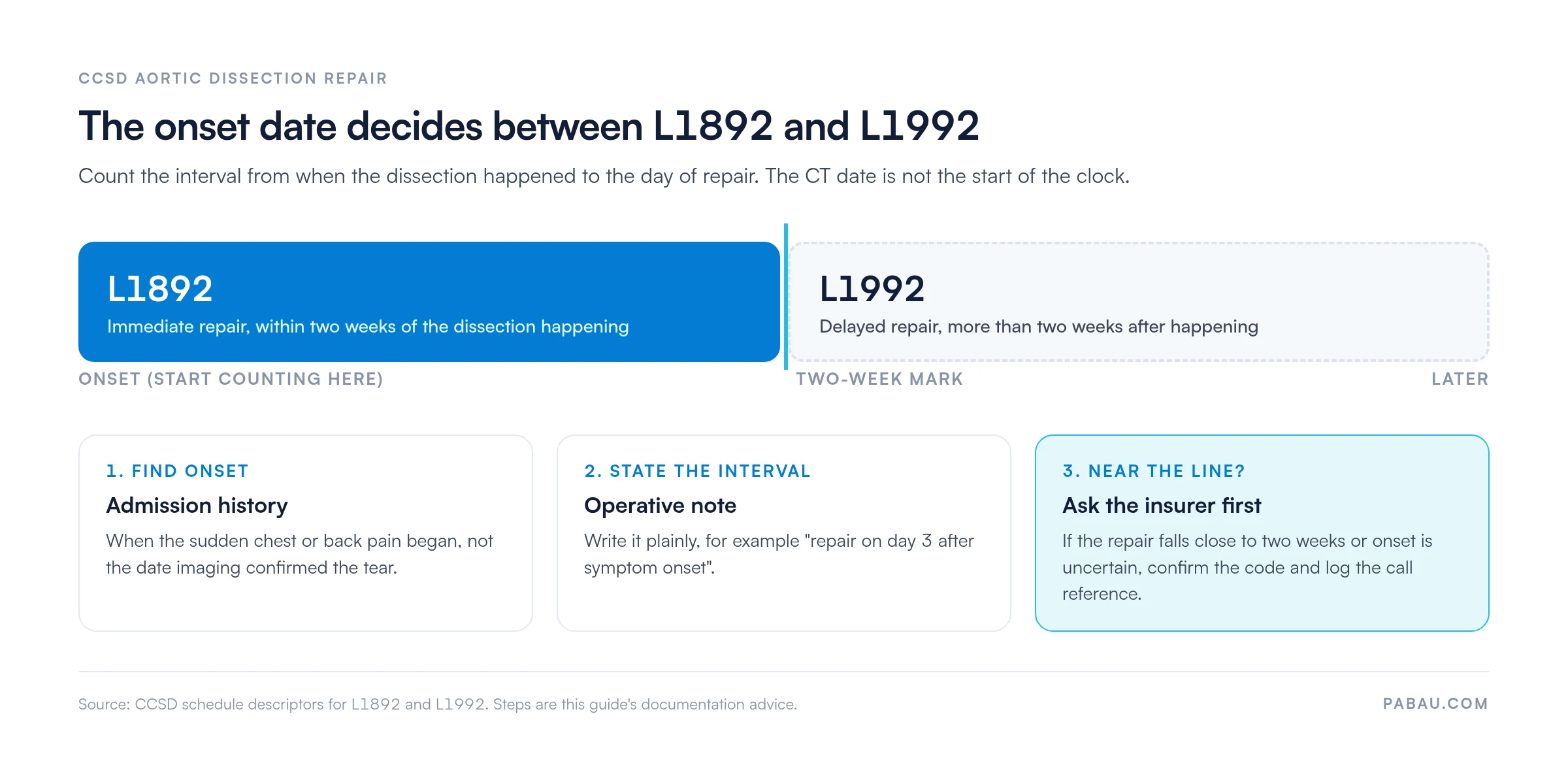
Count from when the dissection happened, not from the date of the CT scan. A patient may live with symptoms for several days before imaging confirms the tear. The admission notes usually carry the best evidence of onset, such as the time sudden chest or back pain began.
Here is how that plays out. A patient’s back pain starts on a Monday evening. A CT scan on Wednesday confirms a type A dissection, and the surgeon repairs it on Thursday. That is day 3 from onset, so the claim carries L1892.
Now picture the same notes with only the CT date recorded. The reviewer cannot see when the clock started, so the claim stalls while someone rebuilds the timeline. Write the interval into the operative note in plain terms, for example “repair on day 3 after symptom onset”.
Where the repair falls close to the two-week mark, or the onset date is uncertain, ask the insurer which code it expects before submitting. Record the answer and the call reference on the patient file.
Once the date is settled, the rest of the record has to back it up. An insurer that queries an L1892 claim will look for five items.
Pair the procedure code with the diagnosis the notes support. ICD-10 code I71.0 covers dissection of the aorta. Your insurer may ask for it alongside L1892.
Structured digital intake and clinical forms make these fields hard to skip. Each entry is time-stamped against the patient record, which helps when a claim is queried months later.
Many L1892 operations happen within hours of diagnosis, so standard pre-authorization is often impossible. Insurers expect to hear about an emergency admission as soon as practical. Each policy sets its own notification window.
Our guide to Bupa CCSD codes explains how one large insurer structures its schedule. Other insurers publish their own fee schedules and set their own fees, because the CCSD does not set reimbursement.
The CCSD publishes unacceptable combinations for each code. These are pairs that should not appear together for the same operation.
L1892 appears as an unacceptable combination on the CCSD entries for L1880 and L2190. If the operative note describes a dissection repair, bill L1892 alone for that work. Do not add an aneurysm repair code for the same segment of aorta.
The anesthetist and any assisting surgeon submit their own claims for the same operation. Check how each insurer expects those claims to be coded, because the rules differ between insurers.
Most queries on this code trace back to a short list of problems. Each one has a straightforward fix.
A two-minute check at the end catches the problems above before the insurer does.
An emergency dissection repair leaves the billing team with notes from the emergency department, imaging, theatre and intensive care. Pulling the claim together by hand means retyping membership numbers and references from several places, which is where errors creep in.
Pabau, the practice management and billing platform we build, pre-fills each claim from the patient record. Its claims management software checks that required fields, such as membership and authorization numbers, are complete before the claim can be sent.
In the UK, claims go through Pabau’s Healthcode integration with live status tracking and payment reconciliation. Your team spends less time chasing references and more time answering the queries that need a clinician.

Pabau pre-fills claims from the patient record and checks required fields before sending. UK claims go straight to Healthcode, with status tracking built in.

L1892 rewards one habit above the rest: write down when the dissection happened. The onset date decides between L1892 and L1992, and an insurer cannot check a date the notes never recorded.
So make the onset time part of the admission routine, where it takes a minute to record. Treat the emergency notification reference as part of the claim, too. A claim built that way rarely comes back with a query.
Book a demo to see how Pabau pre-fills surgical claims and sends them to Healthcode without retyping.

Coding a leaking arch aneurysm instead? CCSD code L1880 covers repair of a leaking aneurysm of the arch of the aorta.
Billing aortic valve surgery? CCSD code K2612 explains how aortic valve replacement claims are coded and documented.
Working on abdominal aortic surgery? CCSD code L1960 covers the infrarenal AAA bifurcation graft.
Need the wider picture? Bupa CCSD codes shows how Bupa structures its procedure code schedule.
CCSD stands for Clinical Coding and Schedule Development. The CCSD Group publishes the procedure code schedule that UK private medical insurers and hospitals share. It does not set fees or decide reimbursement.
Timing alone. L1892 covers repair within two weeks of the dissection happening, and L1992 covers repair more than two weeks after. Count from onset, not from the CT date.
There is no single fee. Each insurer prices L1892 in its own fee schedule, and policy limits vary. Check the insurer’s current schedule before you quote a figure to the patient.
The descriptor does not name an approach. Insurers may map an endovascular repair differently, so confirm the code with the insurer before you submit and note the answer on the file.
No. The CCSD lists both as unacceptable combinations with L1892. Bill the dissection repair on its own for that operation.
In the ICD-10 classification UK insurers use, I71.0 covers dissection of the aorta. Insurers may ask for it alongside L1892, so code the diagnosis the notes support.