HCPCS code G0257: Unscheduled or emergency dialysis billing guide
HCPCS code G0257: Official descriptor and code overview HCPCS code G0257 is defi...

Last Updated: Oct 27, 2026
CCSD code L1910 covers elective repair of aneurysm of ascending aorta. It applies to a planned operation on an aneurysm that has not leaked. Surgery usually follows once scans show the aneurysm has reached the size or growth threshold. The code sits in Chapter 8 of the CCSD schedule, Thorax and intra-thoracic organs, under Great Vessels.
The word "elective" carries the claim. If the aneurysm was leaking when the surgeon operated, the code is L1810 instead. Insurers also check L1910 against other aortic repairs on the same claim. Get the aneurysm's status, the imaging and the code pairings into the record, and the claim can go through cleanly.
Let Pabau's smart automation suggest the right codes, reduce claim denials, and keep your practice compliant—effortlessly.
Automate repetitive tasks and focus on what matters most—your patients.
Reduce coding errors and ensure compliance with the latest regulations.
Clean claims, fewer denials, and faster reimbursements.
Powerful insights and reporting to help your practice thrive.
HIPAA compliant SOC 2 certified GDPR-compliant Trusted by 4,000+ clinics worldwide

CCSD code L1910 covers elective repair of an aneurysm of the ascending aorta, a planned operation before the aneurysm leaks.
A leaking ascending aortic aneurysm is coded L1810, so the operative note must say whether the aneurysm was intact.
The CCSD lists L1910 as an unacceptable combination on its entries for L1880, L2190, L2710 and L2720.
Because the repair is planned, insurers expect a pre-authorization request backed by the imaging report before the operation.
The CCSD does not set fees, so each insurer prices L1910 in its own schedule.
CCSD code L1910 is elective repair of aneurysm of ascending aorta. It sits in Chapter 8 of the CCSD schedule, Thorax and intra-thoracic organs, under Great Vessels.
The ascending aorta is the first section of the aorta, rising from the heart to the aortic arch. An aneurysm there is an abnormal widening of the vessel wall. Most grow slowly and cause no symptoms, so they are often found on a scan done for another reason.
Repair usually means open surgery to replace the widened segment with a synthetic graft, as Johns Hopkins Medicine describes. “Elective” means the operation is planned in advance, before the aneurysm leaks or ruptures.
Cardiothoracic surgeons and private hospitals bill L1910 to UK private medical insurers such as Bupa, AXA Health, Aviva and Vitality. Because the surgery is planned, the claim normally starts with a pre-authorization request.
The descriptor turns on three facts: the condition, the segment of aorta and whether the repair was planned. Each one points to a different code when it changes.
The descriptor does not name a surgical approach, and it says nothing about the aortic valve or root. If the surgeon also replaced either one, ask the insurer how it wants the whole operation coded before you submit.
These are the codes most likely to come up on the same case. Descriptors are given as the CCSD publishes them.
For a closer look at two of these neighbors, see our guides to L1880 and L1892. Our index of CCSD codes covers other procedures on the schedule. Check the current schedule before you rely on a descriptor, because the CCSD updates its codes and combination rules.
Two facts in the notes settle the code: what the surgeon repaired, and whether the aneurysm was leaking. The chart below follows those two questions across the nearby aortic codes.
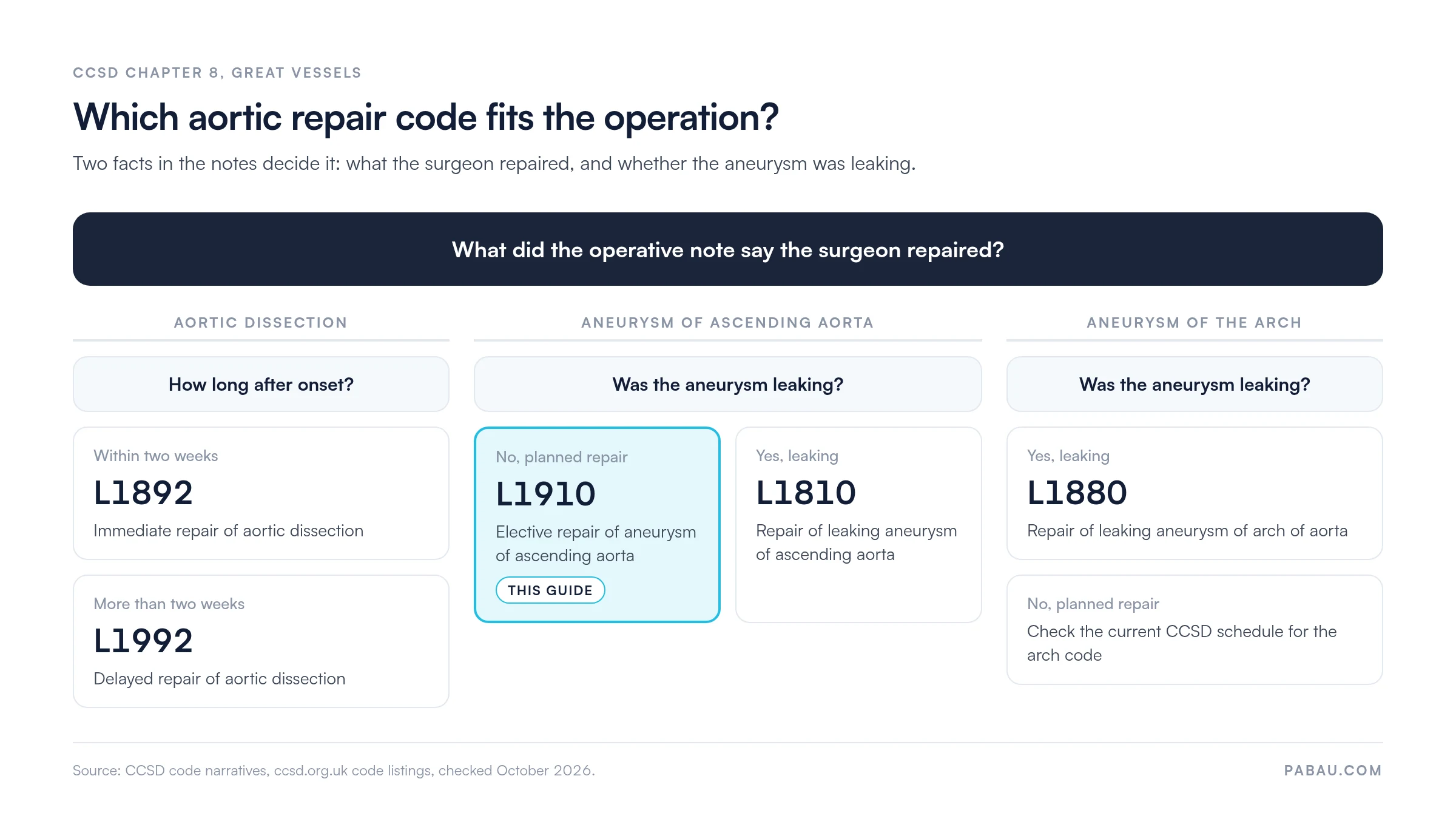
Surgeons usually plan an elective repair once the aneurysm reaches a size or growth threshold. Under the 2022 ACC/AHA aortic disease guideline, the usual threshold for a sporadic aneurysm is 5.5 cm. Lower thresholds apply to selected patients, such as those with Marfan syndrome.
Take a patient under surveillance whose CT scan shows the ascending aorta at 5.6 cm. It measured 5.1 cm a year earlier. The surgeon books a graft replacement for six weeks later, and imaging shows no leak.
That claim carries L1910. The practice requests pre-authorization with the CT report and the surgeon’s letter, then records the reference. Now picture the same patient arriving with sudden chest pain and a leak on the scan. The operation becomes an emergency, and the claim carries L1810.
One case sits between the two. An intact aneurysm repaired urgently, because of symptoms or fast growth, is not leaking but may not read as elective. Ask the insurer which code it expects, and note the answer and call reference on the file.
Once the code is settled, the record has to back it up. An insurer that queries an L1910 claim will look for six items.
Pair the procedure code with the diagnosis the notes support. In the ICD-10 classification UK insurers use, I71.2 covers a thoracic aortic aneurysm without mention of rupture. A ruptured one is I71.1, which points to L1810 rather than L1910.
A planned operation gives the billing team time to get the claim right before surgery. Five steps take it from booking to payment.
Our guide to Bupa CCSD codes explains how one large insurer structures its schedule. Each insurer sets its own fees, because the CCSD does not decide reimbursement.
The CCSD publishes unacceptable combinations for each code. These are pairs that should not appear together for the same operation.
L1910 appears as an unacceptable combination on the CCSD entries for L1880, L2190, L2710 and L2720. L2710 and L2720 are endovascular aneurysm repairs of the infrarenal and suprarenal aorta.
The CCSD describes its coding principles as guidelines, not an exhaustive list. Each insurer decides whether to adopt a combination rule, so check with the insurer when a pairing is unclear.
The anesthetist and any assisting surgeon submit their own claims for the same operation. Check how each insurer expects those claims to be coded.
Most insurer queries on L1910 trace back to four problems. Each one can be fixed before the claim is submitted.
A two-minute check at the end catches the problems above before the insurer does.
An elective aortic repair produces paperwork long before the operation. Scan reports, consultation letters and the authorization number often sit in different places, and retyping them into a claim is where errors creep in.
Pabau, our practice management and billing software, builds each claim from the patient record. Its claims management software checks that required fields, such as membership and authorization numbers, are complete before the claim can be sent.
In the UK, claims go through Pabau’s Healthcode integration, with live status tracking and payment reconciliation. Your team spends less time chasing references and more time on the queries that need a clinician.

Pabau builds claims from the patient record and checks required fields before sending. UK claims go straight to Healthcode, with status tracking built in.

L1910 depends on one word in its descriptor: elective. The claim holds up when the notes show a planned repair of an intact aneurysm, with the scan and the surgeon’s reason attached.
So build the claim before the operation, while there is time. Get the authorization, then compare it with the operative note afterward. If the surgery changed, tell the insurer before the claim goes out, not after it comes back.
Book a demo to see how Pabau builds surgical claims from the patient record and sends them to Healthcode.

Coding a leaking arch aneurysm instead? CCSD code L1880 covers repair of a leaking aneurysm of the arch of the aorta.
Was it a dissection, not an aneurysm? CCSD code L1892 explains immediate dissection repair and the two-week boundary with L1992.
Billing aortic valve surgery? CCSD code K2612 explains how aortic valve replacement claims are coded and documented.
Need the wider picture? Bupa CCSD codes shows how Bupa structures its procedure code schedule.
CCSD stands for Clinical Coding and Schedule Development. The CCSD Group publishes the procedure code schedule that UK private medical insurers and hospitals share. It does not set fees or decide reimbursement.
There is no single fee. Each insurer prices L1910 in its own schedule, and policy limits vary. Check the insurer’s current schedule before you quote a figure to the patient.
The descriptor names only the aneurysm repair. If the surgeon also replaced the valve or root, ask the insurer how it wants the combined operation coded.
The descriptor does not name an approach. Ascending aneurysms are usually repaired with open surgery, so confirm the code with the insurer if the repair was endovascular.
The operating cardiothoracic surgeon bills L1910 for the procedure. The anesthetist and any assisting surgeon claim separately, and the hospital bills its own charges.