CCSD Code M4400: Billing guide for UK private practitioners
CCSD Code M4400: Definition and clinical scope CCSD Code M4400 is the CCSD Group...

Last Updated: Nov 11, 2026
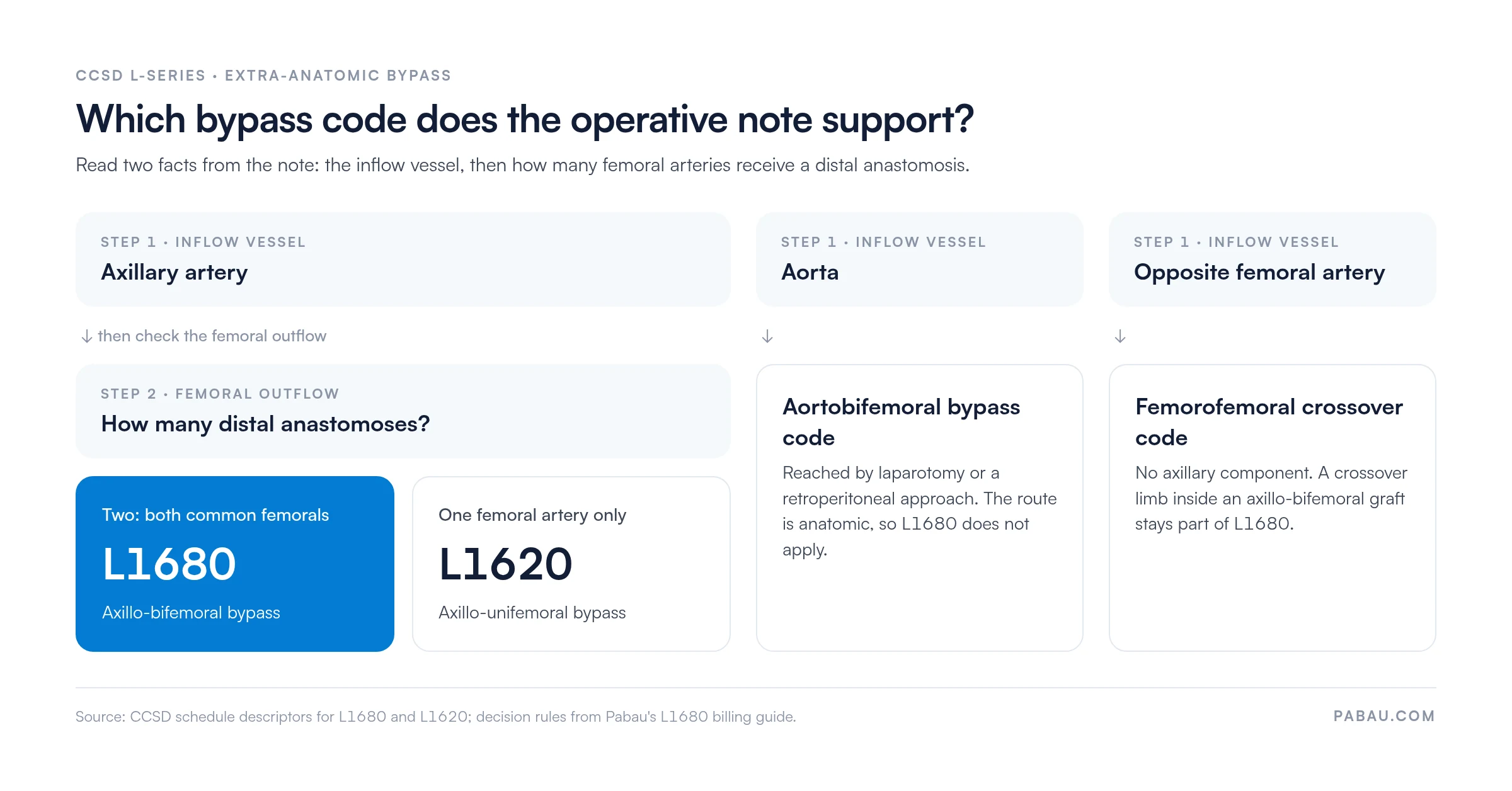
L1680 is the CCSD code for axillo-bifemoral bypass. In this extra-anatomic operation, a prosthetic graft carries blood from the axillary artery to both common femoral arteries.
The code needs an operative note that records axillary inflow and two femoral outflow anastomoses. When only one femoral artery receives the graft, the correct code is L1620, axillo-unifemoral bypass.
Let Pabau's smart automation suggest the right codes, reduce claim denials, and keep your practice compliant—effortlessly.
Automate repetitive tasks and focus on what matters most—your patients.
Reduce coding errors and ensure compliance with the latest regulations.
Clean claims, fewer denials, and faster reimbursements.
Powerful insights and reporting to help your practice thrive.
HIPAA compliant SOC 2 certified GDPR-compliant Trusted by 4,000+ clinics worldwide

CCSD code L1680 covers axillo-bifemoral bypass, where one graft from the axillary artery feeds both common femoral arteries.
When only one femoral artery receives the graft, the correct code is L1620, axillo-unifemoral bypass.
The operative note must record the axillary inflow side and both femoral outflow anastomoses to support L1680.
UK private insurers including Bupa, AXA Health, and Aviva typically require pre-authorization before major vascular bypass surgery.
Pabau, our practice management software, sends CCSD claims through Healthcode and tracks pre-authorization status against each patient episode.
CCSD code L1680 is the Clinical Coding and Schedule Development (CCSD) procedure code for axillo-bifemoral bypass. In this extra-anatomic arterial reconstruction, a prosthetic graft runs under the skin from the axillary artery to both common femoral arteries.
The CCSD Group’s official schedule lists L1680 in chapter 9.4.0, Abdominal Vessels, under 9.0.0 Vascular System. The code covers one bilateral bypass episode. It does not apply when only one femoral artery receives inflow, which is coded as L1620 instead. Our CCSD procedure code library covers the other L-series vascular codes.
The key billing facts at a glance:
The axillo-bifemoral bypass is classified as extra-anatomic because the graft does not follow the normal path of the aorta and iliac arteries. The surgeon takes inflow from the axillary artery, usually on the right side. A prosthetic conduit is then tunneled under the skin along the lateral chest wall and abdomen to the femoral arteries in both groins.
Coders and billers should be able to find each of these steps in the operative note:
The bilateral outflow in step 6 is the defining feature that separates L1680 from L1620, the axillo-unifemoral code. If the operative note describes only one femoral anastomosis, L1680 does not apply.
The axillo-bifemoral bypass is chosen when bilateral lower-limb ischemia requires revascularization but the patient cannot safely undergo direct aortic surgery. The Vascular Society of Great Britain and Ireland and NICE peripheral arterial disease guidelines identify four principal indications:
Each indication carries a different ICD-10 diagnosis code on the claim. The ICD-10 pairing table further down lists the pairings UK private insurers accept most often.
The L-series contains several bypass codes that describe related but distinct operations. A carotid-to-subclavian bypass in the neck, for example, takes CCSD code L3711. Open reconstruction of the renal artery to a transplanted kidney, which can involve a bypass, is billed as code L4292. Billing L1680 when only one femoral limb was built is upcoding. Billing a unilateral code after bilateral outflow was achieved is undercoding. The operative note settles which code applies.
The most reliable check is one question. Does the operative note confirm an axillary inflow anastomosis and two separate femoral outflow anastomoses? If yes, L1680 applies. If only one femoral anastomosis is documented, use L1620 instead. The diagram below runs the same check, starting from the inflow vessel.
CCSD procedure codes bundle the principal operative work. Understanding the scope of L1680 prevents both unbundling errors and missed ancillary charges.
Included within L1680:
May be billed separately (verify per insurer contract):
Must not be double-billed alongside L1680:
Whether prosthetic graft material can be claimed as a separate device code depends on individual insurer contracts. Verify with Bupa, AXA Health, or Aviva before submitting ancillary device charges alongside CCSD code L1680.
A complete operative note is the foundation of a defensible L1680 claim. UK private insurers adjudicate on the operative documentation, and a note that omits any of the core elements below is a likely denial trigger. This applies whether the claim is submitted via Healthcode EDI or as a paper invoice.
The operative note must confirm all of the following to support CCSD code L1680:
Beyond the operative note, most UK private insurers also expect a discharge summary that links the procedure to the admission. They also want any pre-operative imaging, such as duplex ultrasound or CT angiography, used in the MDT decision. A patient record that timestamps each document from imaging through discharge cuts the chance of an insurer asking for more information at adjudication.
Before submitting a CCSD code L1680 claim, run a three-point check on the operative note. Confirm the axillary inflow side is documented and both femoral arteries are named as outflow targets. Then confirm the prosthetic graft material and diameter are recorded. Missing any one of these triggers an information request or outright denial from most UK private insurers.
UK private medical insurers require pre-authorization for high-value procedures, and major vascular bypass surgery falls in that group. Submitting a CCSD code L1680 claim without pre-authorization, where the insurer mandates it, is the leading cause of outright denial for this procedure.
See Bupa CCSD procedure codes for a breakdown of Bupa’s authorization requirements across the L-series. The table below summarizes the general pre-authorization position across the main UK private insurers for L1680-class procedures:
Pre-authorization requirements vary by individual policy and corporate scheme. Verify the current position directly with each insurer before the procedure date. Emergency vascular surgery may be exempt from pre-authorization requirements, but the insurer must still be notified within the timeframe specified in the policy.
Healthcode is the main EDI clearinghouse for UK private healthcare billing. Most electronic L1680 claims route through Healthcode. The submission workflow for a major vascular claim follows these steps:
Practice software with a direct Healthcode EDI integration cuts manual re-keying, which is where most submission errors start. Pabau supports private billing claims management with Healthcode connectivity. Vascular surgery teams submit L1680 claims, track authorization status, and manage claim responses in the system they use for patient records and scheduling.
Denial patterns for major vascular bypass claims are consistent across UK private insurers. The table below lists the most common denial reasons specific to L1680 and the corrective action for each.
Submit an appeal within the insurer’s stated timeframe, typically 28 to 60 days from the denial date. Appeals that arrive after that window are routinely declined on procedural grounds, whatever their clinical merit.
UK private insurers expect the CCSD procedure code to be accompanied by an ICD-10 diagnosis code that reflects the clinical indication. The table below lists the ICD-10 codes most commonly accepted alongside L1680 by UK private payers.
Select the ICD-10 code that most precisely matches the documented clinical indication. Where aortoiliac occlusion and chronic limb-threatening ischemia coexist, the tissue-loss or rest-pain code is generally preferred. It reflects the severity of disease behind the decision for major reconstruction better than a general atherosclerosis code.
Axillo-bifemoral bypass is a high-value procedure with heavy documentation. Its billing cycle runs through pre-authorization tracking, operative note attachment, Healthcode EDI submission, and sometimes a separate device claim for the graft. Each hand-off between disconnected systems is a chance for the claim to stall.
Pabau keeps those steps in one patient record, with a direct Healthcode connection:
The outcome is an L1680 claim that leaves the practice with its pre-authorization number, operative note and diagnosis code already attached. That shortens the time from surgery to payment and leaves fewer information requests to chase.

Pabau supports UK private practice billing with Healthcode EDI integration, CCSD code entry, pre-authorization tracking, and claim status monitoring. Your vascular surgery team spends less time chasing payments and more time with patients.

For L1680, the operative note decides the claim. If it names the axillary inflow side and both femoral anastomoses, and pre-authorization is in place before surgery, the code holds up at adjudication. If either piece is missing, expect an information request, a downcode to L1620, or a denial.
The fix sits upstream of billing. Agree a note template with your vascular surgeons that captures inflow, both outflows and graft details every time. Then check the pre-authorization reference before the operating schedule is confirmed.
Book a demo to see how Pabau keeps the operative note, pre-authorization and Healthcode submission for CCSD L-series procedures in one record.

Looking for a full CCSD code breakdown for Bupa procedures? Bupa CCSD codes guide covers Bupa’s procedure code schedule and how to verify CCSD codes against Bupa’s billing requirements.
Coding a single-limb graft instead? CCSD code L1620 covers axillo-unifemoral bypass and the documentation that separates it from L1680.
Billing an open arterial repair? CCSD code L6840 explains billing for repair of a limb artery using a vein graft.
Working on other abdominal vessel procedures? CCSD code L4530 covers endarterectomy and patch repair of a visceral branch of the abdominal aorta.
CCSD code L1680 covers axillo-bifemoral bypass surgery. In this extra-anatomic reconstruction, a prosthetic graft runs under the skin from the axillary artery to both common femoral arteries. The code covers the full operative episode, including both distal anastomoses. It does not apply when only one femoral artery receives graft perfusion.
L1680 requires bilateral femoral outflow, meaning two distal anastomoses, one to each common femoral artery. L1620 applies when only a single femoral artery is anastomosed. The operative note is the evidence. If both common femoral arteries are named as outflow targets, L1680 is correct, and if only one is documented, L1620 applies.
Yes, in most cases. Bupa, AXA Health, Aviva, and Vitality Health typically require pre-authorization for major inpatient vascular bypass surgery. Emergency cases may be exempt but still require prompt insurer notification. Verify with each insurer before the procedure date, as requirements vary by policy and corporate scheme.
Possibly, depending on the insurer’s contract terms. Some UK private insurers permit a separate device or implant code for the PTFE or Dacron graft conduit. Others bundle it into the procedural fee for L1680. Verify the position with Bupa, AXA Health, or Aviva before adding a graft material charge, so the claim isn’t returned for unbundling.
Missing pre-authorization is the leading denial cause. Next come operative notes that don’t confirm bilateral outflow, and L1680 billed when the operative record describes a unilateral procedure. Billing the femorofemoral crossover limb as a separate code also triggers denials, because it forms part of the same bilateral bypass.
The most common pairings are I74.09 (aortoiliac occlusion or Leriche syndrome), I70.213 (bilateral atherosclerosis with claudication), and I70.263 (bilateral atherosclerosis with gangrene). Select the code that most precisely matches the documented indication. Where tissue loss or rest pain is present, use that specific code rather than a general atherosclerosis code, because it better supports medical necessity.