HCPCS code M0075: Cellular therapy billing guide
HCPCS code M0075: Definition and official descriptor HCPCS code M0075 is a Level...

Last Updated: Oct 22, 2026
H4180 is the CCSD code for full or partial thickness rectal biopsy. UK private medical insurers use it when a rectal tissue sample is taken as a standalone procedure, whatever the depth of the sample.
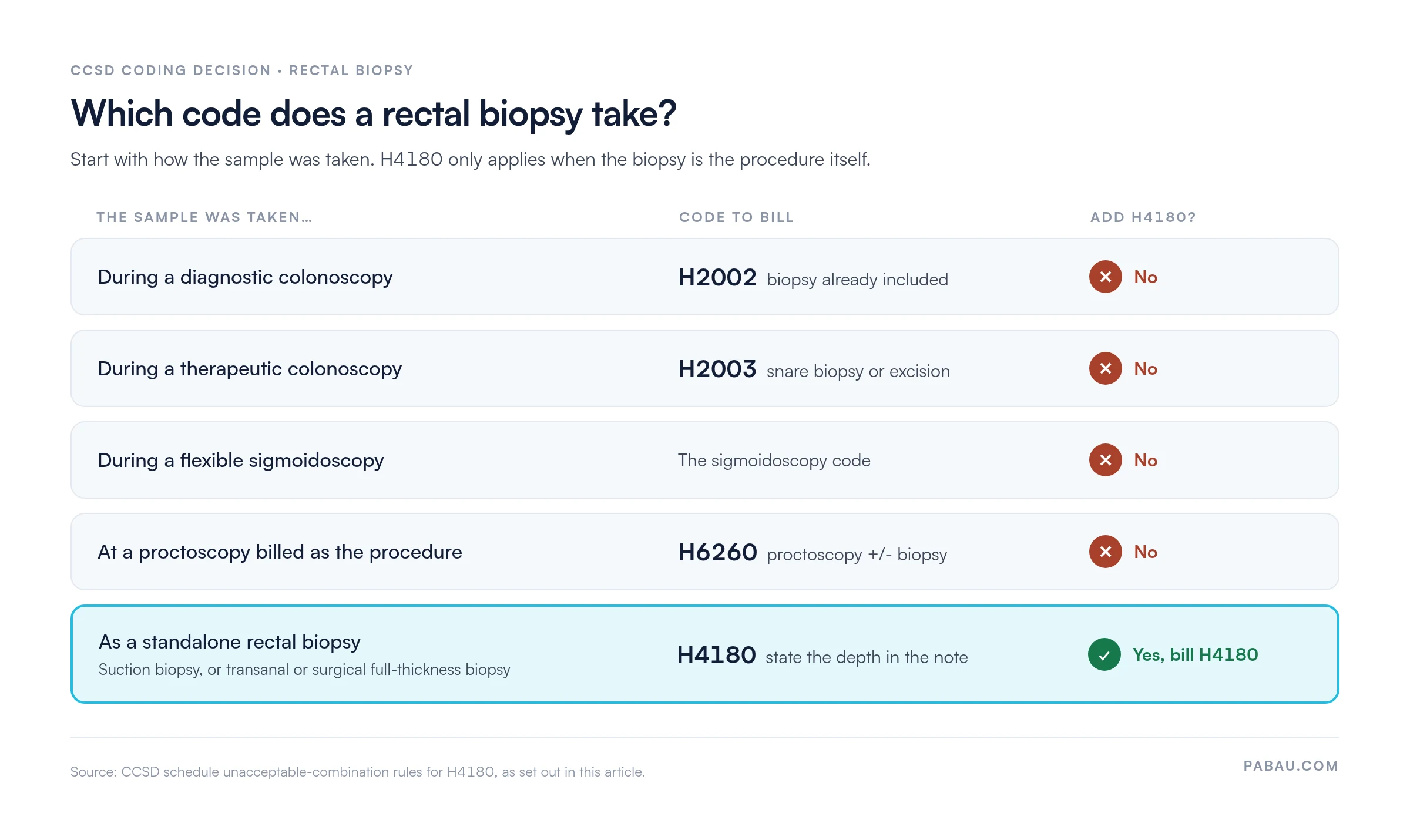
The operative note must state which depth was taken. A biopsy taken during a diagnostic colonoscopy or flexible sigmoidoscopy is not coded H4180, because CCSD lists those as unacceptable combinations. Diagnostic colonoscopy code H2002 already includes biopsy.
Let Pabau's smart automation suggest the right codes, reduce claim denials, and keep your practice compliant—effortlessly.
Automate repetitive tasks and focus on what matters most—your patients.
Reduce coding errors and ensure compliance with the latest regulations.
Clean claims, fewer denials, and faster reimbursements.
Powerful insights and reporting to help your practice thrive.
HIPAA compliant SOC 2 certified GDPR-compliant Trusted by 4,000+ clinics worldwide

CCSD code H4180 covers full or partial thickness rectal biopsy when the biopsy is a standalone procedure and the rectum is the biopsy site.
Suction rectal biopsy of the mucosa and submucosa is the first-line test for Hirschsprung disease, and full-thickness biopsy is kept for inconclusive results. Both use H4180, but the operative note must state which depth was taken.
H4180 is an unacceptable combination with diagnostic colonoscopy code H2002, which already includes biopsy. A biopsy taken during a colonoscopy is not billed as H4180.
Pabau, the practice platform we build, turns the operative note into a structured form that records depth, site and ICD-10 pairing for each claim.
The CCSD schedule lists H4180 as “Full or partial thickness rectal biopsy.” UK private medical insurers that work from CCSD codes use this descriptor for a standalone rectal biopsy. The code covers the sample whatever its depth, as long as the rectum is the biopsy site and the biopsy is a separate procedure.
Two depth variants fall under H4180. A partial-thickness biopsy removes the mucosa (and submucosa), so surgeons use it for inflammatory bowel disease staging, polyp assessment and ruling out mucosal disease. Suction rectal biopsy for suspected Hirschsprung disease is also this type, and it is the standard first-line test. In contrast, a full-thickness biopsy goes on through the muscularis propria, and surgeons keep it for unclear suction results and deeper lesions.
The code allows more than one access route. CCSD accepts transanal access, proctoscope-guided sampling and suction biopsy devices. However, a biopsy taken during a colonoscopy is a different matter. CCSD lists diagnostic colonoscopy and flexible sigmoidoscopy as unacceptable combinations with H4180, and the diagnostic colonoscopy code H2002 already covers the biopsy. The adjacent codes section below sets out the boundaries.
Both procedure variants map to H4180, so the code itself does not tell them apart. Still, the distinction matters for documentation and for the histopathology request. The pathologist checks for ganglion cells in the submucosal plexus, so every specimen needs its depth on the label. A mucosa-only sample mislabelled as full-thickness can give a false positive for aganglionosis, because ganglion cells look absent when the submucosa was never sampled. As a result, the patient needs a further procedure and a second claim follows.
Clinicians perform rectal biopsy under H4180 for several colorectal and paediatric surgical conditions. The most clinically specific is Hirschsprung disease, where suction rectal biopsy is the standard first-line diagnostic test. It samples the mucosa and submucosa, so the pathologist can stain for ganglion cells. Surgeons reserve full-thickness biopsy for cases where the suction result is unclear.
In paediatric care, most centres perform suction rectal biopsy for Hirschsprung disease without anaesthesia. The suction device takes tissue from the posterior rectal wall with minimal discomfort. This technique needs its own documentation, covered below. Importantly, an adequate suction specimen that shows no ganglion cells carries the same diagnostic weight as an open transanal biopsy.
UK private insurers audit H4180 claims against the operative note. A vague procedure report is the fastest route to a claim query or full rejection. For example, a generic “rectal biopsy performed” entry does not meet most insurer standards, so the note needs the elements below.
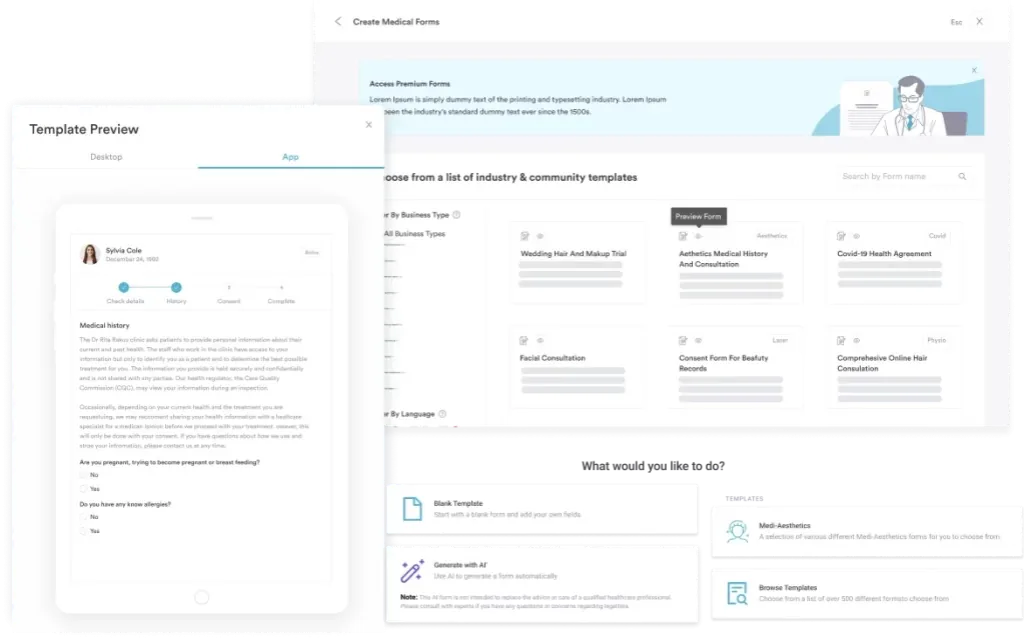
A digital operative note template with these fields built in cuts the gaps that trigger claim queries. In addition, UK GDPR applies to biopsy documentation. Store operative notes and pathology reports securely for the period your data retention policy sets.
Every H4180 claim submitted to a UK private insurer must include a supporting ICD-10 diagnosis code. The code should reflect the clinical indication in the operative note, not the histopathology result. That result is not yet available when you submit the claim. Submitting a code that does not match the documented indication is a common cause of denial.
Therefore, verify all ICD-10 codes against the current edition before submission. The NHS Classifications Browser is the authoritative reference for UK private billing. Always submit the code that reflects the clinical indication at the time of the procedure, not the final pathology diagnosis.
H4180 sits in Chapter 11 (Rectum/Anus) of the CCSD schedule, in sub-chapter 11.6.0. Several neighbouring codes describe procedures that share anatomical territory but differ in scope, approach or clinical intent. Choosing the wrong code, or billing H4180 alongside a code that already includes biopsy, often causes claim rejection.
A therapeutic excision of a rectal lesion is a separate procedure with its own code, so H4180 covers diagnostic biopsy only.
The key distinction for billers is between a biopsy taken as a standalone procedure (H4180) and one taken during a colonoscopy. When the colonoscopy is the primary procedure, diagnostic colonoscopy code H2002 already includes biopsy and covers both elements. CCSD lists H4180 with H2002, and with therapeutic colonoscopy code H2003, as unacceptable combinations. Adding H4180 for the same episode is duplicate billing, so insurers will reject it.
The table below maps each way a rectal sample can be taken to the code it belongs to.
H4180 is appropriate where the biopsy is the primary procedure, not a component of a longer endoscopic session. Examples include a suction biopsy in an infant with suspected Hirschsprung disease, or a full-thickness transanal biopsy after an inconclusive suction result. Likewise, a separate-session biopsy after an earlier colonoscopy found a suspicious area also qualifies.
Most UK private medical insurers require pre-authorisation (pre-auth) for surgical colorectal procedures, including H4180. Rectal biopsy under general anaesthesia is a theatre-based procedure, with anaesthetist, facility and equipment costs that insurers want to approve in advance. Pre-auth requirements vary by insurer and policy type, so always confirm with the insurer before booking. The guidance below reflects general published policy as of early 2026 and may change.
For Bupa-insured patients, the Bupa CCSD billing guide explains the code lookup and pre-authorisation portal. Bupa requires pre-auth for most surgical procedures performed under general anaesthesia.
Claim rejection on H4180 follows familiar patterns, and correct pre-submission checks avoid most denials. The reasons below come up most often in general UK private billing practice.
Before submitting any H4180 claim, run a three-point check. (1) Confirm the pre-auth reference number matches the H4180 procedure code. (2) Verify the ICD-10 code in the claim matches the documented indication in the operative note. (3) Confirm the pathology provider is invoicing histopathology separately. These three checks resolve the majority of preventable rejections.
Billers often confuse two cost components with the H4180 procedure code itself: anaesthesia and histopathological analysis. Bill both separately, and never bundle them into the H4180 claim.
When the surgeon performs H4180 under general anaesthesia, the anaesthetist submits a separate claim under the applicable CCSD anaesthesia code. General anaesthesia is the standard for paediatric full-thickness biopsy and most theatre-based adult procedures. The surgeon’s H4180 claim covers the surgical procedure only. Sedation for an outpatient proctoscope-guided biopsy may or may not attract a separate anaesthesia charge, depending on who gave it and the insurer’s policy. So confirm with the insurer whether the same pre-auth covers sedation or whether it needs a separate approval.
Surgeons typically perform suction rectal biopsy in neonates and infants without anaesthesia or sedation. No anaesthesia code applies in those cases, and including one will trigger a query.
Send the rectal biopsy specimen from H4180 for histopathological examination. The pathology provider bills that laboratory analysis separately under the appropriate CCSD pathology code, not as part of H4180. The operative note and the pathology request form should share the same episode identifier so insurers can link the two claims without a query.
In UK private practice billing, the pathology invoice typically comes from an external laboratory rather than from the operating surgeon. For that reason, advise patients in advance that they may receive a separate invoice from the pathology provider. The insurer should cover it under the same authorisation as the H4180 claim, subject to the patient’s policy terms.
H4180 queries tend to start in the operative note. The surgeon writes “rectal biopsy taken”, and the billing team only spots the missing depth when the insurer asks weeks later.
In Pabau, however, the operative note becomes a structured form. Approach, depth, distance from the anal verge and specimen count are fields the surgeon fills in before signing. As a result, the note, the ICD-10 code and the pre-auth reference sit together in one patient record.
When the claim is ready, Pabau’s claims software for consultants submits it to insurers through Healthcode. Your team stops chasing theatre notes, so fewer H4180 claims come back queried.

Pabau helps UK colorectal and private practice teams capture structured operative notes and manage CCSD claim submissions. Your H4180 claims go out right the first time.

The depth of a rectal biopsy never changes the code, but it decides whether the claim survives an audit. Check the scope first. If the surgeon took the sample during a colonoscopy, a sigmoidoscopy or a billed proctoscopy, H4180 is the wrong code.
In short, the trade-off is a few extra fields in every operative note against a queried claim and a second round of paperwork. Book a demo to see how Pabau builds those fields into your operative notes and sends H4180 claims through Healthcode.

Billing Bupa procedures under CCSD? Bupa CCSD codes guide walks through Bupa-specific coding rules, fee schedule structure, and the pre-authorisation portal for UK private practice teams.
Was the biopsy taken at colonoscopy? CCSD code H2002: diagnostic colonoscopy explains the colonoscopy code that already includes forceps biopsy.
Was a lesion removed with a snare? CCSD code H2003: therapeutic colonoscopy covers snare loop biopsy and lesion excision during colonoscopy.
Sampling during a sigmoidoscopy? CCSD code H2503: therapeutic sigmoidoscopy sets out how therapeutic sigmoidoscopy is coded and claimed.
CCSD code H4180 covers full or partial thickness rectal biopsy. UK private medical insurers use it when tissue is sampled from the rectum as a standalone diagnostic procedure. It covers transanal, proctoscope-guided and suction biopsy techniques, but not a biopsy taken during a colonoscopy.
A full-thickness rectal biopsy goes through the mucosa and submucosa into the muscularis propria. It is reserved for cases such as Hirschsprung disease where a suction biopsy was inconclusive. A partial-thickness biopsy removes the mucosa and submucosa, which is enough for IBD staging, polyp assessment and first-line suction biopsy for Hirschsprung disease. Both use H4180, but the operative note must specify which depth was achieved.
Yes, in most cases. Major UK private insurers including Bupa and AXA Health require pre-authorisation for surgical colorectal procedures performed under general anaesthesia. Pre-auth requirements vary by insurer and individual policy; always confirm with the specific insurer before booking the procedure to avoid claim rejection.
No. When a biopsy is taken during a colonoscopy, it is coded with the colonoscopy. Diagnostic colonoscopy code H2002 already includes biopsy, and CCSD lists H4180 with H2002 as an unacceptable combination. Billing both for the same episode is duplicate billing and will be rejected. H4180 applies only when the rectal biopsy is the primary standalone procedure.