CCSD Code L1960: Infrarenal AAA bifurcation graft
CCSD code L1960: Definition and clinical scope CCSD code L1960 describes the ope...

Last Updated: Oct 26, 2026
H4130 is the CCSD code for perianal excision of lesion of rectum (including sigmoidoscopy). The surgeon removes a rectal lesion through a perianal approach, and the sigmoidoscopy used to assess it is part of the same code.
Surgeons quote H4130 when they bill UK private insurers such as Bupa and AXA Health, usually through Healthcode. A separate sigmoidoscopy code on the same claim counts as unbundling, and the insurer will reject it.
Let Pabau's smart automation suggest the right codes, reduce claim denials, and keep your practice compliant—effortlessly.
Automate repetitive tasks and focus on what matters most—your patients.
Reduce coding errors and ensure compliance with the latest regulations.
Clean claims, fewer denials, and faster reimbursements.
Powerful insights and reporting to help your practice thrive.
HIPAA compliant SOC 2 certified GDPR-compliant Trusted by 4,000+ clinics worldwide

CCSD Code H4130 covers perianal excision of a rectal lesion with the sigmoidoscopy included, usually performed in theatre or a day-case unit under anaesthesia.
H4130 bundles the sigmoidoscopy, so billing it as a separate code counts as unbundling and triggers claim rejection.
UK private insurers such as Bupa, AXA Health, Aviva and Vitality expect pre-authorisation before the surgeon performs H4130, but an authorisation reference does not guarantee payment.
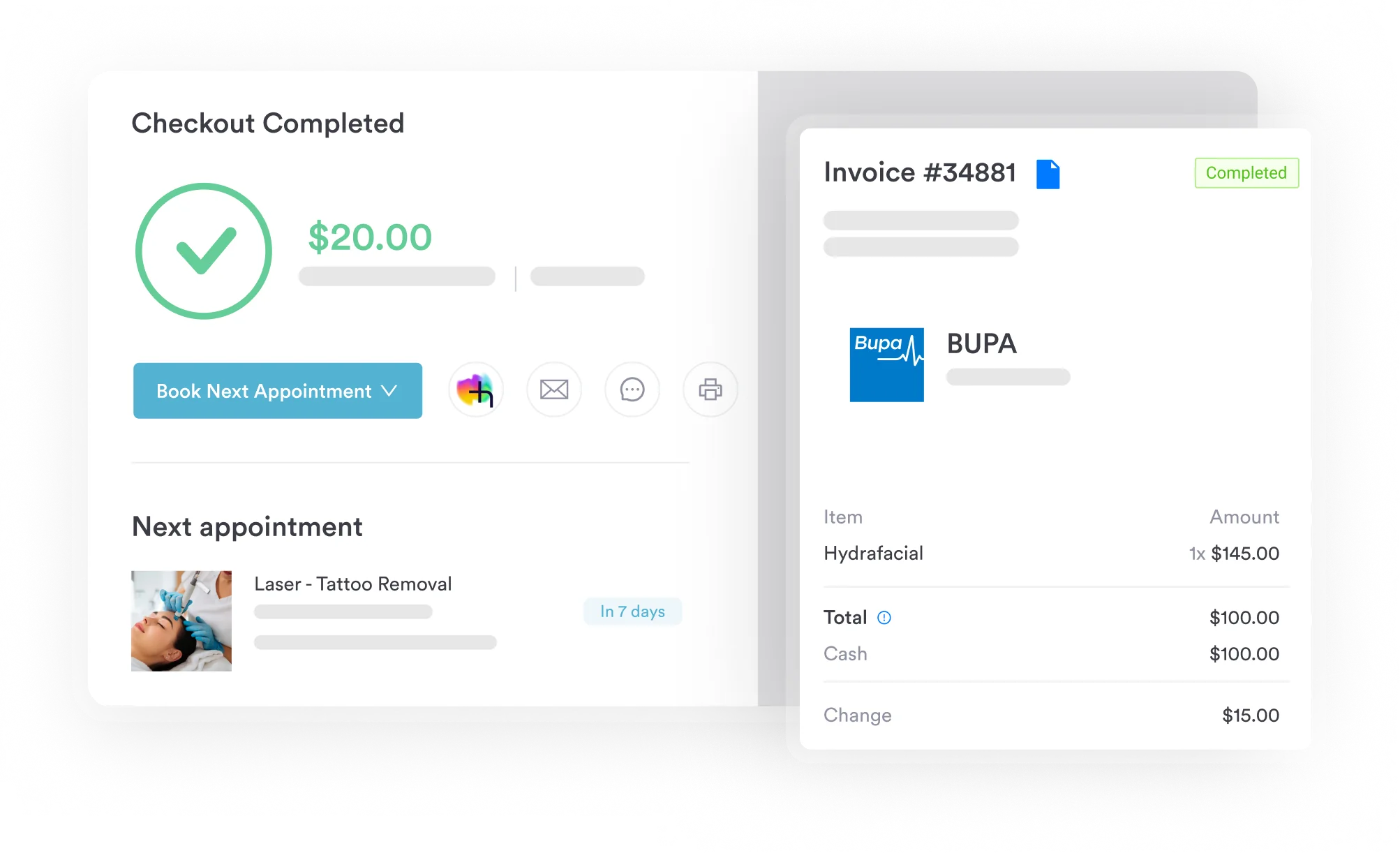
Pabau, the practice management platform we build, turns the H4130 invoice into a Healthcode claim, so surgical claims are submitted and reconciled in one place.
CCSD Code H4130 is “Perianal excision of lesion of rectum (including sigmoidoscopy)” in the schedule from the Clinical Coding and Schedule Development (CCSD) group. It captures a single combined procedure. The surgeon removes a rectal lesion through a perianal approach, and the sigmoidoscopy used to assess it is part of the same code.
CCSD describes its schedule as “the standard codes for procedures and diagnostic tests for the UK private healthcare sector.” Colorectal and general surgeons quote H4130 when they bill UK private insurers such as Bupa, AXA Health, Aviva and Vitality. Most of those claims are submitted electronically through Healthcode.
In the schedule, H4130 sits in chapter 11, sub-chapter 11.6.0 Rectum/Anus, alongside the other rectal and anal CCSD codes.
The parenthetical “(including sigmoidoscopy)” is a bundling directive. It folds the endoscopic component into the procedure, so the sigmoidoscopy earns no fee of its own. Insurers treat any claim that adds a separate sigmoidoscopy code alongside H4130 as unbundling and reject it. In short, H4130 describes one procedure with one fee, however many clinical steps the surgeon performs.
The procedure coded under H4130 typically takes place in an operating theatre or day procedure unit. The team places the patient in the lithotomy position under general or spinal anaesthesia. The operative steps then run in this order:
Because the surgeon performs the sigmoidoscopy to guide the procedure rather than as a separate diagnostic examination, H4130 absorbs it. As a result, the surgical claim covers the whole operative encounter.
H4130 applies when a surgeon removes a discrete low rectal lesion through a perianal approach, with sigmoidoscopy used for assessment. Common clinical indications include:
The descriptor names a lesion of the rectum. By contrast, an anal skin tag or a perianal wart sits in the anal canal or perianal skin. Check the insurer’s schedule for the anal excision codes before you quote H4130.
The ICD-10 diagnosis code paired with H4130 depends on the confirmed clinical or histological finding. UK insurers use the WHO ICD-10 classification. Common pairings are K62.1 (rectal polyp) and D12.8 (benign neoplasm of rectum). D37.5 (neoplasm of uncertain or unknown behaviour of rectum) and K62.8 (other specified diseases of anus and rectum) also appear. Select the code that reflects the established diagnosis. However, if histology changes a provisional diagnosis, the claim may need an amendment.
To bill CCSD Code H4130 correctly, coordinate the surgeon’s practice, the hospital and the patient’s insurer. The workflow for managing surgical claims typically follows these steps:
CCSD maintains the codes, but each insurer sets its own fees, and those fee schedules change. Therefore, check the current schedule for each insurer rather than quoting a fee from memory. Our guide to UK medical billing software compares systems that submit claims through Healthcode.
Insurers check a queried H4130 claim against the clinical record. For this reason, the operative record and supporting documents should contain the following:
H4130 covers the surgeon’s professional fee only. In addition, two other claims usually go to the insurer for the same operation:
Anaesthesia claim: The anaesthetist invoices the insurer separately, under their own provider number. The anaesthetic fee is not part of the H4130 fee. Insurers usually expect the anaesthetist’s invoice to quote the same CCSD procedure code, ICD-10 code and authorisation reference as the surgeon’s.
Hospital claim: The hospital or day-case unit invoices for theatre use, nursing care, consumables and recovery. That claim is separate from the surgeon’s, and the insurer handles it under the hospital’s own agreement.
The table below summarises the codes commonly submitted alongside H4130:
Surgeons often confuse H4130 with several adjacent CCSD colorectal codes. Choosing the wrong code is one of the most common reasons for rejection or audit. The comparison below separates H4130 from its neighbours:
When in doubt, check the current CCSD Technical Guide and the individual insurer’s code schedule. Insurers such as Bupa publish searchable code databases that allow side-by-side comparison of adjacent codes.
A tumour that needs a formal resection through the anus belongs under H4000 instead. The three checks below run the same comparison against the operative note.
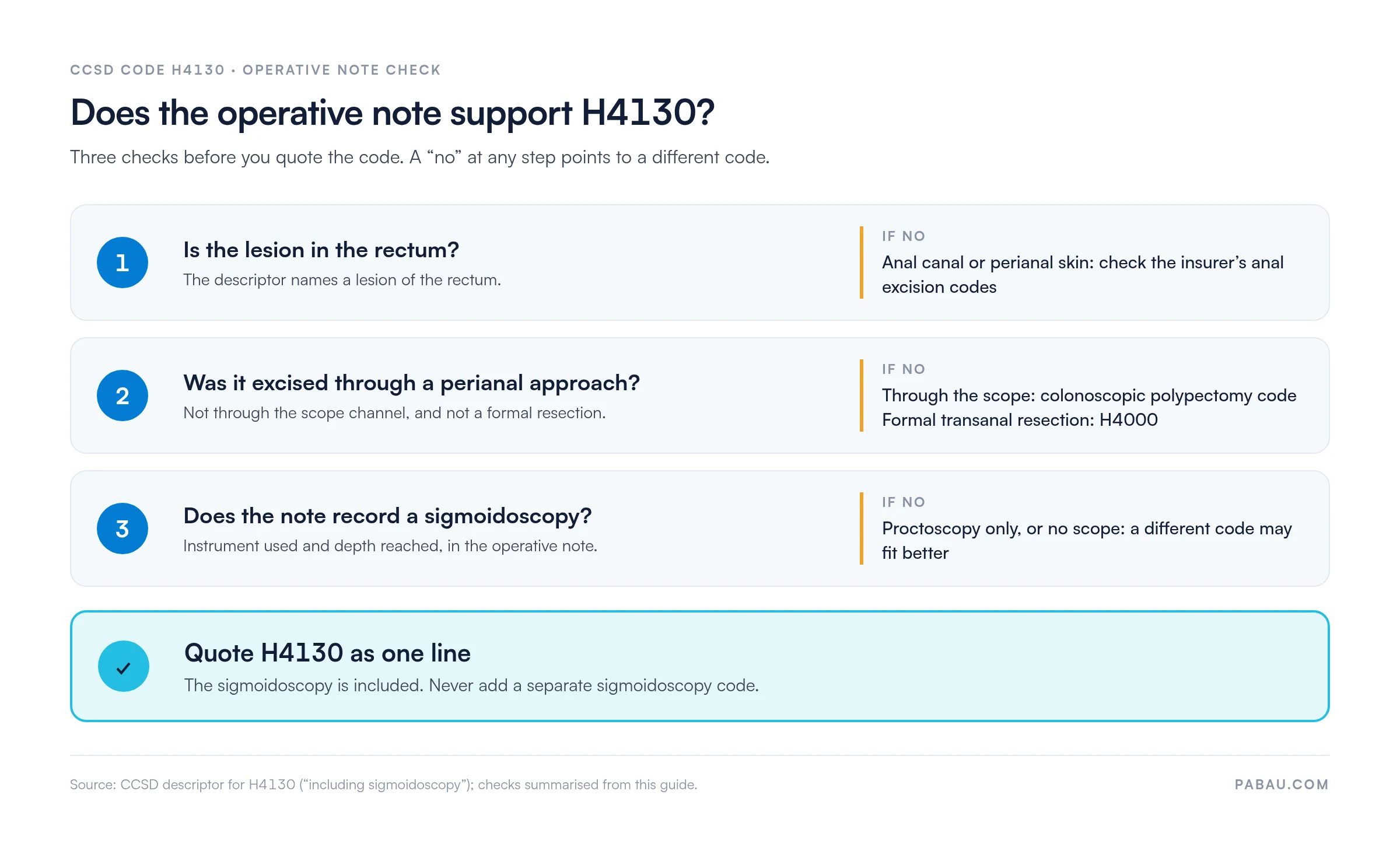
H4130 specifically names sigmoidoscopy, not proctoscopy. A proctoscope usually shows only the distal rectum and anal canal (up to about 10 cm). A sigmoidoscope, however, reaches further into the sigmoid colon and gives a broader view. The CCSD descriptor requires a sigmoidoscopic view. Therefore, if the surgeon performs only a proctoscopy, a different code may fit better.
For billing, two rules apply:
The operative note must state the instrument and the depth reached. Insurers review this first on audit.
UK private insurers expect pre-authorisation before an elective H4130 procedure, and they usually reject a claim without an authorisation reference. Authorisation confirms that the policy covers the procedure. Even so, it does not guarantee full payment, because policy limits and the insurer’s fee schedule still apply.
Bupa, AXA Health, Aviva and Vitality each run their own pre-authorisation process, by phone or online. The patient often contacts the insurer first, so give them the code and descriptor in writing. A request typically needs:
Rules vary between insurers and policy years. Therefore, check current requirements with each insurer before the procedure date, and keep a record of every authorisation reference.
You can catch each trigger below before the claim goes in. The table pairs every rejection reason with its fix:
Build a pre-submission checklist for H4130 claims. Confirm the authorisation reference is present and the ICD-10 code matches it. Then check that no separate sigmoidoscopy code appears, the operative note is ready and the hospital claim details agree. Running it before each submission catches the most common rejection triggers.
Most H4130 procedures produce a tissue specimen for histopathology. The pathology provider bills for that analysis separately, and the H4130 fee does not cover it.
The histopathology result raises two billing points:
H4130 is one of several codes that require the surgeon to coordinate a multi-party claim: surgical, anaesthetic, facility, and potentially pathology. That is normal for theatre-based procedures. Still, one admin error, such as a mismatched authorisation reference or a wrong ICD-10 code, can spread across all four claims at once.
Practices that bill CCSD codes regularly benefit from a structured submission process. For example, Our guide to Bupa CCSD codes explains how the codes are structured and submitted to UK private insurers. The Healix fee schedule and Vitality’s fee finder help you check current fees for H4130 before you submit to those insurers.
On a busy colorectal list, the operative note often sits in one system and the invoice in another. Staff then re-key the claim into Healthcode, and each hand-off risks a lost authorisation reference or an unbundled sigmoidoscopy line.
Pabau’s Healthcode integration turns the invoice you already raise into an electronic claim. The code, amounts and patient details carry over, and Healthcode’s validation rules check the claim before Pabau sends it.
In addition, the operative note, consent forms and histology report sit on the same patient record as the invoice. Your team can set a task to review the diagnosis code when histology returns, and the claims dashboard shows each claim’s status until it settles.

Pabau turns your H4130 invoice into a Healthcode claim, keeps the operative note on the same patient record and tracks each claim until it settles.

Quote H4130 only when the operative note shows a perianal excision of a rectal lesion with a sigmoidoscopy. Never add the sigmoidoscopy as a second line. If the note records a proctoscopy, a transanal resection or an anal lesion, a different code fits better, and the claim is safer for it.
Most H4130 rejections trace back to three problems: the authorisation reference is missing, the sigmoidoscopy is unbundled, or the operative note does not support the code. Therefore, check those three points before each submission, and hold a claim that fails one, because a short delay costs less than a rejection. Book a demo to see how Pabau sends CCSD theatre claims through Healthcode and tracks them to settlement.

Managing CCSD procedure codes across multiple insurers? Bupa CCSD codes and billing guidance explains how CCSD codes are structured and submitted to UK private insurers.
Want to reduce billing errors across your surgical practice? Pabau’s claims management software supports CCSD claim submission through Healthcode, remittance reconciliation and denial tracking.
Removing a rectal growth through the anus instead? CCSD Code H4000 explains when the transanal resection code applies.
Planning a larger rectal operation? CCSD Code H3334 covers billing for a low anterior resection.
Treating an anal fistula instead? CCSD Code H5520 explains coding for laying open a high anal fistula.
CCSD Code H4130 is the procedure code for perianal excision of a lesion of the rectum, including sigmoidoscopy. Colorectal and general surgeons use it to bill UK private insurers such as Bupa, AXA Health, Aviva and Vitality. The procedure usually takes place in theatre or a day-case unit.
Yes. The CCSD descriptor for H4130 explicitly states “(including sigmoidoscopy),” which means the endoscopic component is bundled into the code. Billing a separate sigmoidoscopy code alongside H4130 on the same claim constitutes unbundling and will result in rejection by the insurer.
The most common reasons are missing pre-authorisation, an ICD-10 code that does not match the authorisation, or a separately billed sigmoidoscopy code (unbundling). Insurers also reject claims with a thin operative note, or a mismatch between the surgeon’s claim and the hospital claim. A check of these points before submission catches them before the insurer does.
A CCSD code is a procedure code from the schedule maintained by the Clinical Coding and Schedule Development (CCSD) group. CCSD sets the standard codes for procedures and diagnostic tests in the UK private healthcare sector. Insurers such as Bupa, AXA Health, Aviva and Vitality use them, and most claims go through Healthcode.