ICD-10 code Y83.0: Surgical operation with whole organ transplant
ICD-10 code Y83.0 names the transplant as the cause, not the problem ICD-10 code...

Last Updated: Nov 19, 2026
Billable Code Specific Code
K51.90 is the billable ICD-10-CM code for ulcerative colitis, unspecified, without complications. It applies when the chart confirms UC but documents neither the extent of colon involved nor a complication such as rectal bleeding.
Once a colonoscopy or pathology report names the site, a site-specific code replaces it: K51.0-, K51.2-, K51.3- or K51.5-. A documented complication moves the claim to K51.911 through K51.919.
Let Pabau's smart automation suggest the right codes, reduce claim denials, and keep your practice compliant—effortlessly.
Automate repetitive tasks and focus on what matters most—your patients.
Reduce coding errors and ensure compliance with the latest regulations.
Clean claims, fewer denials, and faster reimbursements.
Powerful insights and reporting to help your practice thrive.
HIPAA compliant SOC 2 certified GDPR-compliant Trusted by 4,000+ clinics worldwide

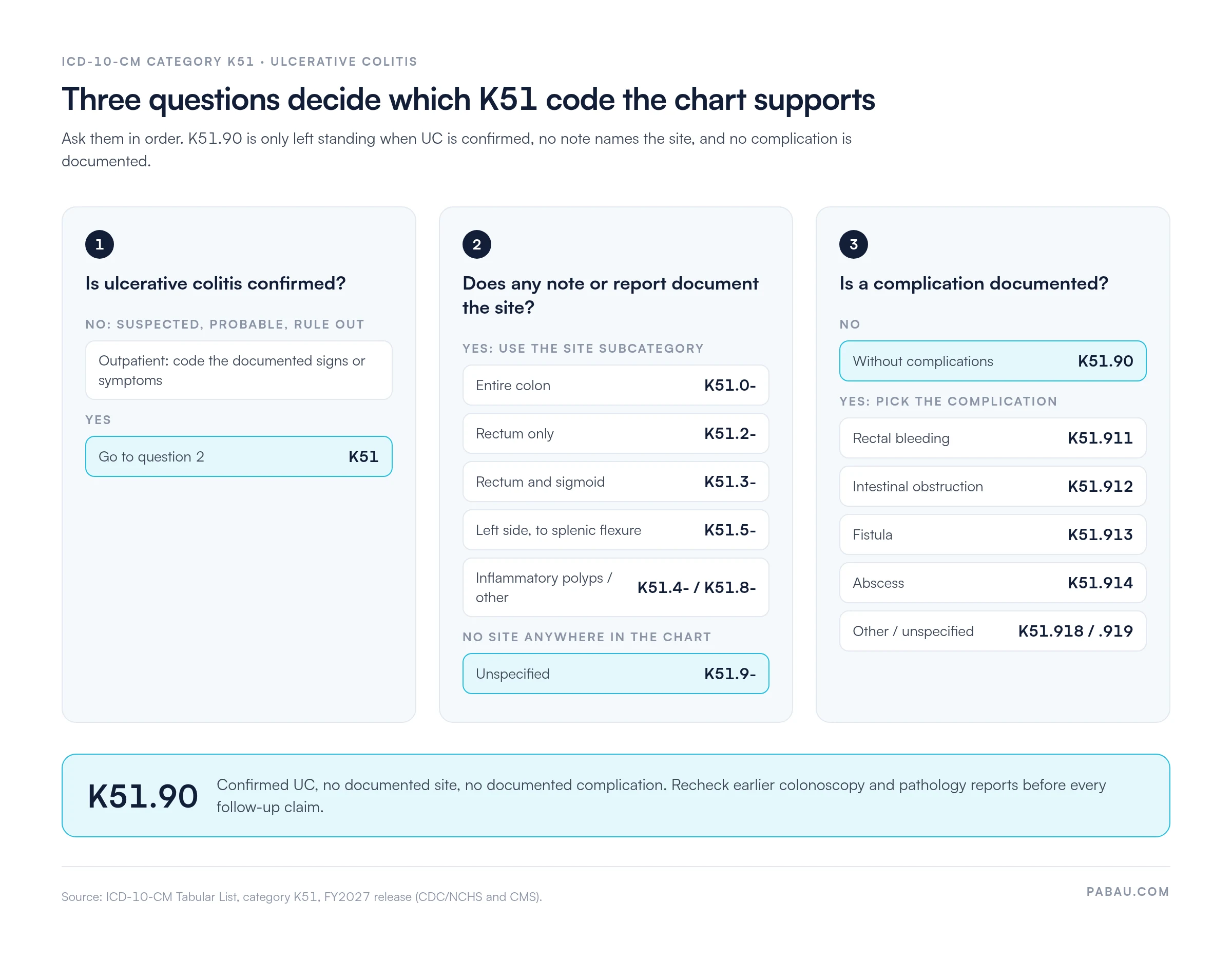
K51.90 is billable for confirmed ulcerative colitis with no documented site and no documented complication. Its parent, K51.9, never goes on a claim.
Once a colonoscopy or pathology report names the site, code the matching K51.0-, K51.2-, K51.3- or K51.5- subcategory instead of K51.90.
A documented complication, such as rectal bleeding or a fistula, moves the code to K51.911 through K51.919.
Outpatient coders do not code suspected or probable UC, so code the documented signs or symptoms until the diagnosis is confirmed.
Pabau, the practice management platform we build, submits US claims through Claim.MD and tracks prior authorization codes, dates and sessions on the case.
ICD-10 Code K51.90 is the billable ICD-10-CM code for confirmed ulcerative colitis with no documented site and no documented complication. It is listed as a valid code in CMS’s FY2027 ICD-10-CM code files, which cover encounters from October 1, 2026 through September 30, 2027.
The official descriptor is: Ulcerative colitis, unspecified, without complications. The complications it leaves out are the ones coded to K51.911 through K51.919. “Unspecified” means the chart does not say whether disease is confined to the rectum, the left colon, or the entire colon. An intestinal obstruction caused by UC is one of those complications, while a blockage with no named cause codes to ICD-10 K56.609.
Ulcerative colitis is a chronic inflammatory bowel disease (IBD) limited to the colonic mucosa and submucosa. It differs from Crohn’s disease because the inflammation is continuous, starts in the rectum, and does not skip segments or reach the small intestine.
Category K51 covers every form of ulcerative colitis. K51.90 sits inside subcategory K51.9, which groups UC cases where the anatomical extent is unspecified. Reading the hierarchy from the top shows exactly where a documented site or complication changes the code.
Key distinction: K51.9 is a non-billable header, and a claim that uses it as the diagnosis code is rejected. Within this subcategory, only K51.90 (without complications) and K51.911 through K51.919 (with complications) are valid for submission.
The ICD-10-CM tabular list attaches notes to category K51 that govern when K51.90 may and may not be used. Review them before you assign the code.
The tabular list carries no inclusion terms under K51.90, so its scope comes from the descriptor itself. In practice, that means three situations.
Category K51 carries one Excludes1 note: Crohn’s disease [regional enteritis] (K50.-). K51.90 and any K50 code cannot be reported together for the same encounter. The note runs both ways, because category K50 excludes ulcerative colitis (K51.-) as well.
When the physician documents Crohn’s disease with no site and no complication, the code is K50.90 instead. Category K51 also carries two “use additional code” notes. One covers associated anal, rectal or anorectal fistulas (K60.3-, K60.4-, K60.5-), and the other covers manifestations such as pyoderma gangrenosum (L88).
These conditions are not Excludes1 notes on K51, but they are often confused with unspecified UC. Each one has its own code.
Two errors recur in this category. Coders use K51.90 when the documentation supports a more specific code, or they confuse UC codes with Crohn’s disease codes. This table covers the side-by-side decisions that come up most.
Read as a sequence, the choice comes down to three questions about confirmation, site, and complications, asked in that order.
K51.90 is defensible only when specific documentation criteria are met. The CMS ICD-10-CM coding guidelines require coding to the highest level of specificity the physician’s documentation supports. If the note contains anatomical detail, that obligation applies.
The physician’s documentation must state a confirmed diagnosis of ulcerative colitis. Outpatient guidelines do not allow coding a suspected or possible diagnosis. Code the documented signs or symptoms until UC is confirmed. Pabau keeps encounter notes and uploaded reports on one patient record, so the confirming language is easy to find.
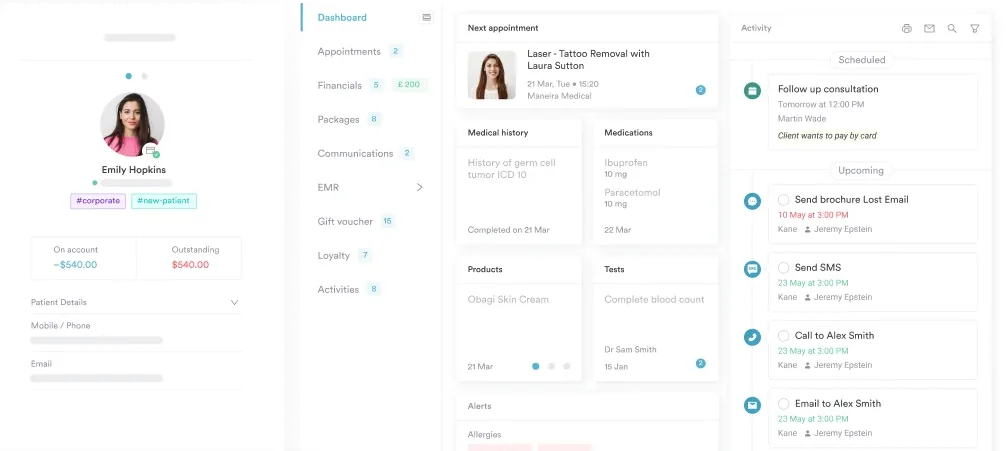
Keeping these records consistent across encounters helps practices pass payer audits and supports medical billing compliance at the encounter level.
K51.90 appears as the primary diagnosis alongside several CPT codes in gastroenterology claims. Each pairing must reflect medical necessity, so the confirmed UC diagnosis has to justify the procedure performed. During workup and surveillance, K51.90 most often supports 45380 when biopsies are taken and 45378 when none are.
Practices billing K51.90 with biologic infusion codes should check eligibility and prior authorization before the infusion. In Pabau, US claims go to payers through the Claim.MD clearinghouse, which also runs eligibility checks before the visit.
Check earlier colonoscopy and pathology reports before assigning K51.90 at any follow-up encounter. If a previous report documented the site, code the site-specific subcategory for encounters coded from that documentation. That holds even when the current note omits the extent.
Prior authorization requirements for services billed with K51.90 vary by payer, plan, and service type. The diagnosis code itself does not trigger PA, but the CPT code for the service can. These are general patterns, so verify requirements with each payer before the service.
In Pabau’s claims software for practices, prior authorization codes, dates and sessions are tracked on the case, with a warning when one is missing. That check matters most before a biologic infusion billed with K51.90 as the supporting diagnosis.
K51.90 denials tend to follow four patterns. When a remittance comes back, match its reason code against the list of medical billing denial codes to see which pattern you are facing.
Grouping K51.90 denials with structured denial management workflows shows whether a wave comes from missing documentation, a specificity trigger, or a PA miss. The team can then fix the cause once instead of resubmitting claim by claim.
These rules reflect the ICD-10-CM Official Guidelines and common payer audit findings for category K51. Apply them at the point of code selection, not during post-claim review.
A clean claim for K51.90 needs a code that matches the documentation level, not just an accurate diagnosis. A correct diagnosis submitted at the wrong specificity level is still a denial waiting to happen.
Check your EHR’s ICD-10 code selection interface. Some systems list K51.9 as the top result for ‘ulcerative colitis unspecified’ and require an additional click to reach K51.90. Train billing staff to confirm the full 5-character code before saving the encounter.
K51.90 has been a stable, valid code in recent ICD-10-CM annual releases. Verify its status against the fiscal year release in the CDC/NCHS ICD-10-CM web tool, which publishes the official tabular list by FY. Codes update on October 1 each year. Billing from the previous year’s list is an audit risk, particularly when claims cross that date.
The CMS ICD-10 codes page publishes the annual update files, addenda, and conversion tables. They detail any additions, deletions, or descriptor revisions for category K51. K51.90 remains valid in the FY2027 release, effective October 1, 2026, with its descriptor unchanged.
Many K51.90 denials start before the claim is built. The colonoscopy report sits in one place, the encounter note in another, and the coder picks a code without seeing both.
Pabau keeps the encounter note, uploaded colonoscopy and pathology reports, and prior authorization details on one patient record. The coder can check whether an earlier report documented disease extent before choosing K51.90 over a site-specific code.
Claims then go out through Pabau’s claims management, which submits them via the Claim.MD clearinghouse and brings remittances back in. A denial then appears next to the record that produced it, so the team can fix the cause instead of resubmitting blind.

Pabau keeps encounter notes, uploaded reports, and prior authorization details on one patient record, then submits US claims through Claim.MD. See how your billing team can cut avoidable K51.90 denials.

K51.90 earns its place only while the chart stays silent on site and complications. Once a colonoscopy, pathology report, or note names either one, a more specific K51 code takes over.
So build that check into code selection rather than denial review. Read the prior reports before each follow-up claim, and confirm prior authorization before any biologic infusion. The upgrade then happens once, at the desk, instead of after a denial.
Book a demo to see how Pabau handles insurance billing for US practices, from the patient record to the remittance.

Need to understand how claims flow after the code is assigned? Claim.MD clearinghouse overview explains how claims travel from Pabau to payers through the Claim.MD integration.
Coding Crohn’s disease instead of UC? ICD-10 Code K50.90 covers Crohn’s disease when the chart documents no site and no complication.
Seeing recurring denials across your colitis claims? Denial codes in medical billing breaks down CARC denial reason codes and what each means for your K51.90 claims.
Need to read the remittance that came back? Understanding electronic remittance advice shows how ERA data from Claim.MD reveals patterns in ICD-10 code denials.
ICD-10 Code K51.90 is the billable ICD-10-CM code for ulcerative colitis, unspecified, without complications. Use it when a physician has confirmed UC but the chart documents neither the extent of disease nor a listed complication. It sits under the non-billable subcategory K51.9.
Yes, K51.90 is a valid billable ICD-10-CM code at the highest level of specificity available for unspecified UC without complications. Its parent code K51.9 is not billable and must never appear on a submitted claim.
K51.9 is a non-billable header that groups all unspecified UC codes. K51.90 is the billable fifth-character code for unspecified UC with no complications. A claim submitted with K51.9 is rejected because the code is not valid for submission.
K51.90 describes ulcerative colitis, which is limited to the colonic mucosa and spreads continuously from the rectum. Crohn’s disease codes fall under K50 and describe transmural inflammation that can skip segments anywhere in the GI tract. Category K51 carries an Excludes1 note for K50, so the two cannot be coded together for the same encounter.
The diagnosis code K51.90 does not trigger prior authorization on its own. The CPT code for the service does. Biologic infusions, such as 96413 with the applicable J-code, usually need PA from commercial payers and Medicare Advantage plans. Diagnostic colonoscopy for established UC generally does not need PA under Medicare Part B, though commercial policies vary.