

HCPCS Code Q4175: Billing, coverage, and documentation guide
HCPCS Code Q4175: Code Description and Product Identity HCPCS Code Q4175 is the ...

Last Updated: Nov 20, 2026
G5320 is the CCSD code for closure of perforated ulcer of duodenum. It covers the emergency operation that seals a peptic ulcer perforation in the duodenal wall. The surgeon closes it with sutures or a Graham omental patch.
Insurers such as AXA Health class it as a major procedure. Claims pair it with a K26 duodenal ulcer diagnosis, and a laparoscopic closure may fall under G3580 instead.
Let Pabau's smart automation suggest the right codes, reduce claim denials, and keep your practice compliant—effortlessly.
Automate repetitive tasks and focus on what matters most—your patients.
Reduce coding errors and ensure compliance with the latest regulations.
Clean claims, fewer denials, and faster reimbursements.
Powerful insights and reporting to help your practice thrive.
HIPAA compliant SOC 2 certified GDPR-compliant Trusted by 4,000+ clinics worldwide

CCSD code G5320 covers surgical closure of a perforated duodenal ulcer only, not gastric ulcer perforation or partial gastrectomy.
The Graham (omental) patch is the most commonly documented closure method. Check a laparoscopic closure against G3580 before billing it as G5320.
Primary ICD-10 pairings are K26.1 (acute duodenal ulcer with perforation) and K26.5 (chronic or unspecified duodenal ulcer with perforation).
Peritonitis (K65.0) may be coded as an additional diagnosis only when the operative note or clinical record documents it.
AXA Health classes G5320 as a major procedure and lists duodenum codes including G5100, G5000 and G5010 as unacceptable combinations with it.
CCSD code G5320 is the procedure code UK private insurers use for closure of a perforated ulcer of the duodenum. AXA Health’s published code schedule lists it in the Duodenum section as a major procedure. The table below sets out the reference data a coder checks before submitting the claim. Bupa’s version of the schedule is covered in our guide to Bupa CCSD codes.
CCSD code G5320 covers the definitive surgical closure of a perforation in the duodenal wall caused by peptic ulcer disease. The ulcer usually sits in the first part of the duodenum (D1). The operation aims to close the perforation and control peritoneal contamination.
The following are included within G5320’s scope:
The code applies whether the ulcer is acute or chronic. What decides it is a duodenal site and an operation that closes the perforation rather than resecting.
Several adjacent procedures are explicitly outside the scope of CCSD code G5320. Using this code when a different procedure was performed is a common source of claim rejection.
The decision path below runs these exclusions in the order a coder meets them, with the code each failed check points to.
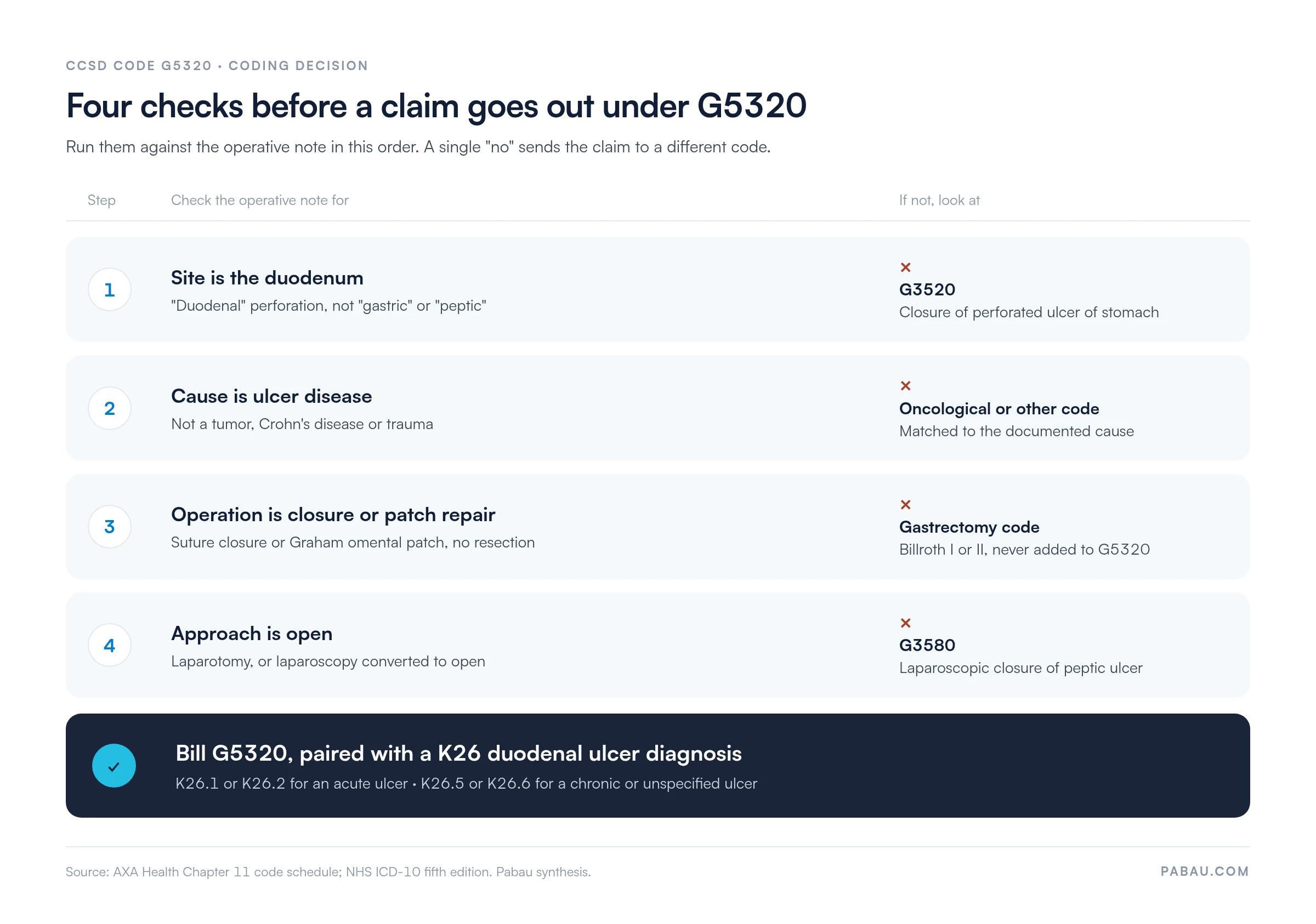
Knowing the operative steps behind G5320 helps coders read operative notes and select the correct code. A perforated duodenal ulcer is a surgical emergency. The patient typically presents with sudden epigastric pain, signs of peritonitis, and free intraperitoneal air on an erect chest X-ray or CT scan.
It can. Insurer schedules list a separate code, G3580 (laparoscopic closure of peptic ulcer), next to G5320 and its gastric counterpart G3520. A peptic ulcer includes a duodenal one, so check G3580 before billing a laparoscopic closure as G5320. The Clinical Coding and Schedule Development Group updates the schedule periodically, so confirm the current edition and the insurer’s own rules before submission.
The operative note must state the approach, the confirmed site, the intra-operative findings, the closure technique, any lavage, and drain placement. Ambiguity on any of these points is a primary driver of claim rejection.
Several upper GI surgery codes sit close to CCSD code G5320 in the schedule and are frequently coded in error. The table below shows which code applies in common scenarios.
Codes in the same section are also barred from the same claim. AXA Health’s Duodenum section lists G5100, G5000 and G5010 as unacceptable combinations with G5320.
Infant pyloric stenosis needs a separate stomach procedure, billed under pyloromyotomy code G4010. The rest of the duodenum and stomach range is easier to rule out side by side, with every CCSD code explained in one library.
Before selecting G5320, confirm four points in the operative note. The perforation is in the duodenum, and the procedure was closure or patch repair. The cause is ulcer disease, and the approach was open. All four must be clearly documented.
CCSD code G5320 is a procedure code, and UK private insurers also require a matching ICD-10 diagnosis code on the claim. The ICD-10 codes below come from the NHS Classifications Browser (UK ICD-10 fifth edition).
Peritonitis (ICD-10 K65.0, acute peritonitis) may be added alongside G5320 when the operative note or clinical record confirms it. It should not be assumed from the perforation alone.
Coders should look for explicit confirmation of peritonitis from the treating surgeon or the clinical record before adding K65.0. Underdocumented secondary diagnoses are a common audit risk in UK private healthcare. When the documentation supports K65.0, it reflects the complexity of the episode and may affect case complexity under some insurer frameworks.
An accurate operative note is the single most important document for a successful G5320 claim. At minimum, it must contain the following elements:
Because G5320 typically follows an emergency presentation, pre-authorization works differently from elective surgery. Most UK private medical insurers, including Bupa, AXA Health, and Aviva, run a retrospective authorization process for surgical emergencies.
The insurer is notified as soon as practicable after admission, and authorization is obtained within a defined window. That window is typically 24 to 48 hours, though it varies by policy.
Missing the insurer’s retrospective authorization window is one of the most common denial reasons for emergency upper GI surgery. Check each insurer’s current provider manual for the exact notification timeframe, because it changes with policy editions.
Claims submitted under CCSD code G5320 are denied for a predictable set of reasons. Most are preventable with accurate documentation and correct code selection before submission. Payer schedules such as the Healix fee schedule publish the code rules each claim is checked against.
G5320 is a major upper GI procedure performed under general anesthesia. A complete claim also covers the anesthetist’s fee and any assistant surgeon. For the wider structure of a private claim, see our guide on how medical billing works.
The anesthetist submits a separate CCSD claim, independent of the surgeon’s G5320 claim, and the two are not bundled. The anesthetist uses the CCSD anesthesia code that matches the duration and complexity of the procedure. Both claims go to the same insurer under the same pre-authorization reference number.
Whether an assistant surgeon fee can be claimed alongside G5320 depends on the insurer’s current policy. Some UK private medical insurers permit a surgical assistant fee for major emergency upper GI procedures, while others require clinical justification. The Bupa code search portal and its AXA Health and Aviva equivalents show whether a second surgeon fee is allowed.
Pabau, a practice management platform, links the principal surgeon and any assistant to the same episode through its private healthcare claims management features.
Check the insurer’s assistant surgeon policy before billing a co-surgeon fee alongside G5320. Many UK private medical insurers require a clinical note explaining why a surgical assistant was medically necessary. Send it with the first submission to avoid a request for further information that delays payment.
Most G5320 denials start with an operative note that leaves the site, technique, or approach open to interpretation. Pabau’s surgical note templates make each element a required field. The duodenal site, closure technique, and approach are then recorded before the note is signed.
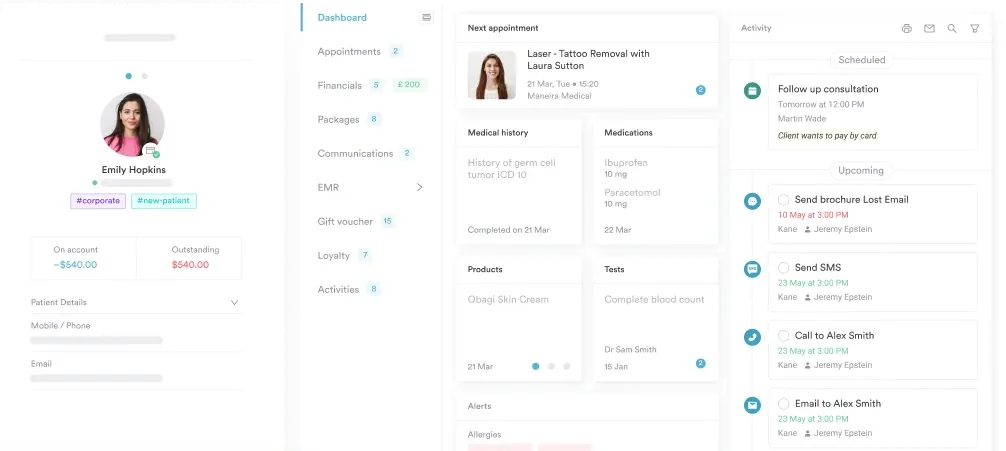
The coder then works from the same patient record. The CCSD code, the K26 diagnosis, and the insurer’s authorization reference sit on one invoice. The claim then goes out electronically, with the anesthetist’s and assistant’s fees linked to the episode.
The outcome is fewer claims returned for missing detail, and faster payment on emergency cases where the authorization window is short.

Pabau helps UK private healthcare practices document surgical procedures accurately, track CCSD claims, and reduce denials. See how it supports your billing team.

G5320 covers one operation, the open closure of a perforated duodenal ulcer. When the note says “laparoscopic”, stop and check G3580 before the claim goes out. When it says “gastric”, the claim belongs under G3520.
The pairing matters as much as the code. A K26 diagnosis that matches the ulcer’s acuity, plus K65.0 only where peritonitis is documented, keeps the claim consistent with the operative note.
Getting the note right the first time costs a few minutes in theater and saves weeks of resubmission. Book a demo to see how Pabau keeps emergency surgical claims complete from the first submission.

Need a full reference for Bupa CCSD procedure codes? Bupa CCSD procedure codes covers code structure, fee schedule navigation, and submission rules for Bupa-covered surgical procedures.
Coding a bypass rather than a closure? CCSD code G5100 explains when bypass of the duodenum applies and how it is billed.
Was a duodenal lesion excised instead? CCSD code G5000 covers open excision of a lesion of the duodenum.
Looking to reduce claim rejections across your private practice? Private healthcare claims management explains how Pabau supports accurate CCSD code submission and claim tracking.
CCSD code G5320 covers open surgical closure of a perforated ulcer of the duodenum, by primary suture or a Graham (omental) patch. It applies when the operative note confirms a duodenal perforation and the operation closed it rather than resecting.
Not automatically. G5320 covers open closure, and insurer schedules list a separate code, G3580, for laparoscopic closure of peptic ulcer. Check G3580 and the insurer’s current schedule before billing a laparoscopic repair as G5320.
The primary pairings are K26.1 (acute duodenal ulcer with perforation) and K26.5 (chronic or unspecified duodenal ulcer with perforation). K26.2 and K26.6 apply when the note documents bleeding as well as perforation. A gastric ulcer code (K25 range) with G5320 creates a diagnosis-procedure mismatch.
Yes. The Graham patch repair (omentoplasty) is within the scope of G5320 and is the most commonly performed closure technique for a perforated duodenal ulcer. The operative note should name it as “Graham patch” or “omental patch repair” to support the code.
Yes, when it is documented. Peritonitis (K65.0) may be coded as an additional diagnosis when the clinical record or operative note confirms it. It should not be inferred from the perforation alone.
The most common reasons are coding the wrong site, submitting without a complete operative note, missing the retrospective authorization window, and diagnosis-procedure mismatches. Billing peritoneal lavage or drain insertion separately also triggers rejections, because most insurers treat them as included in G5320.
The operative note must confirm the duodenal site, the perforation, the named closure technique, the approach, any peritoneal lavage, and drain placement. The claim also needs the insurer’s authorization reference and a matching K26 diagnosis code.





