HCPCS code P9058: Red blood cells, leukocytes reduced, CMV-negative, irradiated
HCPCS code P9058: Official descriptor and key attributes HCPCS code P9058 report...

Last Updated: Oct 26, 2026
J6900 is the CCSD code for open splenectomy, the total removal of the spleen through an open abdominal incision. UK private medical insurers use it to authorise and pay the surgeon's fee for the operation.
The code needs an open approach, such as a midline laparotomy or a left subcostal incision, and removal of the whole spleen. Laparoscopic and partial splenectomy take separate codes, and anaesthesia is billed on its own claim.
Let Pabau's smart automation suggest the right codes, reduce claim denials, and keep your practice compliant—effortlessly.
Automate repetitive tasks and focus on what matters most—your patients.
Reduce coding errors and ensure compliance with the latest regulations.
Clean claims, fewer denials, and faster reimbursements.
Powerful insights and reporting to help your practice thrive.
HIPAA compliant SOC 2 certified GDPR-compliant Trusted by 4,000+ clinics worldwide

CCSD Code J6900 covers open, total splenectomy only. Laparoscopic and partial procedures use separate CCSD codes.
The operative note must confirm the open approach, splenic vessel ligation, and total organ removal before J6900 can be assigned.
Missing prior authorisation and approach-code errors are among the most common reasons UK private insurers deny J6900 claims.
Pabau’s practice management software turns an insured patient’s invoice into an electronic claim and sends it to UK insurers through Healthcode.
CCSD Code J6900 describes open splenectomy: the complete removal of the spleen through a formal abdominal incision. The surgeon typically uses a midline laparotomy or a left subcostal (Kocher) approach.
The code is published by the Clinical Coding and Schedule Development (CCSD) group, which maintains the procedure code schedule used by UK private health insurers.
Three boundaries define what J6900 covers and what it does not:
The indication drives the diagnosis code pairing and the medical necessity documentation. Open splenectomy is performed in two broad contexts: elective and emergency.
Elective indications include:
Emergency indications centre on traumatic splenic injury. Haemodynamically unstable patients with grade IV or V splenic laceration frequently require open splenectomy. In this setting, prior authorisation may be sought retrospectively under emergency admission provisions. Policies differ, so verify the process with each insurer.
The operative report is the primary document audited when a J6900 claim is reviewed. Private insurer clinical reviewers look for specific procedural language that confirms the approach and extent of resection.
A compliant operative note for J6900 should document all of the following:
An operative note that describes a laparoscopic port placement followed by conversion should explicitly state “conversion to open procedure” and document the reason. Auditors will reject a J6900 claim if the note describes only laparoscopic steps.
Miscoding the surgical approach is the most common reason a splenectomy claim is denied. Open and laparoscopic splenectomy are assigned different CCSD codes. Using J6900 for a laparoscopic procedure, or the laparoscopic code for an open one, creates an approach mismatch. That mismatch triggers a clinical review or an outright denial.
CCSD Code J6900 applies exclusively to total open splenectomy. If the operative note describes spleen-preserving surgery (partial or subtotal splenectomy), a different CCSD code is required.
This distinction matters most in paediatric surgery and in cases where the surgeon attempts splenic conservation before deciding on total removal.
Before assigning J6900, the billing administrator should confirm two things in the operative report. The note must use “total” or equivalent language for complete organ removal. It must also confirm that the specimen includes the entire spleen. A note stating “subtotal splenectomy” or “splenic remnant preserved” disqualifies J6900.
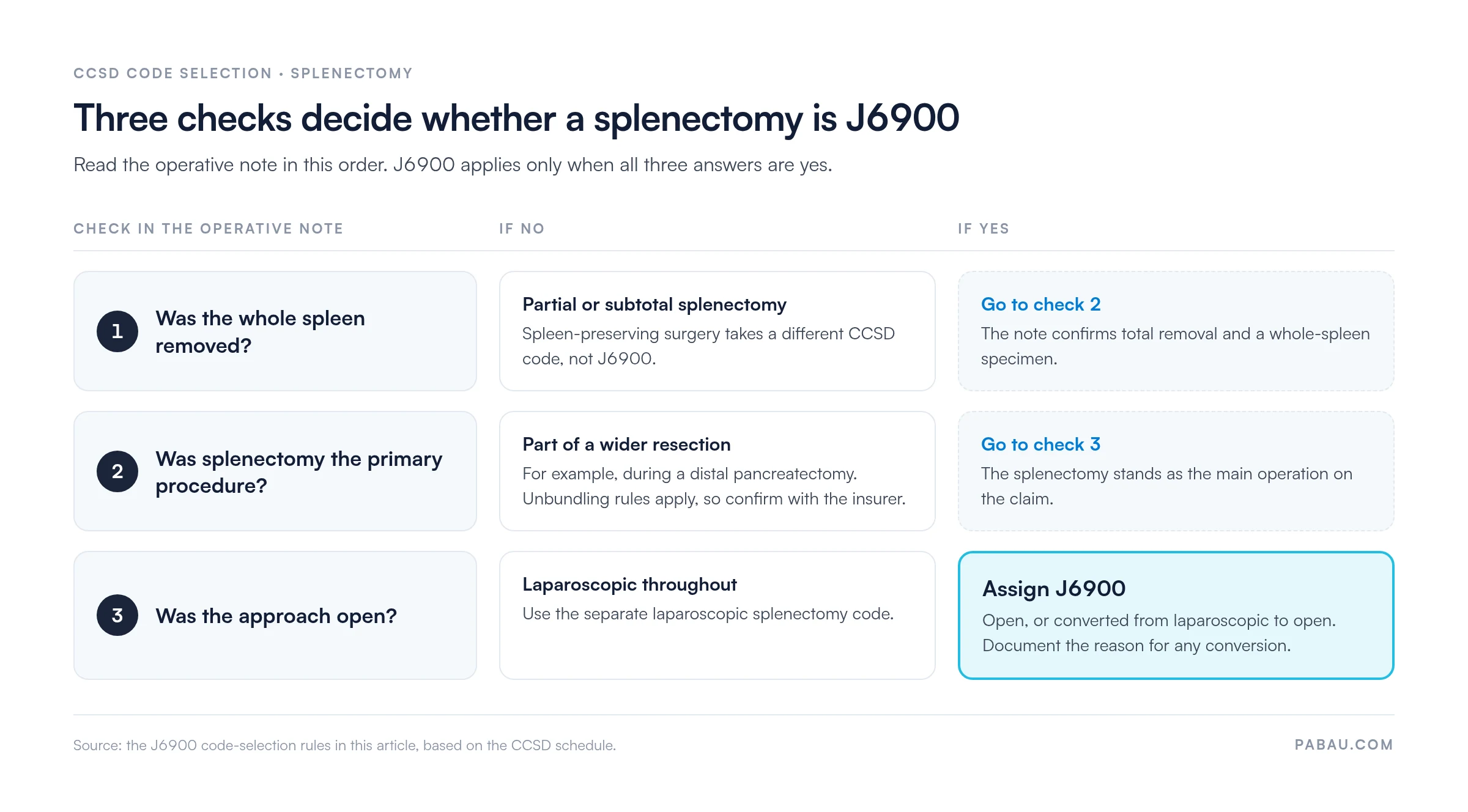
Put together with the approach and unbundling rules above, code selection comes down to three checks, applied in this order.
J6900 sits in chapter 11 of the CCSD schedule, which covers the abdomen, under section 11.7 for other organs (mainly digestive). The codes below are the ones most likely to appear on the same claim or in the same coding session. Total pancreatectomy, coded J5520, sits in the same section and usually removes the spleen en bloc with the pancreas.
For current fee amounts, check the Bupa code search portal or the insurer’s published schedule. Our guide to Bupa CCSD procedure codes explains how to navigate that schedule. Neighbouring procedures are in our CCSD code library.
UK private insurers require a diagnosis code alongside each procedural claim. The table below lists the ICD-10 codes most commonly paired with J6900, grouped by indication. An elective splenectomy for ITP, for example, pairs with D69.3. Payer-specific requirements may differ, so confirm each pairing against the insurer’s current schedule.
UK private insurers typically require prior authorisation before elective open splenectomy. The exact requirements vary by insurer. Most large payers, including Bupa, AXA Health and Aviva, ask for a consultant’s letter confirming the indication. The letter should also show that conservative management was tried and failed.
A complete pre-authorisation submission for an elective J6900 case generally includes:
For emergency trauma admissions, most UK private insurer contracts include retrospective authorisation provisions. Coders should document the emergency admission and notify the insurer within the contractual window, often 24 to 48 hours.
The emergency operative notes then go with the retrospective pre-auth request. Windows differ between contracts, so check each insurer’s terms.
Keeping those records in private healthcare claims management software lets billing administrators pull them up the moment the claim goes in.
The anaesthetist bills separately from the surgeon for open splenectomy. J6900 covers the surgeon’s procedural fee only. The anaesthetist submits their own CCSD-coded claim using the applicable anaesthesia code for open abdominal surgery of equivalent complexity. Both claims are processed independently by the insurer.
Key unbundling considerations for J6900:
Splenectomy leaves the patient permanently more vulnerable to encapsulated bacteria. UK Health Security Agency (UKHSA) guidance recommends vaccines against pneumococcus, meningococcus (ACWY and B) and Haemophilus influenzae type b (Hib). Annual influenza vaccination is recommended as well.
These vaccinations are separate clinical episodes and generate separate billing lines. For fees, refer to WPA medical fee guidance and your insurer’s published schedule. Vaccine schedules are updated periodically, so check current UKHSA guidance for timing.
The surgeon’s J6900 claim does not include these vaccinations. If the private hospital administers them pre-discharge, each vaccine should be billed on a separate line under its appropriate CCSD or drug administration code.
Flag vaccination billing at the time of pre-authorisation. Some UK private insurers will only cover vaccines administered during the inpatient episode if the pre-authorisation request specifically included them. Raising it early avoids a retrospective dispute after discharge.
Denial patterns on J6900 claims are consistent across UK private insurers. Most trace back to incomplete operative notes or approach-code mismatches, and a pre-submission review catches both.
Run through this checklist before submitting any J6900 claim. A single missing item is enough for a clinical reviewer to request additional information, delaying payment by weeks.
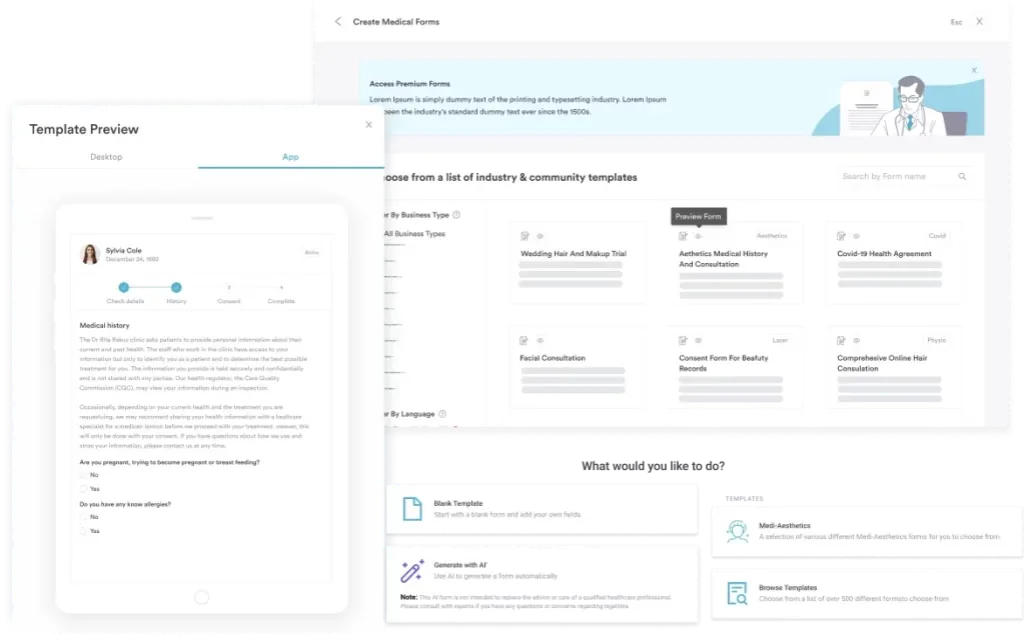
Digital operative note templates with structured fields for approach, extent of resection and vessel ligation let surgeons complete this checklist at the point of care. Structured notes also make the clinical reviewer’s job easier, which typically speeds up claim processing.
Many surgical billing teams move a J6900 case through three places. The operative note sits in one system, the pre-auth reference in an email, and the claim in the insurer portal. Each hand-off is a chance to lose the approach wording or the authorisation number.
Pabau, the practice management platform we build, keeps those steps in one patient record. Operative notes can be built as structured forms, so the approach and extent of resection are recorded every time. The invoice you raise becomes an electronic claim, which our Healthcode integration validates and sends to insurers such as Bupa, AXA Health and Aviva.
Each claim’s status then sits on one claims dashboard. Your team spots a query early and answers it from the same record, so nobody chases paperwork weeks after discharge.
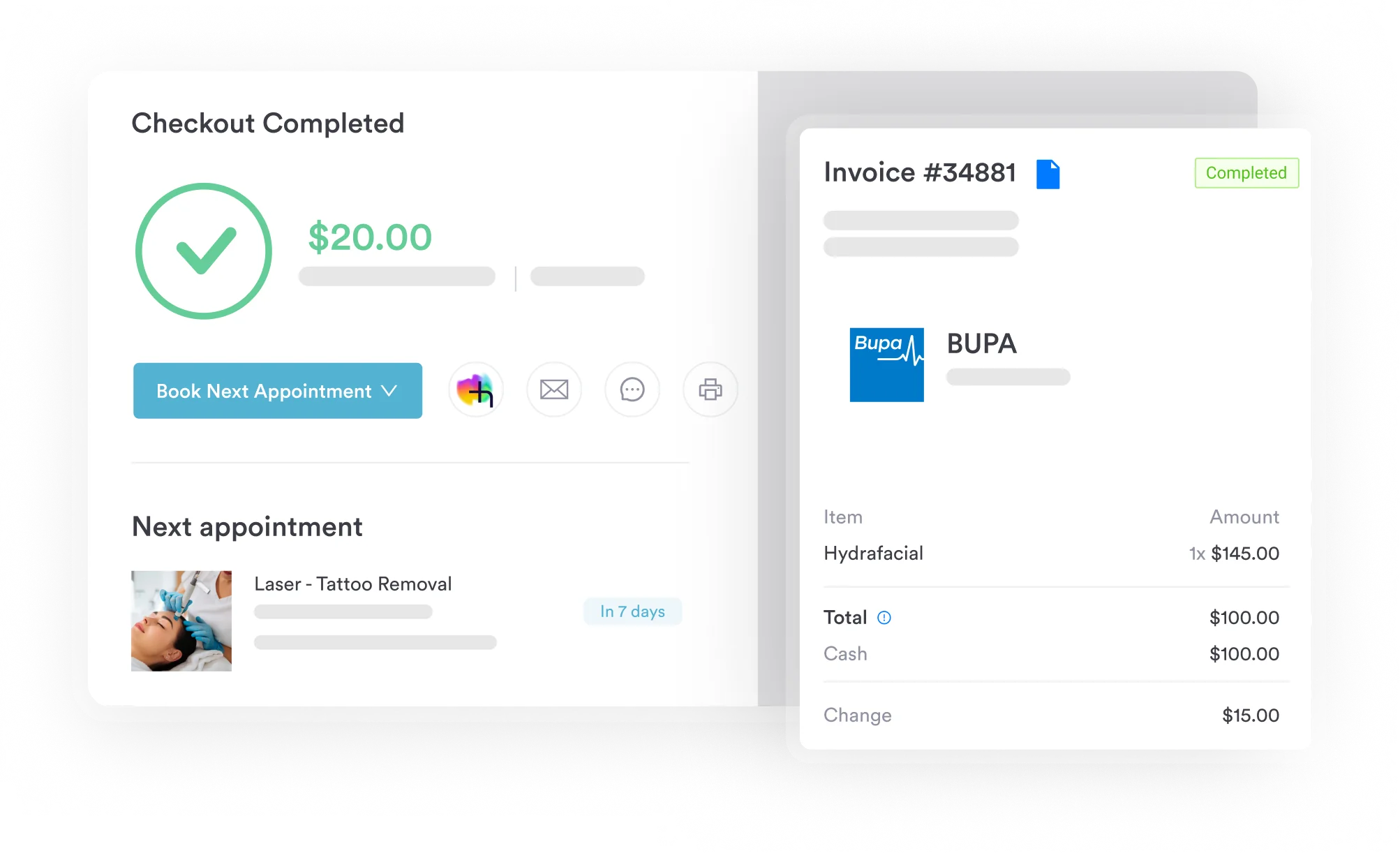

Pabau helps UK private practices structure operative documentation, track authorisation references, and submit CCSD-coded claims accurately. See how it works for your surgical billing workflow.

J6900 is a narrow code, and that narrowness makes it straightforward to bill well. Once the operative note says open, total and primary, the code choice is settled before anyone opens the insurer portal.
The work worth doing sits upstream of the claim. Build the approach, vessel ligation and specimen wording into your operative note template, and log the pre-auth reference at booking. A coder can then check a claim in minutes instead of reconstructing the surgery from a dictated letter.
The trade-off is a little more structure in theatre for far fewer queries after discharge. Book a demo to see how Pabau carries a J6900 case from operative note to a submitted Healthcode claim.

Exploring Pabau’s claims management features? Private healthcare claims management explains how Pabau supports structured claim submission for UK private practice teams.
CCSD Code J6900 covers open splenectomy: the total surgical removal of the spleen via an open abdominal incision (laparotomy or subcostal approach). It applies to the surgeon’s procedural fee only and does not include anaesthesia, post-operative care, or post-splenectomy vaccinations, all of which are billed separately.
Open splenectomy (J6900) and laparoscopic splenectomy are assigned different CCSD codes. The key distinction is the surgical approach: J6900 requires a formal open incision. If a laparoscopic procedure is converted to open, J6900 applies and the conversion must be documented in the operative note.
No. J6900 applies to total open splenectomy only. Partial or subtotal splenectomy, where splenic tissue is preserved, maps to a different CCSD code. Coders must confirm total organ removal in the operative note before assigning J6900.
The most commonly paired ICD-10 codes are D69.3 (ITP), D58.0 (hereditary spherocytosis), D59.1 (autoimmune haemolytic anaemia), R16.1 (splenomegaly), and S36.0x (traumatic splenic injury). The correct pairing depends on the primary clinical indication documented in the consultant’s letter and operative note.
The approximate US CPT equivalent is CPT 38100 (splenectomy, total; open). CCSD codes are used exclusively in UK private healthcare billing; CPT applies in the United States. The two systems are not interchangeable and should not be substituted for one another on UK insurer claims.
Yes. J6900 applies to emergency open splenectomy for traumatic splenic injury as well as elective cases. For emergency admissions, prior authorisation is typically sought retrospectively. Most UK private insurer contracts set a window for emergency notification, often 24 to 48 hours. Check your insurer agreement for the exact requirement.