HCPCS Code A4627: Spacer and valved holding chamber
HCPCS Code A4627: official descriptor and code definition HCPCS Code A4627 is th...

Last Updated: Oct 21, 2026
G3210 is the CCSD code for gastro-jejunostomy, the creation of a new join between the stomach and the jejunum that bypasses the pylorus and duodenum. It covers loop and Roux-en-Y configurations by an open or laparoscopic approach, and it is most often used for gastric outlet obstruction.
The CCSD schedule places G3210 in Chapter 11 under section 11.2.0 Stomach. Revising an existing gastro-jejunostomy is coded as G3220 instead, and CCSD lists the two codes as an unacceptable combination on one claim.
Let Pabau's smart automation suggest the right codes, reduce claim denials, and keep your practice compliant—effortlessly.
Automate repetitive tasks and focus on what matters most—your patients.
Reduce coding errors and ensure compliance with the latest regulations.
Clean claims, fewer denials, and faster reimbursements.
Powerful insights and reporting to help your practice thrive.
HIPAA compliant SOC 2 certified GDPR-compliant Trusted by 4,000+ clinics worldwide

CCSD Code G3210 is the code for a primary gastro-jejunostomy (a new stomach-to-jejunum anastomosis) in UK private practice, and G3220 is the separate revision code.
The code applies to both open and laparoscopic approaches, though the operative note must clearly state the surgical approach used.
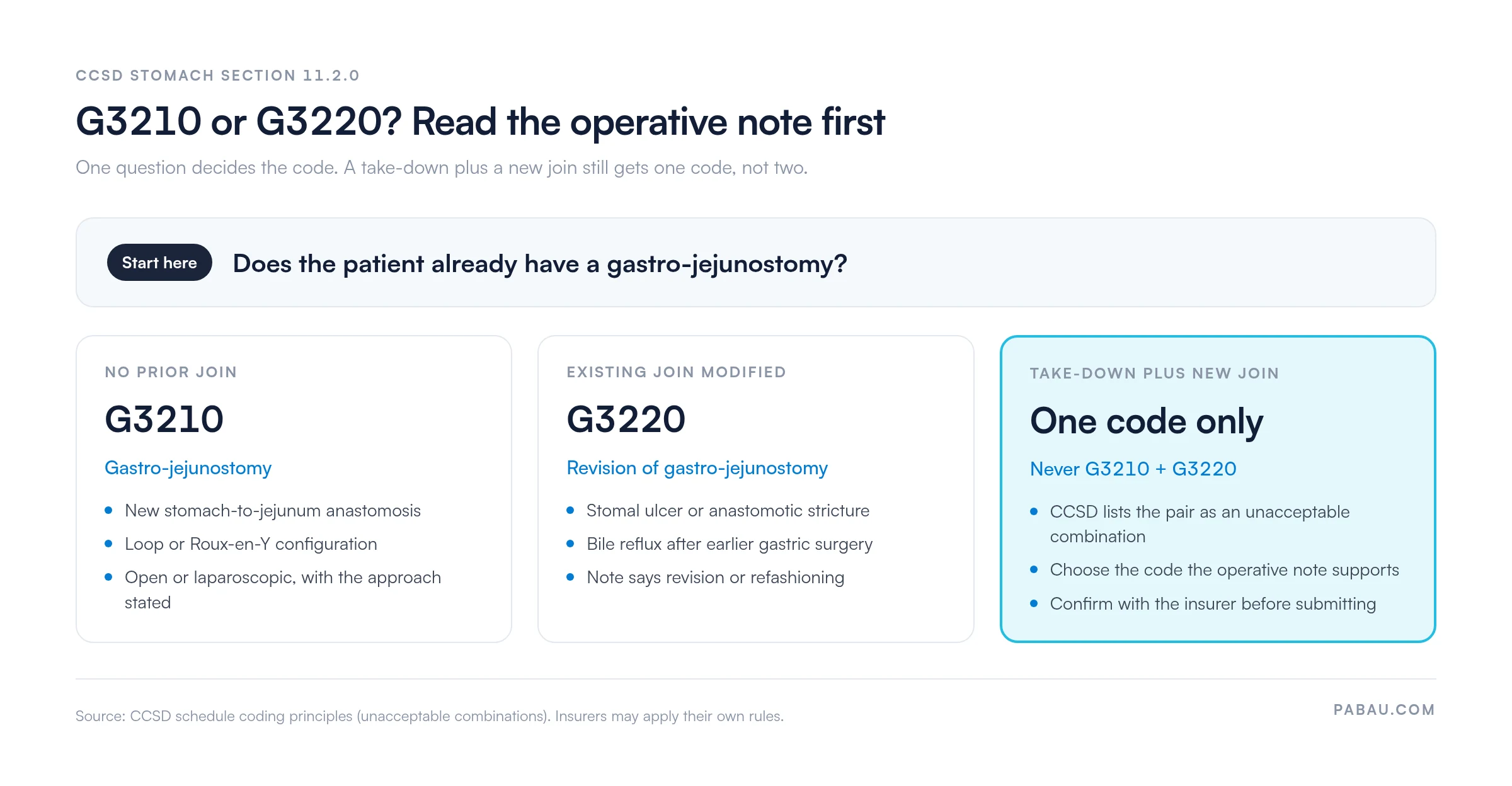
CCSD lists G3210 and G3220 as an unacceptable combination, so a take-down plus a new anastomosis is billed under one code, not both.
Pre-authorisation from UK private insurers is standard for elective gastrojejunostomy, and palliative cases need specific diagnosis coding and supporting clinical evidence.
Pabau’s practice software sends G3210 claims through Healthcode to insurers such as Bupa and AXA Health, while your billing team chooses and checks the code.
CCSD Code G3210 is the Clinical Coding and Schedule Development (CCSD) procedure code for gastrojejunostomy, a new anastomosis between the stomach and the jejunum. It sits in Chapter 11 of the CCSD schedule, which covers the abdomen, under section 11.2.0 Stomach. UK private medical insurers map their own fees and claim checks to the schedule’s codes. Therefore, the right stomach-section code is the starting point for a clean claim.
Procedures elsewhere in the schedule each have their own page in our CCSD codes for practices reference.
The schedule descriptor is simply “Gastro-jejunostomy”. G3210 covers creating a primary gastrojejunal anastomosis, not revising one. In contrast, any revision of a prior gastrojejunostomy falls under G3220. In addition, any extra bowel resection performed in the same sitting, unless bundled by insurer-specific rules, may require a separate code.
Gastrojejunostomy creates a new conduit between the stomach and a loop of small bowel (the jejunum), bypassing the pylorus and duodenum. It restores gastric emptying when a blockage obstructs the normal outflow, or diverts contents away from a diseased or resected segment of gut.
Surgeons perform the anastomosis by one of two main approaches:
The anastomosis may be a simple loop gastrojejunostomy or a Roux-en-Y arrangement. In a Roux-en-Y, the surgeon divides a section of jejunum and reroutes it to reduce bile reflux into the stomach. Importantly, both configurations fall within the G3210 code scope when the primary intent is creating the gastrojejunal connection.
Gastric outlet obstruction (GOO) is the most common indication for gastrojejunostomy in UK private surgical practice. GOO occurs when a blockage at the pylorus stops gastric emptying, and the bypass restores passage of food without requiring resection of the obstructing lesion.
The principal clinical situations that lead to G3210 billing include:
For this reason, coders should pair G3210 with the most precise ICD-10 diagnosis code available. Otherwise, a claim listing only a non-specific abdominal diagnosis code alongside G3210 is a predictable denial trigger for most UK private insurers.
Understanding the bundling scope of G3210 prevents both undercoding (missing billable components) and overcoding (billing items separately when the code already covers them). The table below summarises what the code encompasses and what falls outside it.
G3220 covers the revision of a gastrojejunostomy, meaning the surgical modification or refashioning of an existing anastomosis. Therefore, it is not interchangeable with G3210. Picking the wrong one is a predictable trigger for insurer queries, because the operative note shows whether a prior anastomosis existed.
When the surgeon takes down an old anastomosis and creates a new one in the same sitting, the claim still carries one code. CCSD lists G3210 and G3220 as an unacceptable combination, so they are not billed together under CCSD principles, although individual insurers may differ. Instead, choose the code the operative note supports, and confirm it with the insurer before you send the claim. The diagram below reduces that choice to one question about the patient’s surgical history.
Section 11.2.0 of the CCSD schedule groups the stomach procedures. For this reason, coders in upper GI surgery should know the codes around G3210, so they avoid upcoding, undercoding, or mixing up procedures with different bundling rules.
G3800 is a last resort, because insurers scrutinise catch-all codes more closely than exact ones. As a result, sending G3800 when G3210 or G3220 clearly applies risks denial and audit flags.
Every G3210 claim needs an operative note detailed enough for the insurer to validate the procedure without asking for more information. Missing or ambiguous documentation is the primary driver of initial claim rejections for gastric surgery codes.
The operative note for a G3210 claim should capture all of the following:
A note that describes “gastrojejunostomy performed” without specifying approach, technique, or indication gives the insurer grounds to request a more detailed report before settling. Consequently, that request adds weeks to payment timelines and, in some cases, triggers a full clinical audit.
UK private medical insurers treat gastrojejunostomy as an inpatient elective surgical procedure requiring pre-authorisation in most policy categories. The specific process varies by insurer, but the underlying requirements are broadly consistent. Practices using Bupa CCSD codes and fees should confirm the current authorisation pathway on Bupa’s provider portal before booking elective cases. Bupa updates those requirements periodically.
The typical pre-authorisation process for G3210 across major UK PMI providers involves:
However, insurer rules change, and the guidance above reflects general practice for elective surgical pre-authorisation. Always check the insurer’s current provider portal before you send the claim, and record the authorisation number before admitting the patient.
Request an authorisation number before the patient is listed for surgery, not on the day of admission. For palliative gastrojejunostomy in inoperable malignancy, flag the urgency explicitly when you contact the insurer. Most UK PMI providers have a priority pathway for cancer-related surgery that shortens the pre-auth window.
Most G3210 denials fall into one of five categories. Identifying which type applies to a rejected claim determines the fastest route to resolution.
The CCSD schedule uses a single code (G3210) for gastrojejunostomy regardless of surgical approach. CCSD has no separate laparoscopic code, and it does not use CPT-style modifiers. Bill both open and laparoscopic gastrojejunostomy under G3210, but state the approach explicitly in the operative note.
For example, some insurers negotiate different fee levels for laparoscopic versus open methods under the same code. A practice with a direct contract with Bupa, AXA or another PMI should confirm the rate for the approach used before admission. A laparoscopic note billed against an open-rate schedule (or the reverse) tends to cause under-reimbursement rather than outright denial. As a result, that shortfall is often harder to spot.
Palliative gastrojejunostomy, performed to bypass an inoperable tumour causing gastric outlet obstruction, uses the same CCSD Code G3210 as an elective primary anastomosis. The clinical intent (palliative vs curative) does not change the CCSD code. What changes is the diagnosis coding and the clinical evidence package submitted for pre-authorisation.
For palliative cases, coders should:
Private surgical practices handling upper GI cases benefit from one consistent workflow for G3210 claims, from the pre-auth request through to payment reconciliation. Private insurance claim management software that submits through Healthcode also cuts the retyping between the patient record and the claim.
A reliable G3210 billing workflow includes:
Finally, practices with several operating surgeons get the most from writing these steps down once, so every surgeon’s G3210 claims pass the same checks.
Many surgical practices still rekey each G3210 claim into an insurer portal and chase authorisation numbers by email. That is where a missing auth reference or a mistyped policy detail slips through, and the claim comes back weeks later.
Pabau, the practice management and billing platform we build, sends private medical insurance claims through Healthcode to Bupa, AXA Health, Vitality and other insurers. Pabau stores each insurer authorisation as a case against the appointment and flags a claim still missing one before it goes out.
However, your team still chooses the CCSD code and checks it against the operative note. Pabau then tracks each claim from pending to paid and matches the insurer’s remittance to the invoice, so a short payment on G3210 surfaces quickly.

Pabau submits private medical insurance claims through Healthcode and flags any claim still missing an authorisation. Your team chooses the CCSD code, and Pabau tracks the claim through to payment.

G3210 rewards a surgeon who writes the operative note with the coder in mind. If the note states the approach, the configuration and whether a prior anastomosis existed, the code choice settles itself before anyone builds the claim.
Take-down cases are where the temptation to bill both codes sits. CCSD treats G3210 and G3220 as an unacceptable combination. So pick one, agree it with the insurer and secure the authorisation before listing the patient.
Book a demo to see how Pabau sends your G3210 claims through Healthcode and flags a missing authorisation before submission.

Coding a revision instead? CCSD Code G3220: Revision of gastrojejunostomy explains when an existing anastomosis takes the revision code.
No specific stomach code fits? CCSD Code G3800: Open stomach surgery covers the catch-all code and why insurers scrutinise it.
Closing a gastrostomy in the same section? CCSD Code G3440: Closure of gastrostomy is the reference for that stomach-section procedure.
Need Bupa-specific fees and coding rules? Bupa CCSD codes and fee schedule guide covers Bupa’s procedure code framework and its provider portal.
Submitting claims through Healthcode? Pabau’s claims management software sends private medical insurance claims and tracks them to payment.
CCSD Code G3210 covers the primary creation of a gastrojejunostomy, a new anastomosis between the stomach and the jejunum that bypasses the pylorus and duodenum. It includes open and laparoscopic approaches and both loop and Roux-en-Y configurations. It does not cover revision of an existing gastrojejunostomy (G3220) or associated bowel resection.
G3210 is used when the surgeon creates a gastrojejunostomy for the first time; G3220 is used when an existing gastrojejunostomy is surgically revised or refashioned. The presence or absence of a prior anastomosis in the patient’s history, confirmed by the operative note, is the determining factor. Using G3220 when no prior anastomosis exists is one of the most common audit flags on upper GI surgery claims.
Bupa, AXA Health, Vitality Health, WPA, Aviva and most other UK private medical insurers cover gastrojejunostomy when the indication is established. The procedure must also be performed by a recognised surgeon. Pre-authorisation is standard for elective inpatient procedures under virtually all PMI policies. The specific documentation each insurer requires at authorisation varies – check each provider’s portal for current requirements.
Yes – anaesthetic fees are billed separately by the anaesthetist using the relevant CCSD anaesthetic codes. They are not bundled within G3210. Similarly, any assistant surgeon fee is billed separately, though not all insurers allow an assistant’s fee for this procedure. Verify assistant fee eligibility with the relevant insurer before the procedure date.