

HCPCS code E0198: Water pressure pad billing guide
HCPCS code E0198 is a water pad for a standard mattress HCPCS code E0198 is the ...

Last Updated: Oct 13, 2026
E4400 is the CCSD code for carinal resection +/- pneumonectomy. It covers removal of the tracheal carina with reconstruction of the airway, whether or not the lung on that side is also removed.
The code sits in section 8.5 (bronchi/lungs/pleura) of the CCSD schedule used by UK private medical insurers and carries a Complex rating. A robot-assisted operation is billed as E4401 instead.
Let Pabau's smart automation suggest the right codes, reduce claim denials, and keep your practice compliant—effortlessly.
Automate repetitive tasks and focus on what matters most—your patients.
Reduce coding errors and ensure compliance with the latest regulations.
Clean claims, fewer denials, and faster reimbursements.
Powerful insights and reporting to help your practice thrive.
HIPAA compliant SOC 2 certified GDPR-compliant Trusted by 4,000+ clinics worldwide

CCSD Code E4400 covers carinal resection with or without pneumonectomy, so one code applies whether or not the lung is removed.
E4400 sits in section 8.5 (bronchi/lungs/pleura) of the CCSD schedule with a Complex rating. The robot-assisted operation has its own code, E4401.
UK insurers such as Bupa, AXA Health, Aviva and Vitality generally expect pre-authorization before surgery, with the diagnosis coded in ICD-10.
The operative note must name the carina, describe the reconstruction and state whether a pneumonectomy was performed.
Pabau, our practice management platform, keeps the authorization number on the patient record and checks it before the claim goes to Healthcode.
CCSD Code E4400 is the UK private medical insurance code for carinal resection with or without pneumonectomy. Its official descriptor reads Carinal resection +/- pneumonectomy.
The carina is the ridge of cartilage where the trachea divides into the left and right main bronchi. Removing it means the surgeon has to rebuild the airway, and sometimes remove the lung on that side.
E4400 sits in chapter 8 (thorax and intra-thoracic organs), section 8.5 (bronchi/lungs/pleura), and carries a Complex rating.
The +/- notation means E4400 applies whether or not the lung is removed. The schedule has no separate code for carinal resection without pneumonectomy, so both outcomes are billed the same way. A robot-assisted operation is the exception, because it has its own code, E4401.
Carinal resection removes the point where the trachea divides and reconnects the airway with a primary anastomosis. It is one of the most demanding operations in thoracic surgery. The surgeon has to keep the patient ventilated while the airway is open, often through a right posterolateral thoracotomy.
The operation usually follows these stages:
Cardiopulmonary bypass is sometimes used when the airway can’t be ventilated safely during reconstruction. Whether it is needed depends on the surgeon and the case.
Non-small cell lung cancer (NSCLC) that invades the carina is the most common reason for E4400. The operation is chosen when the tumor or involved nodes reach the carina and a smaller resection can’t clear the margins.
Other accepted indications include:
UK private claims carry the diagnosis as an ICD-10 code. The codes most often paired with E4400 are C34.0 (main bronchus), C34.1 (upper lobe), C34.2 (middle lobe), C34.3 (lower lobe) and C33 (trachea). Code the principal diagnosis from the confirmed histology, not the working diagnosis on the referral.
Match the ICD-10 code on the claim to the final pathology report before you submit. The site on that report can differ from the pre-operative imaging, such as main bronchus (C34.0) instead of upper lobe (C34.1). A diagnosis that contradicts the histology gives the insurer a reason to query the claim.
E4400 is one surgeon’s fee for the whole operation. The thoracic chapter of the CCSD schedule says a routine rigid bronchoscopy is not charged separately during intra-thoracic surgery. Neither is a chest drain inserted during the operation. The table shows who bills what.
Each insurer sets its own fee for E4400, and fees change. Check the current figure in the insurer’s schedule before you raise an invoice. For Bupa patients, the Bupa CCSD codes guide explains how that schedule works.
Several thoracic codes sit near E4400 in chapter 8. The right one depends on three questions. Was the carina itself resected? Was the whole lung removed? Was the operation robot-assisted? The decision tree below takes them in order.
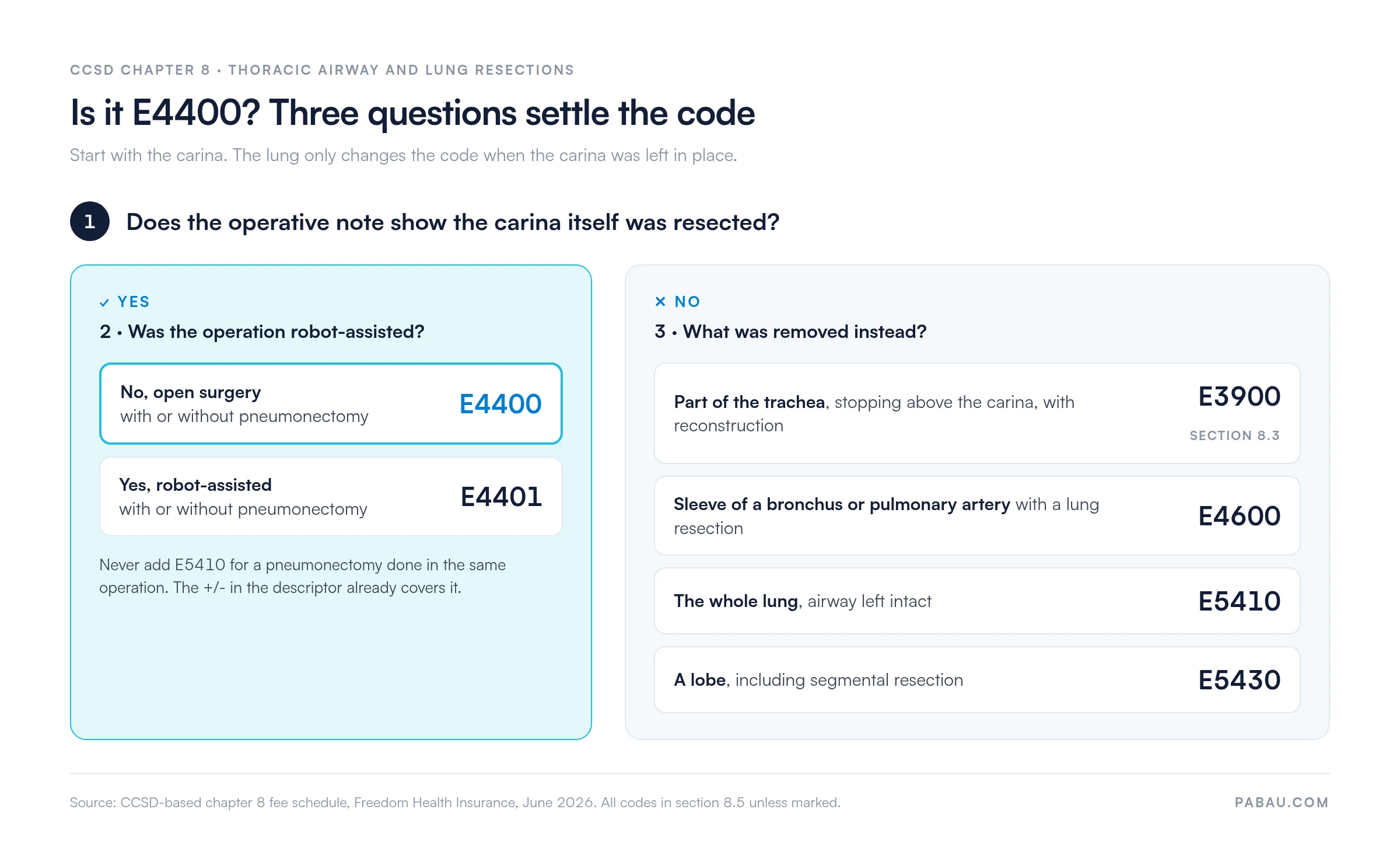
E4600 is the code most often confused with E4400. It covers a sleeve resection of a bronchus or the pulmonary artery alongside a lung resection. Choose E4400 only when the operative note shows the carina itself was removed. For a tracheal resection that stops above the carina, see CCSD Code E3900.
Codes and sections in this table come from the CCSD-based chapter 8 fee schedule published by Freedom Health Insurance in June 2026.
Insurers assess the operative note against the CCSD descriptor. If the note doesn’t clearly support a carinal resection, the insurer has grounds to query or reject the claim. Record each of the following.
In Pabau, the operative note sits on the patient’s clinical record alongside the claim. Billing staff can check the note against the descriptor before the invoice goes out.
UK private insurers such as Bupa, AXA Health, Aviva, Vitality and WPA generally expect pre-authorization before elective surgery. The patient usually contacts the insurer to get an authorization number. A claim without a valid number is likely to be rejected, and insurers rarely approve retrospective applications.
Evidence the insurer typically asks for:
For an urgent admission, contact the insurer as soon as possible. Each insurer sets its own notification rules, so confirm them against the patient’s policy.
Record the authorization number, the approved code and the approved hospital on the patient record before admission. If the plan changes to a robotic approach, tell the insurer and update the authorization. An E4401 claim against an E4400 authorization is likely to be queried.
UK private insurers don’t use CPT codes. CCSD claims reach insurers through Healthcode or a similar electronic claims platform. The cross-reference below is for US-trained coders working in UK private hospitals.
The two systems don’t line up one to one. CPT splits the operation into separate codes, while CCSD covers both outcomes with the +/- notation. CPT is maintained by the AMA for US billing, so never put a CPT code on a UK private invoice.
E4400 denials usually trace back to the claim paperwork, such as a missing authorization number or an operative note that never names the carina. Build a pre-submission check for each trigger below into your medical claims management process.
For the appeal process itself, the guide to managing claim denials covers each step.
Many thoracic practices still run billing across separate tools. The authorization number sits in an email and the operative note in a document. Then someone keys the claim into Healthcode by hand, and the authorization reference or the approach can drop out along the way.
Pabau keeps the insurer, policy and authorization details on the patient record. When the invoice is ready, it pulls the patient, procedure and insurer details into the claim and sends it to Healthcode. Validation runs first, so a claim can’t go out without the membership number and authorization code.
Each claim then moves through clear stages, from pending and submitted to paid or error. Your billing team can see which E4400 claims need attention without phoning insurers.

Pabau checks authorization codes and membership numbers before each CCSD claim goes out. It then sends the claim to Healthcode and tracks it through to payment.

E4400 pays cleanly when the operative note names the carina and the approach matches the code. A valid authorization number has to be on file as well. If the carina wasn’t resected, switch to E4600 or E5410 rather than defending E4400 on appeal.
The trade-off is effort before surgery, because the pre-auth pack and a structured operative note take time. That time costs far less than an appeal weeks later. Book a demo to see how Pabau checks authorization details before each CCSD claim goes to Healthcode.

Coding a resection that stopped short of the carina? CCSD Code E4600 covers sleeve resection of a bronchus or pulmonary artery, the code most often confused with E4400.
Coding an airway repair that leaves the carina intact? CCSD Code E4030 explains how to bill tracheoplasty for UK private practice.
Pairing E4400 with a tracheal tumor diagnosis? ICD-10 code C33 sets out the documentation for a malignant neoplasm of the trachea.
Choosing a system to bill UK private insurers? Best medical billing software in the UK compares the platforms that handle CCSD claims, pre-authorization, and remittance.
CCSD Code E4400 covers carinal resection with or without pneumonectomy in UK private medical insurance billing. The surgeon removes the tracheal carina and reconstructs the airway. The +/- in the descriptor means one code applies whether or not the lung is removed.
Pneumonectomy is added when the tumor has spread beyond the carina into the lung, or when the bronchial anatomy can’t be preserved. The surgeon decides during the operation, and E4400 applies in both cases.
Robot-assisted carinal resection is billed as E4401, robotic assisted carinal resection +/- pneumonectomy. It sits in the same section as E4400 with the same Complex rating. Use it only when the operative note records robotic assistance.
The operative note must name the carina, describe the extent of resection and the reconstruction, and state whether a pneumonectomy was performed. The claim also needs a valid authorization number and an ICD-10 diagnosis code that matches the histology.
The most common reasons are a missing authorization number and an operative note that never names the carina. Others include the wrong neighboring code, a mismatched ICD-10 diagnosis and unbundled items such as a separate thoracotomy. A pre-submission checklist prevents most of them.
The anesthetist bills E4400 against the insurer’s anesthetist fee. Some insurers don’t pay a separate surgical assistant fee, so check the policy first. The hospital bills ICU and theater charges, and thoracotomy access and routine bronchoscopy are included in E4400.



