

HCPCS code E0198: Water pressure pad billing guide
HCPCS code E0198 is a water pad for a standard mattress HCPCS code E0198 is the ...

Last Updated: Oct 13, 2026
E4600 is the CCSD code for sleeve resection of bronchus or pulmonary artery with pulmonary resection. The surgeon removes a full ring of bronchus or pulmonary artery, rejoins the ends, and removes lung tissue in the same operation.
The most common form is a sleeve lobectomy for a central lung tumor. The code sits in CCSD chapter 8.5 with a Complex rating. A lobectomy without a sleeve is E5430, and a pneumonectomy is E5410.
Let Pabau's smart automation suggest the right codes, reduce claim denials, and keep your practice compliant—effortlessly.
Automate repetitive tasks and focus on what matters most—your patients.
Reduce coding errors and ensure compliance with the latest regulations.
Clean claims, fewer denials, and faster reimbursements.
Powerful insights and reporting to help your practice thrive.
HIPAA compliant SOC 2 certified GDPR-compliant Trusted by 4,000+ clinics worldwide

CCSD Code E4600 covers a sleeve resection of the bronchus or pulmonary artery done together with a lung resection, most often a sleeve lobectomy.
The operative note must name the segment removed and the end-to-end anastomosis, or the claim reads as lobectomy code E5430.
Freedom Health Insurance’s June 2026 schedule pays a £1,600 specialist fee for E4600, the same as E5430, so each insurer’s own schedule decides the fee.
Get preauthorization before surgery and record the reference number, because insurers match it against the claim.
A routine rigid bronchoscopy and a chest drain placed during the operation aren’t charged separately under the chapter 8 schedule notes.
CCSD Code E4600 describes sleeve resection of bronchus or pulmonary artery with pulmonary resection. The surgeon removes a full ring of the main or lobar bronchus, or of the proximal pulmonary artery. The ends are then rejoined with an end-to-end anastomosis, and lung tissue is removed in the same operation.
The most common form is a sleeve lobectomy. The affected lobe comes out with the bronchial sleeve, which saves the lung tissue below it that a pneumonectomy would remove.
The code covers three surgical configurations:
E4600 doesn’t cover lobectomy or segmentectomy without a sleeve, which share code E5430. Pneumonectomy is E5410, and a resection that reaches the carina is E4400.
Sleeve resection is chosen when a central tumor has invaded the bronchial wall or proximal pulmonary artery too far for a simple lobectomy. It’s also chosen when the patient’s lung function makes a pneumonectomy too risky.
Guidance from the European Society of Thoracic Surgeons and the British Thoracic Society favors it for suitable non-small cell lung cancer (NSCLC) patients. It achieves comparable cancer clearance while keeping working lung tissue, with less postoperative morbidity than pneumonectomy.
The key operative steps that must appear in the documentation include:
Each of these steps creates a documentation requirement. A coder who receives a note that says only “left upper lobe lobectomy” can’t assign E4600. The sleeve component has to be described explicitly.
Sleeve resection of bronchus or pulmonary artery with pulmonary resection is indicated in these clinical scenarios:
Some findings take a case away from E4600. Confirmed N2 mediastinal nodal disease is a relative contraindication, depending on the multidisciplinary team (MDT) decision. So is an inability to achieve clear bronchial or vascular margins.
Tumor that reaches the main carina needs a carinal resection, which is coded E4400. When the airway work stays in the trachea, look at E3900 instead.
Most coding errors with E4600 happen at the boundaries. The table below sets out where the code stops.
The codes most often confused with E4600 sit beside it in chapter 8.5 of the CCSD schedule. Each one turns on a single distinguishing detail in the operative note.
Fees are specialist fees from Freedom Health Insurance’s chapter 8 schedule, updated June 2026. Other insurers set their own fees for the same codes. A VATS lobectomy without a sleeve has its own code, E5432.
The route to E4600 comes down to one question. Did the surgeon excise a full ring of bronchus or artery, rejoin it, and remove lung tissue in the same operation? If yes, E4600 applies.
If the bronchus was simply divided and stapled, the procedure is a standard lobectomy under E5430. The diagram below walks through the order to check. Neighboring code numbers can change, so confirm them against the current CCSD schedule or the full CCSD code library.
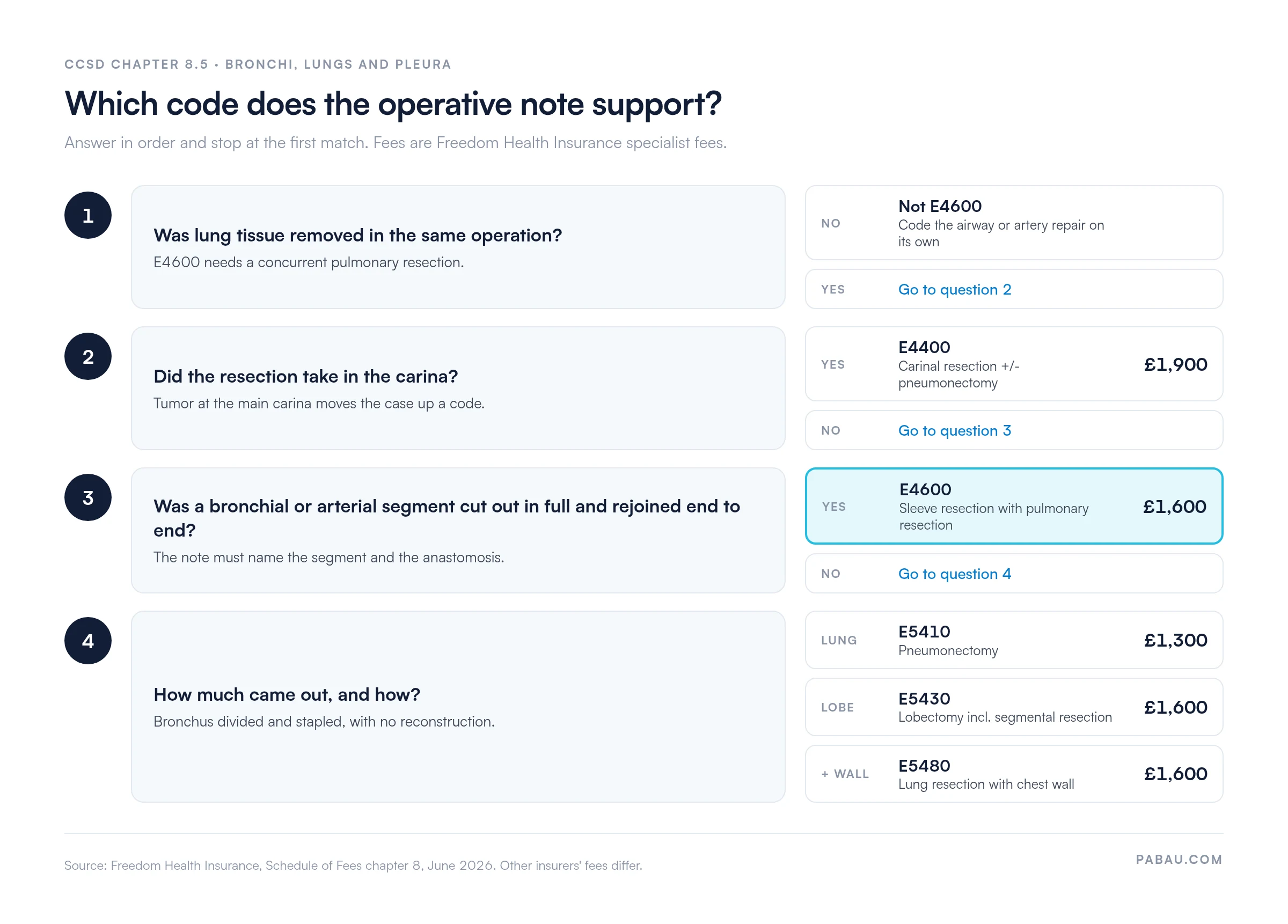
Download the current CCSD technical guide from ccsd.org.uk before coding a thoracic case. Freedom Health Insurance’s chapter 8 notes also say a routine rigid bronchoscopy and an intraoperative chest drain aren’t charged separately.
The operative note is the most important document in an E4600 claim. Insurers use it to confirm that the procedure behind the code took place.
A generic lobectomy note that never mentions the sleeve invites the insurer to recode the claim to E5430. Correcting that later usually takes a supplementary operative report.
These elements must be in the operative note before coding goes ahead:
Where frozen-section margins were checked, the pathologist’s result should appear in the operative note or be referenced by specimen number. Insurers reviewing high-value thoracic claims compare the pathology report against the operative note, and discrepancies trigger manual review.
Sleeve resection is a major thoracic procedure, and UK private health insurers expect preauthorization before it takes place. A claim submitted without a matching authorization reference can be rejected at electronic validation, however complete the clinical notes are.
A preauthorization request to Bupa, AXA Health, Aviva, Vitality Health, or Cigna UK typically needs:
Some insurers take requests through online provider portals, while others want a phone call above a set cost or complexity level. Submission routes change, so check each insurer’s current process. The Aviva procedure guidelines and the AXA Health specialist procedure codes portal publish current requirements.
Record the authorization number in the patient record before the admission date. A missing or mismatched number is one of the most common reasons an E4600 claim bounces at submission.
Healthcode is the main electronic billing platform for UK private medical claims, and most UK private insurers accept claims through it. The Healthcode provider portal walks you through claim entry for CCSD-coded procedures.
Each denial reason below needs a different fix, so work out which one applies before you appeal.
The official descriptor for E4600 joins its two structures with “or”: sleeve resection of bronchus or pulmonary artery with pulmonary resection. That wording leaves coders unsure about a double-sleeve case, where both the bronchus and artery are resected alongside a lobectomy.
The cautious reading is that E4600 covers either variant under one code. The descriptor names both structures and the schedule creates no separate code for the combined form. For a genuine double-sleeve case, check the current schedule notes and ask the insurer’s medical review team before submission.
Adding a vascular reconstruction code alongside E4600 without insurer guidance risks rejection for unbundling. If the artery is repaired with no lung tissue removed, E4600 doesn’t apply at all. Open repair of the pulmonary artery has its own code, L1080.
Mediastinal lymph node dissection done during the resection needs the same check. Chapter 8.6 lists E6112 for removal of mediastinal and hilar lymph nodes, but bundling varies by insurer policy. Pabau’s Bupa CCSD code guide covers the wider bundling principles for UK private surgical billing.
A patient having a sleeve resection for NSCLC in UK private care generates billable encounters across several specialties. E4600 is the surgeon’s primary procedure code, and the practice team has to manage the rest of the episode alongside it.
Separately codeable components alongside E4600 typically include:
The surgeon’s billing team claims E4600 and any other procedure that surgeon personally performed in the same operation. A routine rigid bronchoscopy and an intraoperative chest drain don’t count, because the schedule treats them as part of the main procedure.
Across the MDT, someone needs to track which clinician has claimed which component. Without that, the same part of the episode can end up billed twice.
Build a pre-admission checklist for E4600 cases that captures the preauthorization number, the clinicians who will also bill, and the operative note deadline. A missing operative note at billing time is the most avoidable cause of a delayed or denied E4600 claim.
For an E4600 claim, a thoracic billing team usually chases three items by hand: the authorization number, a finished operative note, and the right code. When those live in separate systems, the claim waits for whichever arrives last.
Pabau, the practice management platform we build, keeps all three on one patient record. The patient’s insurer and policy sit on the record, so each invoice routes to the right insurer. Before a claim goes out, Pabau checks that membership numbers and authorization codes are in place.
Claims then go straight to Healthcode without rekeying. With faster claims management, every claim sits in one dashboard as pending, submitted, processing, paid, or error. A stuck E4600 claim shows up the day it fails.
Digital forms close the documentation side. Build an operative note template with required fields for the sleeve segment, the anastomosis, and the margins. An incomplete note is then caught before it reaches the coder.
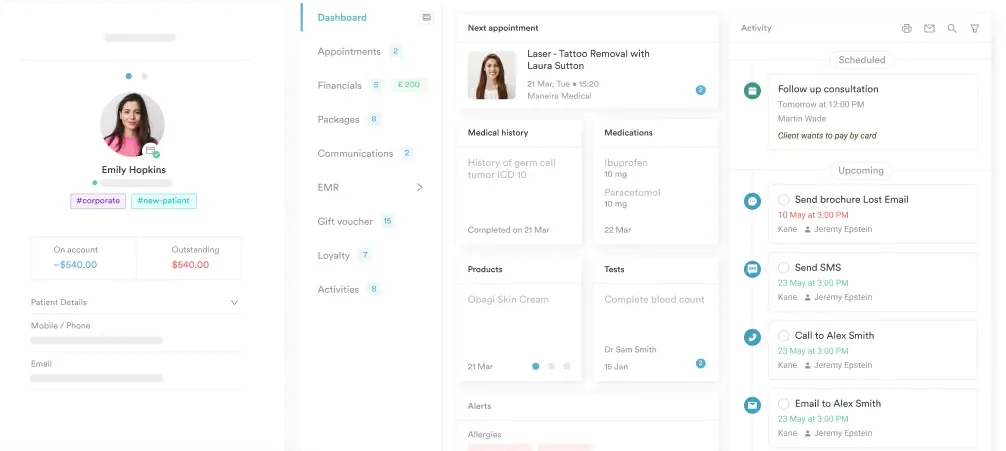

Pabau tracks preauthorization references, structures operative notes, and sends claims to Healthcode. Your E4600 claims reach the insurer with the details they check.

Code E4600 only when the operative note proves three facts. A full ring of bronchus or artery came out, the ends were rejoined, and lung tissue was removed in the same operation. If one is missing, the case belongs under E5430, E5410, or E4400.
The fee won’t always reward getting this right, since some schedules pay E4600 and E5430 the same. Audits still check the note against the code, so an E4600 claim needs a sleeve the note can prove.
Fix it upstream. Put the operative note template and the preauthorization check into the pre-admission routine, and your coder stops chasing surgeons after discharge.
Book a demo to see how Pabau keeps operative notes, authorization numbers, and Healthcode claims together for your thoracic list.

Billing a pulmonary artery repair without a lung resection? CCSD code L1080 explains when open pulmonary artery repair is coded on its own.
Need a diagnostic thoracotomy code? CCSD code E5532 covers thoracotomy and lung biopsy as a sole procedure.
Need guidance on CCSD codes for Bupa claims? Bupa CCSD codes guide covers the code structure, fee rules, and submission requirements for Bupa-insured patients.
Looking for a Bupa procedure fee reference? Bupa procedure codes and fee schedule lists Bupa-recognized procedure codes, including thoracic surgery fees.
CCSD Code E4600 covers sleeve resection of bronchus or pulmonary artery with pulmonary resection. A full ring of bronchus or proximal pulmonary artery is excised and rejoined end to end, and lung tissue is removed in the same operation. The most common form is a sleeve lobectomy for central non-small cell lung cancer.
A sleeve resection removes a ring of bronchus or artery and rejoins the ends, as well as removing the lobe. A standard lobectomy divides and staples the bronchus with no reconstruction. For coding, the anastomosis is what moves the claim from E5430 to E4600.
Yes. UK private insurers expect preauthorization before a sleeve resection, and a claim without a matching authorization reference can be rejected at electronic validation. Get the authorization before the procedure date and record the reference number in the patient record.
The insurer can recode the claim to lobectomy code E5430. Some schedules pay E5430 less, while Freedom Health Insurance’s June 2026 schedule pays both the same. Correcting the code usually needs a supplementary operative report, so complete a detailed note before the claim goes in.
The closest US CPT match is 32486, sleeve lobectomy: removal of lung with circumferential resection of a bronchial segment and broncho-bronchial anastomosis. Sleeve pneumonectomy is CPT 32442, and CPT 32501 is an add-on for bronchoplasty during a lobectomy or segmentectomy. CCSD and CPT aren’t interchangeable, so treat any crosswalk as approximate.
It depends on the insurer’s bundling rules. Chapter 8.6 of the schedule lists E6112 for removal of mediastinal and hilar lymph nodes. Some insurers still treat node dissection as part of the main resection. Check the schedule notes and get written confirmation from the insurer before submitting both codes.



