CPT code 36600: Arterial puncture billing guide
CPT code 36600: definition and procedure overview CPT code 36600 is classified u...

Last Updated: Oct 15, 2026
E2940 is the CCSD code for partial laryngectomy, the removal of part of the larynx with most of its framework kept. UK private medical insurers such as Bupa and AXA Health accept it on the surgeon's claim, usually for laryngeal cancer coded C32.0 to C32.9.
The code sits in section 5.7.0 Larynx and Trachea, within the Ear, Nose and Throat chapter of the CCSD schedule. Total laryngectomy (E2910), horizontal supra-glottic laryngectomy (E2920) and vertical hemi-laryngectomy (E2930) each have their own code.
Let Pabau's smart automation suggest the right codes, reduce claim denials, and keep your practice compliant—effortlessly.
Automate repetitive tasks and focus on what matters most—your patients.
Reduce coding errors and ensure compliance with the latest regulations.
Clean claims, fewer denials, and faster reimbursements.
Powerful insights and reporting to help your practice thrive.
HIPAA compliant SOC 2 certified GDPR-compliant Trusted by 4,000+ clinics worldwide

CCSD code E2940 is the UK private insurer code for partial laryngectomy, in section 5.7.0 Larynx and Trachea of the CCSD schedule.
Named partial procedures have their own codes. Horizontal supra-glottic laryngectomy is E2920, and vertical hemi-laryngectomy is E2930.
Total laryngectomy is E2910, and robotic assisted total laryngectomy is E2942. Neither can be billed with E2940.
The CCSD coding principles bar a set of laryngeal codes, including E3410 and E3520, from the same claim as E2940.
Pair E2940 with the WHO ICD-10 code for the tumor site, and make sure the operative note names the structures removed and kept.
CCSD code E2940 has the official descriptor “Partial laryngectomy”. It covers surgery that removes part of the larynx while most of the laryngeal framework stays in place. The code has been in the schedule since January 6, 2012, under CCSD reference Fe.101.
CCSD stands for Clinical Coding and Schedule Development. The Clinical Coding & Schedule Development Group maintains the schedule, and UK private medical insurers such as Bupa and AXA Health use it. Consultants put CCSD procedure codes on their insurer claims, which most practices send through Healthcode.
E2940 sits in section 5.7.0 Larynx and Trachea, part of the Ear, Nose and Throat chapter (5.0.0). That section also holds the codes for total, sub-total and named partial laryngectomies. As a result, the operative note decides which of them applies.
The CCSD Group sets codes and descriptors, not fees. Each insurer applies its own fee schedule, benefit limits and authorization rules. Check the patient’s policy and the insurer’s current schedule before quoting a figure.
A partial laryngectomy removes the diseased part of the larynx and keeps enough of it for breathing and speech without a permanent stoma. Surgeons perform it mainly for early laryngeal cancer, most often squamous cell carcinoma of the glottis or supraglottis.
The procedure takes place under general anesthesia. A temporary tracheostomy often protects the airway while the larynx heals, and the patient usually works with a speech and language therapist afterward.
Two questions guide the coding decision:
The ladder below runs those questions against every code in section 5.7.0, from the widest resection down to E2940.
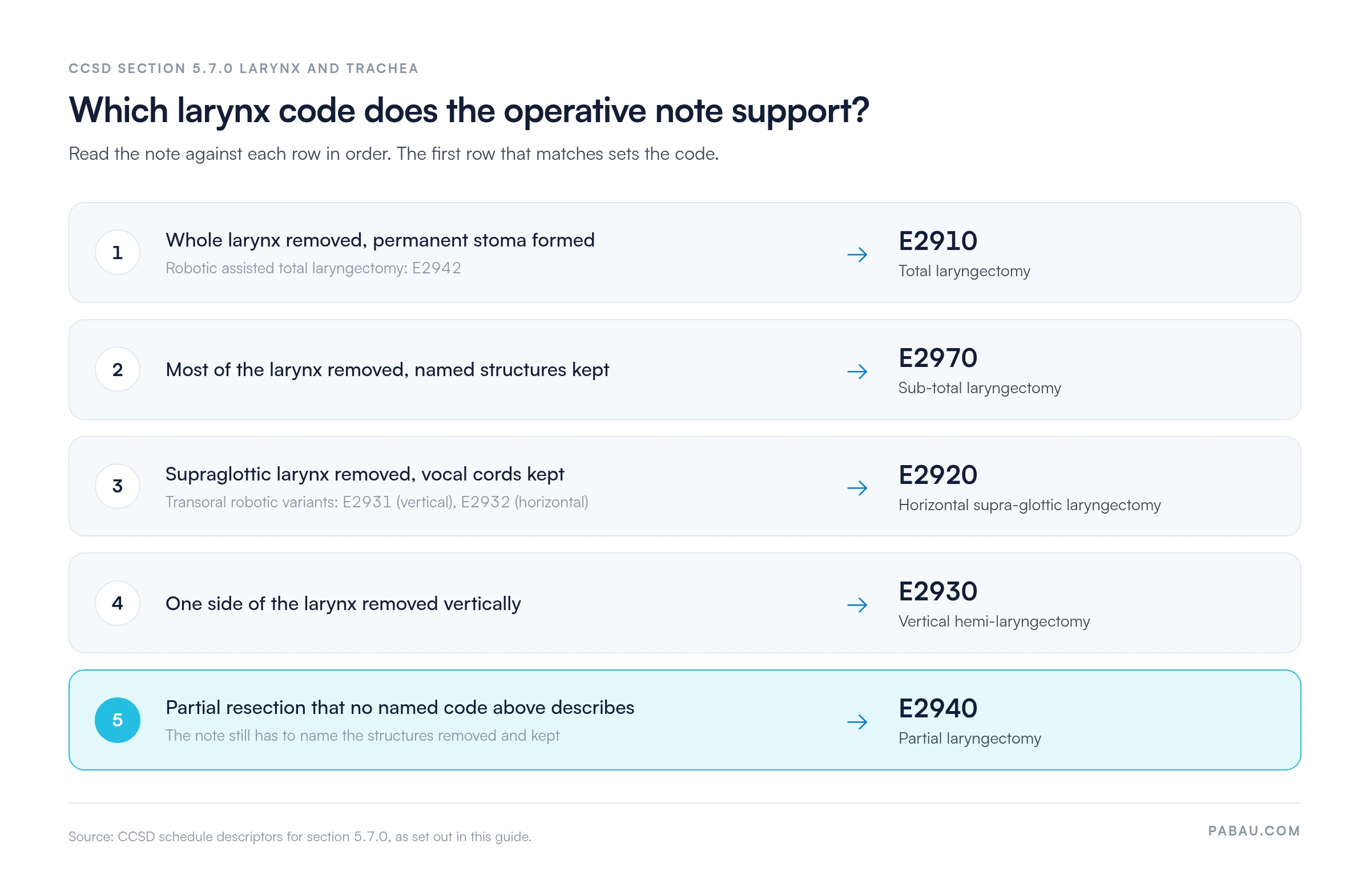
The most common coding mistake is billing E2940 for a procedure that the schedule codes separately. Insurers compare the descriptor with the operative note, so the code has to match what the note describes.
In practice, use E2940 only when the operative note describes a partial resection that none of the named codes fits. For example, a note that reads “vertical hemi-laryngectomy” points to E2930, not E2940.
If the surgeon kept only named structures, the guide to E2970 covers sub-total laryngectomy. The Bupa CCSD codes guide explains how the wider schedule is structured.
The CCSD schedule lists codes that should not appear on the same claim as E2940. Most of these pairings are reciprocal, so the rule applies whichever code is the main procedure.
So a diagnostic laryngoscopy billed as E3520 stays off any claim that carries E2940. The same rule covers laser vocal cord surgery under E3410. Check the current coding principles on the CCSD website before you add any second laryngeal code.
UK insurers expect a WHO ICD-10 diagnosis code on every surgical claim, not the US ICD-10-CM. For E2940, the diagnosis is usually a malignant neoplasm of the larynx, coded by tumor site.
Code from the histopathology report and the operative note, not the referral letter. If pathology confirms a glottic primary, C32.0 tells the insurer more than C32.9 and supports the case for surgery.
The operative note is the main evidence for E2940. An insurer reviewer should be able to read it and see why no more specific larynx code applies.
Keep these documents on the patient record from the day of surgery. Insurers can ask for them during an audit, long after they pay the claim. The medical billing compliance guide covers what auditors look for.
Before an E2940 claim goes out, read the operative note against the larynx codes in section 5.7.0. If the note names a hemi-laryngectomy, a supra-glottic laryngectomy or a total resection, a more specific code applies.
Laryngeal surgery is usually planned, so most insurers expect authorization before the operation. Each insurer runs its own process, and the rules can differ between policies.
A request for E2940 normally includes:
Record the authorization code the insurer issues and use the same procedure code on the final claim. If the plan changes during surgery, tell the insurer and update the code before billing.
A partial laryngectomy is rarely the only service on the day. Each clinician bills their own work, subject to the CCSD coding principles for E2940.
Insurers set their own rules for paying more than one procedure at a sitting. Check each insurer’s terms rather than applying a standard reduction.
Most queries on E2940 trace back to a mismatch between the claim and the clinical record. Check these patterns before submission:
When an insurer queries a claim, reply with the corrected code or the missing document and quote the original claim reference. Our guide to denial management in healthcare covers how to track these replies.
An E2940 claim draws on several documents: The operative note, the histopathology report, the consent form and the insurer authorization. When they sit in separate inboxes, the billing team spends time searching before every claim.
Pabau, the practice management software we build for private practices, keeps those documents on the patient record. Its claims management software pulls the patient, treatment and insurer details from that record into a pre-filled Healthcode submission.
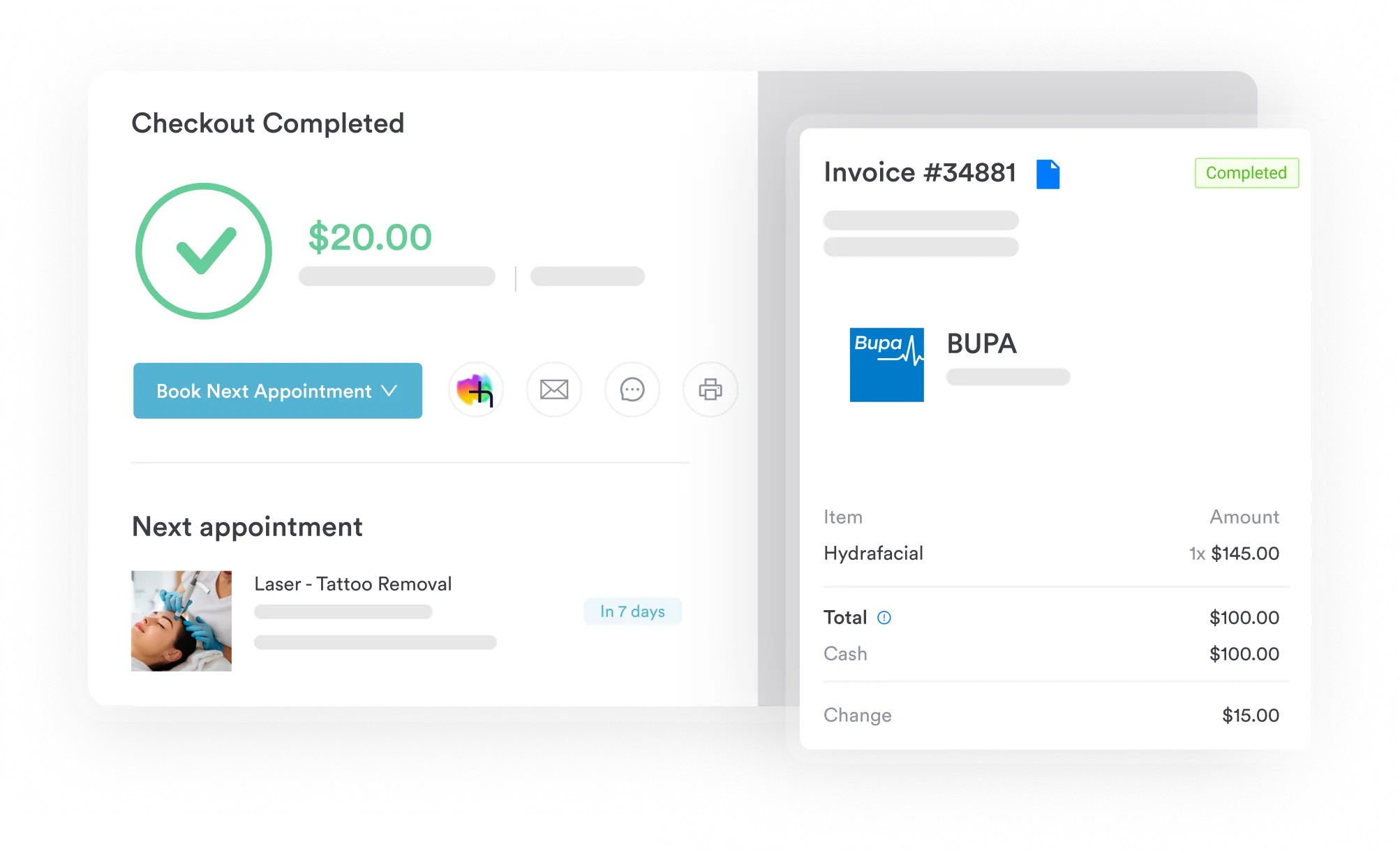
Insurer-specific price lists apply your agreed Bupa or AXA Health rate to the invoice. Each claim then shows in one dashboard as pending, submitted, paid or error, so your team can see where every laryngectomy claim stands.

Pabau stores operative notes and consent forms on the patient record and pre-fills Healthcode claims from it, so your team spends less time re-keying invoices.

E2940 is the fallback code in the larynx section, not the default. When the operative note names a hemi-laryngectomy, a supra-glottic laryngectomy or a total resection, a more specific code applies.
Settle the code, the C32 diagnosis and the insurer authorization before the invoice goes out. Then check that no non-combinable laryngeal code sits on the same claim.
Book a demo to see how Pabau keeps the operative record and the Healthcode claim together for your ENT billing team.

Billing a larger resection? CCSD code E2970 covers sub-total laryngectomy and how it differs from E2910.
Need a guide to Bupa CCSD codes? Bupa CCSD codes reference explains how the procedure schedule is structured.
Coding laser surgery on the vocal cords? CCSD code E3410 covers laser vocal cord surgery with microlaryngoscopy.
Billing a smaller vocal cord resection? CCSD code E3400 covers endoscopic cordectomy.
Fitting a voice prosthesis after laryngeal surgery? CCSD code E4100 covers voice prosthesis insertion.
CCSD code E2940 covers partial laryngectomy, the removal of part of the larynx with most of its framework kept. It sits in section 5.7.0 Larynx and Trachea of the CCSD schedule.
No. Vertical hemi-laryngectomy has its own code, E2930, and horizontal supra-glottic laryngectomy is E2920. Use E2940 only when no more specific larynx code describes the procedure.
Total laryngectomy is E2910, and robotic assisted total laryngectomy is E2942. Both remove the whole larynx. Neither can be billed on the same claim as E2940.
The CCSD coding principles bar E2910, E2920, E2930, E2931, E2932, E2942, E2970, E3410, E3520, E3810 and F4307 from the same claim as E2940. E3010 is listed as a non-reciprocal pairing.
UK insurers use WHO ICD-10 codes. For laryngeal cancer these are C32.0 to C32.9 by tumor site, and D02.0 for carcinoma in situ. Use the most specific code the histopathology supports.
UK private medical insurers such as Bupa and AXA Health use the CCSD schedule. The Clinical Coding & Schedule Development Group maintains it. Each insurer sets its own fees and authorization rules.