

HCPCS Code G0163: Skilled nursing observation and assessment
What is HCPCS Code G0163? HCPCS Code G0163 is a deleted Level II code for skille...

Last Updated: Oct 15, 2026
E2970 is the CCSD code for sub-total laryngectomy, the open removal of most of the larynx with part of the laryngeal framework preserved. UK private medical insurers accept it on the surgeon's claim, most often for laryngeal cancer coded C32.0 to C32.9.
The code sits under Larynx and Trachea in Chapter 5 (Ear, nose and throat) of the CCSD schedule. Total laryngectomy has its own code, E2910, so the operative note's description of what was removed and kept decides which one applies.
Let Pabau's smart automation suggest the right codes, reduce claim denials, and keep your practice compliant—effortlessly.
Automate repetitive tasks and focus on what matters most—your patients.
Reduce coding errors and ensure compliance with the latest regulations.
Clean claims, fewer denials, and faster reimbursements.
Powerful insights and reporting to help your practice thrive.
HIPAA compliant SOC 2 certified GDPR-compliant Trusted by 4,000+ clinics worldwide

CCSD code E2970 is the UK private insurer code for sub-total laryngectomy, in the Larynx and Trachea section (5.7.0) of the schedule.
Total laryngectomy is a separate code, E2910, and robotic-assisted total laryngectomy has its own code, E2942.
Pair E2970 with the WHO ICD-10 code for the tumour site, from C32.0 (glottis) to C32.9 (larynx, unspecified).
The operative note must name the structures removed and preserved, because that record is what separates E2970 from E2910 and the partial codes.
CCSD sets codes, not fees. Each insurer, such as Bupa, AXA Health, Aviva or Vitality, sets its own benefit and authorisation rules.
CCSD code E2970 has the official descriptor “Sub-total laryngectomy”. It covers open removal of most of the larynx, with part of the laryngeal framework left in place. In fact, the code has been in the schedule since 6 January 2012.
CCSD stands for Clinical Coding and Schedule Development. UK private medical insurers, including Bupa, AXA Health, Aviva and Vitality, run the CCSD Group. Consultants then use CCSD procedure codes on claims, which most practices send through Healthcode.
E2970 sits in Chapter 5 (Ear, nose and throat), under section 5.7.0 Larynx and Trachea. That section opens with E2910, the code for total laryngectomy. Therefore, choosing between the two depends on how much of the larynx the surgeon removed.
The CCSD Group does not set fees or decide cover. Each insurer applies its own fee schedule, benefit limits and authorisation rules to the code. Therefore, check the patient’s policy and the insurer’s current schedule before quoting a figure.
A sub-total laryngectomy is a major open operation under general anaesthetic. The surgeon removes most of the larynx but keeps enough of it to protect some swallowing and, often, some voice. Supracricoid and near-total laryngectomy are common variants.
The main operative steps usually run in this order:
In contrast, a partial laryngectomy removes less tissue and leaves most of the laryngeal skeleton intact. A total laryngectomy removes the whole larynx and leaves a permanent tracheostoma. E2970 sits between the two, so the operative note has to say which structures were kept.
UK insurers expect a WHO ICD-10 diagnosis code on every surgical claim, using the 5th edition rather than the US ICD-10-CM. Specifically, the diagnosis for E2970 is usually a malignant neoplasm of the larynx, coded by tumour site.
Code from the histopathology report and the operative note, not the referral letter. For example, if pathology confirms a glottic primary, C32.0 tells the insurer more than C32.9 and matches the clinical case for surgery.
The most common coding mistake is billing E2970 for a resection that was larger or smaller than a sub-total laryngectomy. Insurers compare the code descriptor with the operative note, so the code has to match what the note describes. The chart below then sorts the section’s codes by how much of the larynx each one removes.
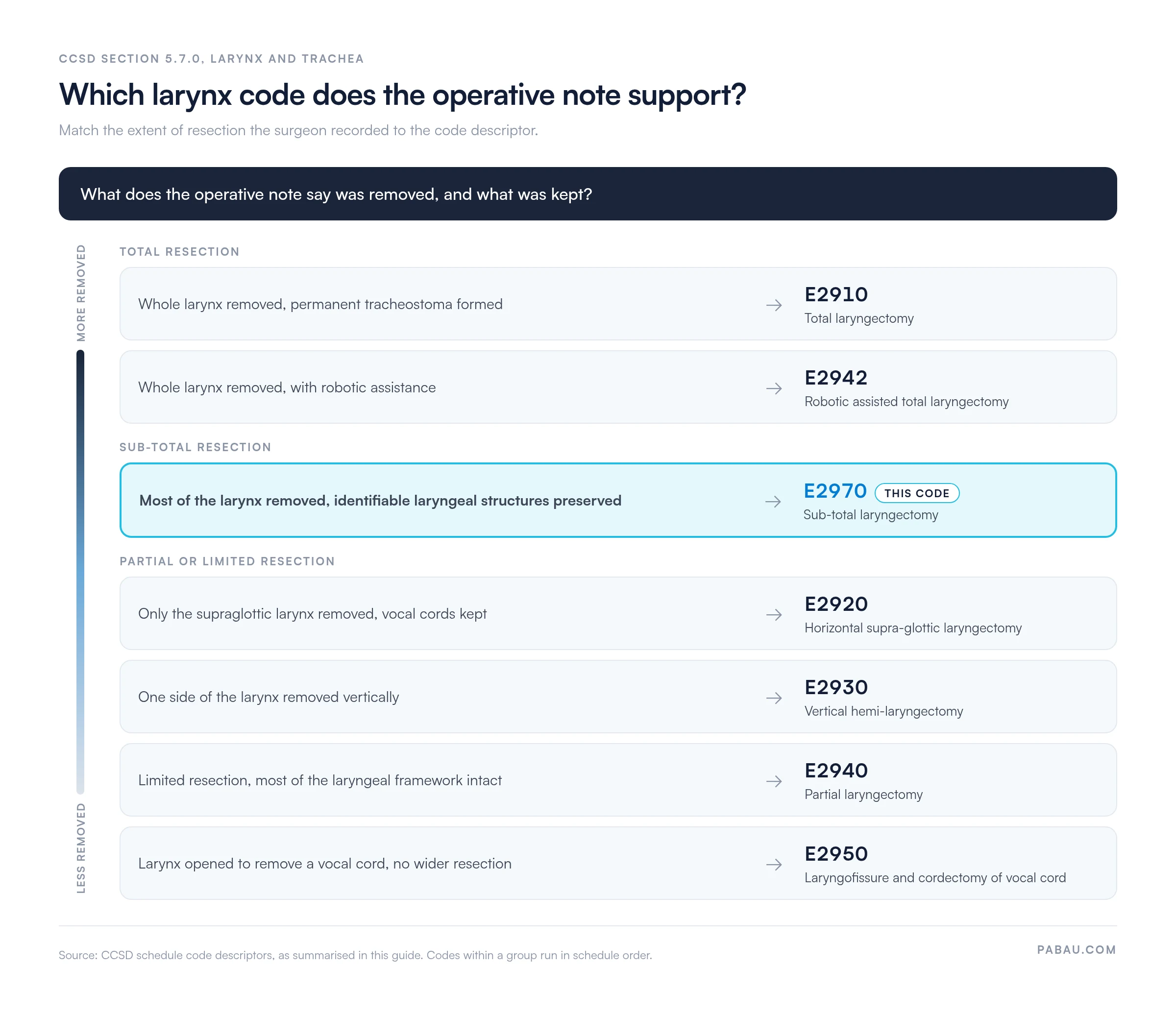
For example, the schedule lists E3410, laser surgery to the vocal cord, as an unacceptable pairing with E2970. Codes in such a pair should not appear together on one claim. Check the pairing rules on the CCSD website before adding a second laryngeal code to the same claim.
Endoscopic work on the vocal cords falls outside these open resections. An endoscopic cordectomy, for example, uses E3400 rather than any code in the table above.
If the operative note and histopathology disagree on the extent of resection, ask the surgeon to clarify before the claim goes out. The Bupa CCSD codes guide explains the structure of the wider schedule.
The operative note is the main evidence for E2970. An insurer reviewer should be able to read it and see why the procedure is a sub-total laryngectomy, not a total or partial one.
Keep these documents on the patient record from the day of surgery. In fact, insurers can ask for them during a later audit, long after they pay the claim.
Before an E2970 claim goes out, check four items against each other: the operative note, the histopathology report, the C32 code and the insurer authorisation. If the note describes a total resection, the code should be E2910.
Surgeons usually plan major laryngeal surgery ahead, so most insurers expect the patient or practice to request authorisation before surgery. However, each insurer runs its own process, and the rules can differ between policies.
A request for E2970 normally includes:
Record the authorisation code the insurer issues and use the same procedure code on the final claim. If the plan changes during surgery, for example from sub-total to total, tell the insurer and update the code before billing.
A sub-total laryngectomy is rarely the only procedure on the day. Instead, each clinician and procedure gets its own line, subject to the schedule’s pairing rules.
However, insurers set their own rules for paying more than one procedure at the same sitting. The CCSD schedule does not fix a percentage, so check each insurer’s terms rather than applying a standard reduction.
Most queries on E2970 trace back to a mismatch between the claim and the clinical record. These are the patterns to check before submission:
When an insurer queries a claim, reply with the corrected code or the missing document and quote the original claim reference. In addition, check the insurer’s own deadline for resubmission, because the time limits vary.
Billing does not end with the surgical claim. Instead, patients recovering from a sub-total laryngectomy need follow-up care, and the team bills each service on its own, apart from E2970.
Ask the patient to check their remaining outpatient and therapy benefits early. In fact, rehabilitation often runs for months, and some policies cap the number of sessions.
An E2970 claim draws on several documents: the operative note, the histopathology report, the consent form and the insurer authorisation. However, when they live in separate inboxes, the billing team spends time hunting before every claim.
Pabau, the practice management software we build for private practices, keeps those documents on the patient record. In addition, its claims software for consultants pulls the patient, treatment and insurer details from that record into a pre-filled Healthcode submission.
Insurer-specific price lists apply your agreed Bupa, AXA Health or Aviva rate to the invoice. Each claim then shows in one dashboard as pending, submitted, paid or error, so your team can see where every laryngectomy claim stands.

Pabau stores operative notes and consent forms on the patient record and pre-fills Healthcode claims from it, so your team spends less time re-keying invoices.

E2970 stands or falls on the operative note. If the note names the structures kept, the code is easy to defend. In contrast, if it describes a complete resection with a permanent stoma, the claim belongs under E2910.
Settle the code, the C32 diagnosis and the insurer authorisation before the invoice is raised. Overall, a few minutes of checking at that point saves weeks of emails with the insurer later.
Book a demo to see how Pabau keeps the operative record and the Healthcode claim together for your ENT billing team.

Need a guide to Bupa CCSD codes? Bupa CCSD codes reference explains how the procedure schedule is structured and how claims are submitted.
Fitting a voice prosthesis after laryngeal surgery? CCSD code E4100 covers voice prosthesis insertion and how it is billed.
Billing a smaller vocal cord resection? CCSD code E3400 covers endoscopic cordectomy and its laser counterpart.
Scoping the larynx in clinic? CCSD code E3680 explains the outpatient laryngopharyngoscopy code.
Operating on the trachea as well? CCSD code E3900 covers partial excision of the trachea with reconstruction.
CCSD code E2970 covers sub-total laryngectomy. The surgeon removes most of the larynx through an open approach but preserves identifiable laryngeal structures. It sits in section 5.7.0 Larynx and Trachea of the CCSD schedule.
E2910 is total laryngectomy, where the whole larynx is removed and a permanent tracheostoma is formed. E2970 applies when part of the larynx is preserved. The operative note decides which code is correct.
UK insurers use WHO ICD-10 codes. For laryngeal cancer these are C32.0 (glottis), C32.1 (supraglottis), C32.2 (subglottis), C32.8 (overlapping lesion) and C32.9 (unspecified). Use the most specific code the histopathology supports.
Most UK private insurers expect authorisation before planned major surgery such as a sub-total laryngectomy. Each insurer runs its own process. Check the patient’s policy and put the authorisation code on the claim.
Yes. E2942 covers robotic assisted total laryngectomy and was added to the schedule in April 2024. It describes a total resection, so it does not replace E2970 for a sub-total procedure.
The CCSD Group sets the code and its descriptor, not the fee. Each insurer, such as Bupa, AXA Health, Aviva or Vitality, applies its own fee schedule and benefit rules.




