CPT code 36600: Arterial puncture billing guide
CPT code 36600: definition and procedure overview CPT code 36600 is classified u...

Last Updated: Oct 15, 2026
E3410 is the CCSD code for laser surgery to vocal cord (including microlaryngoscopy). It covers laser excision, ablation, or vaporization of a vocal cord lesion, and the microlaryngoscopy that gives access is part of the code.
E3410 sits in CCSD sub-chapter 5.7.0, Larynx and Trachea. Endoscopic cordectomy is a separate code, E3400, and CCSD lists the two as an unacceptable combination on one claim. UK private medical insurers expect pre-authorization before the procedure.
Let Pabau's smart automation suggest the right codes, reduce claim denials, and keep your practice compliant—effortlessly.
Automate repetitive tasks and focus on what matters most—your patients.
Reduce coding errors and ensure compliance with the latest regulations.
Clean claims, fewer denials, and faster reimbursements.
Powerful insights and reporting to help your practice thrive.
HIPAA compliant SOC 2 certified GDPR-compliant Trusted by 4,000+ clinics worldwide

CCSD code E3410 covers laser surgery to the vocal cord, and the microlaryngoscopy that gives access is part of the code.
E3400 is endoscopic cordectomy, a separate operation, and the CCSD coding principles list it with E3410 as an unacceptable combination.
Pre-authorization is required by all major UK private medical insurers before the procedure is performed.
The operative note must name the laser type, the target site, and the technique, because that record is what supports the claim.
Pabau’s practice management platform keeps pre-authorization references, operative notes, and CCSD claims together on one record for ENT practices.
CCSD code E3410 is the billing code used in UK private healthcare for laser surgery to the vocal cord, including microlaryngoscopy. It sits in chapter 5.7.0 (Larynx and trachea) of the CCSD schedule of procedures.
The Clinical Coding and Schedule Development Group maintains it. The schedule forms the basis of fee schedules used by Bupa, AXA Health, Aviva, Vitality, and other UK private medical insurers.
The official descriptor reads: Laser surgery to vocal cord (including microlaryngoscopy). The parenthetical means the microlaryngoscopy that gives the surgeon access to the vocal cord is part of E3410.
E3400 is a different operation. It covers endoscopic cordectomy, the removal of all or part of a vocal cord. The CCSD coding principles list E3400 and E3410 as an unacceptable combination on the same claim.
A procedure billed under CCSD E3410 typically follows the six stages below. The operative note should reflect each one, because billing staff check the code against it.
The surgeon chooses the laser on clinical grounds. CO2 and KTP are the most common, with thulium lasers increasingly used in some centers. The operative note must name whichever laser was used. An operative note that says only “laser applied” without specifying the type is insufficient for insurer purposes.
CCSD E3410 applies when a surgeon uses laser energy via microlaryngoscopy to treat a pathological lesion of the vocal cord or larynx. The most commonly billed indications and their ICD-10 code pairings are set out below. Where a nodule, polyp, or cyst is removed by phonomicrosurgery, E3450 may describe the procedure more closely.
These ICD-10 pairings are provided as commonly used examples for coding reference. The diagnosis code on any claim is a clinical determination made by the treating clinician. Verify pairings against the current UK ICD-10 edition using the NHS Classifications Browser before submission.
Several codes in chapter 5.7.0 of the CCSD schedule sit close to E3410. The table below sets out what each one describes, using the official CCSD descriptors. Codes from other parts of the schedule are covered in our CCSD billing guides.
The operative note decides which code fits, as the diagram below shows. Laser treatment of a vocal cord lesion points to CCSD code E3410. An endoscopic cordectomy points to E3400, and phonomicrosurgery on a nodule, polyp, or cyst points to E3450. A microlaryngoscopy with biopsy or cold excision points to E3520.
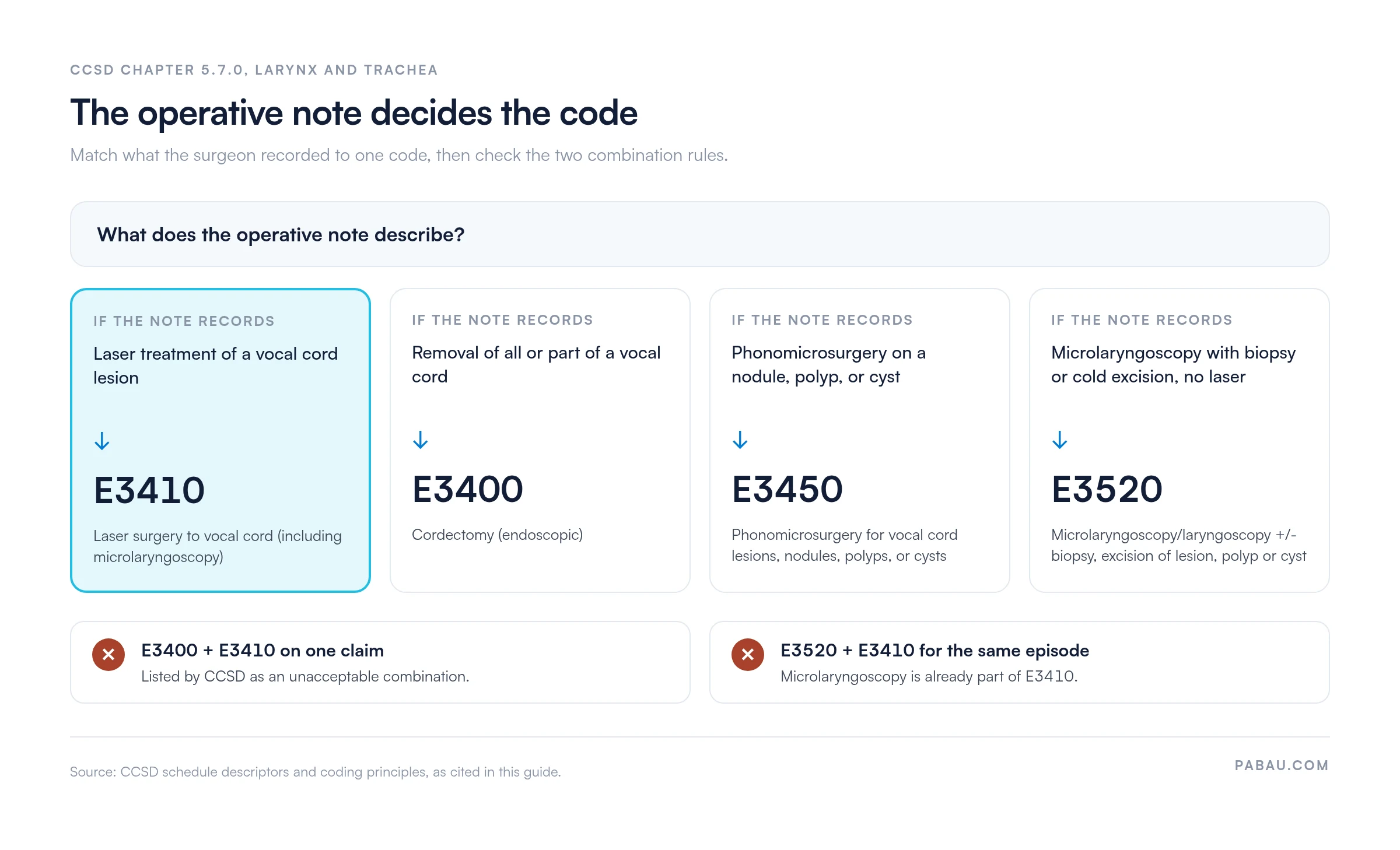
E3400 and E3410 describe two separate operations, and the CCSD coding principles list them as an unacceptable combination on one claim. Check the current schedule and the insurer’s code list before submitting any pairing from this family.
All major UK private medical insurers treat E3410 as an elective surgical procedure requiring pre-authorization before the procedure date. A claim submitted without a valid pre-authorization reference number will be rejected at triage, before any clinical review takes place. Refer to Bupa CCSD procedure codes for guidance on Bupa’s specific coding requirements.
Insurer pre-authorization policies change periodically. Always verify current requirements against each insurer’s provider manual before submitting a claim. The table above reflects commonly reported requirements and is not a substitute for current insurer documentation.
The operative note is the single most important document in an E3410 claim. It shows the insurer that a laser was used on the vocal cord, which separates E3410 from neighboring codes such as E3450 and E3520. Digital clinical documentation helps ensure every required element is captured at the time of the procedure rather than reconstructed later.
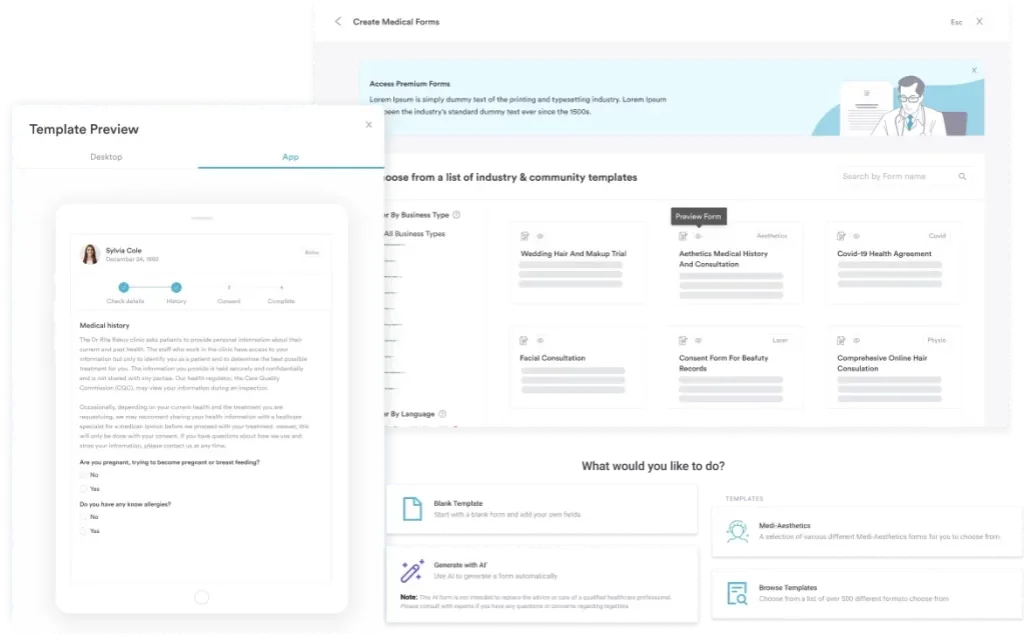
Run a documentation checklist for every E3410 procedure before the patient leaves the operating room. Confirm the operative note names the laser type, the target site, and the technique. Then check that the pre-authorization reference, the ICD-10 code, and the consultant’s insurer recognition all match the claim.
Most E3410 claim denials are preventable. They usually trace back to four checks: The operative note, pre-authorization, the ICD-10 pairing, and consultant recognition.
Recurrent respiratory papillomatosis (RRP) is the clinical indication that most often generates multiple E3410 claims for the same patient. Because RRP is caused by persistent HPV infection of the laryngeal mucosa, laser ablation controls rather than cures the condition. Patients commonly return every four to 12 weeks, and some require ongoing treatment over years.
Each RRP treatment session is a separate procedure and must be submitted as a separate E3410 claim. Each session also requires its own pre-authorization reference. Insurers do not carry a single authorization forward across multiple sessions.
An E3410 claim gets paid when three elements line up: The correct code, a valid pre-authorization reference, and a complete operative note. If any one of them is missing, the insurer can deny the claim. When the code, the note, and the reference sit in separate systems, a mismatch usually surfaces only after the rejection arrives.
Pabau’s claims management software holds all three on the patient’s record, so the billing team checks them together before the claim goes out.
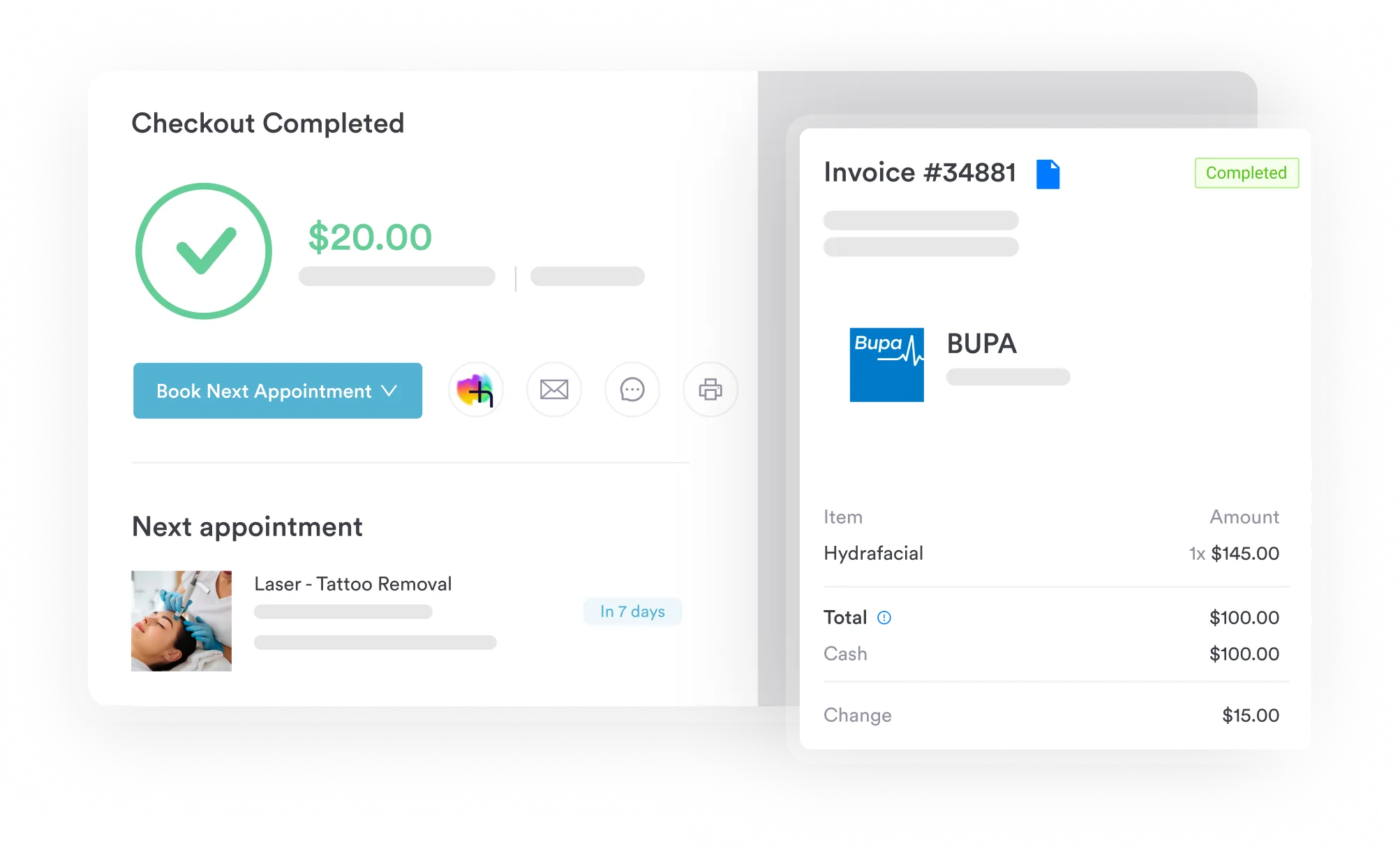
Practices using Pabau can track pre-authorization references against scheduled procedures and attach operative notes to patient records. They can also submit CCSD claims without switching between systems. For ENT consultants running private practice alongside NHS commitments, one workflow cuts the administrative errors that delay or block payments.

Pabau helps private ENT practices track pre-authorization references, store operative notes, and submit CCSD claims that match them. See how it fits your practice.

CCSD code E3410 is narrower than its family suggests. It describes laser treatment of the vocal cord, and the microlaryngoscopy that gives access is already part of the code. Neighboring codes such as E3400, E3450, and E3520 describe different procedures, so the operative note decides which one fits.
An E3410 claim holds up when the operative note names the laser and a pre-authorization reference covers the episode. The ICD-10 code must support laser surgery, and the insurer must recognize the consultant. Building those checks into booking and surgical workflows costs far less than reworking a rejected claim.
Pabau gives ENT billing teams one platform for pre-authorization tracking, operative notes, and CCSD claim submission. Book a demo to see how it gets your E3410 claims paid the first time.

Want the full picture of Bupa coding rules? Bupa CCSD codes covers the Bupa procedure code schedule with billing guidance for UK private practices.
Was the vocal cord removed rather than treated with a laser? CCSD code E3400 explains how to bill endoscopic cordectomy and why it never shares a claim with E3410.
No laser, just a biopsy or cold excision? CCSD code E3520 covers microlaryngoscopy with biopsy or excision of a lesion, polyp, or cyst.
Treating the vocal cord by injection instead? CCSD code E3810 sets out the billing rules for injection into the larynx.
Planning a more extensive laryngeal operation? CCSD code E2940 walks through billing for partial laryngectomy.
CCSD code E3410 covers laser surgery to the vocal cord with microlaryngoscopy included as a bundled component. It applies when a surgeon uses a laser through suspension laryngoscopy under general anesthesia. The laser excises, ablates, or vaporizes a lesion of the vocal cord or larynx.
Microlaryngoscopy is included in E3410. The official CCSD descriptor reads “Laser surgery to vocal cord (including microlaryngoscopy)”, so the access procedure is part of the code. Do not add a separate microlaryngoscopy code, such as E3520, for the same procedure.
E3400 is endoscopic cordectomy, the removal of all or part of a vocal cord through an endoscope. E3410 is laser surgery to the vocal cord, including microlaryngoscopy. They are separate operations, and the CCSD coding principles list them as an unacceptable combination on the same claim.
Yes. Bupa requires pre-authorization for E3410 before the procedure date. You will need to provide the planned CCSD code, ICD-10 diagnosis, outpatient assessment evidence, and the consultant’s GMC number. Claims submitted without a valid pre-authorization reference are rejected at triage without clinical review.
The most common causes are a missing pre-authorization reference and an operative note that does not name the laser type, target, and technique. Other frequent causes are an ICD-10 code that does not support laser surgery and a consultant the insurer does not recognize. Billing E3400 on the same claim as E3410 also leads to rejection.
Yes. RRP (ICD-10: D14.1) is an accepted indication for CCSD E3410. Because RRP recurs, patients typically require multiple sessions, each of which must be submitted as a separate claim with its own pre-authorization. Check the patient’s remaining annual benefit with the insurer before scheduling each session.