

HCPCS Code G0163: Skilled nursing observation and assessment
What is HCPCS Code G0163? HCPCS Code G0163 is a deleted Level II code for skille...

Last Updated: Oct 15, 2026
E3400 is the CCSD code for cordectomy (endoscopic), the removal of all or part of a vocal cord through a rigid laryngoscope. UK private medical insurers accept it on the surgeon's claim for glottic cancer, carcinoma in situ and benign cord disease that needs excision.
The code sits under Larynx and Trachea in Chapter 5 (Ear, nose and throat) of the CCSD schedule. Laser surgery to the vocal cord has its own code, E3410, and microlaryngoscopy with biopsy or lesion excision is E3520. The operative note's description of the instrument and the extent of resection decides which one applies.
Let Pabau's smart automation suggest the right codes, reduce claim denials, and keep your practice compliant—effortlessly.
Automate repetitive tasks and focus on what matters most—your patients.
Reduce coding errors and ensure compliance with the latest regulations.
Clean claims, fewer denials, and faster reimbursements.
Powerful insights and reporting to help your practice thrive.
HIPAA compliant SOC 2 certified GDPR-compliant Trusted by 4,000+ clinics worldwide

CCSD code E3400 describes Cordectomy (endoscopic): Surgical removal of vocal cord tissue through direct laryngoscopy. Laser surgery (E3410) and microlaryngoscopy with biopsy (E3520) have their own codes.
Supporting ICD-10 diagnoses include C32.0 (glottic carcinoma), D02.0 (carcinoma in situ), D38.0 (tumor of uncertain behavior) and J38.1 (vocal cord polyp), among others.
Anesthesia and histopathology are billed separately, because E3400 covers only the endoscopic resection itself.
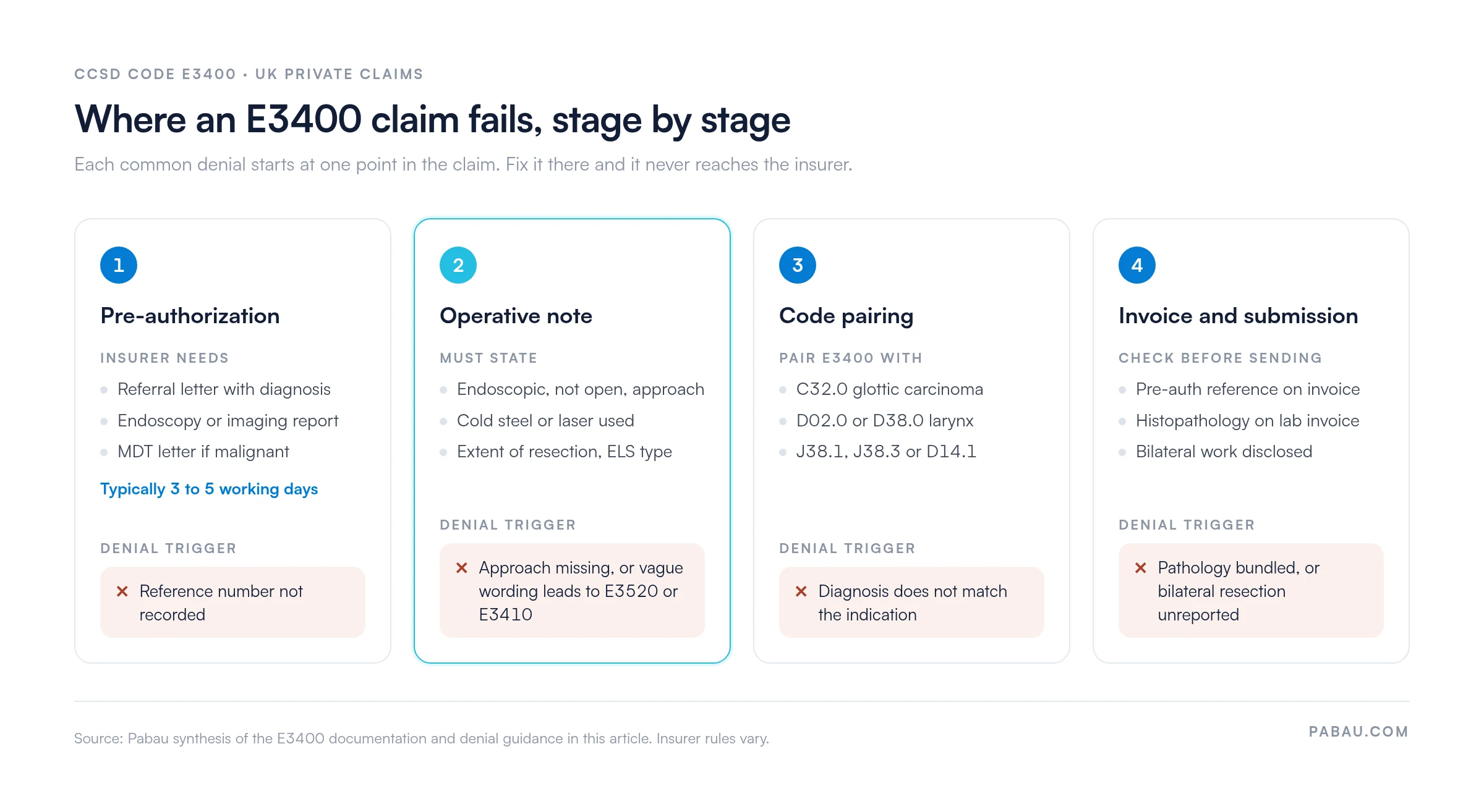
Most UK private medical insurers require pre-authorization before E3400 is performed, and a missing pre-auth reference is a leading denial reason.
Pabau, the practice management platform we build, pre-fills Healthcode claims from the patient record and checks authorization codes before each E3400 claim is sent.
CCSD code E3400 is the CCSD procedure code with the official descriptor “Cordectomy (endoscopic).” It applies when a consultant laryngologist or ear, nose and throat (ENT) surgeon resects vocal cord or vocal fold tissue endoscopically. The surgeon works through direct suspension laryngoscopy, typically under general anesthesia (GA) or total intravenous anesthesia (TIVA).
The code sits in chapter 5.7.0, Larynx and Trachea, of the CCSD codes schedule. Its closest neighbors there are laser surgery to the vocal cord (E3410) and microlaryngoscopy (E3520). The same chapter also covers airway reconstruction, such as tracheoplasty under E4030.
The procedure involves introducing a rigid operating laryngoscope into the airway while the patient is supine and under GA. The laryngoscope is suspended on a chest support to free both of the surgeon’s hands. The surgeon then excises the target tissue with cold-steel microsurgical instruments.
When a CO2 or KTP laser does the resection, CCSD codes it as laser surgery to the vocal cord, E3410. Confirm the choice against the current schedule. Resection depth and lateral extent determine the European Laryngological Society (ELS) sub-classification, which should be documented in the operative note.
The ELS classifies endoscopic cordectomy into six types based on the anatomical layers removed, with Type V split into four subtypes.
Recording the ELS type in the operative note is not mandatory for CCSD billing, but it supports medical necessity and helps insurers understand procedure complexity.
E3400 is indicated whenever tissue excision from the vocal cord is required and can be performed endoscopically. The three main clinical categories are malignancy, dysplastic or pre-malignant lesions, and benign pathology that has not responded to non-surgical management.
For oncological indications, insurers may require evidence of MDT discussion and imaging before granting pre-authorization. Avoid stating that E3400 is curative for any specific cancer stage without supporting clinical documentation.
Understanding scope boundaries prevents both under-coding and inadvertent unbundling denials. CCSD code E3400 covers the surgical resection of vocal cord tissue performed endoscopically. The operating microscope is generally considered integral to the procedure and is not separately billable alongside E3400.
CCSD lists E3400 and E3410 as reciprocal partners under its coding principles. Check the schedule before billing both for the same session.
The following services are typically not bundled within E3400 and require separate coding.
Bilateral cordectomy, the resection of both vocal cords at the same session, is uncommon but possible in bilateral RRP or bilateral dysplasia. Before submitting, confirm against the current CCSD schedule whether it attracts a bilateral modifier or a second listing of E3400.
Selecting the wrong adjacent code is the most avoidable cause of E3400 denials. The decision turns on whether cord tissue was excised, whether a laser was used, and whether the approach was endoscopic or open. The table below maps the most commonly confused CCSD larynx codes.
The most common error is billing E3520 for microlaryngoscopy and biopsy when the surgeon performed an endoscopic cordectomy. The distinction lies in intent and extent. A biopsy is diagnostic and limited, while a cordectomy is therapeutic and removes a defined portion of the vocal cord.
When in doubt, the operative note must state that cordectomy was performed, not simply that tissue was removed. A scope of the larynx in clinic, with no admission, is billed under the outpatient code E3680 instead.
Before finalizing the code, check the operative note for ‘cordectomy’ or ‘endoscopic resection of vocal cord’. An ELS type from I to VI also confirms it. If none appear, contact the consultant to clarify the extent of resection before submitting. If the note records a laser, check E3410 first. Submitting a biopsy code for a cordectomy leaves significant reimbursement on the table.
Submitting a complete E3400 claim requires a documentation package that supports medical necessity, confirms the endoscopic approach, and satisfies the insurer’s evidence requirements. Missing any element is a predictable denial trigger.
The operative note is the anchor document. It must do four jobs.
Royal College of Surgeons of England operative note standards require the date, the surgeon’s name, the procedure performed, and post-operative instructions. Insurers reviewing laryngeal cancer cases often cross-reference the operative note against an MDT outcome document.
The pre-operative documentation should include the following.
A diagnostic scope done at an earlier outpatient visit is a separate claim, such as E2500 for diagnostic nasolaryngopharyngoscopy. Keep it off the E3400 invoice.
Digital capture of the operative note at the point of care reduces transcription errors and speeds claim submission. In Pabau’s digital forms, ENT teams complete structured post-operative notes in the same system that handles scheduling and billing. The full patient record then stays in one place, under one set of UK GDPR controls.
UK private medical insurers (PMIs) treat endoscopic cordectomy as a surgical procedure requiring pre-authorization (pre-auth). The requirement applies across the major payers, including Bupa, AXA Health, Aviva, and Vitality Health, though evidence thresholds and turnaround times vary. Check the current PMI provider handbook before booking the operating list, because insurer policies change periodically.
Typical pre-authorization evidence requested by PMIs for E3400 includes the following.
Most insurers issue a pre-authorization reference number within three to five working days for straightforward cases. Oncological cases involving MDT evidence may take longer. The reference number must appear on the invoice and the claim submission, and submitting without it is a near-certain denial.
Our Bupa CCSD codes guide covers Bupa-specific pre-auth workflows. Cross-check the Bupa code search portal for the current E3400 fee schedule and authorization requirements.
AXA Health manages pre-authorization through its specialist forms portal. Aviva publishes its CCSD-coded fee schedule and invoicing rules in Aviva’s practitioner fee schedule. Vitality Health runs Vitality’s procedure fee lookup, where you can confirm the E3400 fee band under your provider agreement.
E3400 claims are denied for a predictable set of reasons. Each one starts at a specific stage of the claim, as the flow below shows, and each is avoidable with a pre-submission checklist.
Entering E3400 correctly in a practice management system reduces transcription errors and speeds PMI payment. A well-configured system lets the billing coordinator complete submission in four steps without leaving the platform.
Pabau’s claims management software pulls the patient, treatment and insurer details from the patient record into a pre-filled Healthcode submission. Before a claim goes out, it checks that the membership number and authorization code are in place. A missing pre-auth reference is caught at your desk instead of the insurer’s.
Insurer-specific price lists raise the E3400 fee against the right Bupa, AXA Health or Aviva rates automatically. Each claim then sits in one dashboard as pending, submitted, processing, paid or error, so a stalled cordectomy claim surfaces before it ages.
Run a monthly audit of your E3400 submissions: Compare the ICD-10 code on the invoice against the pre-authorization approval letter. A diagnosis code mismatch between these two documents is one of the most frequent post-payment audit findings for oncological laryngeal procedures. Catching it before submission takes a few minutes. Catching it after a payment demand arrives is far more disruptive.

Pabau pre-fills Healthcode submissions from the patient record and checks authorization codes before each claim goes out. Your team stops re-keying invoices and chasing avoidable denials.

Treat the operative note as the claim. If it names a cold-steel endoscopic resection, the ELS type and the diagnosis, E3400 is easy to defend. If it mentions a laser or an open approach, the code changes before the fee does.
The trade-off is a few minutes of checking before submission against weeks of chasing a query afterward. Settle the code and the pre-auth reference before the invoice is raised, and most E3400 queries never start.
Book a demo to see how Pabau links the operative record, the pre-auth reference and the Healthcode claim for your ENT billing team.

Need a guide to Bupa CCSD codes and fee schedules? Bupa CCSD codes reference covers the full Bupa procedure code structure, how to submit claims, and what fee chapters apply to ENT procedures.
Scoping the larynx in clinic without admitting the patient? CCSD code E3680 explains the outpatient laryngopharyngoscopy code and the two conditions its descriptor sets.
Billing the diagnostic scope that came before surgery? CCSD code E2500 covers diagnostic nasolaryngopharyngoscopy billing for UK private practice.
Working further down the airway? CCSD code E4030 covers tracheoplasty, its congenital-case sibling E4032, and the airway procedures coded separately.
Sending a claim to an insurer outside Healthcode? Medical insurance claim form gives your team a structured template for recording claim details.
CCSD code E3400 covers the surgical removal of all or part of a vocal cord through direct suspension laryngoscopy. The surgeon uses cold-steel microsurgical instruments under general anesthesia. Laser surgery to the vocal cord is coded E3410. E3400 does not include anesthesia fees, histopathology charges, or post-operative follow-up consultations, which are billed separately.
No. CCSD codes laser surgery to the vocal cord, including microlaryngoscopy, as E3410, so a CO2 or KTP laser resection belongs there. E3400 covers endoscopic cordectomy with cold-steel instruments. The two codes are reciprocal partners under CCSD coding principles, so confirm the choice against the current schedule before submitting.
Microlaryngoscopy (E3520) covers endoscopic examination of the larynx, with or without a biopsy or removal of a lesion, polyp or cyst. It involves no formal resection of cord tissue. E3400 is selected when a discrete portion of the vocal cord has been surgically removed. If the operative note describes only inspection, biopsy or lesion removal, E3520 applies instead.
Anesthesia is billed separately by the anesthetist under the CCSD anesthesia codes. The CCSD schedule generally separates surgeon fees from anesthetist fees, and E3400 covers only the surgical resection. Verify against the current CCSD schedule wording, as bundling rules are periodically updated.
It can, but confirm the coding approach against the current CCSD schedule before submitting, because bilateral cordectomy is uncommon. Most PMIs require notification when a bilateral procedure is planned. Inform the insurer before the operating date and state the bilateral nature explicitly in the operative note and the pre-authorization request.
Four reasons cause most E3400 denials: Selecting the wrong CCSD code, omitting the endoscopic approach, mismatching the diagnosis code, and leaving off the pre-authorization reference. Each is preventable with a pre-submission documentation checklist.




